
What if buying a new car didn’t require you to become a skilled negotiator? The fear of negotiating car price Australia-wide is understandable: you may worry about being pressured, comparing quotes that include different costs, or raising your budget and trade-in with a dealer.
You can still make a confident decision without handling every conversation yourself. Start by comparing written, all-inclusive drive-away quotes for the same make, model and variant. If negotiating directly feels uncomfortable, an independent car buying service can represent you. Private Fleet works with a national network of authorised dealerships and invites multiple dealers to compete for your business through a tender process.
This guide explains practical ways to compare new-car offers, what details to prepare before requesting quotes, and how trade-in assistance or a representative may make the process feel more manageable. You’ll also learn how to keep discussions focused on the car and the total price, so you can take time to consider your options without feeling pushed into a decision.
Key Takeaways
- The fear of negotiating car price Australia buyers may experience doesn’t mean they have to negotiate alone; there are several ways to approach a new-car purchase.
- Shortlist your preferred make, model and variant, then note the features you consider essential before requesting offers.
- Compare direct negotiation, written offers and using a representative to find an approach that suits your comfort level.
- Ask for details in writing and give yourself time to review them before deciding; clear, calm boundaries can help keep the conversation manageable.
- Private Fleet’s tender process invites multiple dealers to compete for your business, offering a way to involve dealer competition without handling every discussion yourself.
Why negotiating a new-car price can feel stressful, and what you can control
Feeling uncomfortable about negotiating is a valid reason to choose a different way to buy a new car. You don’t have to turn a dealership visit into a contest to make a considered decision. The goal is to understand what’s being offered and compare it with other suitable options. Bargaining is only one possible way to get there.
Several things can make the conversation feel demanding: you may be discussing a major purchase, weighing up a particular model and variant, or trying to understand a quote while someone waits for an answer. That doesn’t mean every dealership conversation is adversarial. Dealerships help buyers explore and purchase vehicles, as the general description of a car dealership explains, but the pace and detail of a sales discussion can still feel unfamiliar if you haven’t bought a new car for a while.
What makes negotiating a car price feel uncomfortable?
Uncertainty is often at the centre of it. You might wonder whether the quoted price is typical, whether another buyer would ask for a better offer, or whether a question will make you sound uninformed. If the conversation moves quickly, it can be harder to weigh up the car, the price and any trade-in discussion at the same time.
Unfamiliar terms can add another layer. A quote might refer to a variant, accessories, dealer delivery or a trade-in value. If you’re not sure what each item means or whether two offers cover the same things, it’s reasonable to pause and ask for a clearer explanation. Discomfort doesn’t mean you’re bad at making decisions. It may simply mean you need information in a format and timeframe that work for you.
For some buyers, the fear of negotiating car price Australia-wide starts with the idea that they must persuade a dealer to agree to a particular figure. That isn’t the only route. You can focus on what the offer includes, whether it matches the car you want and how it compares with another written offer. Understanding the offer and bargaining over it are separate tasks.
What a confident new-car decision actually needs
Confidence comes from having enough clarity to choose, not from delivering a perfect counteroffer. Before discussing price, know which make, model and variant you’re considering, along with the features you need. If you’re comparing offers, ask for the details in writing so you can review the same items side by side rather than relying on memory.
A confident car purchase is an informed choice, not a performance in negotiation. You can take time to read a quote, ask what an unfamiliar term means, or decide that you’d prefer someone else to handle dealer discussions. Those are practical ways to stay involved in the decision without needing specialist knowledge or an aggressive approach.
Hypothetical example: You’re considering a new SUV and receive an offer during a dealership visit. Rather than deciding on the spot, you could request the written details, check that the model and variant match your shortlist, and review the offer when you’re ready. The important thing is that the next step is clear to you.
Prepare for a new-car price conversation without turning it into a battle
A little preparation can make a new-car price discussion feel more manageable. You don’t need a clever bargaining tactic. A clear shortlist, a comfortable budget range and written offers you can compare are enough to keep the conversation focused on your decision.
Set your priorities before discussing a new car
Before contacting a dealership, jot down what you want and what you’re still flexible about. This gives you a simple reference point if the conversation moves quickly, and helps you avoid getting sidetracked by features or alternatives that don’t suit your needs.
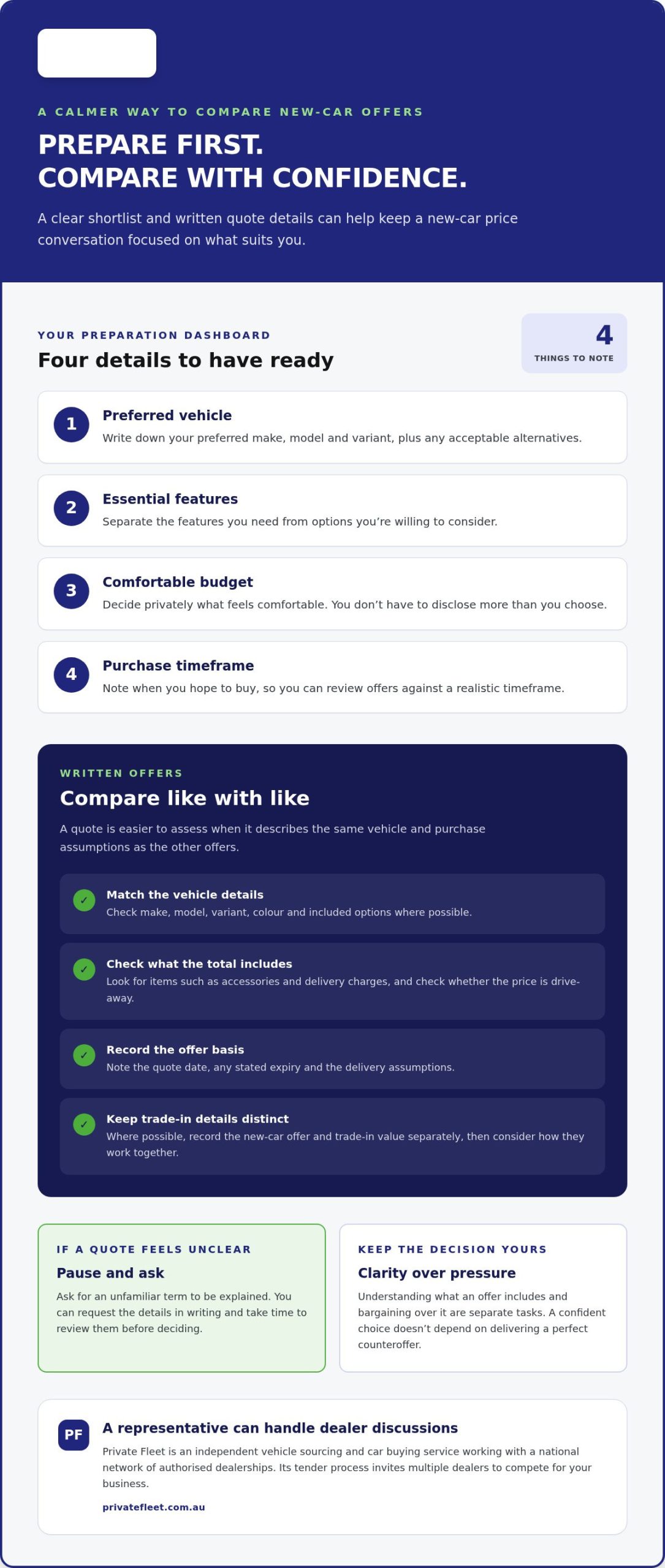
- Preferred vehicle: note your preferred make, model and variant, plus any acceptable alternatives.
- Essential features: distinguish must-haves from options you’d consider if they suit the car and offer.
- Budget range: decide privately what feels comfortable, including whether you’re considering a trade-in. You don’t have to disclose more than you choose.
- Purchase timeframe: note when you hope to buy, so you can compare offers with a realistic timeframe in mind.
Decide whether you want to include a trade-in before comparing totals. A trade-in can affect the amount you pay overall, but it can make the vehicle price harder to assess if it’s bundled into the same figure. Where possible, record the new-car offer and trade-in value separately, then consider how they work together.
Make quotes easier to compare
A written quote is most useful when it describes the same vehicle and purchase assumptions as the other offers you’re reviewing. A different variant, accessory package or delivery arrangement can change the comparison. Check the details rather than relying on the model name alone.
- Match the make, model, variant, colour and included options where possible.
- Check what each quoted total includes, such as accessories or delivery charges, and whether the price is a drive-away figure.
- Note the quote date, any stated expiry and the delivery assumptions, so you know when and on what basis the offer applies.
- Use current Australian manufacturer specifications and authorised-dealer information to compare features and changing offers.
If two quotes aren’t based on the same vehicle or price basis, ask for the details to be clarified before deciding which looks more suitable. This is a request for information, not a challenge. Buyers who want a structured overview of each stage can follow Private Fleet’s new-car buying process as they prepare.
For buyers who find the fear of negotiating car price Australia-wide discussions bring up distracting, preparation can keep attention on the details rather than the pressure to respond quickly. If you’d prefer help bringing your shortlist together, you can share your preferred make or model, postcode and buying timeframe.
Compare your options: negotiate yourself, seek written offers or use a buyer service
There isn’t one right way to approach a new-car purchase. You can speak with dealerships yourself, request written offers and compare them, or use a representative to manage parts of the process. The best fit depends not only on how comfortable you feel negotiating, but also on how much time and involvement you want.
Use this comparison to weigh up the approaches. None guarantees a particular price or outcome; each gives you a different level of control over the discussions.
| Approach | Your involvement | Useful when | Points to consider |
|---|---|---|---|
| Negotiate directly | You contact dealerships, ask questions and discuss the offer yourself. | You enjoy researching options and feel comfortable following up. | Keep written details so you can compare equivalent vehicles and offers. Direct bargaining doesn’t guarantee a better result. |
| Request written offers | You ask dealerships for offer details, then review and compare them at your own pace. | You prefer to avoid an extended discussion or want time to think. | Check that each offer covers the same make, model, variant, options and price basis. |
| Use a buyer service | A representative helps source the vehicle and handle dealer discussions on your behalf. | You want support without managing every dealership conversation yourself. | Understand how the service sources vehicles and what information is needed to begin. |
When handling the dealer conversation yourself may suit
If you like comparing offers and are happy to ask follow-up questions, direct discussions may feel straightforward. You can check details with dealerships, request written quotes and decide whether to discuss the offer further. Keep the comparisons organised: a different variant or included option can make one quote look cheaper without representing the same vehicle. Negotiating directly gives you involvement, not a guaranteed advantage.
When independent support may reduce the pressure
If you’d rather not handle each dealer discussion, an independent buyer service can provide another route. Private Fleet sources new cars through a national network of authorised dealerships. Its tender process invites multiple dealers to compete for your business, introducing dealer competition without requiring you to manage each conversation. Learn more about the new-car buying service and how it can support your search.
The fear of negotiating car price Australia buyers experience doesn’t need to decide how involved they are in every step. You might prefer to research and negotiate personally, collect written offers, or have a representative involved. If you’d like support with a shortlist, you can share your preferred make or model, postcode and buying timeframe.
Use simple boundaries to stay in control of a new-car discussion
You can keep a new-car conversation clear without being confrontational. A calm request for details, a pause to review them or a later follow-up can give you room to make a considered choice. These are practical ways to manage the discussion, not claims about what a dealership must do.
Useful phrases when you need more time or clarity
It can help to have a few words ready, especially if you’re comparing cars or offers and don’t want to decide while you’re still processing information. Adapt these phrases to sound natural to you:
- “Could you please email or print the offer so I can review the details?”
- “Thanks, I’m not ready to decide during this conversation. I’ll take some time to consider it.”
- “Can you confirm which model and variant this figure is for, and what’s included?”
- “I’d like to compare this with the same specification before I make a decision.”
You can also agree on a practical next step, such as arranging a follow-up after you’ve had time to read the information. That keeps communication open without committing you to a purchase. If the quote uses terms you don’t recognise, ask for a plain-language explanation or a written breakdown. You’re seeking clarity, not picking a fight.
Pausing to review an offer is a practical step in making a considered decision. You don’t need to fill a silence with an answer. If you feel rushed, return to what matters most: the vehicle you want, the features you need and whether you understand the offer in front of you.
How to respond when a conversation feels rushed
A dealership conversation may move faster than you’d prefer, particularly if you’re discussing several details at once. That alone doesn’t tell you whether an offer suits you. Restate your priorities, then ask to look at the details in your own time. For example: “I’m still comparing this variant with another option. Could I review the written offer and get back to you?”
If you’re considering a trade-in, keep its value distinct from the new-car offer while you compare. Ask for the vehicle price and trade-in figure to be shown separately, then work out how the combined deal fits your plans. A generous-looking trade-in figure can be difficult to assess if the new-car price or included items also differ. Separating the figures makes the overall decision easier to understand.
The fear of negotiating car price Australia buyers may feel can ease when they have a simple plan: ask, clarify, pause and compare. You can choose how much discussion feels comfortable, and take the next step once the information makes sense to you.
How Private Fleet can help you buy a new car without negotiating alone
If you’d prefer support with the buying process, Private Fleet offers an independent new-car sourcing service. As outlined earlier, its approach brings dealer competition into the process, so you can get help without personally managing every dealer discussion. It doesn’t guarantee a particular price or saving.
You remain involved in choosing the car and considering the offers. You can explain what matters to you, review the options and decide how you’d like to proceed. Private Fleet sources vehicles through dealerships; it doesn’t hold its own vehicle inventory.
What happens when you use Private Fleet?
You can begin with the details you already know, such as the make or model you prefer, the features you need and when you hope to buy. If you’re still weighing up alternatives, describe your priorities so the search can reflect what matters to you.
Private Fleet can also assist with trade-ins and finance. If you have a car to trade, mention it as part of your enquiry. Keeping the trade-in figure distinct from the new-car offer can help you understand how each part contributes to the overall purchase.
The new-car buying process can help you understand the stages involved. You can consider how much support you want while staying in control of the decisions about your next car.
Take the next step at your own pace
A few details can help you explain what you’re looking for:
- Your preferred make or model, and any alternatives you’re considering.
- Your postcode and intended buying timeframe.
- A shortlist, must-have features and a budget range you’re comfortable sharing.
- Whether you have a trade-in you’d like included in the discussion.
You don’t need to have every choice settled before starting an enquiry. Share what you know, then refine your preferences as you consider suitable options.
Choose a next step that feels right for you
The fear of negotiating car price Australia buyers can feel doesn’t have to set the pace of a purchase. Give yourself permission to make the decision in stages: first decide what you still need to know, then take one manageable step towards finding the right new car.
You don’t need to settle every detail at once. A clear decision can begin with choosing what matters most for your day-to-day driving and what you want clarified before moving forward. That keeps the focus on a car that suits your plans, rather than on how confident you feel in a negotiation.
Buying a new car should be a decision you can make with care and at a pace that feels comfortable. Take the next step when you’re ready.
You can approach the process calmly, one considered choice at a time.
Frequently Asked Questions
Is it normal to feel nervous negotiating a new-car price?
Yes. A new-car purchase involves choices and unfamiliar details, so it’s understandable to feel unsure about what to say. You can make the conversation easier by writing down questions before a dealership visit or taking someone you trust along for a second perspective. If you lose track during a discussion, ask to return to one question at a time. You don’t need to prove your confidence to make a sound decision.
Can I buy a new car in Australia without negotiating directly with a dealer?
Yes. You can use a car buying service to help with sourcing and dealer discussions. The vehicle is still supplied through a dealership, and you’ll need to consider the offer and complete the purchase decisions that apply to you. If you prefer to manage more yourself, you can also request information in writing and decide how you want to follow up. Choose the level of involvement that feels workable.
Should I tell a car dealer my maximum budget?
You can, but you don’t have to reveal the highest amount you could pay. Think about the full cost of owning the car, not just the purchase figure: insurance, registration, servicing and fuel or charging may also affect what feels affordable. Decide privately what you’re comfortable spending, then share only the information that helps the discussion. If asked for a figure, you can state the range you’re considering rather than your limit.
What should I do if two dealers provide different new-car quotes?
Ask each dealer to clarify any differences that aren’t obvious, such as how long the offer applies, whether an accessory is included or what delivery timing is assumed. Record the response beside each quote. If one offer has a condition or expiry, note it before weighing up the figures. This helps you understand whether the difference reflects the offer itself or a detail that changes how and when you could buy.
Is a drive-away quote enough to compare two new-car offers?
It’s a useful price figure, but it can’t tell you whether the car itself suits you. Compare the cabin, visibility, comfort, controls and features that matter for your regular driving, and check that the quote refers to the version you’d choose. Drive-away costs can also differ between Australian states and territories. Treat the quote as one part of the decision, alongside the vehicle’s suitability and the offer’s stated conditions.
Can someone help me buy a new car if I have a trade-in?
Yes. Private Fleet provides trade-in assistance as part of its new-car buying support. To help describe your current car, have its make, model, year, variant and approximate kilometres on hand. You can also note its general condition and any features or accessories that may be relevant. This gives the discussion a useful starting point; it doesn’t require you to decide on a trade-in before exploring a new car.
What information should I have ready before asking for help buying a new car?
Along with your basic buying details, think about how the car will be used. Note your usual passengers, any regular luggage or equipment, typical trip patterns and whether you expect to tow. If you have a particular variant in mind, include it, as trim levels can differ in features. These practical details can help shape a search around the way you drive, rather than just the vehicle’s badge.