
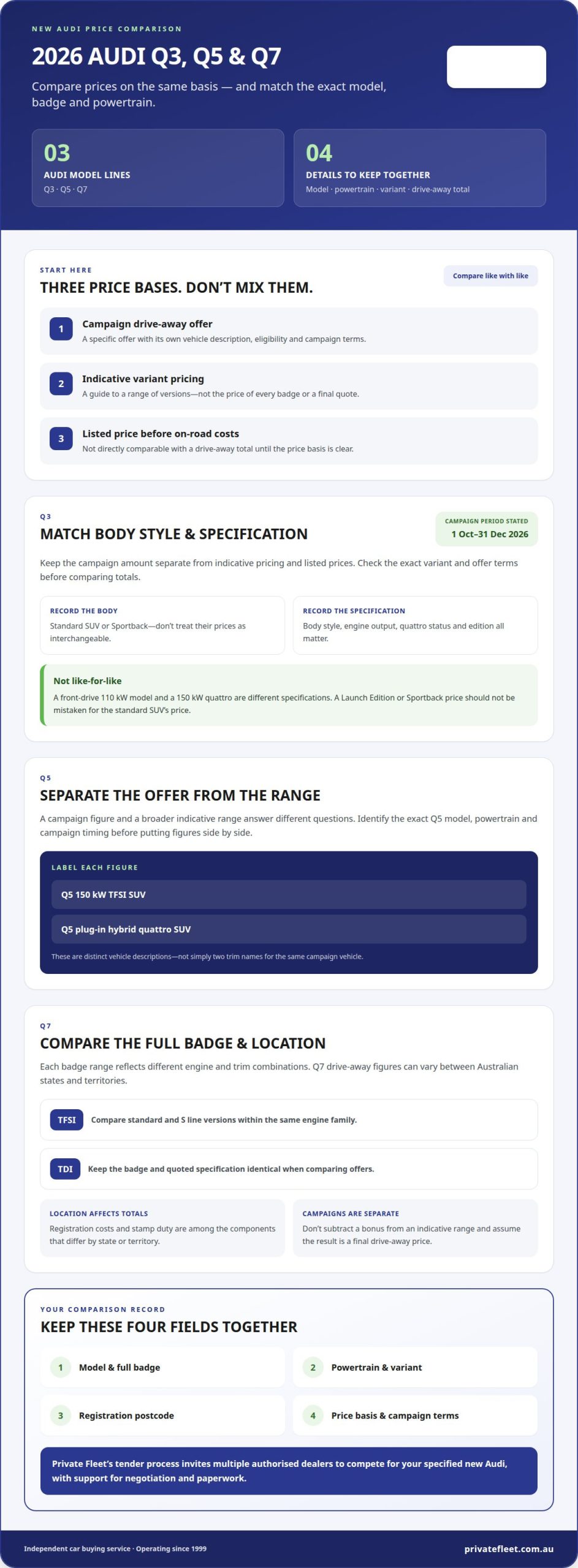
For the 2026 Audi Q3, Q5 and Q7 prices in Australia, separate campaign drive-away offers from indicative variant pricing.
These figures are a starting point for your shortlist, not a single price for every version. Before comparing offers, identify the model, badge and powertrain you want, then check that each price uses the same basis. Your postcode and any current campaign terms can also affect a drive-away figure. This helps you compare like with like, rather than unrelated headline prices.
This guide sets out Q3 and Q5 indicative pricing, then explains how Q7 prices differ by badge. It also helps you make sense of the wider Audi line-up and prepare for a like-for-like dealer tender quote. Use the details to narrow your choices and decide what information to provide when you’re ready to buy.
Key Takeaways
- Compare drive-away offers with indicative variant pricing on the same basis; a listed price before on-road costs isn’t directly like-for-like.
- For the Q7, match the model badge and powertrain to your needs, then factor in that drive-away pricing can vary by state or territory.
- When weighing Q3 and Q5 options, compare the variant and powertrain as well as the headline price to identify the right fit for your shortlist.
- Private Fleet’s tender process invites multiple authorised dealers to compete for your specified new Audi, with support for negotiation and paperwork.
- Get a clearer comparison by deciding which model and variant you want, your postcode and when you plan to buy.
2026 Audi Q3 and Q5 indicative drive-away prices
Compare Audi campaign drive-away offers separately from indicative ranges and listed prices before on-road costs. Each price basis tells you something different.
Q3 indicative drive-away pricing
These figures have different contexts, so don’t treat the campaign amount as the price of every Q3 variant. The offer applies from 1 October to 31 December 2026.
Listed prices before on-road costs show how body style and specification affect the comparison:
Don’t assume the difference represents a saving against either listed price. Match the exact variant and offer terms first, then compare the total drive-away figure.
Body style matters too. A buyer weighing those options should compare the body style and equipment as well as engine output. For quattro versions, include the powertrain designation in the comparison; a front-drive 110 kW model isn’t like-for-like with a 150 kW quattro.
The Q3 indicative range covers a broad spread of versions. Use its lower and upper figures as context, not as a substitute for pricing a chosen badge. For a clear quote comparison, record the body, output, quattro status, edition and whether the figure includes on-road costs. That prevents a Launch Edition or Sportback price being mistaken for the standard SUV’s price.
Q5 indicative drive-away pricing
Keep the campaign figure separate from the wider range: they answer different questions and aren’t two prices for the same offer.
That is a comparison of advertised prices only; it doesn’t establish which powertrain best suits your use. Identify the exact Q5 and campaign timing before placing the figures side by side.
A practical comparison keeps four details together: model, powertrain, variant and drive-away total. For instance, label one figure “Q5 150 kW TFSI SUV” and the other “Q5 plug-in hybrid quattro SUV”. This avoids treating the plug-in hybrid offer as a trim variation of the TFSI campaign vehicle. It also makes the difference between a campaign amount and the broader indicative range visible.
Its range is presented by model badge in the next section. Across the Q3, Q5 and Q7, use the same location and price basis when assessing quotes, since the Q7’s drive-away components can vary between Australian states and territories.
The listed Audi Q7 MRDP may vary if the vehicle is registered in a different Australian state or territory because price components such as stamp duty or registration fees differ. Check the applicable registration location when considering that figure, and keep this variation distinct from the Q3 and Q5 figures.
Q7 prices by model badge
Each badge has its own range, reflecting different engine and trim combinations. Compare the full badge name and your registration location before judging the figures. Matching the descriptions helps show whether a price difference comes from the vehicle or its drive-away calculation.
How to compare the Q7 badge ranges
The starting figure depends on the Q7 badge and specification. These differences compare the lower ends only. They don’t establish the price of a particular vehicle in every location.
Compare S line editions within the same engine family. This makes the trim comparison clearer than comparing an S line TDI directly with a standard TFSI.
The TFSI 250 kW S line occupies the highest range shown. That comparison isolates two petrol S line badges, while still reflecting their different outputs. For a quote comparison, keep the badge and quoted specification identical before attributing a price difference to the offer.
Why the location and campaign matter
Q7 drive-away figures may vary between Australian states and territories. Registration costs and stamp duty are among the price components that differ by location. Use the registration postcode when interpreting a range. A quote for one state may not match another state’s total, even if both name the same Q7 badge.
Treat this campaign as distinct from the indicative ranges above. Don’t subtract the bonus from a range and assume the result is a final drive-away price. Compare the campaign vehicle, badge, eligibility and price basis with the specific quote.
For example, a buyer considering a TDI 170 kW S line edition can record the badge, registration location and campaign period together. That creates a more useful comparison than noting only “Q7” and a headline price. If an offer uses a different location or vehicle description, separate those details before comparing totals.
Before choosing, decide whether the TFSI or TDI badge fits your shortlist, then compare standard and S line versions within that powertrain. Keep campaign terms and registration location visible beside each figure. This makes the listed ranges easier to interpret and helps you focus on equivalent Q7 specifications, rather than simply selecting the lowest number.
For help comparing an Audi Q7 badge, share your preferred model, postcode and buying timeframe through Private Fleet’s contact page, call 1300 303 181, or view Audi buying options.
Price and seating questions are best kept separate when reviewing Audi choices. The Audi Q2 and Q3 models accommodate up to five adults. That detail applies to those models, not as a description of any Q7 badge in the ranges above. If you are weighing alternatives, keep the model name beside each note so that a seating detail is not mistaken for a Q7 specification. The Q7 comparison remains anchored to its full badge, registration location and quoted price basis.
A useful comparison record can keep each question in its own place: note the model and its seating information separately from the Q7 badge and its quoted figure. This avoids treating a detail about one model as if it described another. When reviewing a Q7 offer, return to the specific badge and location rather than relying on general information about Audi models. When considering a different model, confirm that its own details match the decision you are making. Keeping those notes distinct makes it easier to assess the price range and the vehicle choice without mixing the two.
Audi line
The Q3, Q5 and Q7 cover different sizes and powertrain choices. Comparing their Australian line-up means looking beyond the badge. Engine output, body style, seating and price basis all shape a useful shortlist. For a 2026 comparison of Audi Q3, Q5 and Q7 prices in Australia, match those details before weighing the totals.
The 2026 Q3 offers a clear example of how one model name covers distinct vehicles. The SUV and Sportback share some engine outputs, yet their listed prices differ. Within the SUV range, buyers can choose front-wheel drive or quattro all-wheel drive. The Q5 adds a plug-in hybrid quattro option, while the Q7 is a seven-seat SUV.
Q3: compare body style and performance
The front-drive Q3 uses a 1.5-litre turbo-petrol engine producing 110 kW and 250 Nm. Its stated 0 to 100 km/h time is 9.1 seconds. The 150 kW quattro uses a 2.0-litre turbo-petrol engine, producing 320 Nm and reaching 100 km/h in 7.1 seconds.
At the higher-performance end, the Q3 quattro produces 195 kW and 400 Nm. Its stated 0 to 100 km/h time is 5.7 seconds. These figures help explain why Q3 prices vary across the range. A buyer choosing between 110 kW front-drive and 150 kW quattro is comparing more than trim or body shape.
The third-generation Q3 was due to arrive in Australia in the second quarter of 2026.
Those changes make model year and body style important when comparing prices. An older-generation figure isn’t directly comparable with a new-generation Q3. Match the generation, SUV or Sportback body, engine output and drive system first. Then compare the full drive-away amount for the same specification.
Q5: distinguish petrol and plug-in hybrid
The Q5 line includes a 150 kW TFSI SUV and a plug-in hybrid quattro SUV. The campaign drive-away figures differ, reflecting separate powertrain choices. A PHEV can be charged externally, unlike a conventional hybrid. Buyers comparing these Q5s should consider charging access and daily driving alongside the purchase figure.
Keep the Q5’s campaign figures separate from its broader indicative range. That avoids treating one advertised drive-away amount as the price of every Q5 badge. For a practical comparison, record the powertrain, quattro designation, variant and offer period. A matching specification makes differences between quotes easier to interpret.
Q7: space and ownership details
The Q7 seats seven, giving it a different role from the five-seat Q3 and Q5. Its boot capacity ranges from 780 to 1,908 litres. That range reflects seating and cargo configuration, so consider how often the third row will be used. The Q7’s size may suit buyers who regularly carry more passengers or luggage.
The Q7’s listed fuel consumption ranges from 7 to 9.3 L/100 km, depending on badge. Its Australian vehicle warranty is five years with unlimited kilometres. The suggested service schedule is every 12 months or 15,000 km. These details can help compare expected ownership routines across Q7 variants.
Use a simple shortlist: choose the body style, identify the engine or powertrain, then select the badge. For a Q3, that means comparing outputs such as 110 kW and 150 kW quattro. For a Q5, separate TFSI from plug-in hybrid quattro. For a Q7, factor in seven seats and the intended badge.
A like-for-like comparison of 2026 Audi prices in Australia across the Q3, Q5 and Q7 starts with the exact vehicle specification. Include the model year and campaign period, since the Q3 generation changed during 2026 and Q5 campaign pricing has an end date. That gives you a consistent basis for assessing the Audi line.
Private Fleet
Private Fleet’s New Car Buying Service can help turn an Audi shortlist into comparable dealer tenders. It works with a national network of authorised dealerships, inviting multiple dealers to compete for your specified Q3, Q5 or Q7. Private Fleet manages negotiation and paperwork, then provides regular delivery updates. It doesn’t hold its own vehicle inventory.
Share your preferred Audi model and badge, postcode and buying timeframe to get started. If you’re trading in your current vehicle, Trade-In Assistance can be part of the purchase, and Car Finance is also available. Explore Private Fleet’s new-car buying service or view Audi buying information.
For help with your Audi purchase, contact Private Fleet or call 1300 303 181.
Turn your Audi shortlist into a clear next step
Use the Q3, Q5 or Q7 that best fits your plans as the starting point for a tailored purchase. Share your preferred model and variant, postcode and buying timeframe so the comparison can focus on the vehicle you actually want. A precise shortlist makes it easier to assess equivalent quotes and consider a trade-in as part of the purchase.
For help with your next steps, explore Audi buying options, contact Private Fleet or call 1300 303 181. The audi Q3, Q5 and Q7 2026 prices in Australia are a starting point; your chosen specification and location shape the comparison.
When you’re ready, take the next step with your preferred Audi and buying timeframe in hand.
Frequently Asked Questions
What is the 2026 Audi Q3 price in Australia by trim?
Listed Q3 prices vary by body style and trim, with several amounts shown before on-road costs.
What is the 2026 Audi Q5 price in Australia by trim?
These campaign offers run from 1 October to 31 December 2026. The figures don’t provide a price for every individual trim, so identify the exact Q5 specification before comparing totals.
What is the 2026 Audi Q7 price in Australia by trim?
Registration location affects the final figure.
Are 2026 Audi Q3, Q5 and Q7 prices in Australia drive-away or before on-road costs?
They can be either, so read the price basis beside each figure. Q5 campaign offers are also drive-away, but its broader range is indicative. Q7 figures are indicative drive-away ranges. State or territory affects components such as registration and stamp duty, so compare quotes for the same location and specification.
When will the 2026 Audi Q3, Q5 and Q7 go on sale in Australia?
The third-generation Audi Q3 is due to arrive in Australia in the second quarter of 2026.