
What if you could create more competition for your new-car purchase without buying a fleet of vehicles? That’s the idea behind bulk buying power for private car buyers: an individual buyer can use a car buying service to invite multiple dealers to compete for their business. It’s not a group purchase, and it doesn’t guarantee a particular price, but it can give you more offers to assess than approaching one showroom alone.
Comparing offers can still be confusing. Quotes may cover different variants, delivery costs, accessories or trade-in assumptions, so the lowest headline figure may not represent the best value. A competitive process brings offers together, but you’ll still need to check that each one covers the same vehicle and purchase details.
This guide explains how dealer tenders work in Australia and how Private Fleet’s independent sourcing service connects private buyers with a national network of authorised dealerships. You’ll learn what to compare in new-car and drive-away quotes, what to clarify about trade-ins, and what information to have ready when seeking help. The aim is to support a more informed decision, without promising guaranteed savings.
Key Takeaways
- Bulk buying power for private car buyers comes from inviting dealers to compete for one buyer’s business, not from purchasing multiple cars.
- A clear brief covering your preferred make, model, variant, postcode and buying timeframe helps dealers respond to the right request.
- Compare quotes for the same vehicle and check what each drive-away offer includes before weighing up the total.
- Assess the new-car price separately from your trade-in, finance and optional protection products to see how each affects the overall deal.
- A buying service can organise dealer competition and assist with sourcing, but offers still need careful review and don’t guarantee the lowest price.
What does bulk buying power mean for private car buyers?
Bulk buying power for private car buyers means gaining leverage through organised purchasing or competition between dealers. Fleets and buying groups may negotiate based on purchasing volume. A private buyer can take a different approach: ask multiple authorised dealers to respond to the same new-car requirements, then compare their offers.
These approaches are related, but they aren’t the same. A purchasing cooperative pools demand from multiple participants. A fleet arrangement is based on an eligible organisation or vehicle-purchasing arrangement, with its own terms. A dealer tender asks dealers to compete for one buyer’s business. This can give you more offers to consider, but it doesn’t guarantee a particular price or that every dealer will respond.
Does a private buyer need to buy a fleet of cars?
No. A private buyer can seek competing offers for one new car. That doesn’t automatically make the buyer eligible for formal fleet pricing. Eligibility and terms depend on the relevant arrangement, and offers can vary between dealers. Treat any fleet-price claim as something to clarify rather than assuming every private buyer receives the same pricing or conditions.
Bulk purchasing versus dealer competition
Bulk purchasing usually involves buying several vehicles together, or combining demand through a group arrangement. Dealer competition involves multiple authorised dealers responding to one buyer’s brief, which can include a preferred make, model, variant and buying timeframe. You can then compare what each offer includes and decide whether it suits your needs.
Bulk purchasing uses the number of vehicles to build leverage; dealer competition uses multiple offers to strengthen one buyer’s position. You don’t need to organise a group purchase to ask dealers to compete for your business.
Private Fleet is an independent Australian vehicle sourcing and car buying service. Its tender process invites multiple dealers in its national network of authorised dealerships to compete for a private buyer’s business. Private Fleet doesn’t hold its own vehicle inventory, and the process doesn’t promise the lowest price or guaranteed savings. It provides a structured way to seek and review dealer responses. Find out more about the new-car buying service.
How dealer competition can give private car buyers fleet-like buying power
A dealer tender turns your new-car requirements into a request that multiple authorised dealerships can respond to. You set the brief, review the responses and decide whether any offer is right for you. This can provide fleet-like purchasing leverage without implying that you qualify for formal fleet pricing.
What happens during a dealer tender?
The process generally has four steps: prepare a buyer brief, invite dealers to respond, receive competing offers, then review them. Include your preferred make, model, variant and buying timeframe so responses relate to the car you’re looking for.
Before comparing offers, check that each response specifies the same vehicle and variant. Review the quote basis, inclusions and conditions. If anything is unclear, ask for clarification before treating the offers as like-for-like. Availability and proposed timing can vary, so confirm those details with the relevant authorised dealer.
Private Fleet is an independent sourcing and car buying service. It invites dealers in its national network of authorised dealerships to compete for a buyer’s business, then supports the sourcing process. It doesn’t hold its own vehicle inventory. To see the steps in more detail, read how the car-buying process works.
What the buyer still decides
You remain in control of your preferred model and variant, budget and purchase timeframe. Review dealer responses, ask questions about anything unclear, and decide whether to proceed. You’re not obliged to accept an offer simply because dealers have competed to provide one.
A dealer tender is a way to source and compare offers, not a promise of a discount. It can make the options easier to review, but the outcome depends on the responses and terms available for your request. For independent background on purchase routes and costs, see Moneysmart’s Ways to buy a car guide.
If you’re considering a tender, you can share your preferred make and model, postcode and buying timeframe to discuss getting help with your new-car purchase.
Does bulk buying power guarantee a cheaper new car? Compare the process fairly
No. Bulk buying power for private car buyers doesn’t guarantee the lowest price or a better outcome. A competitive process can give you more offers to assess, but value depends on what each quote includes and whether it suits your needs. Contacting dealers directly and negotiating for yourself can also work well. A buying service is another way to organise the comparison.
Use this table to weigh up the approaches. The right option depends on how much time you want to spend contacting dealers and checking details.
| Process | Buyer effort | Comparison points | Caveats |
|---|---|---|---|
| Enquire directly with dealers | Contact and follow up with each dealer yourself. | Ask each for a written quote on the same vehicle and quote basis. | Offers may arrive in different formats, so check inclusions and conditions. |
| Negotiate with a dealer | Discuss the offer and terms directly, then decide whether to accept. | Review the vehicle specification, drive-away quote and any trade-in separately. | The result depends on the offer and negotiation; a particular outcome isn’t assured. |
| Use a buying service | Provide your requirements and review the responses arranged through the service. | Check that dealer responses match your requested vehicle and quote details. | A tender doesn’t guarantee a lower price or mean every response has identical terms. |
Which details make two new-car offers comparable?
Match the make, model, variant, powertrain and colour. Check whether factory or dealer-fitted options are included, and confirm the quote basis, inclusions, conditions and validity with the supplying dealer. Compare drive-away quotes on the same basis. Check current specifications and any advertised offers with the Australian manufacturer or an authorised dealer, as details can change.
How should a trade-in be assessed alongside a new-car offer?
Keep the new-car offer and trade-in valuation separate at first. Ask what condition, inspection and valuation assumptions apply to your current car, then compare the figures independently before considering the overall amount you’d pay. A trade-in figure isn’t a saving by itself and may depend on inspection or other stated conditions.
If you’re considering a buying service, read more about the car-buying process. Private Fleet is an independent sourcing and car buying service that invites authorised dealerships to compete for your business; it doesn’t hold its own vehicle inventory.
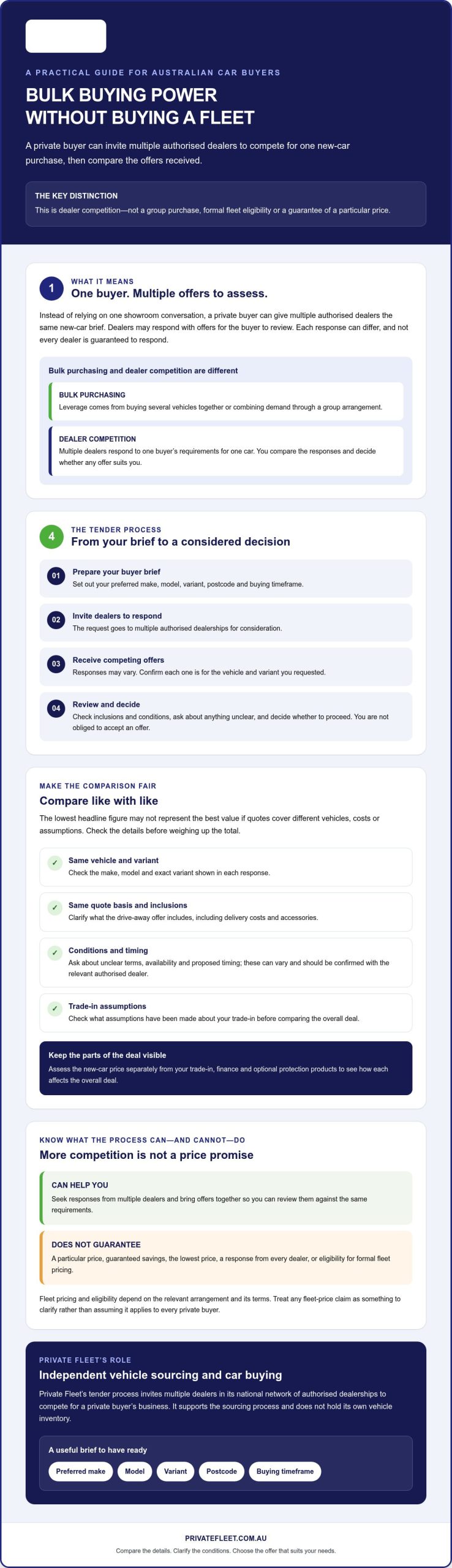
How to assess bulk buying power: a practical new-car offer checklist
Dealer competition is most useful when you can see exactly what each offer covers. Compare the vehicle first, then consider your trade-in and any optional products separately. This helps prevent a headline figure or bundled offer from obscuring what you’re being quoted for the new car.
What should a like-for-like quote comparison include?
Matching the vehicle specification is essential: if the model, variant or included equipment differs, the offers aren’t directly comparable. Record the quote date and check each dealer’s written offer against the same requirements.
- Vehicle: Note the make, model, variant, powertrain and colour. Record any factory-fitted or dealer-fitted options, accessories or equipment included.
- Price basis: Check whether the quote is drive-away or uses another basis. Ask the dealer which costs and inclusions are covered and whether anything is excluded.
- Conditions: Record the offer’s validity and any conditions that could affect the quoted vehicle or terms.
- Trade-in: Keep the trade-in valuation separate from the new-car price. Note the assumptions about condition and inspection.
- Finance and protection: Compare the vehicle offer without optional finance or protection products, then assess those separately if you’re considering them.
For current specifications and offers, check Australian manufacturer information and confirm quote details directly with the authorised dealer supplying the vehicle. If a quote doesn’t state whether an item is included, ask rather than assuming it’s covered.
What should you confirm before proceeding?
Before deciding, ask the dealer to confirm the offer expiry, availability of the specified vehicle and any conditions that apply. Check delivery information directly with the dealer, including what timing they can currently advise, rather than treating an estimate as confirmed. If you’re trading in your car, clarify the inspection and valuation process and whether the quoted trade-in figure depends on its condition.
These checks help you judge the practical value of bulk buying power for private car buyers: compare clear, relevant terms rather than assuming one offer must be best. Once you’ve reviewed the details, you can talk through your shortlist.
How to use a buying service to put dealer competition to work
A buying service can organise the sourcing process so you don’t have to approach each dealership separately. Private Fleet is an independent Australian vehicle sourcing and car buying service. It invites multiple dealers in its national network of authorised dealerships to compete for your business, then helps you review the responses. It doesn’t own or hold vehicle inventory.
This approach can make bulk buying power for private car buyers more practical: you provide the requirements for one new car, and the service arranges dealer competition around them. Responses depend on the vehicle you’re seeking and current circumstances, so a particular offer, price or availability isn’t guaranteed. You remain in control of whether to proceed.
What information helps start a vehicle search?
A clear brief helps focus the search and gives dealers relevant details to respond to. You can provide:
- Your shortlist: preferred make, model and variant, or other vehicles you’d consider.
- Your location: postcode, so the enquiry can be considered in context.
- Your timing: when you intend to buy. This helps set expectations for the request, but doesn’t guarantee a delivery date.
- Your requirements: essential equipment, colour or other priorities that could affect which vehicle suits you.
- Trade-in needs: whether you have a current car to exchange and want help considering its trade-in as part of the purchase.
If you’re still choosing between models, say so. A shortlist is useful, and explaining what you need from the car can help shape the sourcing request. For example, identify your first-choice variant and note an alternative you’d consider, rather than leaving the dealer brief open-ended.
What to expect from the next step
Once your requirements are clear, the buying service can seek responses through its authorised-dealer network. Compare options against your preferred specification, ask for clarification where details are missing, and consider trade-in information separately from the new-car offer. The final decision is yours: proceed with an option that suits you or decide not to accept the responses.
To get started, share your preferred make and model or shortlist, postcode and buying timeframe. Mention any trade-in and the features you consider essential, so your enquiry reflects what you’re looking for.
Put dealer competition to work on your next car
Bulk buying power for private car buyers doesn’t require purchasing a fleet. A dealer tender can invite multiple authorised dealerships to compete for one buyer’s business, giving you a structured way to compare options without promising a particular price or guaranteed savings.
For a confident decision, check that quotes cover the same make, model, variant and inclusions. Assess the new-car offer separately from any trade-in, finance or optional protection products, then confirm conditions and availability with the supplying dealer.
Private Fleet is an independent Australian brokerage founded in 1999. Its national network of authorised dealerships is invited to respond through a tender process. Private Fleet supports vehicle sourcing but doesn’t hold its own inventory, and you remain in control of whether to proceed.
Share your preferred make and model, postcode and buying timeframe to discuss help with your new-car purchase.
Get help buying my new car
With clear requirements and like-for-like comparisons, you can approach your next purchase with greater clarity and confidence.
Frequently Asked Questions
Can private buyers get bulk buying power when buying one new car?
Yes. A private buyer can seek competing offers for one new car. Bulk buying power for private car buyers can come from having multiple authorised dealers respond to the same request, rather than literally buying several vehicles. This differs from formal fleet pricing, which depends on the relevant arrangement and eligibility. A competitive process may offer more options to compare, but it doesn’t guarantee the same terms or pricing available to a fleet.
How does a dealer tender work for a private car buyer?
A dealer tender starts with your vehicle requirements, such as preferred make, model, variant and buying timeframe. A buying service invites authorised dealers to respond, then helps present the offers for review. Check that each response relates to the same specification and quote basis, and clarify missing details with the supplying dealer. You decide whether an offer suits you and whether to proceed.
Does bulk buying power guarantee the lowest new-car price?
No. A tender or other competitive process doesn’t guarantee the lowest price, a discount or a particular outcome. Dealer responses depend on the vehicle and current circumstances, and the terms offered may differ. Compare written offers carefully, including the vehicle specification, quote inclusions, conditions and validity. Treat any trade-in valuation separately from the new-car offer so you can understand each part of the deal.
What should I compare in new-car dealer offers?
Check that each offer is for the same make, model, variant, powertrain, colour and included equipment. Compare quotes on the same basis, such as drive-away pricing, and confirm which costs, options and conditions are included. Record the quote date and ask the dealer to clarify expiry and availability. Assess any trade-in separately, and keep optional finance or protection products outside the vehicle-price comparison.
Does Private Fleet own the cars it sources for buyers?
No. Private Fleet is an independent Australian vehicle sourcing and car buying service, not a vehicle inventory holder. It works with a national network of authorised dealerships and uses a tender process that invites multiple dealers to compete for a buyer’s business. Dealers provide responses for the requested vehicle, and the buyer reviews the available options before deciding whether to proceed. Confirm vehicle availability and offer terms with the dealer.
What information should I provide when asking for help buying a new car?
Share your preferred make and model, the variant you’re considering or a shortlist, your postcode and intended buying timeframe. Mention essential requirements, such as equipment or colour preferences, so the request reflects what matters to you. If you have a car to trade in, include that too. Clear details help shape a relevant enquiry, but don’t guarantee a particular dealer response, price or delivery timing.