
A new-car purchase can start in a browser, not a showroom. To buy a brand new car online in Australia, compare models and variants, read reviews, then enquire about a vehicle that suits you. An enquiry lets you discuss pricing, trade-ins, finance and delivery before deciding whether to proceed.
It makes sense to research at your own pace and understand the details before making a major purchase. Online reviews can help you shortlist options, while enquiries let you ask about specific vehicles, features and buying arrangements without starting with a dealership visit.
This guide covers how to browse new cars online, assess reviews, make useful enquiries and compare responses. You’ll also find practical points for choosing a model and moving from shortlist to purchase, so you can decide what to do next with a clearer picture of the process.
Key Takeaways
- Compare the same make, model and variant using drive-away quotes, so you can assess the total purchase price on a like-for-like basis.
- Use reviews to build a shortlist, then weigh reported strengths against your own priorities, such as comfort, visibility and ease of use.
- Make online enquiries with clear questions about specifications, pricing, trade-ins and delivery arrangements to make responses easier to compare.
- Car news and buying advice can help you understand new models and features, but use current Australian information when comparing vehicles.
- Private Fleet’s tender process invites multiple authorised dealerships to compete for your business, with support for sourcing a new car and arranging trade-in assistance.
Indicative drive-away prices for new cars
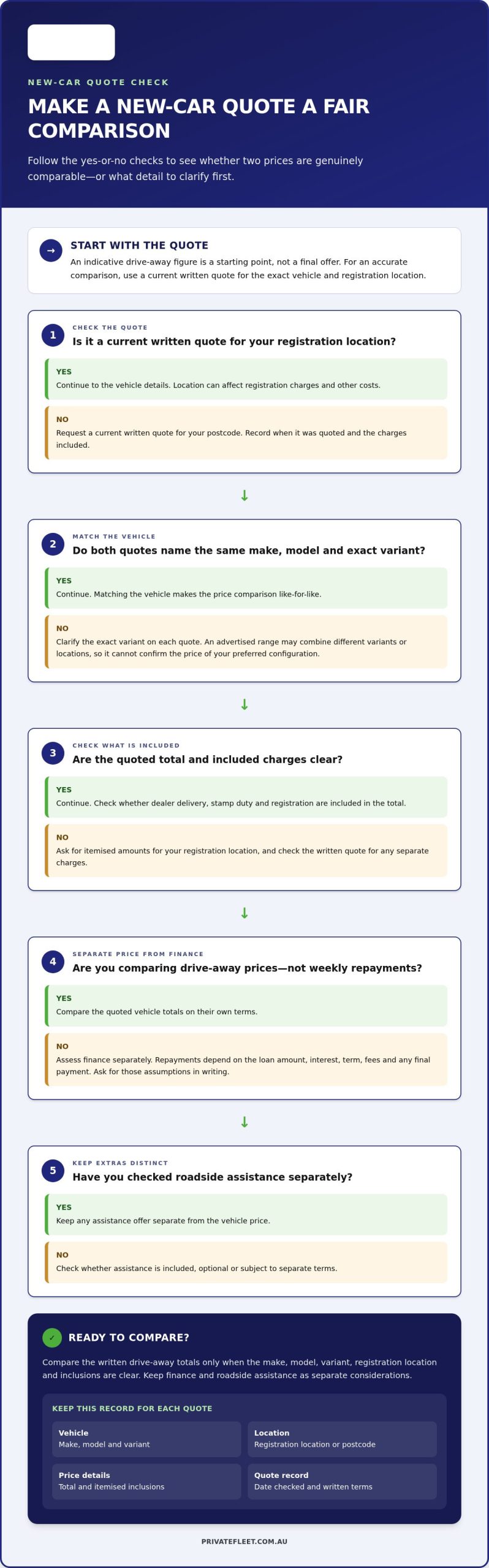
An indicative drive-away figure is a starting point, not a final offer. For an accurate comparison, request a current written quote for the exact variant and registration location.
Drive-away prices by location
Location affects a quote because registration charges and other costs can vary between jurisdictions. Start with the manufacturer’s Australian model page, then request an itemised quote for your postcode. Record the quote date, vehicle variant and included charges. This makes it easier to compare offers on the same basis, rather than relying on an undated listing that may not reflect the price available to you.
Vehicle prices and weekly finance amounts
A vehicle price and a weekly finance amount describe different parts of a purchase. Repayments depend on the loan amount, interest, term, fees and any final payment. Ask for those assumptions in writing, then assess the total repayment separately from the drive-away quote. For example, two listings for the same model may show different weekly amounts because their finance terms differ.
Keep any roadside assistance offer separate from the vehicle price. Before comparing offers, check whether assistance is included, optional or subject to separate terms.
Additional costs when buying a new car
Ask whether dealer delivery, stamp duty and registration are included in the quoted total. If any charges are separate, request itemised amounts for your registration location before comparing the final payable figure. Check the written quote and its stated inclusions to identify any extra costs.
For selected new cars, treat online prices as comparison prompts, not verified current offers. Use the Australian manufacturer page or an authorised dealer’s current listing, note when you checked it, and request a quote for the exact model and variant. An advertised range may combine different variants or locations, so it can’t establish the price of your preferred configuration.
Used-car listings offer a separate reference point, not a direct new-car quote. Where possible, compare the same model, while noting the used vehicle’s age, kilometres and condition. Keep this comparison distinct from new-car pricing, which applies to a new vehicle and its specified variant.
Delivery timing depends on the order’s progress, vehicle allocation, transport and destination. Ask the selling dealer how order updates are provided and what milestones they can report. Keep any written timing updates with your order documents.
For business identification, the Australian Business Register lists ABN 61 814 236 264.
Customer reviews
Customer reviews can show how a vehicle performs in daily use beyond what its specification sheet tells you. Read them alongside manufacturer information, and separate comments about the car from those about the buying or delivery experience. A review of a Toyota hybrid, for example, may discuss fuel use, cabin comfort or controls. These are the reviewer’s experiences, not a guarantee of your own.
Start with the exact model, variant and powertrain. Reviews of a petrol version may not reflect the driving feel or equipment of a hybrid variant. Check the review date and vehicle details, especially if the model has been updated. Look for recurring observations across reviewers rather than treating one strong opinion as decisive.
- Check the context: Note whether the reviewer drives mostly in town, on motorways or on regional roads.
- Separate experience from fact: Compare claims about standard equipment with the Australian variant’s current specifications.
- Look for useful detail: Specific comments about seat adjustment, visibility, cabin noise, boot space and touchscreen menus help you assess everyday suitability.
- Read critical feedback: Recurring concerns may point to questions worth exploring during a test drive.
Reviews have limits. A brief ownership account may not cover servicing, warranty support or long-term reliability. A comfortable drive on smooth roads may not reflect your regular route. Treat fuel-consumption claims as personal reports unless they cite a clearly identified test method. For a hybrid, consider whether the reviewer’s driving pattern resembles yours.
Online ratings need context. Check how many reviews there are, when they were posted and whether they describe a new car, a used car or a dealership interaction. A dealership review can offer insight into one person’s purchase experience, but it doesn’t show how another dealer will handle your order. Look for detailed descriptions instead of relying on a star rating alone.
If a car-related offer includes CommBank Yello points, read the current conditions before factoring them into your decision. Eligibility, qualifying transactions and any offer period can affect whether points apply. Treat points as a separate consideration, not a reduction in the vehicle’s quoted price, and assess the car’s price and specification on their own merits.
Use reviews to create a short list of questions for a test drive: Can you adjust the seat comfortably? Are the controls easy to follow? Does visibility suit your parking routine? If comments leave you weighing two models, you can get help comparing your new-car shortlist before deciding what to enquire about.
Browsing new cars and making online enquiries with manufacturers
Manufacturer websites help you explore Australian models, compare variants and make an enquiry. Use them to build a shortlist, then compare written responses with the vehicle and terms you want.
Online car websites
Start with the Australian website for the make you’re considering, such as Toyota, Mazda or Kia. Open the model page and compare variants, powertrains, listed features and available colours. Note the exact variant name so your enquiry and any later quote refer to the same vehicle.
Use the website’s enquiry form to request information about the model. Include your postcode, preferred variant and buying timeframe. These details help the responding dealer address location-specific pricing and your intended purchase timing.
Brokers, marketplaces and direct dealer buying
Marketplaces bring vehicle information or offers together, while a broker can source a car through dealer relationships. Buying directly from a dealer means discussing the vehicle and purchase with that dealership. The right fit depends on how much help you want comparing offers and whether you prefer dealing with one seller or considering several.
Before proceeding, establish who will supply the vehicle, issue the purchase documents and answer delivery questions. An online listing is a starting point, not a substitute for clear written terms. If you want to compare dealer responses, a dealer tender buying process can structure those enquiries.
Online quotes and price negotiation
Yes, you can request an online quote and negotiate with an Australian dealer. Provide the exact model, variant, postcode and trade-in details, then ask for the complete drive-away amount in writing. Compare equivalent vehicles and quote inclusions before discussing changes to the offer.
Keep the conversation specific. For example, ask whether the quoted amount includes dealer delivery and registration, and whether an accessory is optional. If you have another written quote for the same vehicle, use it as a comparison. A lower figure may reflect different inclusions, so compare the total and terms, not just the headline amount.
Before submitting a manufacturer enquiry, prepare a short checklist: preferred make and model, variant, colour, postcode, purchase timeframe and whether you have a trade-in. Ask about test-drive arrangements, order updates, delivery and roadside assistance if these details matter to your decision. Save each reply with its date and vehicle details to keep follow-up discussions precise.
Online browsing can narrow your choices, but it can’t tell you whether the seating position, visibility or controls feel right. Where practical, use your enquiry to arrange a test drive. If you’ll use the vehicle for commuting, regional travel or family trips, consider whether its features suit those regular journeys.
When you’re ready to compare responses, share your preferred model and postcode to discuss your next step.
Car news and buying advice
Car news can flag model updates, while buying advice can help you assess what matters. For an online purchase, understand your Australian consumer rights and take care before sending money.
Consumer guarantees and warranty rights
When you buy a new car from a business, Australian Consumer Law consumer guarantees apply, including online purchases. The car must be of acceptable quality, match its description and be fit for a disclosed purpose. If it has a major failure, you can choose a refund or replacement; for a minor failure, the seller can generally repair it. The Australian Competition and Consumer Commission’s consumer guarantee guidance explains these protections.
A manufacturer’s warranty is separate from consumer guarantees and doesn’t replace them. Read the warranty terms for exclusions, servicing conditions and how to make a claim. Keep the contract, warranty documents and service records together. If a problem arises, contact the selling business, describe the fault and explain the outcome you’re seeking.
Online buying risks and scam avoidance
Buying online can make it harder to assess a seller or inspect a vehicle before paying. Check that the dealership’s name and contact details match its listing on the manufacturer’s Australian website. If an advertisement uses a brand name, find the dealership’s contact details independently instead of relying only on the advert.
Be cautious if a seller pressures you to transfer money urgently, changes payment details by email or asks for payment to an unrelated account. Before paying a deposit, get the seller’s identity, vehicle description, total price, refund terms and payment recipient in writing. A professional-looking listing alone doesn’t prove an offer is genuine.
Use this check before making payment:
- Match the seller’s details against the manufacturer’s dealership information.
- Get the vehicle description, price and order terms in writing.
- Confirm payment instructions through a trusted contact method.
- Keep copies of the advert, messages, invoice and signed contract.
Where practical, arrange a test drive before finalising the purchase. A video call can help you discuss specific features, but it doesn’t replace experiencing the vehicle in person. Review the order confirmation carefully, particularly if the chosen colour, variant or accessories differ from your enquiry.
What are the best websites for buying new cars online in Australia?
The best website depends on what you need to do. Manufacturer sites are useful for model research, authorised dealer sites for enquiries, and buying services for comparing dealer offers. Use each site for a clear purpose rather than treating one listing as the whole purchase.
Manufacturer websites: Toyota Australia, Mazda Australia and Kia Australia publish model and variant information for their ranges. Start here to explore configurations, colours and features. Use the Australian website, since overseas specifications can differ. Manufacturer pages help you build a shortlist, while a selling dealer provides the final quote and handles the purchase.
Authorised dealership websites: These can connect your preferred model with a local sales team. Look for clear vehicle details, dealership identity and a direct enquiry option. A dealer website is especially useful when you want to discuss a test drive, local delivery arrangements or a trade-in. Check that the displayed vehicle and variant match your shortlist before submitting details.
Vehicle marketplaces: Listing platforms make it easier to browse several makes in one place. Filter by body style, fuel type or other needs, then open the vehicle details and identify the seller. Listings can present prices, inclusions and availability differently, so use them to discover options rather than assuming every advert is directly comparable.
Independent buying services: These can help buyers approach dealerships and compare responses. Ask how the service sources vehicles, who the seller is, and how purchase documents and delivery are handled. A tender process invites multiple authorised dealerships to compete for your business. The service helps source the car; it doesn’t mean the service owns it.
For a practical online shortlist, choose a vehicle category, then compare a small set of models on manufacturer websites. For example, if you’re considering a medium SUV, compare the exact variants you’d actually buy, not just the model names. Assess seating comfort, visibility, controls, safety equipment and luggage space against your regular driving needs.
Before acting on a listing, record the website, seller, model, variant and quoted inclusions. Check whether the information is current, and keep replies and order documents together. If a page shows a finance estimate, assess it separately from the vehicle’s purchase price. Clear records make follow-up questions easier and help you spot differences between offers.
Choose a site that suits your next step: researching a model, contacting a seller or comparing buying options. Then move from browsing to a written enquiry with your preferred make, model, postcode and timeframe.
Private Fleet: New Cars
Private Fleet helps Australian private buyers source a new car through its New Car Buying Service. As an independent car broker, it uses a national network of authorised dealerships and a tender process that invites dealers to compete for your business. Private Fleet doesn’t hold stock for you to browse. Instead, the service helps compare dealer responses and progress your purchase.
This service can suit buyers who have a shortlist but want support approaching dealerships, weighing offers or managing the buying process. Trade-In Assistance can help if you’re replacing your current vehicle, and Car Finance is available if you’re considering finance as part of the purchase.
Share your preferred make or model, postcode and buying timeframe to start a conversation about your next steps. Explore Private Fleet’s new-car buying service.
Make your shortlist work for you
Turn your online research into a decision that fits everyday life. Before moving ahead, choose the qualities you value most, such as an easy-to-use cabin, comfortable long-distance driving, or room for family and luggage. Clear priorities help you judge options by your needs, not just by whichever feature catches your attention first.
If you’re ready to buy a brand new car online in Australia, include your preferred make and model, postcode and buying timeframe in your enquiry. This gives the conversation a practical starting point and helps focus on the details that matter to your purchase. Mention a trade-in too if you’re replacing your current vehicle.
A considered decision doesn’t have to happen all at once. Identify the questions you still have, get the relevant details in writing, and move forward when the choice feels right for your circumstances.
Frequently Asked Questions
How does it work?
An online car purchase starts digitally, but the final sale still involves an identified seller. You can browse a model, submit an enquiry and discuss the purchase remotely, then complete the transaction with the selling dealer. Before accepting an order, confirm who the contract is with and who is responsible for supplying the vehicle. Keep copies of the order confirmation and any later changes.
Which Australian car brands let you buy a brand-new car online?
Many Australian manufacturer websites let you explore models and contact a dealer, but that isn’t always the same as completing a purchase online. Look at the next step: a checkout or order function is different from a request-an-enquiry form. If the site directs you to a dealership, ask how the remaining order and paperwork can be handled remotely.
How does the online new-car buying process work in Australia?
Online steps may include selecting a configuration, discussing the order remotely and receiving documents electronically. Once the order is accepted, ask how changes to your chosen colour or accessories are recorded and how amendments are confirmed. Keep one current copy of the order details. This helps avoid confusion if your preferences change before handover.
How do car deposits, finance and online payment work when buying a new car in Australia?
A deposit may reserve or secure an order, while finance covers some or all of the purchase under a separate agreement. Read the seller’s deposit terms before paying, including what happens if the order changes. If you use finance, ensure the lender’s approval and loan documents match the vehicle and amount you intend to buy. Use the lender’s secure payment process.
How can you arrange a test drive, inspection and delivery of a new car bought online?
Ask the seller to arrange a test drive and clarify whether you’ll collect the vehicle or have it delivered. At handover, compare the vehicle identification number and supplied accessories with your order, and note any visible damage or missing items before completing the handover. Check that you receive the relevant vehicle documents and keys. Raise discrepancies with the seller promptly and keep a written record.