
An ABN doesn’t automatically reduce a new car’s drive-away price. Buying a new car on an ABN in Australia may lower your after-tax cost if the vehicle is used for business, but GST credits and deductions depend on business use and applicable vehicle limits.
It’s reasonable to expect a business purchase to come with a lower price. In practice, an ABN holder and a private buyer generally pay the same drive-away price unless business or fleet pricing is offered. When buying a new car on an ABN in Australia, the potential difference is usually the tax treatment, which depends on how the car is used and your business’s GST position.
This article explains how GST credits, passenger vehicle limits and chattel mortgages can affect the numbers, and what lenders may consider when assessing an application. It also covers why financial accounts and tax returns matter when buying a new car on an ABN in Australia, so you can weigh the purchase price, tax treatment and paperwork before deciding how to buy.
Key Takeaways
- An ABN doesn’t automatically change a car’s drive-away price; any business or fleet pricing is separate from tax treatment.
- Business-use records help establish what share of vehicle costs and GST may relate to business use.
- Passenger vehicle limits can affect the GST credit available, so the vehicle’s design and price matter.
- Finance options differ in ownership, repayments and cash-flow impact; compare the overall terms, not just the repayment amount.
- Lenders may assess repayment ability using business financial accounts and tax returns, so documentation is an important part of an application.
Buying a Car Through a Business or ABN: Is It Cheaper?
Yes, you can buy a new car in Australia using an ABN, including through business vehicle finance. An ABN alone doesn’t make the purchase cheaper. Business use, tax treatment and lender assessment affect the outcome, while mostly private use can limit deductions and raise fringe benefits tax considerations.
Business and Private Vehicle Use
Business use means travel connected with earning business income; private use covers personal trips, including most travel between home and a usual workplace. This distinction matters because personal use can’t be claimed as a business tax deduction. For a vehicle used for both purposes, business-use records help establish the share of eligible expenses and GST credits. A sole trader can use a logbook covering at least 12 continuous weeks; it can apply for up to 5 years.
Business-Use Requirements and Deductions
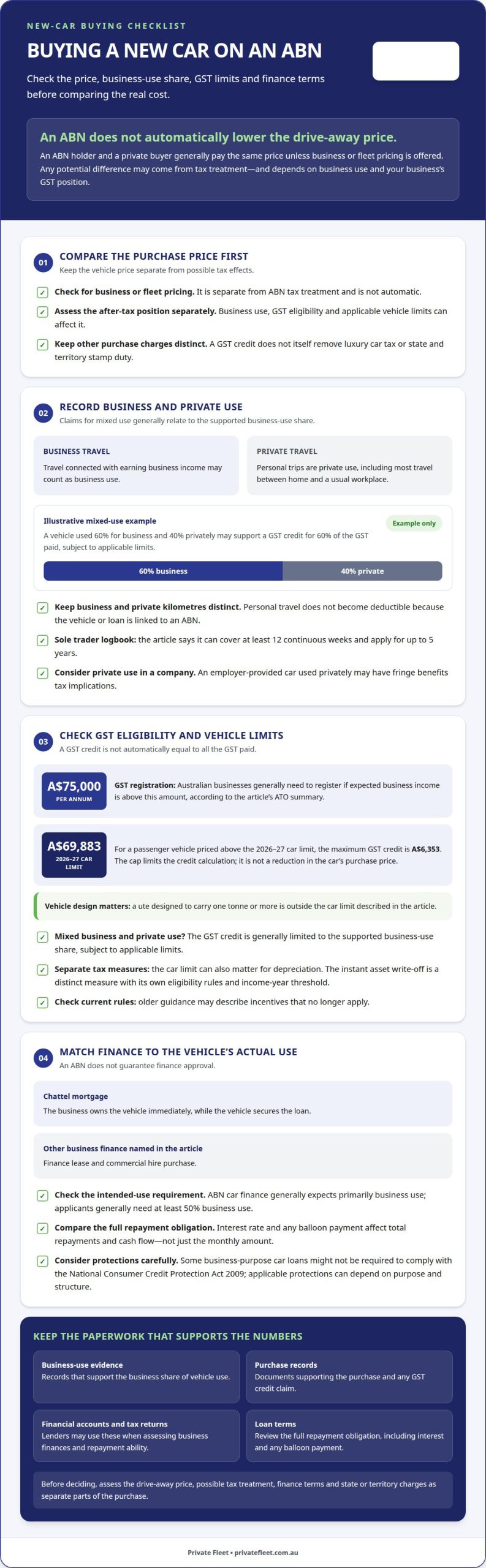
The business-use percentage is the share of vehicle use supported by records as relating to the business. It matters because deductions and GST credits for mixed use are generally limited to that share. For example, a vehicle used 60% for business and 40% privately may support a GST credit for 60% of the GST paid, subject to applicable limits. Personal travel doesn’t become deductible just because the vehicle or loan is linked to an ABN.
Mostly private use also raises a separate issue for companies: private use of an employer-provided car may have fringe benefits tax implications. A sole trader’s personal use isn’t a business deduction either. Keep business and private kilometres distinct so any claimed share reflects actual use, rather than assuming the ABN or business name determines the tax treatment.
Financing Through a Business
Business vehicle finance can include a chattel mortgage, finance lease or commercial hire purchase. With a chattel mortgage, the business owns the vehicle immediately, while the vehicle secures the loan. A lender assesses the application and repayment ability; an ABN doesn’t itself guarantee approval. ABN car finance generally expects the vehicle to be used primarily for business, and applicants generally need business use of at least 50%.
That distinction makes intended use important when choosing finance. If personal driving will dominate, business finance may not suit the vehicle’s actual purpose. Companies also need to consider employee private use, while sole traders need to separate personal travel from business kilometres. Finance structure and tax treatment relate to the same purchase, but they aren’t interchangeable.
Illustrative Five-Year Cost
The example includes a A$4,000 GST credit on purchase and a A$400 GST adjustment for the private-use share at sale. These figures illustrate how business-use share and finance costs affect the result, not a universal outcome.
GST credits and passenger vehicle limits
A GST credit may reduce the effective purchase cost of a new car, but it isn’t automatically equal to all the GST paid. Eligibility depends on GST registration, business use and passenger vehicle limits. According to the Australian Taxation Office, Australian businesses generally need to register for GST if expected business income is above A$75,000 per annum.
A GST-registered business may generally claim a credit for GST included in a vehicle’s purchase price when it’s used for business. If the car also has private use, the credit is generally limited to the business-use share. For example, a 60% business-use share may support a credit for 60% of the GST paid, subject to applicable limits. Keep the purchase records and business-use evidence that support the claim.
Passenger vehicle limits and write-offs
For 2026-27, the Australian car limit is A$69,883. For a passenger car priced above that limit, the maximum GST credit is A$6,353. The cap applies to the credit calculation; it doesn’t mean the car’s purchase price is reduced by that amount. A ute designed to carry one tonne or more is outside the car limit.
The car limit also matters when working out depreciation deductions for a passenger vehicle. It’s separate from the instant asset write-off, which is a distinct tax measure with its own eligibility rules and applicable income-year threshold. Older guidance may describe tax incentives that no longer apply, so check the current rules before relying on them. Don’t treat that historic figure as the 2026-27 threshold.
GST, luxury car tax and stamp duty are separate parts of a vehicle purchase. GST credit eligibility doesn’t itself remove luxury car tax or state and territory stamp duty; those amounts depend on the vehicle and transaction. Consider the drive-away figure separately from any potential GST credit or tax deduction for the business.
Finance terms and consumer credit protections
A car loan application may involve a review of credit history, business finances and repayment capacity. Loan terms, including the interest rate and any balloon payment, affect total repayments and cash flow. Compare the full repayment obligation, not just the monthly amount.
The National Consumer Credit Protection Act dates from 2009. Some business-purpose car loans might not be required to comply with it, so the protections that apply can depend on the loan’s purpose and structure. A company vehicle made available for an employee’s private use can also raise fringe benefits tax considerations, separate from GST treatment.
For a purchase involving business use, assess the car limit, GST treatment, finance terms and state or territory charges as separate items. You can share your vehicle shortlist and purchase details or call 1300 303 181 to discuss the new-car buying process.
ABN eligibility and purpose
An Australian Business Number can support a business vehicle finance application, but having one doesn’t establish eligibility by itself. Lenders and manufacturers may consider who owns the business, how long it has operated, the applicant’s financial position and the vehicle’s intended purpose.
What eligibility can involve
An ABN is an 11-digit number identifying a business to the Australian Government and community. Typical eligibility criteria for ABN car finance include a valid ABN, an applicant aged at least 18, and Australian citizenship or permanent residency. These criteria sit alongside a lender’s assessment of the business and its ability to make repayments.
Business history can affect which application pathway is available. Lenders typically expect an ABN to have been active for at least 12 months, while full-documentation applications may call for a longer operating history. Some low-documentation finance may be available to businesses with an ABN active for 6-12 months. Some manufacturers may also require an ABN active for 12 months for business purchasing arrangements.
These timeframes describe different checks, not one universal rule. A lender assesses finance eligibility, while a manufacturer may set separate conditions for a business purchase. For example, a newer sole trader may have an active ABN but limited trading history. Business records and evidence of income can therefore matter to the application.
Purpose and business use
The vehicle’s purpose helps explain why the business is seeking finance and how the purchase relates to its work. A car used for client visits or carrying work equipment has a different business-use pattern from one mainly used for family trips. The stated purpose should match actual use, not simply the name attached to the ABN.
Business use can also affect the treatment of interest, running costs and depreciation. The business-use share indicates what portion may relate to earning business income; private use doesn’t become a business expense just because the business arranged the loan. For a company vehicle available for an employee’s private use, fringe benefits may also need consideration.
For example, a sole trader choosing a vehicle for regional appointments should be able to explain how those trips connect with the business. A car chosen mainly for personal travel has a different purpose, even if the owner also attends business appointments.
Making the decision
Before choosing a finance structure, match the intended use, operating history and repayment plan. Consider how long the business expects to keep the vehicle, how it will manage interest and repayments, and whether private use is likely to change. These details help frame both the application and the tax treatment.
An ABN is a starting point, not a substitute for business purpose or financial capacity. A clear account of the vehicle’s role, supported by consistent business records, helps distinguish a genuine business purchase from a personal car financed under a business identity.
Application steps and loan selection
For a new car bought under an ABN, the process usually moves from vehicle selection to finance assessment, purchase paperwork and registration. A sole trader should match the vehicle, loan structure and registration details to the business’s actual use, then retain records supporting the transaction.
- Choose the vehicle and establish its purpose. Settle on the make, model and variant, then explain how it will be used for business. A sole trader travelling to client appointments has a different use pattern from someone choosing a car mainly for personal trips.
- Work out the finance amount. Factor in the purchase price, any contribution, running expenses and repayments. A lender assesses the applicant’s ability to repay, so the proposed loan should fit the business’s cash flow and existing commitments.
- Compare loan structures and terms. A fixed rate keeps the interest rate unchanged for the agreed period, helping make repayments more predictable. A variable rate can move with the market, which can make future repayment costs harder to budget for.
- Submit the application and review the offer. Provide the lender with the requested business and financial documentation. Check the interest rate, fees, repayment schedule, term and any balloon payment before accepting. Some ABN car loans have terms of up to 7 years, and some offer balloon payments of up to 50% of the vehicle purchase price.
- Complete the purchase and registration. Ensure the sale and finance documents identify the correct buyer. Registration processes differ across Australian states and territories, so the registration details must follow the rules for the vehicle’s jurisdiction.
- Keep records after delivery. Retain purchase and finance documents, business-use evidence and a logbook where applicable. These records help distinguish business travel from private use when reviewing expenses, deductions and any fringe benefits obligations.
Match the loan to the vehicle’s use
A chattel mortgage gives the business ownership from the outset, with the vehicle securing the loan. It may suit a business that wants to own its vehicle while spreading payments, but the repayment obligation remains part of the decision. Compare total repayments and any final balloon amount, not just the regular instalment.
For example, a regional sole trader planning to keep a vehicle should consider whether the loan term matches the intended ownership period. A large final payment can affect cash flow when it falls due. A shorter term may mean higher regular repayments, so weigh that against expected business income and expenses.
Tax treatment follows the vehicle’s use, not just the finance product selected. A logbook can help record business and private kilometres, while company vehicles available for employee private use may involve fringe benefits considerations. Keep usage records with the loan and purchase paperwork.
Required financial documentation
A lender uses financial documents to assess whether a business can manage repayments on a new vehicle. For an ABN application, the documents should show the business’s income, financial position and identity. Organising them together gives a clear picture of the applicant and proposed finance, rather than leaving the lender to reconcile separate or inconsistent records.
Documents commonly used for a full application
A full-documentation application typically includes two years of business activity statements (BAS) and tax returns, profit and loss information, and identification. Lenders may also request financial accounts and tax returns to assess repayment ability. These records serve different purposes: BAS reports business activity, tax returns show declared income, and profit and loss information sets out revenue and expenses.
Keep the records aligned with the entity applying. A sole trader’s application should connect the ABN, business income and tax records to that individual. If a company applies, its financial information should correspond to the company named on the application. Consistency helps the lender understand who is borrowing and which business finances support the repayments.
Show how income supports repayments
Income documents help a lender assess repayment capacity alongside the business’s expenses and overall financial position. Profit and loss information puts revenue in context, rather than presenting an income figure on its own. This matters for sole traders because business costs affect the funds available for regular loan commitments.
Before submitting an application, organise the BAS, tax returns, profit and loss information and identification. Make sure the records present a coherent financial picture. If recent business activity differs from the figures in tax returns, supporting records can help explain the change, such as a shift in revenue or operating expenses.
Keep vehicle-use records separate
Financial documents help assess a loan, but they don’t establish the percentage of vehicle use relating to the business. A logbook and odometer readings provide a separate record of business and private travel. Keep these with the vehicle purchase and finance paperwork to support the business-use share when working out relevant deductions or GST credits.
If the business is registered for GST, its records should support the GST treatment claimed for the vehicle. For mixed use, the business-use percentage informs the potentially claimable share, subject to eligibility and passenger vehicle limits. Purchase documents, GST records and vehicle-use evidence each serve a distinct purpose, so retain them together without treating one as a substitute for another.
What the paperwork helps clarify
A well-organised application connects the applicant’s identity, the business’s financial capacity and the proposed vehicle finance. Keep copies of the submitted documents and loan agreement for future reference. This makes it easier to track repayments and distinguish finance records from evidence supporting the vehicle’s business-use percentage.
Private Fleet can help with your new car purchase
Private Fleet offers New Cars and a New Car Buying Service, giving you a place to continue your search when you’re ready to choose a vehicle for your ABN needs.
If you’re considering a trade-in or financing, Private Fleet offers Trade-In Assistance and Car Finance. Car Protection Products are also available to consider as part of your purchase.
Frequently Asked Questions
Can I Get a Loan on ABN?
Yes, a lender can assess a car loan application made using an ABN. Approval depends on the applicant’s circumstances, business finances and ability to meet repayments. A sole trader may need to show how business income supports the proposed loan, while a company applies using its own business records. An ABN identifies the business, but it doesn’t replace a lender’s assessment or guarantee approval.
Can I Finance A Car Under My ABN?
Yes, businesses can finance a new vehicle under an ABN, provided the finance structure and applicant meet the lender’s criteria. A chattel mortgage is one option; finance leases and commercial hire purchases are other structures. Before choosing, consider who will own the vehicle, how repayments fit the business’s cash flow, and whether its expected use supports a business-purpose application. The right structure depends on the purchase and business circumstances.
Do ABN holders really pay less for a car?
Not automatically. An ABN holder and a private buyer generally pay the same drive-away price for the same car unless business or fleet pricing is offered. Any difference in total cost may come from eligible tax treatment, not simply presenting an ABN. Compare the exact vehicle, variant and drive-away inclusions, then consider applicable tax treatment separately. A tax credit or deduction isn’t the same as a lower dealer purchase price.
How Does ABN Car Loans Work?
An ABN car loan finances a vehicle for business use, with the lender assessing the applicant and proposed repayments. With a chattel mortgage, the business owns the vehicle immediately and the vehicle secures the loan. The agreement sets out the loan amount, interest, repayment schedule and any balloon payment. Review the total amount payable and final payment obligations, rather than judging the arrangement by regular repayments alone.
What Do You Need An ABN?
An Australian Business Number identifies a business to the Australian Government and community. A person generally applies for an ABN when carrying on an enterprise, rather than simply to obtain a car discount. For a business finance application, a lender may consider whether the ABN is active, the business’s trading history and its financial records. Having an ABN alone doesn’t establish that a vehicle purchase qualifies for business tax treatment.
What should be considered when it’s time to buy?
Start with a vehicle that suits your intended use, then assess its drive-away price, finance structure and likely business-use share. Consider whether repayments fit the business’s cash flow and whether the vehicle will also be used privately. If a trade-in is part of the purchase, assess its value separately from the new-car price. Choose a practical vehicle; tax treatment shouldn’t be the only reason for selecting one.
What are the tax benefits of buying a car through an ABN in Australia?
Depending on eligibility and business use, a business may claim a GST credit and tax deductions for eligible vehicle costs, depreciation and loan interest. The amount depends on factors such as GST registration, vehicle use and passenger vehicle limits. A deduction reduces taxable income; it isn’t a refund of the full expense. Fringe benefits tax may also be relevant if a company car is available for an employee’s private use.
How does business-use percentage affect deductions for a car bought with an ABN?
The business-use percentage helps determine the share of eligible vehicle expenses and GST that relates to business activity. For mixed use, records such as a logbook and odometer readings support the calculation. A larger share of business travel may mean a larger potentially claimable portion, subject to applicable limits and eligibility. Personal kilometres remain private use, even when the business owns or finances the car.