
For the BYD Shark 6 and Sealion 6, 2026 prices in Australia depend on the trim and whether a figure includes on-road costs. Plug-in hybrid SUV prices vary by model and trim, so treat market comparisons as context rather than a quote for either BYD. Both the 2026 Sealion 6 and Shark 6 are listed with a five-star ANCAP safety rating.
Look beyond the headline price: trim, powertrain and the final drive-away figure all affect the comparison. This guide explains how the models differ, what to check when comparing quotes, and how their engines and transmissions suit different driving needs.
You’ll also find practical context for comparing the Sealion 6 with the Shark 6 and Atto 3, including which questions to settle before choosing a variant. The aim is a clearer shortlist and a more confident view of the costs involved.
Key Takeaways
- Compare Essential, Dynamic Extended Range and Premium Extended Range pricing alongside each trim’s powertrain and equipment to find the best fit for your needs.
- Separate advertised prices before on-road costs from drive-away figures; location and included charges affect how useful a headline price is.
- Check the Shark 6’s drive-away price by trim before weighing it against the Sealion 6, as they serve different vehicle needs.
- Look beyond fuel-consumption figures: engine, transmission and how often you can charge shape the real-world comparison.
2026 BYD Sealion 6 indicative drive-away price range
An indicative drive-away price estimates the total cost of a vehicle with applicable on-road costs included. Comparing the BYD Shark 6 and Sealion 6 prices in Australia for 2026 means matching trim and price basis first.
The Sealion 6 is a five-seat plug-in hybrid SUV; the Shark 6 is a plug-in hybrid ute offered as a dual-cab pickup or cab chassis. Their different body styles suit different needs. Towing capacity varies between the Shark 6 and Sealion 6 trims, so check the specification for the exact model you’re considering. Compare each vehicle against your passenger, cargo and towing requirements.
Trim affects the indicative price within each range.
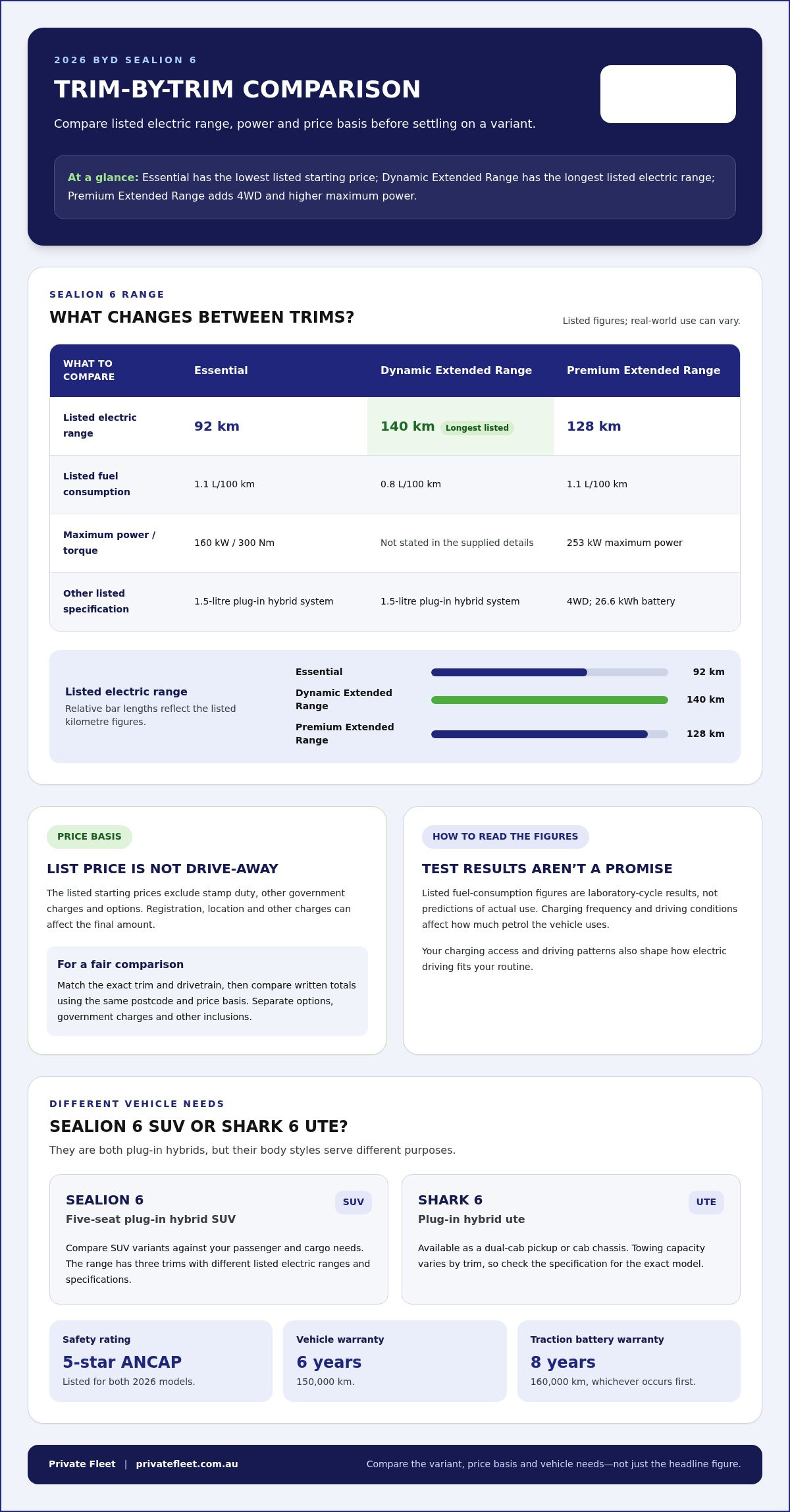
The Sealion 6 combines a 1.5-litre plug-in hybrid engine with a continuously variable transmission (CVT). Listed electric range is 92 km for Essential, 140 km for Dynamic Extended Range and 128 km for Premium Extended Range. These figures help distinguish trims, while charging access and driving patterns determine how electric driving fits your routine.
Shark 6 specifications also vary by trim. Premium pairs a 1.5-litre turbo petrol engine with combined output of 321 kW and 650 Nm. Performance uses a 2.0-litre turbo petrol engine, with combined output of 350 kW and 700 Nm. Premium’s listed NEDC electric range is 100 km, and Performance’s is 80 km. Their listed combined fuel consumption figures are 2.0 L/100 km and 1.3 L/100 km respectively. NEDC results are test-cycle figures, not guaranteed real-world consumption.
For an Australian buyer weighing BYD Shark 6 and Sealion 6 2026 prices, a drive-away total is more useful than a pre-cost list price. Registration and other charges can affect the final amount, so compare offers using the same postcode, trim and included equipment.
2026 BYD Sealion 6 prices by trim
The 2026 BYD SEALION 6 range has three trim levels, with listed prices varying by equipment and powertrain. Treat these as starting list prices, not drive-away totals.
This manufacturer’s suggested retail price applies to the lowest-priced variant and excludes stamp duty, other government charges and options. Its 1.5-litre plug-in hybrid system has maximum power of 160 kW and torque of 300 Nm. Listed electric range is 92 km, while stated fuel consumption is 1.1 L/100 km.
Its listed electric range is 140 km, the longest figure among these trims, and stated fuel consumption is 0.8 L/100 km. Those consumption figures are laboratory-cycle results, not predictions of actual use. Charging frequency and driving conditions affect how much petrol the vehicle uses.
Its listed electric range is 128 km, and maximum power is 253 kW. Stated fuel consumption is 1.1 L/100 km. The Premium Extended Range battery capacity is 26.6 kWh, a useful specification when comparing electric-driving capability across the range.
Compare each trim on the same price basis and against your own priorities:
The listed prices aren’t drive-away totals. Registration, stamp duty, other government charges, options and location can affect the final amount. When comparing written offers, match the exact trim and drivetrain, then separate the vehicle price from charges and extras. This helps you see whether a price difference reflects the specification or additional costs.
For a practical shortlist, weigh the price difference against your charging routine, typical journeys and preference for FWD or 4WD. Essential has the lowest listed starting price; Dynamic offers the longest listed electric range, while Premium adds 4WD and higher maximum power. To discuss your shortlist, explore BYD discount information, contact Private Fleet, or call 1300 303 181.
BYD Sealion 6 2026 price comparison
Compare like-for-like variants and price bases before judging value, because drive-away totals include charges that listed prices exclude. The Shark 6 and Sealion 6 serve different vehicle needs, so body style matters as much as the headline figure.
Rival vehicle price and value
A rival comparison measures vehicles with similar body styles, powertrains and equipment against each other. The Sealion 6 is a five-seat plug-in hybrid SUV, while the Shark 6 is a plug-in hybrid ute; comparing them directly on price alone misses their different jobs. The broader Australian plug-in hybrid SUV market typically ranges from A$47,000 to A$53,000, a useful context for assessing Sealion 6 value, not a price for a specific rival.
For a fair comparison, shortlist SUVs against the Sealion 6 and utes against the Shark 6. Match drivetrain, electric range, warranty and safety rating, then compare drive-away totals in the same postcode. Both BYD models have a five-star ANCAP rating. Each has a six-year, 150,000-kilometre vehicle warranty, while each traction battery warranty is eight years or 160,000 km, whichever occurs first.
2026 Model-year price changes
A model-year price change is the difference between comparable variants in successive model years, measured on the same price basis.
These ranges show different endpoints, but they don’t establish a like-for-like increase. First, check that variant names, specifications and price presentation align. Treat the figures as a current range, not evidence of a year-on-year price movement.
Use this sequence to make the figures comparable:
- Match the variant: compare Sealion 6 Essential with Essential, or Shark 6 Premium with Premium.
- Align price basis: set manufacturer list prices beside list prices, or drive-away totals beside drive-away totals.
- Compare equipment: weigh electric range, drivetrain, safety rating and warranty alongside price.
- Check the written total: identify options, government charges and any other inclusions separately.
For example, a Sealion 6 Essential price before on-road costs cannot be directly ranked against a Shark 6 drive-away offer. Their vehicle types differ, too. A ute buyer may prioritise towing and tray use; an SUV buyer may focus on passenger space and regular electric driving. These requirements affect which features represent value.
To assess whether 2026 pricing reflects a genuine change, compare the same trim, drivetrain and charge basis across model years. For rival Australian vehicles, use the same checklist; the closest alternative depends on whether you need an SUV or a ute.
Engine and transmission details
A plug-in hybrid powertrain combines a petrol engine with electric drive and a rechargeable battery. The Sealion 6 and Shark 6 use this setup differently, so compare engine, output and electric range by variant.
The Sealion 6 Essential pairs a 1.5-litre plug-in hybrid engine with a continuously variable transmission (CVT). Its maximum power is 160 kW and torque is 300 Nm. These figures describe the combined system’s stated output, rather than the petrol engine alone.
Dynamic Extended Range FWD is listed with fuel consumption of 0.8 L/100 km and electric range of 140 km. Premium Extended Range 4WD produces maximum power of 253 kW and torque of 550 Nm. Its battery capacity is 26.6 kWh, with a listed electric range of 128 km. The Essential’s stated fuel consumption is 1.1 L/100 km.
The Shark 6 variants differ in petrol engine size and combined output. Premium uses a 1.5-litre turbo petrol engine, producing a combined 321 kW and 650 Nm; Performance has a 2.0-litre turbo petrol engine, with combined output of 350 kW and 700 Nm. The Dynamic Cab Chassis is listed with maximum power of 321 kW.
Those outputs matter in different ways. Power describes the rate at which the drivetrain can deliver work, while torque indicates its turning force. A buyer comparing the Shark 6 Performance with Premium can see the stated output difference, then consider whether their regular driving needs that extra performance.
Fuel-consumption figures need context. The Shark 6 Premium is listed at 2.0 L/100 km combined, while Performance is listed at 1.3 L/100 km. These are test-cycle figures, not a forecast for every trip. A plug-in hybrid’s actual petrol use depends in part on charging and how much driving occurs on electric power. Don’t compare these figures directly with a conventional hybrid’s consumption without accounting for that difference.
Use these factors to compare specifications for your driving:
- Engine: note the 1.5-litre or 2.0-litre petrol engine and the exact Shark 6 variant.
- Output: compare combined kW and Nm, rather than engine size alone.
- Charging: consider whether regular charging suits your routine and expected electric driving.
- Transmission: the Sealion 6 is listed with a CVT; compare the exact variant’s documented drivetrain details.
For a Sealion 6 buyer, the choice spans Essential’s stated 160 kW output and Premium Extended Range’s 253 kW. For a Shark 6 buyer, Premium and Performance pair different turbo engines with different combined outputs. Match those specifications to your everyday journeys, charging access and intended vehicle use.
What are the Australian drive-away prices for BYD Shark 6 and Sealion 6 by trim?
A drive-away price is the quoted total for a new vehicle with applicable on-road costs included. Indicative 2026 prices vary by trim and location, so compare the same variant, postcode and price basis when assessing offers for the byd shark 6 sealion 6 2026 price australia.
| Model and trim | Indicative drive-away price |
|---|---|
| Shark 6 Dynamic | Contact for pricing |
| Shark 6 Premium | Contact for pricing |
| Shark 6 Performance | Contact for pricing |
| Sealion 6 Essential | Contact for pricing |
| Sealion 6 Dynamic Extended Range | Contact for pricing |
| Sealion 6 Premium Extended Range | Contact for pricing |
The Sealion 6 Essential has the lowest indicative drive-away range, while Premium Extended Range sits at the top of the SUV range. Shark 6 prices start higher, reflecting its ute body style and different intended use. These are indicative ranges, not a single national price. Location, registration and vehicle configuration affect the final quoted total.
Individual advertised prices offer another reference point, but compare them carefully with the ranges. Each figure relates to a specific advertised vehicle, so it may not represent every trim or the price for every buyer.
Use a consistent method when comparing offers:
- Match the variant: compare the same trim and body style, not a Shark 6 cab chassis with a dual-cab ute.
- Confirm the price basis: distinguish drive-away totals from prices excluding on-road costs.
- Separate extras: note options and inclusions so you’re comparing equivalent specifications.
- Use your postcode: location affects registration and other charges included in the final amount.
These aren’t drive-away totals, so don’t compare them directly with the table without aligning the price basis. Apply the same approach to any Shark 6 list price or advertisement.
For BYD-specific buying assistance, explore Private Fleet discount information or call 1300 303 181 to discuss your preferred trim and postcode.
The final drive-away total varies with location, registration and vehicle configuration, and includes applicable on-road costs. Compare prices on the same basis: list prices that exclude on-road costs are not directly comparable with drive-away totals.
Private Fleet: New Cars
Private Fleet can help turn your BYD shortlist into a new-car purchase through its New Car Buying Service. This independent buying service uses a national dealer network and a tender process that invites dealers to compete for your business.
This can be useful when you’ve chosen between Sealion 6 trims or the Shark 6 but want help comparing offers and managing the purchase. Private Fleet can also assist with a trade-in and car finance.
Explore the new-car buying service and BYD discount information as you narrow your shortlist. Share your preferred model, postcode and buying timeframe through Private Fleet’s contact page, or call 1300 303 181.
Make your shortlist work for your needs
Choose the next step around how you’ll use the vehicle, not just its badge. For the 2026 BYD Shark 6 and Sealion 6 prices in Australia, compare the exact trim you’d buy and the drive-away total for your postcode. Then weigh its powertrain against your access to charging, regular journeys and any towing or cargo needs. If the Atto 3 is also on your shortlist, keep its distinct vehicle type and powertrain in view rather than treating it as a direct substitute. A clear shortlist makes it easier to focus on what matters in an offer and what you’ll live with day to day.
Private Fleet can help source a new BYD through its New Car Buying Service, and can assist with a trade-in. Explore BYD buying information, or call 1300 303 181 to discuss your preferred model, postcode and timeframe.
Frequently Asked Questions
What is the 2026 BYD Shark 6 price in Australia?
The Australian indicative drive-away price is trim-specific; use the by-trim comparison above to identify the relevant figure. Before choosing, check that a quote describes the exact cab configuration and separates factory options from the vehicle specification. This helps you compare equivalent new vehicles and judge whether a price difference reflects a different configuration or included equipment, rather than treating every Shark 6 listing as interchangeable.
What is the 2026 BYD Sealion 6 price in Australia?
The Australian price depends on the Sealion 6 variant, and the earlier by-trim table gives the indicative figures. For your shortlist, note the precise trim name and whether the offer is valid for your intended purchase timing. Keep that detail with your preferred configuration, so you can compare like-for-like options without confusing an Essential with a higher-specification variant.
What are the 2026 BYD Sealion 6 specifications, electric range and fuel economy in Australia?
Electric range and fuel consumption differ by Sealion 6 variant; the specification details earlier in the article set out those figures. Other useful checks include its five-seat layout, 4775 mm length, 1890 mm width and 1670 mm height. The boot holds 425 to 1440 litres, depending on seat configuration. These dimensions can help you assess garage fit and luggage needs alongside the powertrain figures.
What Australian rebates, fees or on-road costs affect the 2026 BYD Shark 6 and Sealion 6 prices?
Listed prices may exclude stamp duty, other government charges, registration and options. These on-road costs, along with location, can affect the final drive-away price; compare quotes for the same trim and postcode.