
The best new car for a busy professional isn’t always the one that looks right on paper. Car buying for busy professionals in Australia gets easier when you compare a focused shortlist against the details that matter every day, from comfort and space to running costs and the drive-away offer.
That takes time, especially when work and other commitments leave little room to coordinate research, dealer discussions and the purchase. You can make a considered choice without weighing every model on the market. Start by separating must-haves from nice-to-haves, then compare vehicles on the same basis.
This article explains how to assess shortlisted cars, weigh your priorities and compare offers. It also covers how a national dealer network and competitive tender can help source your preferred make, model and variant. You’ll learn where a car-buying service fits, what information helps move the process along and which purchase tasks can be managed for you.
Key Takeaways
- Compare shortlisted new cars against your budget, practical needs and reviews, keeping finance secondary to choosing the right vehicle.
- Assess drive-away offers on the same basis, including what’s included, optional add-ons and any trade-in assistance.
- Rank fuel use, comfort, space, safety and features by how you’ll use the car, rather than treating every preference as essential.
- Private Fleet’s tender process invites authorised dealerships across its national network to compete for your chosen car.
- Share your preferred make and model, postcode and buying timeframe to help shape the sourcing process.
How can a car-buying service compare your shortlist?
A car-buying service can assess shortlisted new vehicles against your budget, practical needs and preferred variants. It can also assist with finance and purchase paperwork, while keeping the vehicle choice central. A structured comparison helps you identify what suits your daily routine, rather than simply choosing the car with the longest feature list.
Start with your shortlist and the details that affect everyday use: commute distance, passenger numbers, luggage space, parking conditions and how long you expect to keep the car. A service can compare equivalent variants and highlight differences in equipment. For example, if you regularly carry work equipment, boot capacity may matter more than an optional styling package.
Reviews add context, but shouldn’t decide the purchase on their own. They can help assess ride comfort, cabin noise, visibility, controls and handling. Those observations are most useful when matched to your priorities and the exact variant under consideration. A review of one trim may not describe another trim’s equipment. The new-car review library can help you consider reviewer perspectives alongside specifications and intended use.
Consider finance after deciding which vehicles suit your needs. A service can assist with finance and help organise the relevant steps. Compare the total amount repayable, interest rate, fees, repayment schedule, loan term and any final payment. A trade-in or contribution can change the amount borrowed. Read the written terms against your budget before choosing an arrangement.
Business size alone doesn’t determine which finance arrangement suits you. Private buyers can assess finance against their circumstances and chosen vehicle. Sole traders and companies may have different purchase and accounting considerations, so those arrangements need separate attention. A novated lease involves an employee, employer and leasing provider, with vehicle costs managed through salary packaging. It may suit an employee whose employer supports that arrangement, depending on their circumstances and the lease terms.
For an Australian new-car purchase, cooling-off periods and deposit terms depend on applicable rules and the signed contract, so don’t assume a deposit is refundable. According to the ACCC, a manufacturer or extended warranty cannot replace, change or take away consumer guarantee rights.
A car-buying service can organise the purchase in stages, keeping your selected vehicle central:
- Research: review the shortlist, budget, preferred variants and practical requirements.
- Compare: assess specifications, reviews, equipment and suitability for your needs.
- Source: seek offers for the selected vehicle through the relevant dealer network.
- Arrange: review the chosen offer, finance paperwork if required, and purchase documents.
- Complete: coordinate order details and delivery arrangements with the dealership.
This sequence keeps research, sourcing and paperwork moving in a clear order. Before proceeding, understand the vehicle, offer and finance documents you’re signing. Reviewing the terms connects your shortlist to the actual purchase, rather than relying on a review or estimate alone.
How to compare drive-away offers, trade-ins and dealer options
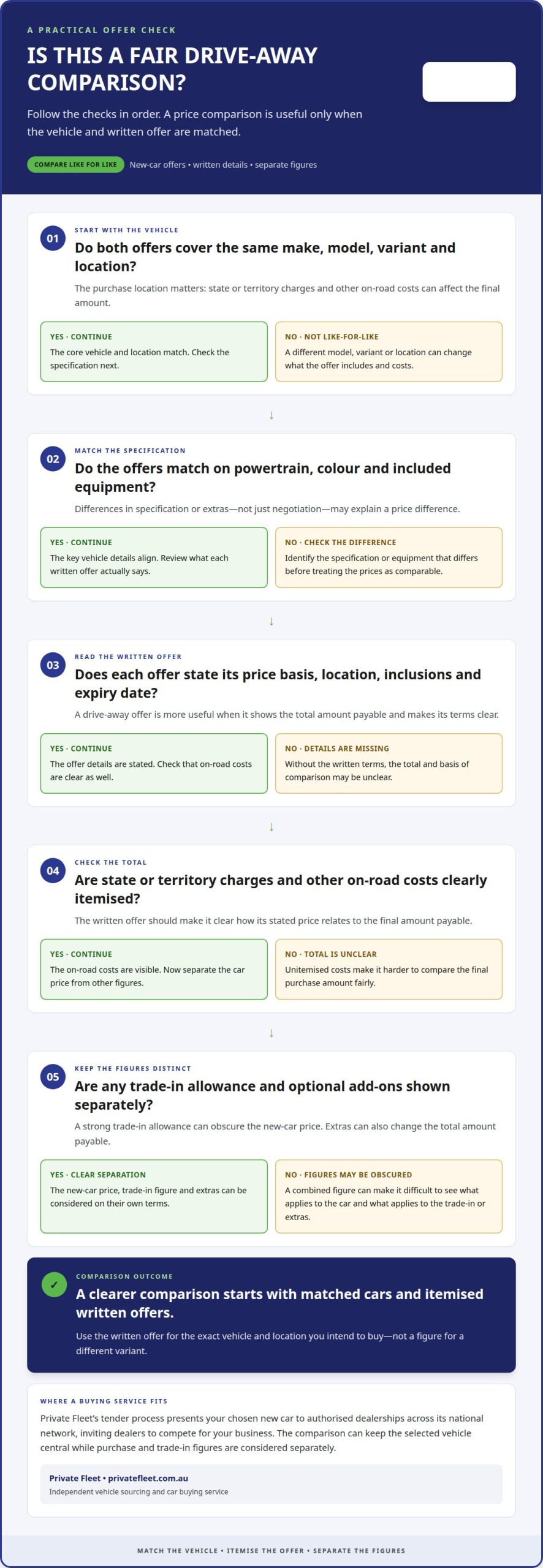
Compare written offers for the same new-car make, model, variant and location. The total purchase cost depends on the vehicle, its inclusions and the terms of each offer.
Market Prices and Drive-Away Costs
Market prices are the amounts buyers can compare for a particular vehicle and purchase location. They matter because a drive-away offer is more useful than a headline price when it shows the total amount payable.
For a fair comparison, match the vehicle’s model, variant, powertrain, colour and included equipment. Check that each offer states its price basis, location, inclusions and expiry date. Differences may reflect specifications or extras, not just negotiation. State or territory charges and other on-road costs can also affect the final amount, so ask for them to be clearly itemised in the written offer.
Use matched offers to understand the price range for your exact choice, rather than relying on a figure for a different variant. A national comparison can frame the discussion, but the relevant figure is the written offer for the vehicle you intend to buy in your location.
Negotiating Price and Trade-In Value Through a Car-Buying Service
A car-buying service can negotiate the price of your chosen new vehicle and seek a separate trade-in valuation. Keep the figures distinct: a strong trade-in allowance can obscure the new vehicle’s purchase price.
For example, the service can present the exact model and variant to dealerships, compare their responses and clarify what each offer includes. It can also obtain trade-in assessments for your current vehicle and show the allowance separately from the new-car price. This makes it easier to compare purchase terms without treating a trade-in as a discount on the new vehicle.
Australian buyers can negotiate the purchase price, trade-in value and extras. A service can manage those discussions on your behalf, guided by your preferred vehicle and requirements. The written figures should make clear which amount applies to the new car and which relates to the trade-in.
Dealer Add-Ons and Extras
Dealer add-ons are optional products or services offered alongside a vehicle purchase. Separating them from the car’s drive-away offer matters because each extra can change the total amount payable.
Ask for each item to be listed separately in the written offer, with its price and description. This makes it easier to decide whether an accessory or protection product suits your needs. For example, compare an offer that includes an add-on with one for the same vehicle without it. Don’t assume a bundled package is included equipment unless the offer says so clearly.
Price discussions can cover extras as well as the vehicle and trade-in. A car-buying service can clarify which items are optional and include your preferences in negotiations. The comparison should show the vehicle price and selected extras separately, so your decision reflects what you actually want.
Comparing New-Car Offer Costs
A new-car offer’s drive-away price is only one part of the cost of buying the vehicle. Check the full amount payable and the terms attached to the offer before deciding.
For a new-car comparison, weigh the drive-away offer against the exact specification, included features and intended use. Consider costs relevant to your plans, such as servicing, insurance, fuel or charging, and finance. Check whether each offer includes the same equipment and extras, and whether any listed items are optional. Without comparable vehicles and offer details, a headline price gives an incomplete picture.
If you’re focused on a new car, compare like-for-like offers to keep attention on the purchase you’re actually considering. The decision should fit your budget and intended use, rather than rely on a general claim that one offer always costs less.
How to weigh fuel use, comfort, space, safety and features
Start by ranking what matters most in everyday ownership: fuel use, comfort, space, safety and features. A vehicle may look appealing on paper yet feel wrong for your routine if its cabin, controls or running costs don’t suit you. A service can organise these priorities into a practical comparison using Australian specifications for the exact variant, giving you a clearer basis for choosing between shortlisted vehicles.
Fuel use matters differently for a city commute than for regular long-distance travel. Compare Australian fuel-consumption figures, remembering that your route, traffic, load and driving style affect real-world use. If you’re considering an electric vehicle, plug-in hybrid or conventional hybrid, factor in access to charging and the length of your regular trips. For car buying for busy professionals in Australia, these everyday patterns make the powertrain comparison practical, not just theoretical.
Comfort deserves a close look, especially if you spend long periods behind the wheel. Consider seat adjustment, entry and exit, visibility, ride quality and cabin noise. Someone with a lengthy commute may value supportive seating and a quieter cabin more than a larger touchscreen. If passengers regularly travel with you, check rear-seat access and room. A test drive lets you experience these details directly instead of relying on a feature list or review.
Choose space based on what you carry. Compare the boot opening and shape, rear-seat room, storage areas and how easily bulky items fit. A compact vehicle may suit tight parking, while a larger cabin may better accommodate passengers or luggage. If you plan to tow, compare specifications for the exact Australian variant and powertrain. Don’t assume different versions of the same model have identical towing limits.
Safety comparisons should focus on the exact variant. Review the safety equipment fitted to the Australian model and distinguish standard items from optional ones. Driver-assistance and parking features can vary across a model range. A reversing camera, parking sensors or blind-spot monitoring may be useful priorities depending on where and how you drive. Match safety information to the precise vehicle you’re considering.
Separate essential features from preferences before comparing variants. Adaptive cruise control, for example, may matter for frequent motorway travel, while a panoramic roof may be optional. If you prefer physical climate controls, touchscreen-only operation may feel less intuitive. These preferences can narrow your variant choice and help you decide whether an upgrade adds practical value.
- Fuel use: compare Australian figures with your routes, kilometres and powertrain needs.
- Comfort: consider seating, access, visibility, ride and cabin noise.
- Space: match passenger, luggage and storage needs to the cabin.
- Safety: compare the equipment fitted to the exact Australian variant.
- Features: identify must-haves before weighing optional upgrades.
Imagine two shortlisted vehicles with similar equipment. One offers easier entry and clearer controls, while the other provides more luggage space. A service can set out that trade-off against your priorities and help identify which variants meet your essential needs. Good car buying for busy professionals in Australia means weighing these practical differences alongside the specifications.
Once you’ve ranked your priorities, the shortlist becomes easier to assess. Focus on vehicles that suit how you travel, park and carry passengers, then compare variants without giving equal weight to every feature. That keeps the decision centred on everyday use.
Private Fleet’s new-car buying service
Private Fleet’s new-car buying service helps busy buyers source and purchase their chosen vehicle through a national dealer network. It suits people with a shortlist or clear requirements who have limited time to coordinate dealer discussions, compare offers and manage purchase paperwork.
Private Fleet doesn’t hold its own vehicle inventory. Instead, its tender process invites dealers in its network to compete for your business. The tender is based on the specific car you select, including its make, model and preferred variant. That keeps the discussion centred on the vehicle you want, rather than one already held in stock by a sourcing company.
To begin, share useful details such as your preferred make and model, variant, postcode, budget and buying timeframe. Your priorities may include fuel type, key features, space, comfort and intended use. A clear brief helps Private Fleet seek offers that match your requirements. If you’re still weighing options, your shortlist and must-have features can guide the discussion before you choose a vehicle.
Dealers respond through the tender process, allowing offers to be considered against your requirements. Comparing them means looking beyond the headline figure: vehicle specification, location, inclusions and purchase terms all matter. Private Fleet handles negotiation on your behalf and manages purchase paperwork. You can then review the proposed terms and decide how to proceed.
Trade-in assistance is available if you want to replace your current vehicle as part of the new-car purchase. Private Fleet helps with trade-in discussions alongside the new-car offer. Keeping the new vehicle’s price and trade-in value clear makes each part of the transaction easier to understand. You can consider the overall arrangement while seeing how the separate figures contribute.
Finance can be considered as a separate part of the purchase. Private Fleet can assist with car finance and organise finance-related steps alongside the vehicle transaction. Compare the terms with your budget and review the relevant documents before proceeding. The vehicle choice remains central: finance should support the purchase decision, not determine which car suits you.
The service helps coordinate the process from selecting a car to completing the purchase. Your chosen specification and agreed terms provide the basis for the order and associated paperwork. You receive regular updates on delivery times, so you can follow progress after ordering. Delivery timing depends on the particular vehicle and its circumstances, making updates useful as the process moves forward.
This arrangement can help when work commitments make separate dealer conversations difficult, or when you want negotiation and paperwork managed around your chosen vehicle. It also brings trade-in or finance discussions into one process, while leaving the decision about which car suits your needs with you.
To help the process start smoothly, have your preferred make or model, postcode and buying timeframe ready. You can also share your budget, shortlist, annual kilometres, charging access and the features that matter most. These details help shape the sourcing request and keep dealer discussions focused on your requirements. The new-car buying process explains how sourcing, negotiation and purchase steps fit together.
For help with your new-car purchase, contact Private Fleet or call 1300 303 181 with your preferred make or model, postcode, buying timeframe, budget, shortlist, annual kilometres and charging access.
Frequently Asked Questions
How long does it take?
Timing for sourcing options varies and isn’t guaranteed. This refers to sourcing options, not delivery. A less common specification may take longer to locate, and delivery timing depends on the vehicle and order. If your current car is nearing the end of its lease or you have a planned travel date, factor that into your buying timeframe.
Is a broker worth it for a standard new car?
A car-buying service can be worthwhile if you’d rather have someone coordinate purchase discussions, even for a standard specification. The value is in the time and administration handled, not a promised price result. If you’re comfortable managing the process yourself, you may prefer to do so. Consider whether support comparing offers, discussing a trade-in or managing paperwork would make the purchase easier.
Should I buy a petrol, diesel, hybrid or electric car?
Choose based on your journeys and how you can refuel or charge. For example, a driver with reliable home charging and predictable local trips may consider an electric car, while someone who regularly travels long distances may value the flexibility of a combustion engine. A diesel may suit particular driving demands, but consider the exact vehicle’s suitability, servicing and ownership costs.
Should I buy an SUV, ute, hatchback or sedan?
Think about where the vehicle spends most of its time. A hatchback may be easier to manoeuvre and park in a tight garage; a sedan’s separate boot may suit luggage kept apart from the cabin. An SUV can offer a higher seating position, while a ute is designed to carry loads. Compare how each body style fits your regular parking, passengers and cargo.
What car should I buy in Australia?
There’s no single model that suits every Australian buyer. Before choosing a model, identify your non-negotiables, such as a particular parking space, regular passenger needs or a specific towing task. Then compare current Australian variants that meet those requirements. A test drive on roads similar to your usual route can reveal details such as visibility at junctions or how easily the car fits your garage.
What are the best car-buying services for busy professionals in Australia?
The right service depends on the support you want during a new-car purchase. Private Fleet is an independent car-buying service for private individuals, with a national network of authorised dealers. It can coordinate purchase tasks if you prefer a guided process. Having your shortlist and buying timeframe ready helps focus the conversation on the decision you need support with.
What are the best new cars in Australia for commuting and busy lifestyles?
The best choice depends on your commute and its practical details. A driver who parks in a narrow space may prioritise a clear reversing view and parking assistance; someone carrying a laptop and presentation gear may value a boot opening that makes loading easy. Compare exact variants available in Australia, then consider how each fits your regular route, workplace parking and weekday schedule.
How do car finance options and interest rates compare in Australia?
Compare finance options using the same amount borrowed and loan term, then look at the rate, fees and any final payment together. A lower repayment alone doesn’t show the full cost if the terms differ. Ask for the written figures for the specific vehicle and finance arrangement, and assess them against your budget. To discuss your new-car purchase, contact Private Fleet or call 1300 303 181.