
Could a generous trade-in offer still leave you paying more for your new car? A car finance and car broker in one Australia-wide service can make the process more convenient, but it’s still important to understand each figure separately.
It’s understandable to want your trade-in, new-car purchase and finance handled together. Convenience shouldn’t blur what your current car is worth, what the new car costs or how much you may repay.
This guide explains how to prepare accurate information for a trade-in appraisal, compare the offer with the new-car price, and understand how finance owing affects your trade-in equity and potential new-car loan. It also explains how a car broker or buying service can coordinate the steps. Private Fleet is an independent vehicle-sourcing and car-buying service that uses a tender process, inviting authorised dealerships across Australia to compete for your business. Trade-in assistance and car finance can sit alongside new-car sourcing, helping you see how the parts of your changeover fit together.
Key Takeaways
- Prepare clear, accurate details about your current car so its condition and history can be considered in the trade-in appraisal.
- Compare the new-car price and trade-in offer as separate figures, using equivalent specifications and offer terms.
- Check how any finance owing affects your trade-in equity before deciding how much to put towards your next car.
- Weigh the convenience of a trade-in against the extra steps of selling privately; the right option depends on your priorities.
- Learn how car finance and car broker in one australia services can bring new-car sourcing, trade-in assistance and finance into the same buying process.
What a trade-in appraisal means when you are buying a new car
A trade-in appraisal is an assessment used to inform a dealer’s offer for your current vehicle. It gives you a proposed value to consider as part of changing cars, but it isn’t the new car’s price or a verdict on whether the overall deal is right for you.
Keep three decisions distinct: whether the new car suits your needs, whether its price and terms are acceptable, and whether the trade-in offer reflects your vehicle and priorities. Finance is another part of the overall purchase. Understanding these elements separately makes it easier to see how they fit together, rather than relying on one combined changeover figure.
What does a trade-in appraisal assess?
The discussion will generally need accurate details such as your car’s make, model, year, variant, kilometres travelled and condition. The same model can vary considerably in age, distance travelled and condition, so a clear description helps both you and the dealer discuss the specific vehicle rather than a broad model category.
Be straightforward about the car’s condition, including faults or damage. Incomplete or inaccurate details can make it harder to understand what an offer relates to. An appraisal is not a guaranteed sale price: the outcome depends on the individual vehicle and the offer being considered.
Before discussing a trade-in, note the details you know and describe the car as it is. If you’re unsure of the exact variant, use the vehicle documents or information you already have rather than guessing. This gives you a clearer basis for reviewing the proposed offer.
How does an appraisal differ from a new-car quote?
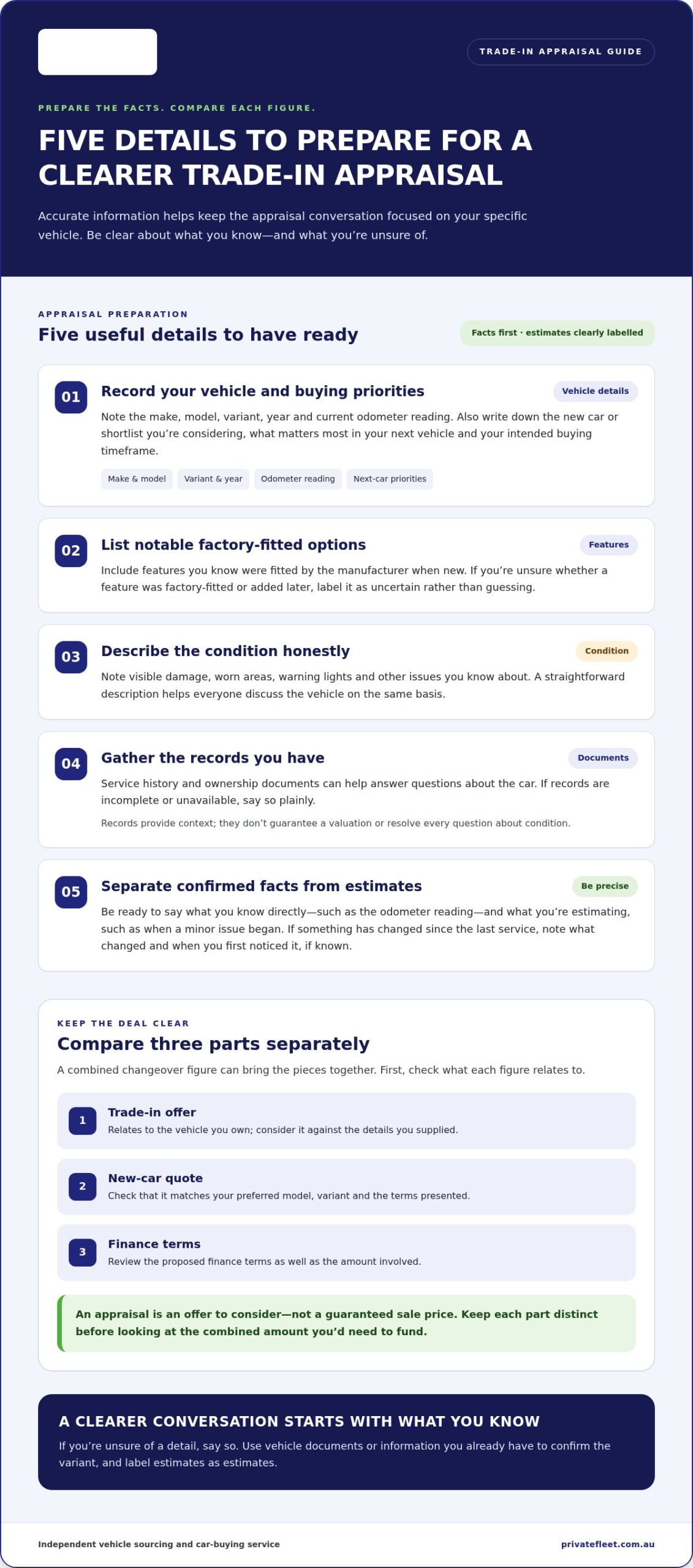
A trade-in offer relates to the vehicle you own. A new-car quote relates to the vehicle you intend to buy, including its specified model and variant and the terms presented. They may be brought together in a changeover proposal, but first consider each figure on its own. That way, a change to one figure won’t hide what’s happening to the other.
Hypothetical example: You receive a quote for a new car alongside a trade-in offer. Ask yourself whether the new-car quote matches your preferred specification and terms, then assess whether the trade-in offer reflects the details you supplied. Only after that should you look at the combined amount you’d need to fund.
This separation matters even when a single service coordinates the steps. The phrase car finance and car broker in one australia can describe a combined buying and finance process, but it doesn’t remove the need to examine the vehicle offer, new-car price and proposed finance independently. Car finance covers different ways of funding a vehicle, so focus on the finance option’s terms as well as the amount involved.
Private Fleet is an independent Australian vehicle-sourcing and car-buying service working with authorised dealerships nationally. Its tender process invites multiple dealers to compete for your business, while trade-in assistance can sit alongside new-car sourcing. You can also review how the new-car buying process works as you consider each part of the transaction.
How to prepare for a new-car trade-in appraisal
A little preparation can make the appraisal conversation more precise and help you keep it aligned with the new car you’re considering. Start with the facts you have, note what you want from your next vehicle, and be clear about anything you’re unsure of.
Which vehicle details should you have ready?
Put together the key information before discussing your car. Accurate vehicle details make appraisal discussions more useful. Documents can help you refer to the correct variant or service history, but having them doesn’t guarantee a particular offer.
- Record your vehicle and buying priorities. Write down the make, model, variant, year and current odometer reading. Also note the new car or shortlist you’re considering, what matters most in your next vehicle and your intended buying timeframe. This gives the discussion useful context without confusing the trade-in assessment with your new-car preferences.
- List notable factory-fitted options. Include features you know were fitted by the manufacturer when new. If you’re uncertain whether something was factory-fitted or added later, label it as uncertain rather than presenting a guess as fact.
- Describe the condition honestly. Note visible damage, worn areas, warning lights and other issues you’re aware of. Don’t conceal a fault or assume that a small issue won’t matter. A clear description helps everyone discuss the vehicle on the same basis.
- Gather records that are available. Service history and ownership documents can help you answer questions about the car. If records are incomplete or unavailable, say so plainly. They provide context; they don’t guarantee a valuation or resolve every question about condition.
- Separate facts from estimates. Be ready to say what you know directly, such as the odometer reading, and what you’re estimating, such as when a minor issue began. If something has changed since the last service, note what changed and when you first noticed it, if known.
How can you make the appraisal discussion clearer?
Give a straightforward account of how you use the car, such as regular commuting, occasional longer drives or mostly short local trips. Keep this factual and relevant. If you don’t know a detail, say so. Clear boundaries between confirmed information and an estimate are more useful than an overly certain answer that may later need correcting.
Write down your questions before the conversation. Ask how and when a trade-in offer is made, how long it applies, and whether the offer’s terms are recorded with the new-car quote. You can then compare like with like as you assess the changeover. For finance questions, the Australian Government’s Car loans in Australia guidance can help you understand borrowing considerations; keep that assessment distinct from the vehicle appraisal.
For buyers exploring car finance and car broker in one australia, preparation helps keep the trade-in discussion grounded in your vehicle’s details while you consider the new-car purchase and finance separately. If you’d like help bringing your shortlist and trade-in plans into the buying process, share your preferred make or model, postcode and buying timeframe.
How to compare a trade-in offer with the new-car deal
Compare the new car and your current vehicle as separate parts of the transaction before looking at the combined changeover figure. A single amount can look simple, but it may not show how the new-car price and trade-in offer were each set. A clear side-by-side record makes the comparison easier to follow.
Which figures should buyers compare side by side?
Use a table like this to keep the figures distinct. Fill in the terms and date shown on each offer, rather than relying on memory or a headline amount.
| New-car offer | Trade-in offer | Resulting amount to fund |
|---|---|---|
| Model, variant, options and quoted price basis, such as drive-away pricing | Offered value for your vehicle, based on the details provided | New-car price less the trade-in contribution, with any other agreed amounts shown separately |
| Included items, conditions and offer date | Conditions, offer date and how long the offer applies | Deposit amount and proposed finance amount, recorded separately |
Check that you’re comparing the same new-car specification, including the model and variant, and equivalent offer terms. A quote for one specification isn’t directly comparable with another just because the headline prices look similar. Record what each offer includes, any conditions attached and when it was provided. If terms or timing differ, note that too.
A higher trade-in figure doesn’t automatically mean the better overall deal. Consider it alongside the new-car price and the terms of both offers. A hypothetical comparison might show one proposal with a higher trade-in offer but a different new-car price or included items. Without figures for each part, the combined changeover amount alone won’t tell you which proposal better fits your priorities.
How does trade-in equity relate to car finance?
Trade-in equity is the value left after accounting for any finance still owing on your current vehicle. If the offer is more than the amount needed to clear that finance, the difference may contribute towards the new-car purchase. If finance owing is greater than the trade-in offer, there’s a shortfall to account for. The actual amounts depend on your vehicle and finance details; don’t assume the new loan will cover a shortfall or that a lender will approve a particular amount.
Show any equity, deposit and proposed new-car finance as distinct lines in your comparison. That makes it easier to see how the purchase might be funded, without confusing the trade-in offer with the loan. For an overview of broker roles in the buying process, How car brokers work in Australia offers additional context. Private Fleet’s new-car buying process uses a tender process in which multiple authorised dealerships compete for the buyer’s business, while trade-in assistance and finance can support the broader purchase.
For a comparison tailored to your shortlist, share your preferred make or model, postcode and buying timeframe.
Trade-in or separate sale: which approach suits your new-car purchase?
A trade-in can make changing cars easier to coordinate, while selling your current vehicle separately gives you a different process to manage. Neither option is automatically better financially. The right fit depends on the offer, the time you want to spend and how you’d like to hand over your current car as you move into the next one.
When might a trade-in be the more convenient option?
A trade-in may suit buyers who prefer to discuss their current car as part of the new-car purchase. Coordinating the handover with the replacement vehicle can reduce the number of separate tasks and conversations. It may also help if you want a clear transition between vehicles rather than arranging a sale independently and managing the changeover yourself.
Convenience isn’t proof that the offer is financially preferable. Consider the trade-in figure alongside the new-car offer and any finance still owing on your current vehicle. A coordinated proposal can be straightforward, but it’s still worth understanding the separate terms before deciding.
Private Fleet’s trade-in assistance sits alongside its new-car sourcing service. The service works with a national network of authorised dealerships, and its tender process invites multiple dealers to compete for the buyer’s business. Private Fleet doesn’t hold its own vehicle inventory. Its new-car buying process provides broader context on how sourcing and purchase steps can come together.
What should you weigh before selling separately?
Selling your car separately means taking responsibility for the steps involved in completing that sale and coordinating it with your new-car purchase. Think through the time and administration you’re comfortable taking on, and how you’d manage transport if your current car is sold before the replacement is ready. If timing matters, make your preferred handover clear as you compare options.
Use written figures and terms to make a fair comparison. Set the trade-in proposal beside the new-car offer, then consider what a separate sale would mean for your plans. Don’t assume a private sale will produce a higher amount, or that a trade-in will always be the simpler choice for every buyer. The outcome depends on the vehicle, the offers and your circumstances.
- Prioritise simplicity: A trade-in may fit if you value coordinating the changeover through the new-car purchase.
- Consider your time: A separate sale may suit you if you’re comfortable managing its additional tasks and timing.
- Keep the comparison clear: Review the current-car offer, new-car terms and finance implications on their own merits.
- Plan the handover: Consider when you need your current vehicle and how that aligns with the replacement car.
A car finance and car broker in one australia service can bring sourcing, trade-in assistance and finance into the same buying journey, but you still choose whether a trade-in or separate sale suits you. Focus on the process that fits your priorities, not an assumption that one route always delivers a better result.
Bring your trade-in, new-car choice and finance together
A clear sequence helps you keep the changeover manageable: first settle on a new-car shortlist, then review the trade-in offer, and finally assess how you’ll fund the purchase. This order keeps the vehicle decision at the centre while giving each part of the transaction its own attention. You can then see how the figures connect without letting finance or a combined changeover amount obscure the new-car offer.
What information helps move a new-car enquiry forward?
Start with the make and model you’re considering. If you have a shortlist, include it, along with any important variant requirements, such as a particular trim level or powertrain. You don’t need every decision finalised; distinguishing firm preferences from options you’re still weighing helps frame the discussion.
Your postcode and intended buying timeframe add useful context to the enquiry. For a trade-in discussion, include your current car’s make, model, year, variant, kilometres and a straightforward description of its condition. If you have finance owing, mention that too, so the trade-in and potential changeover can be considered with the right context. These details support a clearer conversation, but they don’t predetermine an offer or finance outcome.
- New-car shortlist: preferred make and model, plus variant requirements or alternatives.
- Buying plans: postcode and when you’re aiming to purchase.
- Current vehicle: identifying details, kilometres and an accurate condition summary.
- Funding plans: whether you expect to use a deposit, finance or a combination, and whether your current car has finance owing.
How can Private Fleet support the next step?
Private Fleet is an independent Australian vehicle-sourcing and car-buying service working with a national network of authorised dealerships. Its tender process invites multiple dealers to compete for the buyer’s business. Private Fleet does not hold its own vehicle inventory. Through its new-car buying service, sourcing is the focus; trade-in assistance and car finance can support the purchase without replacing your assessment of each offer’s terms.
Once you have a shortlist, consider the trade-in offer against the new-car price on its own merits. Then review any finance proposal, including the amount you may need to borrow and the relevant terms. Keeping those decisions in sequence can make a combined buying process easier to understand and help you identify what still needs consideration before committing.
For buyers considering car finance and car broker in one australia, coordination can bring key parts of the new-car journey together while leaving the decision-making clear. Share your preferred make or model, postcode and buying timeframe to start a conversation about your plans.
Make your next-car decision with clarity
Your next step is to turn what you’ve learned into a practical shortlist. Decide which models and variants deserve a closer look, then consider how each fits your everyday driving, budget and preferred changeover timing. Keeping those priorities clear will help you assess offers without losing sight of the car you actually want.
If you’re considering car finance and car broker in one australia, focus on how the service supports your buying decisions, not simply on having several steps handled together. Private Fleet has operated since 1999, helping buyers approach the new-car process with established experience.
Bring your preferred make or model, postcode and buying timeframe to your enquiry. You can also outline your trade-in plans and whether finance is part of your purchase, so the conversation can start with the details that matter to you.
Get help buying my new car
A considered changeover starts with the right questions. Take the next step when you’re ready, with confidence in the choices ahead.
Frequently Asked Questions
Can I trade in a car that still has finance owing?
Yes, a car with finance owing may be considered for trade-in, but first obtain the current payout figure from your lender and compare it with the proposed trade-in offer. If the payout exceeds the offer, the shortfall may affect what you need to fund or settle; if the offer is higher, the difference may contribute to the changeover. The outcome depends on your finance agreement and transaction, so use your lender’s account-specific figure.
Is a trade-in appraisal an obligation to sell my car?
Receiving or discussing an appraisal doesn’t automatically mean you’ve completed a trade-in. Before accepting an offer, read the documents that apply to the transaction and check what you’re agreeing to, including any conditions. An appraisal also shouldn’t be treated as a guaranteed final offer, as the terms can depend on the individual vehicle and transaction. Keep a copy of the paperwork so you can refer to the agreed details.
What information should I provide when requesting a trade-in appraisal?
Provide the car’s make, model, variant, year, kilometres travelled and an accurate account of its condition. Include relevant service history and ownership documents if available, and mention known faults or damage rather than leaving them out. Clear photographs can help illustrate visible details, but they don’t replace an assessment. Complete information gives the discussion a more reliable starting point; it doesn’t guarantee a particular appraisal value.
How long does a trade-in appraisal remain valid?
Don’t assume every trade-in appraisal has the same validity period. Note when the specific offer was provided and any conditions attached, including how timing or a change in your car’s condition could affect it. For example, if the vehicle is damaged or its kilometres increase before handover, raise that change before relying on the earlier figure. The offer’s own terms are the useful reference, not a general timeframe.
Can I trade in a damaged car when buying a new one?
You can discuss a damaged car as a potential trade-in, but disclose known damage and describe it accurately when seeking an appraisal. The vehicle’s condition may affect the offer, and you shouldn’t assume every car will be accepted or predict the amount. Share relevant details, such as where the damage is and whether you know when it occurred. Then assess any offer alongside the new-car price and transaction terms.
Should I arrange finance before or after I receive a trade-in appraisal?
You can work on your new-car shortlist, trade-in details and finance planning at the same time, then compare the figures before committing. An appraisal may help clarify the amount you need to fund, while finance suitability depends on your circumstances and the lender’s assessment. If you’re considering car finance and car broker in one australia, keep the vehicle offer, proposed loan amount and finance terms distinct. No sequence guarantees approval or a particular rate.