
Yes, arranging car finance before visiting a dealership can help you set a practical budget for a new car. If you’re asking whether you should get car finance before going to a dealership, consider seeking pre-approval before choosing a vehicle. It can indicate how much you may be able to borrow and help focus your search, but it doesn’t guarantee final approval.
It’s reasonable to want to understand your finance options before making a significant purchase. First-time borrowers can explore their options, and pre-approval can provide a useful starting point. Look beyond the lender’s initial offer: consider the vehicle you want, the total loan cost and whether repayments fit your circumstances.
This article explains how to set a new-car budget, compare finance options and understand how debts or credit applications may affect an application. It also covers what pre-approval can and can’t tell you before visiting a dealership, including how to account for an existing car loan. You’ll have a clearer basis for weighing the car and its finance as related but separate decisions.
Key Takeaways
- Set a new-car budget around repayments you can manage alongside insurance, registration, maintenance and other ownership costs.
- Compare finance offers by looking beyond the interest rate to fees, repayment flexibility, loan term and any balloon payment.
- Consider how credit limits, existing debts and recent credit applications may affect a lender’s assessment.
- Pre-approval can help you understand your borrowing capacity before visiting a dealership, but it’s conditional and may not be the final offer.
- Private Fleet can tender your chosen new car to its national network of authorised dealerships, with support for finance and trade-ins as part of the buying process.
Set a budget for the new car before applying for finance
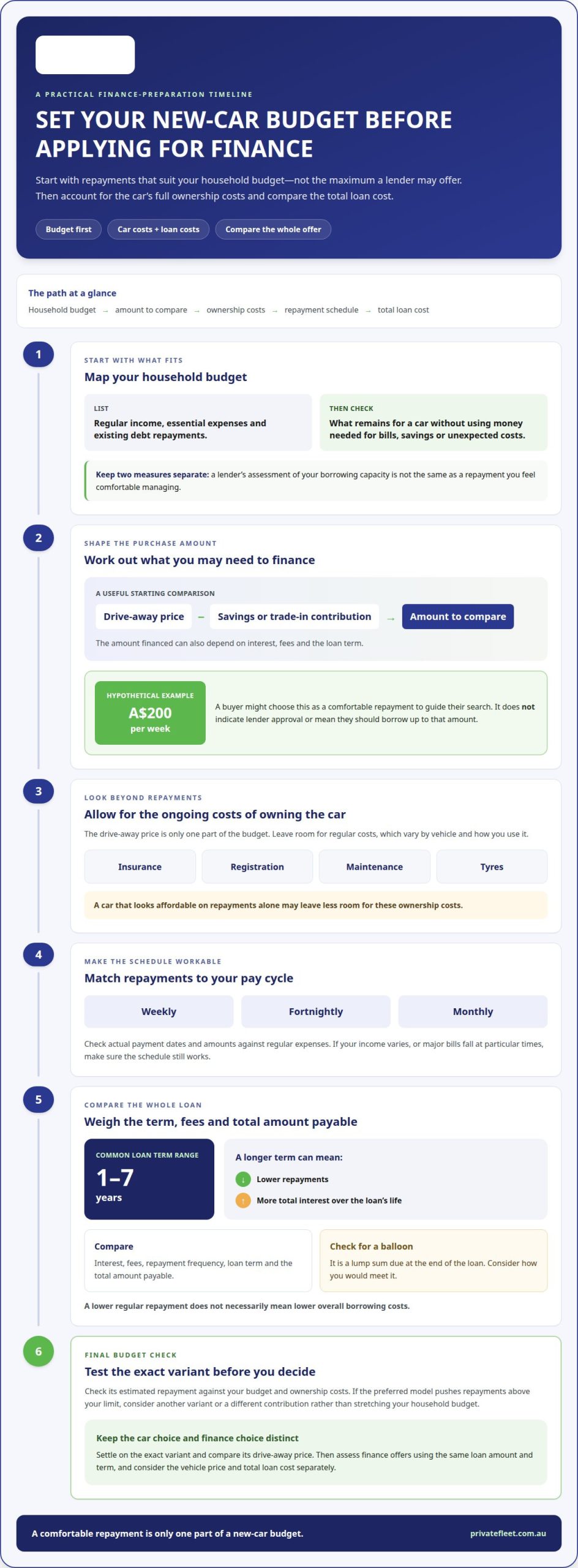
Start with a repayment that fits your household budget, not the maximum amount a lender might offer. List your regular income, essential expenses and existing debt repayments. Then work out what remains for a car without using money needed for bills, savings or unexpected costs. A lender’s assessment of your borrowing capacity and the repayment you’re comfortable with are different measures.
As a hypothetical example, a buyer who chooses A$200 per week as a comfortable repayment can use it to guide their search. It doesn’t mean a lender will approve that amount or that the buyer should borrow up to it. The amount financed also depends on the car’s drive-away price, any contribution from savings or trade-in, interest, fees and loan term.
Build the full new-car budget before settling on a model. The drive-away price is only one part of ownership. Allow for regular costs such as insurance, registration, maintenance and tyres, which vary by vehicle and how you use it. A car that looks affordable based on repayments alone may leave less room for these costs.
Use this sequence to shape a realistic budget:
- Choose a repayment amount that leaves room for household bills.
- Subtract your planned savings or trade-in contribution from the drive-away price.
- Set aside room for insurance, registration, maintenance and tyres.
- Compare the repayment and total loan cost across the terms available to you.
Match repayment timing to your pay cycle. Australian car loans can have weekly, fortnightly or monthly repayments. If you’re paid fortnightly, a fortnightly schedule may make it easier to track payments against each pay. Check the actual payment dates and amounts against your regular expenses, especially if your income varies or major bills fall at particular times.
Loan terms in Australia typically range from one to seven years. A longer term can reduce each repayment but increase the total interest paid over the loan’s life. Compare the full amount payable, including fees, rather than judging affordability by the instalment alone. Check whether the offer includes a balloon repayment, a lump sum due at the end of the loan, and consider how you’d meet it.
Before settling on a variant, test its estimated repayment against your budget and ownership costs. If the preferred model pushes repayments above your limit, consider another variant or a different contribution rather than stretching your household budget. This lets your budget guide the shortlist while leaving room to choose a car that suits your everyday needs.
Compare finance options alongside the car you’re buying
A bank, third-party lender or dealership can each offer ways to finance a new car. Dealership finance may include bank-backed lending or factory finance, while a bank application is arranged separately. A third-party lender gives you another offer to assess. Compare options for the same model, variant and borrowing amount so the differences are easier to see.
Look beyond the headline interest rate. Compare fees, repayment frequency, loan term, total amount payable and any balloon repayment. Offers and conditions can change, so verify any advertised rate or promotion with the lender before relying on it. Check which vehicle and purchase price the offer applies to, and whether a balloon leaves a large final payment. A lower regular repayment doesn’t necessarily mean lower overall borrowing costs.
Prequalification can give you an early indication from a lender before you make a full application. Many lenders offer prequalification using a soft credit check that doesn’t affect your credit score. Treat the result as an estimate, not a confirmed loan offer. Compare the indicative amount and rate with your planned purchase, then consider whether to make a formal application.
Check whether each offer is secured or unsecured. A secured car loan uses the vehicle as collateral, and the lender may claim it if you default on repayments. A secured loan may have a lower interest rate than an unsecured loan. Weigh that potential rate difference against the security arrangement, fees and repayment terms rather than assuming either type suits every buyer.
Use the same comparison points for each offer:
- Interest and fees: review the rate and each listed charge.
- Repayment structure: note frequency, term and any final balloon amount.
- Vehicle conditions: confirm which model, variant and purchase price the offer covers.
- Flexibility: compare repayment options and how changes to the loan are handled.
Keep the vehicle decision separate from the finance decision. First settle on the exact variant and compare its drive-away price. Then assess finance offers using the same loan amount and term. Dealership finance may involve less paperwork and can give you leverage when discussing the vehicle’s sale price. Still, assess the car’s price and the loan’s total cost separately before deciding whether the combined offer works for you.
A dealership visit can help you decide whether a car suits your needs. Take your driver’s licence for a test drive and be prepared to sign an insurance waiver. Pay attention to practical details such as visibility, ease of parking and whether the controls feel intuitive. If you’re comparing several models, use the same criteria for each drive so your choice reflects how you’ll use the car.
If you’re weighing a shortlist against finance options, you can discuss your buying plans and vehicle choices before deciding. A clear shortlist makes it easier to keep the lender’s terms connected to the car you actually intend to buy.
Check how debts and credit applications may affect approval
Lenders assess your existing commitments alongside your income and expenses. Credit card limits, other loans and recent application activity can all affect how much you can borrow.
Assessing credit limits and other debts
A credit limit is the maximum amount available on a card, even if you haven’t used it. An unused limit can still matter because it represents credit you could draw on.
List each card limit, monthly repayment and outstanding debt before applying. Include personal loans and other regular credit commitments. This gives you a clearer view of your finances and helps you explain your current obligations in a car finance application.
Checking credit and addressing issues
A credit check lets a lender review information about your credit history when assessing an application. Checking your credit file before applying can help you spot issues, such as an account you don’t recognise or an incorrect entry.
Address errors through the relevant credit reporting body, and be ready to accurately explain missed payments or other past difficulties. A clear account of your current circumstances helps a lender assess your application alongside your income and debts.
Several applications close together can create multiple credit enquiries. Experian recommends keeping car-loan pre-approval applications within a 14-day period, if possible, to minimise their impact on credit scores. Before applying, compare lenders’ offers and decide which applications are relevant, rather than submitting applications broadly.
Prequalification may use a soft credit check that doesn’t affect your credit score. A full application may involve a different type of check. Ask what type applies before proceeding, so you understand whether it may appear on your credit file.
Review your credit file and financial commitments with these points in mind:
- Record each credit card’s limit, including unused cards.
- List other loan repayments and any overdue amounts.
- Note recent credit applications and check entries for accuracy.
If you’re already having trouble meeting repayments, contact your lender before taking on a new commitment. In NSW, a borrower who can’t repay a credit contract because of unemployment, illness or another reasonable cause may seek a contract variation when the difficulty is temporary and they expect to manage the changed repayments. Lenders may be able to discuss support with borrowers having difficulty meeting credit contract obligations.
A variation may change how a contract is repaid, so consider whether the revised amount fits your monthly budget and other commitments. For a new-car application, explain existing repayment difficulties clearly and include any agreed changes to your current credit contract in your budget. This helps you judge whether a new repayment would fit alongside what you already owe.
Should you get pre-approved before visiting a dealership?
Pre-approval can clarify your borrowing limit before you choose a vehicle. It can help focus your search, but it isn’t final approval.
Getting pre-approval before choosing a car
Pre-approval is a conditional indication of how much a lender may let you borrow and at what rate. Getting it before visiting a dealership can help you set a firm buying budget and compare suitable models. Start by estimating the amount you need, then compare lender options. Once you shortlist a car, the lender can assess the vehicle and your circumstances before setting final terms.
Preparing information for a lender
For pre-approval, lenders commonly ask about your income, employment, regular expenses, debts and the amount you want to borrow. They may also request identification and documents to support your application details. Give accurate information about existing credit and your intended purchase. Complete the application with the information requested by that lender, as requirements can differ.
Checking pre-approval timing and certainty
Pre-approval offers can have an expiry date, such as 30 days, so check the period stated in your offer. It isn’t guaranteed finance: approval is conditional, and final terms may change if the vehicle or your financial circumstances change. Arrange pre-approval when you’re ready to shop, then allow time for the lender to assess the specific car.
Comparing loan terms and costs
Compare each car loan’s interest rate, fees, repayment schedule, term and any balloon payment. A balloon is a lump sum due at the end of the loan. Look at the total amount payable, not just the regular repayment. Ask how the terms apply to the car you’re considering and whether the offer remains suitable for its price.
A practical sequence is to set your borrowing amount, compare lenders, apply for pre-approval and then choose a vehicle within your budget. Once you’ve selected the car, provide its details for the lender’s final assessment. This connects the car and finance decisions without treating an initial approval as a completed loan.
If you have an existing car loan, obtain its payout figure before working out the replacement vehicle budget. For example, if a trade-in is valued at A$15,000 and the payout is A$12,000, around A$3,000 remains before other adjustments. If the trade-in value is below the payout, the shortfall affects how much you need to finance.
Don’t assume dealership finance is automatically the best fit or sign a purchase contract before understanding its finance conditions. In NSW, purchase and finance contracts are legally enforceable. If you need loan approval first, make the purchase contract conditional on obtaining that loan. A buyer may be able to cancel and recover the deposit if finance isn’t obtained after reasonable attempts and the contract includes that condition.
How Private Fleet can help with your new-car purchase
Private Fleet can coordinate your new-car purchase, helping compare dealer offers, arrange finance and manage a trade-in. Its new-car buying service works with a national network of authorised dealerships, rather than holding its own vehicle inventory.
Start with the car you want: share your preferred make and model, variant, postcode and buying timeframe. Private Fleet can tender that exact vehicle to multiple authorised dealers, inviting them to compete for your business. This keeps the comparison focused on your chosen car, rather than shifting attention to a different model or specification.
Consider dealer offers alongside your priorities, including drive-away pricing, variant details and purchase arrangements. Private Fleet handles negotiation and paperwork as part of the buying process. You’ll also receive regular delivery updates, making it easier to follow the order’s progress as you decide how to proceed.
Finance can be considered as part of the same purchase journey while remaining a separate decision from choosing the vehicle. If you already have pre-approval, the loan amount and conditions can help set a budget for your preferred car. If you’re comparing finance options, Private Fleet’s car finance assistance can help you consider the application alongside the vehicle purchase. Review the rate, fees, term and any balloon payment before accepting an offer.
A trade-in adds another figure to the overall transaction. Private Fleet provides trade-in assistance to help coordinate this part of the purchase with the new-car process. If a current loan remains on the trade-in, its payout figure matters: compare it with the trade-in value to understand how the balance affects the amount needed for the new vehicle.
This support can be useful if you’ve shortlisted a new car but want help comparing dealer offers, handling paperwork or arranging a trade-in. It can also suit buyers who prefer to discuss the car and finance together while keeping the vehicle’s price and loan costs clear as separate parts of the decision. You stay in control of the model, variant and whether to proceed.
To get started, provide your preferred make or model, postcode and buying timeframe. This gives the team a clear basis for discussing your new-car purchase and the support you need, whether that’s dealer tendering, finance or trade-in assistance.
Contact Private Fleet or call 1300 303 181 to discuss your new-car purchase.
Take the next step with a clear car-buying brief
If you’re weighing whether you should get car finance before going to a dealership, connect the loan decision with the new car you actually want. Your preferred make and model, postcode and buying timeframe give Private Fleet a practical starting point to discuss your purchase.
Private Fleet can source new cars through its New Car Buying Service, inviting multiple authorised dealerships to tender for your chosen vehicle. New Cars, Trade-In Assistance and Car Finance can support different parts of the purchase. Choose the services that fit your plans, without treating finance as a substitute for comparing the car itself.
Share your shortlist and any trade-in details when you get in touch. This helps shape a conversation about the vehicle and buying process that suits your circumstances.
Call 1300 303 181 or contact Private Fleet to discuss your new-car plans.
A considered next step can help you move from planning to choosing your new car with confidence.
Frequently Asked Questions
What if she has never had a loan before?
A first-time borrower can still apply for car finance; having no previous loan doesn’t automatically rule out approval. Lenders assess the full application, including income, expenses, debts and credit history. A stable record of paying bills and other commitments can help show how you manage money, but doesn’t guarantee approval. Before applying, prepare a clear account of your finances and avoid borrowing more than your budget can comfortably support.
What if there is still finance owing on the current car?
You can still plan a new-car purchase, but first establish your current loan’s payout figure and compare it with the trade-in value. If the trade-in is worth more, the difference may contribute towards the next purchase; if it’s worth less, account for the shortfall. For example, a hypothetical buyer whose payout exceeds the trade-in value should include that gap when working out how much new finance they need.
Should I get pre-approved for car finance before visiting a dealership in Australia?
Often, yes, if you want a clearer spending limit before looking at vehicles. If you’re deciding whether you should get car finance before going to a dealership, pre-approval can help you compare suitable cars with a potential loan in mind. It’s conditional, not a guarantee of final finance. Once you choose a vehicle, compare the lender’s final terms with the car’s drive-away price before signing a purchase contract.
How does car loan pre-approval work in Australia?
Pre-approval is an initial lender assessment of your finances and proposed borrowing, made before you settle on a particular car. You provide information about income, expenses, debts and the amount you want to borrow. The lender may give an indicative borrowing amount and interest rate, subject to conditions. After you select a vehicle, the lender assesses the car and your circumstances before confirming final loan terms.
Does applying for car finance affect my credit score in Australia?
It can, depending on the type and number of credit checks involved. Many lenders offer prequalification using a soft credit check that doesn’t affect credit scores, while a full application may create a credit enquiry. According to Experian, keeping car-loan pre-approval applications within a 14-day period, if possible, can minimise their impact on credit scores. Ask what check applies before you submit an application.
Is dealer finance usually more expensive than a bank or online car loan in Australia?
Not necessarily. Dealership finance can include bank-backed lending or factory finance, and some offers have zero interest. A bank or other lender may suit a different borrower or vehicle. Compare the same loan amount and term across offers, including fees, repayment schedule, any balloon payment and total payable. A low advertised rate alone doesn’t show which option costs less overall or best fits your purchase.
What car loan interest rates, fees and comparison rates are typical in Australia?
There isn’t one typical rate or fee figure that applies to every Australian buyer. The interest rate can depend on the lender’s offer, your application, loan amount and whether the loan is secured. Fees and comparison rates also differ between products. Compare current written offers for the same vehicle and borrowing amount, considering the rate, fees, repayment amount, term and total payable rather than relying on a general market estimate.
Can I negotiate a better car price if I arrange finance before going to a dealership?
Having finance arranged can make your budget and buying position clearer, but it doesn’t automatically reduce the vehicle’s price. Treat the car price and finance as separate parts of the transaction. Compare the written drive-away offer for the exact model and variant, then assess the loan’s total cost independently. Dealership finance may also form part of a price discussion, so judge the full offer rather than focusing on one repayment figure.