
Could the best car-buying support help you compare the vehicle and the loan without treating them as one deal? If you’re considering car loan and purchase assistance australia, the short answer is yes: vehicle sourcing, trade-in support and car finance can be part of the same buying journey, while the dealer offer and loan still deserve separate comparisons.
It’s understandable to focus on the drive-away price or the monthly repayment first. But neither tells the whole story on its own. Private Fleet is an independent vehicle sourcing and car-buying service that works with a national network of authorised dealerships. Its tender process invites multiple dealers to compete for your business, and it can also assist with trade-ins and car finance. Private Fleet sources vehicles; it doesn’t hold its own inventory.
This guide explains how purchase assistance and finance can fit together, what to compare across dealer quotes and loan terms, and what to prepare before committing. You’ll also find practical ways to consider your preferred model, trade-in and total borrowing costs as connected parts of the decision, so you can move forward with greater clarity and less stress.
Key Takeaways
- Understand how car loan and purchase assistance australia can work together while serving different purposes in your buying journey.
- Keep the vehicle price, trade-in value and finance proposal visible as separate figures when reviewing an offer.
- Compare self-managed buying, dealer discussions and independent sourcing assistance by the effort and support each involves.
- Use a practical checklist to compare like-for-like drive-away offers, vehicle variants and included items before accepting.
- See how Private Fleet’s dealer tender process can help bring multiple authorised dealerships into your new-car search.
Car loan and purchase assistance in Australia: how the two fit together
Car purchase assistance and car finance can support different parts of a new-car purchase. Purchase assistance helps you source a vehicle and manage buying steps; finance is borrowing used to pay for some or all of the purchase. They can be considered together, but they aren’t the same service or decision. You still choose the make, model and variant, review the purchase offer and decide whether the proposed finance suits your circumstances before committing.
The key is to understand what each part is responsible for. Sourcing and buying support can help you work through vehicle options and purchase steps. A loan proposal sets out borrowing terms, repayments and costs. Keep those details distinct so it’s clear what you’re paying for the car and what you’re agreeing to repay under the loan.
What does car purchase assistance cover?
Car purchase assistance is help with vehicle sourcing and the practical steps involved in buying a new car. This can include narrowing down suitable models and variants, comparing purchase offers and progressing the transaction. It isn’t a loan, and it doesn’t itself provide the vehicle or determine the lending terms. The buyer remains responsible for choosing the car and deciding whether an offer meets their needs.
Trade-in assistance can support the purchase process, too, but it’s not a feature of the loan. Keep a proposed trade-in value separate from the new-car price so you can see how it affects the amount you may need to fund. The new-car buying process can help you understand how the vehicle requirements and purchase steps fit together.
Where does car finance fit in?
Finance is a separate borrowing decision connected to the vehicle purchase. Compare the repayment amount, loan term, fees and total amount payable, rather than focusing only on the headline interest rate. The right comparison depends on the loan details and your circumstances. For a general overview of borrowing structures, Car finance outlines common types and characteristics.
Purchase assistance helps you source and buy the car; finance provides the borrowing to help pay for it. Loan approval, rates and conditions depend on the lender and applicant. Assistance with purchase steps doesn’t guarantee approval or particular finance terms.
Before proceeding, consider the vehicle and loan in turn:
- Vehicle: Does the make, model and variant suit your needs?
- Offer: Are the purchase terms clear, including the price basis and included items?
- Trade-in: Is its proposed value clear as a separate figure?
- Finance: Have you considered the term, fees, repayments and total amount payable?
Taking time to check each part helps you understand the commitment before you agree. If one element changes, such as the vehicle variant or trade-in value, review how that affects the overall plan before moving ahead.
How new-car finance and the buying process connect
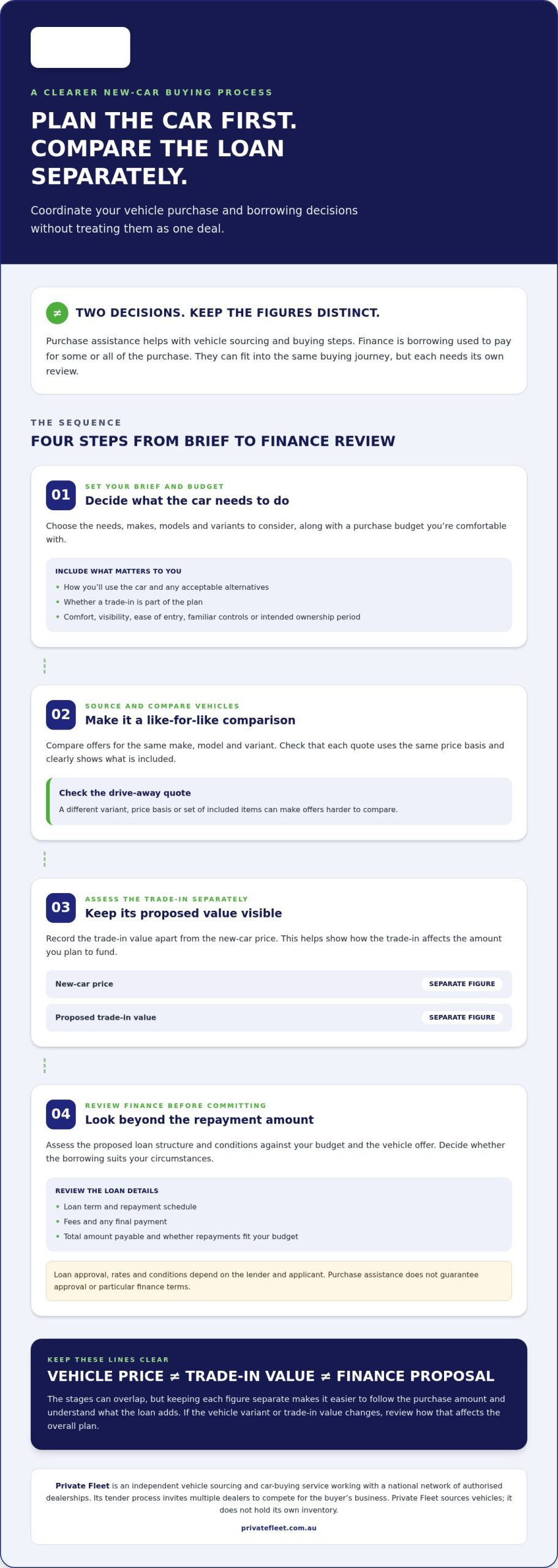
Plan the vehicle decision first, then assess the borrowing against the offer you intend to accept. This sequence keeps your priorities clear and helps you spot when a change to the car, trade-in or loan would alter the overall commitment. A practical approach to car loan and purchase assistance australia means coordinating these steps while keeping their figures distinct.
- Set your brief and budget. Decide what the car needs to do, which models and variants suit those needs, and the purchase budget you’re comfortable with.
- Source and compare vehicles. Seek offers for the same model, variant and price basis, then check what each drive-away quote includes.
- Assess the trade-in separately. Record its proposed value apart from the new-car price so you can see how it affects the amount you plan to fund.
- Review finance before committing. Compare the proposed loan structure and conditions against your budget and the vehicle offer, then decide whether to proceed.
The stages can overlap, but keep the figures in separate lines: vehicle price, trade-in value and finance proposal. This makes it easier to follow how the purchase amount is calculated and what the loan adds, without treating a repayment figure as the price of the car.
Prepare a clear vehicle and budget brief
Write down your preferred make, model and variant, how you’ll use the car, and any acceptable alternatives. Set a purchase budget and note whether a trade-in is part of the plan. If comfort, visibility, ease of entry, familiar controls or a particular ownership period matter to you, include them too. A concise brief helps focus sourcing on vehicles that suit your day-to-day needs.
Use the new-car buying process as a guide to how vehicle requirements can move through sourcing and purchase. The clearer your brief, the easier it is to assess whether an offer matches what you asked for, rather than being distracted by a different variant or an appealing but less suitable alternative.
Review the vehicle offer and finance proposal separately
For vehicle quotes, compare the same model, variant, drive-away price basis and included items. For finance, inspect the loan term, repayment schedule, fees and any final payment. Check the total amount payable as well as whether the repayments fit your budget. The ASIC Moneysmart car loan guide offers independent information to help you understand loan features and costs.
Don’t accept a finance commitment just because the car offer looks suitable. Read the loan conditions, confirm how repayments are scheduled, and understand any final payment before agreeing. Loan approval, rates and conditions depend on the lender and applicant. If you’d like support progressing a vehicle shortlist, you can share your preferred make or model, postcode and buying timeframe with Private Fleet.
Compare car loan and purchase assistance options without mixing the costs
There’s no single buying approach that suits every new-car buyer. Consider how much time you want to spend organising enquiries, how confident you feel assessing offers and what kind of support would make the process easier. Whichever approach you take, keep the vehicle decision and any loan proposal distinct. Purchase assistance doesn’t guarantee a lower price, and no buying approach guarantees finance approval.
The comparison below focuses on who manages each part of the process. Finance involvement can vary, so treat it as a separate consideration rather than assuming it is included in every purchase discussion.
| Buying approach | Buyer effort | Vehicle sourcing and offer comparison | Trade-in support | Finance involvement |
|---|---|---|---|---|
| Self-managed buying | You contact dealerships and organise the purchase steps. | You request and compare offers for your chosen vehicle. | You arrange trade-in discussions and assess the proposed value. | You research and compare loan proposals yourself. |
| Dealer-led purchase discussions | You work directly with a dealership on the purchase. | You review the offer presented for the vehicle you’re considering. | You may discuss a trade-in as part of the purchase. | Finance may be raised alongside the vehicle offer; assess its terms separately. |
| Independent sourcing assistance | You explain your requirements and stay involved in the decisions, with support coordinating purchase steps. | An independent service helps progress vehicle sourcing and assess offers against your brief. | Trade-in support may help you consider this part of the transaction. | Finance can be considered as a separate part of the wider purchase journey. |
Which buying approach suits your circumstances?
If you’re comfortable contacting dealerships, tracking responses and comparing like-for-like quotes, managing the process yourself may suit you. If coordinating those tasks feels burdensome, independent sourcing assistance can help organise the steps around your requirements. Neither route is essential for every buyer. Private Fleet’s new-car buying service supports buyers who want assistance with sourcing and progressing a purchase.
What should you compare in a car loan?
Look beyond the repayment amount. Compare the interest rate, comparison rate where applicable, fees, loan term and total amount payable using the actual proposal and conditions. A different term can change both the repayment amount and the total paid, so weigh the two together rather than choosing by instalment size alone.
Repayments show what you pay along the way, not the loan’s full cost by themselves. A secured loan generally uses an asset as security, while an unsecured loan doesn’t; read the lender’s documents for the specific terms. The vehicle offer alone doesn’t determine the loan’s total cost. That depends on the finance terms and lender charges, as well as the applicant’s circumstances. For help with a vehicle shortlist, share your preferred make or model, postcode and buying timeframe through Private Fleet’s enquiry page.
A practical checklist before accepting a car loan or new-car offer
Pause before signing and check the vehicle offer and borrowing documents as two connected parts of the decision. This car loan and purchase assistance australia checklist helps you catch mismatched vehicle details, unclear trade-in figures or loan conditions that need closer attention.
- Confirm your vehicle brief. Make sure the offer is for the make, model, variant and options you actually want. Note any acceptable alternatives separately so you don’t accidentally compare different cars.
- Check the offer in writing. Confirm the price basis, offer expiry and included items. Compare like-for-like drive-away offers, and check that registration, delivery and any listed accessories are treated consistently across quotes.
- Verify current vehicle details. Use the manufacturer’s Australian specifications or an authorised dealer’s information to check the variant, features and availability. If you’re assessing a car in person, take time to consider seat comfort, ease of entry and exit, visibility, cabin noise and whether the controls feel intuitive.
- Record trade-in value separately. Keep the proposed trade-in amount distinct from the new-car price. This makes it easier to see how the figures affect the amount you need to fund.
- Read the complete finance proposal. Review the interest rate, comparison rate where applicable, repayment frequency, loan term, fees and any final payment in the lender’s documents. Check the total amount payable, not just the regular repayment.
- Check the timing and commitment. Consider whether the repayments and loan term fit your budget, expected annual kilometres and intended ownership period. Don’t treat a suitable vehicle offer as a reason to accept finance before you understand its conditions.
- Review documents before agreeing. Make sure the written vehicle offer and loan paperwork match what you’ve discussed. Keep copies of the documents and note any conditions or dates that affect your decision.
Check the new-car offer before proceeding
Small differences can undermine a comparison. Two quotes may appear to cover the same car but refer to different variants, optional equipment or price bases. Check the exact specification and what’s included, then compare the stated drive-away amounts on the same basis. If a detail is unclear, resolve it before you rely on the quote or sign purchase documents.
Check the borrowing commitment and purchase timing
Read the lender’s documents carefully, including the repayment schedule and any final payment. For Australian loan information, ASIC’s Moneysmart car loan guide can help you understand features and costs; use official Australian consumer sources for relevant purchase information, and avoid relying on overseas rules. The new-car buying process can also help you understand the purchase steps that follow offer review.
Once the vehicle details and finance documents align with your needs, you can make a considered decision rather than rushing to meet an offer deadline. If you’d like support with the new-car buying steps, share your preferred make or model, postcode and buying timeframe.
How Private Fleet supports a new-car purchase with finance assistance
Private Fleet can help bring the practical parts of a new-car purchase into a clearer sequence. Start with the vehicle you’re looking for, then consider how sourcing, a possible trade-in and finance fit around that choice. You remain in control of the decisions, with the option to use support across the parts of the process that would be most useful to you.
A focused vehicle brief gives the purchase a useful starting point. Note your preferred make and model, any variants you’re considering, the features you value and acceptable alternatives. If you have a trade-in, include that in your plan. Private Fleet’s new-car buying service can support you as you progress from those preferences towards reviewing suitable purchase options.
What the buying assistance does and does not promise
Support with the buying process can help you organise vehicle and purchase decisions, but it doesn’t remove the need to assess each offer. Consider the vehicle specification, price basis, included items and any conditions before proceeding. A trade-in is another part of the overall transaction, so evaluate its proposed value in context rather than treating it as a feature of the new-car price or loan.
Finance can be considered alongside the purchase, but it remains subject to the lender’s assessment and the terms of the relevant lending arrangement. Private Fleet’s assistance doesn’t promise loan approval, a particular rate or a set finance outcome. Review the lender’s documents and make sure the proposed commitment suits your circumstances before accepting it.
This kind of support may be useful if you have a shortlist but want help keeping vehicle selection, trade-in considerations and finance from becoming one confusing negotiation. You can also manage the steps yourself if that better suits your preferences. The aim is to make the process easier to follow, not to make the decision for you.
What to share to make the next step useful
A few details can help shape a productive starting point. Share:
- Your preferred make or model, plus any alternatives you’re considering.
- Your postcode and buying timeframe.
- Your budget and any priorities for the vehicle or variant.
- Your expected annual kilometres and how you plan to use the car.
- Whether you have a trade-in, and relevant details about it.
You don’t need to have every choice finalised. A shortlist, timeframe and clear priorities are enough to begin a focused discussion, and you can refine the brief as you consider your options. Share your details through the enquiry page to take the next step.
Move ahead with a clear buying plan
A new car is a substantial commitment, so give yourself room to make the decision on your terms. Use what you’ve learned about car loan and purchase assistance australia to turn your shortlist into a practical buying plan, without letting a repayment figure or an offer deadline make the choice for you.
Before taking the next step, decide what matters most in the vehicle and what finance commitment fits your circumstances. You don’t need every detail settled at once. A clear starting point can make the next conversation more focused and help you feel in control as you consider your options.
If you’d value support with your new-car purchase, Private Fleet can help you progress the sourcing and buying steps while you assess finance terms separately. Share the details that matter to you and take the next step with confidence.
Get help buying my new car
Frequently Asked Questions
Is car purchase assistance the same as a car loan?
No. Purchase assistance helps you source a vehicle and manage buying steps; a car loan is borrowing from a lender under its own terms and approval process. The two may sit within the same purchase journey, but assess them separately. For example, getting help comparing two trim levels doesn’t determine whether a lender approves your application or what rate it offers. Nor does assistance guarantee a particular vehicle price.
Can I arrange finance while getting help buying a new car?
Yes, finance can be considered alongside vehicle sourcing, while remaining a separate decision. Private Fleet provides car finance assistance as part of its broader purchase support, but it isn’t the lender and can’t promise approval or particular terms. Before accepting a proposal, read the lender’s documents and check the rate, fees, repayment schedule and total amount payable. This helps keep car loan and purchase assistance Australia decisions connected without combining their costs.
How much should I borrow for a new car in Australia?
There’s no universal borrowing amount that suits every buyer. Work from your budget, deposit, trade-in and chosen vehicle, then consider the amount a lender may assess as suitable for your circumstances. Include the purchase commitment and loan costs rather than setting a borrowing target from repayments alone. For current Australian guidance on car loans and borrowing, consult ASIC’s Moneysmart resources and consider your own financial position before applying.
Does car finance approval guarantee the car I want will be available?
No. Finance approval and vehicle availability are separate. Availability can depend on the exact Australian model and variant, as well as dealer circumstances, so use current manufacturer or authorised dealer information when checking the vehicle. For example, approval for a particular loan doesn’t confirm that a preferred trim can be supplied. Confirm the vehicle details before finalising finance, and don’t assume approval guarantees stock or a delivery date.
Can I include a trade-in when arranging a car loan and purchase assistance?
Yes. A trade-in can be part of your purchase plan, and Private Fleet offers trade-in assistance. Treat the trade-in value as a separate figure from both the new-car offer and the loan proposal. For example, record the offered trade-in amount before calculating how much you may need to borrow. Its value and how it affects the finance amount depend on the specific transaction, so don’t assume a particular valuation or outcome.
Should I compare the car loan or the new-car price first?
Compare both, but keep them distinct. Start by settling the vehicle requirements and comparing drive-away offers for the same model and variant. Then review the loan’s interest rate, fees, term, repayment schedule and total amount payable. A lower vehicle offer doesn’t automatically make a loan suitable, just as a repayment that fits your budget doesn’t prove the car offer is competitive. Review the documents together before deciding.