
A lower car-loan repayment can leave a larger bill waiting at the end. If you’re asking how balloon payments on car loans work, the key point is that part of the loan remains unpaid during the term. At the end, you must pay the balloon, refinance it, or sell or trade in the car to help cover the balance.
Smaller regular repayments can make a balloon loan appealing, but they don’t erase the debt. Interest may increase the total cost, and if the car’s value falls below the balloon amount, you could face a shortfall.
This article explains how the payment structure works, what options you have at the end of the term, and why the car’s future value matters. You’ll also learn what to weigh up before choosing a balloon, so the final payment is part of your plan rather than an unwelcome surprise.
Key Takeaways
- A balloon can reduce regular repayments, but leaves a lump sum to manage when the loan term ends.
- Compare the total loan cost as well as the repayment amount, since interest may make the balloon option more expensive overall.
- Consider how depreciation, mileage and vehicle-condition terms could affect the car’s value and your ability to cover the final amount.
- Match the payment structure to how long you plan to keep the car and how you expect to pay or refinance the balance.
- Private Fleet can help you compare new-car buying options, with trade-in and finance assistance as part of the process.
How a balloon payment affects the cost of a new car
A balloon payment leaves part of the car loan unpaid during the term. This can reduce regular repayments, but it also creates a separate amount to manage at the end. Compare finance options only after identifying the new car, variant and purchase price you want.
For Australian car loans, fees, eligibility criteria and disclosure details depend on the lender and agreement. Before deciding, review the offer and contract for charges, the interest rate, repayment schedule and balloon amount.
Lower regular repayments
A balloon reduces scheduled repayments by deferring an agreed portion of the loan until the term ends. That can leave more room in your monthly budget for other costs.
The deferred balance remains part of your debt. Compare the regular repayment with the final sum, so a manageable payment doesn’t obscure the later commitment.
Balloon and regular repayment differences
A regular car loan is structured to be paid off through scheduled repayments. A balloon loan leaves a balance owing at the end, so the repayment figure alone doesn’t show the full obligation.
Compare offers using the same car, deposit, term and interest rate. Then consider the complete payment schedule, charges and total interest instead of choosing solely by the lowest monthly repayment.
Monthly repayments and the final lump sum
Use the lender’s repayment schedule to compare regular repayments with the balloon due at the end. A calculator can illustrate how changing the balloon affects repayments and interest, but the lender’s offer sets your actual obligations.
Record the scheduled repayments, interest rate, fees and final amount for each option. This gives you a clearer view of both the immediate budget impact and the balance still owing.
Paying or refinancing the balloon
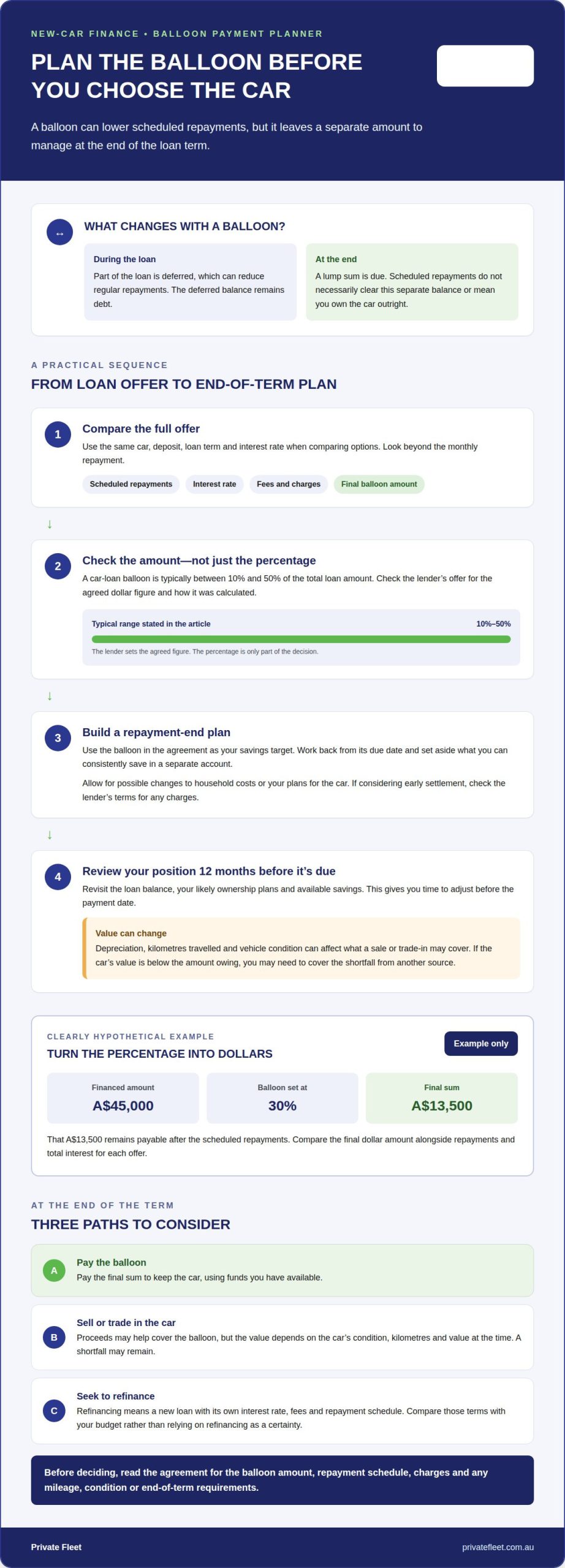
At the end of the term, you can pay the balloon, sell or trade in the car, or seek to refinance the balance. These options differ: paying it lets you keep the car, while selling or trading may mean changing vehicles.
Refinancing involves a new loan with its own rate, fees and repayment schedule. Compare those terms with your budget before relying on refinancing as your plan.
The lump sum at loan end
The balloon is a one-off amount due when the car loan or lease agreement ends. Making every scheduled repayment doesn’t necessarily clear this separate balance or mean you own the vehicle outright.
Read the agreement to understand the amount due and the conditions that apply at the end. Your plans to keep, sell or replace the car affect how you prepare for that date.
A car-loan example
Consider a clearly hypothetical loan of A$45,000 with a balloon set at 30% of the financed amount. The final sum would be A$13,500, leaving that amount payable after the scheduled repayments.
This example shows why the percentage and its calculation base matter. Compare the final dollar amount, not just the stated percentage, alongside the repayments and total interest for each offer.
Plan for the end of the loan before you choose a car
Before choosing a new car with a balloon, consider how the final obligation fits your ownership plans. The car’s future value, your ability to save and the agreement’s conditions all affect whether your plan is workable. Relying only on a sale can leave a gap if the car’s value falls short of the amount due.
How large can the balloon be?
A car-loan balloon is typically between 10% and 50% of the total loan amount. Lenders set the agreed figure according to factors such as the loan term, asset type and asset value. The percentage is only part of the decision: check the dollar amount in the offer and how the lender has calculated it.
A larger balloon means more of the balance remains for the end. Consider whether you could afford that sum from savings if your circumstances change. A future cash boost may form part of your plan, but it shouldn’t be the only way you can meet the obligation.
Allow for depreciation and negative equity
Negative equity can arise if the car’s value is lower than the amount still owing. Depreciation may reduce the vehicle’s value while the balloon remains payable, leaving a shortfall if you sell or trade it in. You would need to cover the gap from another source.
To reduce reliance on an uncertain future sale, plan to review your options 12 months before the balloon is due. At that point, consider your loan balance, likely ownership plans and available savings together. This gives you time to adjust your approach before the payment date, rather than relying on a last-minute sale.
Build a plan for the lump sum
Use the balloon amount in the agreement as your savings target. Work backwards from its due date and set money aside regularly in a separate account. If your income varies, base the plan on what you can consistently save, not an optimistic estimate of a future bonus or other cash boost.
Also consider changes that could affect your finances during the loan term, such as household costs or plans to replace the vehicle. If you intend to settle the loan early, read the lender’s terms, as early settlement may involve charges. Include any applicable amount in your planning.
Check selling, trade-in and vehicle terms
Selling or trading in the car may help fund the balloon, but the proceeds depend on its condition, kilometres travelled and value at the time. The agreement may also set mileage or condition requirements. Read its terms before assuming you can return or trade the car under particular conditions.
Consider how long you expect to own the car and how much you may drive it. A high-kilometre commute or frequent regional travel could affect your estimate of its future value. If keeping the vehicle matters to you, include a savings plan that doesn’t depend entirely on trade-in proceeds.
If you’re weighing up a new car and its future payment commitment, discuss your buying plans before deciding.
Compare your new-car buying options
Choose a vehicle that meets your needs, then assess the finance structure. A lower repayment shouldn’t distract you from whether the car suits your passengers, regular trips and ownership plans. Start with a shortlist of new cars, then compare the exact make, model and variant you would buy. This keeps the vehicle decision separate from how you pay for it.
Compare drive-away offers on a like-for-like basis. Check that each quote covers the same variant, equipment and purchase conditions, and note what the price includes. Differences may reflect different specifications or inclusions, not simply a better deal. Matching the details gives you a clearer basis for choosing the right car.
Consider practical details as you choose. If you travel with passengers, think about access, seating and room for the items you carry. For frequent longer drives, consider whether the cabin, visibility and controls suit your preferences. If you’re downsizing, compare how the new car will fit your daily routine rather than assuming a smaller vehicle is automatically the right choice.
Once you’ve chosen a preferred car, consider how its purchase fits your budget. A balloon could suit someone who needs lower monthly repayments now and has a credible plan for the later obligation. It may be less suitable if there’s no room in the budget to save or if the plan depends entirely on an uncertain future sale.
Use these questions to compare options:
- Does the exact model and variant meet your passenger, luggage and driving needs?
- Are the drive-away offers based on the same specification and purchase conditions?
- Does the repayment schedule fit your regular budget without relying on hoped-for income?
- Could you manage the final obligation if your plans change or the car’s value is lower than expected?
- Does the ownership period you expect match the way you plan to pay for the car?
These checks help keep the new-car choice at the centre of the decision. A new-car buying service can help you focus on your preferred vehicle and compare the purchase options before considering finance. Give the car’s fit, specification and purchase terms proper weight; the monthly figure is only one part of the overall decision.
For a business buyer, lower scheduled payments may help keep more cash available for operating needs. For a private buyer, the priority may be balancing household spending with a realistic plan for the car’s ownership period. Either way, compare the complete loan offer with a regular repayment structure using the same vehicle and purchase details. This makes the trade-off easier to judge without letting finance dictate your choice of car.
Think through what you would do if you kept the car longer than planned, changed your driving needs or decided not to replace it at the loan’s end. A sound comparison considers those possibilities alongside the vehicle’s comfort, usefulness and purchase conditions. Choose a car that works for your life first, then select a payment structure you can manage.
Call 1300 303 181 to discuss your preferred vehicle, postcode and buying timeframe.
How Private Fleet can help with your new-car purchase
Private Fleet is an independent new-car buying service that can help you compare the vehicle purchase before deciding how to finance it. Its tender process invites multiple dealers in a national network of authorised dealerships to compete for your business. You can stay focused on the exact make, model and variant you want, rather than choosing a car simply because its repayments appear lower.
Start with your shortlist and intended use. For example, tell the team which model and variant you’re considering, where you’re based and when you plan to buy. Those details help define the vehicle you want dealers to tender for. A close comparison depends on matching the specification and purchase details, so the offers relate to the same car rather than different variants.
Once you’ve reviewed the vehicle and purchase options, consider the balloon as part of the broader decision. Private Fleet can assist with car finance alongside your selected car. For a balloon structure, focus on the scheduled repayments, final amount and how each fits your plans. The aim is to understand the obligation, not to treat a lower repayment as a saving or expect a particular outcome.
That distinction matters if you’re still deciding between models. A lower monthly commitment shouldn’t outweigh practical factors such as comfort, cabin layout, visibility, luggage space or how you’ll use the vehicle. Private Fleet’s new-car buying process sources the buyer’s chosen vehicle through its dealer network, rather than supplying cars from Private Fleet-owned inventory.
If you have a current vehicle to trade in, Private Fleet’s Trade-In Assistance can form part of your new-car purchase. A trade-in may be one source of funds towards the next vehicle or its final loan balance, but its value and the balloon amount are separate considerations. Treat expected trade-in proceeds cautiously when planning for a future payment, because the final value depends on the vehicle and circumstances at the time.
Private Fleet also handles negotiation and paperwork as part of the buying process, and customers receive regular updates on delivery times. This can help keep the vehicle purchase organised while you consider finance and the end-of-term commitment. You can share your preferred make and model, postcode, buying timeframe and any trade-in plans, then discuss how those details relate to your purchase.
For example, if you’re choosing a new SUV and expect to change cars at the end of the loan, explain that plan when discussing the purchase. If you’d rather keep the vehicle, say so. Your intended ownership period affects how you weigh the car, repayments and remaining balloon. Private Fleet can support the vehicle-buying process and finance discussion without promising a particular price, loan approval or resale result.
For help considering your new-car purchase, contact Private Fleet or call 1300 303 181. Share your preferred make or model, postcode and buying timeframe to get the conversation started.
Make your next car decision with a clear plan
Understanding how balloon payments on car loans work is useful, but the next step is to choose a new car that suits your needs. Start with the make, model and variant you want, then consider how the purchase and any trade-in fit your plans for the years ahead. A finance structure should support that decision, not make a less suitable car appear affordable.
Private Fleet can help you source a new car through its buying service and assist with a trade-in as part of the purchase process. Share your preferred vehicle, postcode and buying timeframe to begin a focused discussion about your options.
You can also call 1300 303 181 to discuss your new-car plans. Take the next step when you’re ready, with your preferred car and ownership goals in mind.
Frequently Asked Questions
What other factors should I consider?
Consider the new car’s suitability, drive-away price and full loan cost alongside the balloon. Check whether the balloon is calculated from the loan amount or vehicle price, and read the agreement for fees, repayment dates and any mileage or condition requirements. Your planned ownership period matters too: keeping the car, changing vehicles or refinancing can each affect how you manage the final balance.
What is a balloon payment on a car loan in Australia?
Understanding how balloon payments on car loans work starts with the amount left owing at the end of the agreement. You make scheduled repayments during the term, then the agreed balloon amount falls due separately. It can reduce regular repayments, but it doesn’t remove the balance. Read the loan documents for the amount, due date and options available at the end.
How is a car loan balloon payment calculated in Australia?
The lender sets the balloon amount in the loan agreement, often as a percentage of a stated base. That base might be the amount borrowed or the car’s purchase price, so identify which applies before calculating the amount. The figure in the contract, rather than an estimate, determines what is due.
What percentage can a balloon payment be of a car’s purchase price?
Car balloon payments can represent 10% to 50% of a vehicle’s purchase price. The percentage alone doesn’t tell you the cash amount: apply it to the base specified in the agreement. A lender could instead express the balloon as a share of the loan amount. Compare the actual A$ balance across offers, as well as the percentage and repayment schedule.
How do balloon payments affect monthly car loan repayments and total interest?
A balloon generally reduces scheduled repayments because part of the balance remains outstanding until the loan ends. Interest can still accrue on that deferred amount, so total interest may be higher than with a comparable loan without a balloon. Compare offers using the same vehicle, loan term and interest rate, then weigh the repayment schedule against total interest and the end balance.
What happens when a balloon payment is due at the end of a car loan?
The balloon becomes payable on the date set out in the agreement. You can pay it, arrange refinancing, or sell or trade in the vehicle and put the proceeds towards the balance. Before choosing, ask the lender for the settlement amount and payment instructions, then compare that amount with your available funds. Scheduled repayments alone don’t clear a separately stated balloon.
Can you refinance or extend a car loan balloon payment in Australia?
Refinancing the balloon can be an option, but it means arranging finance for the remaining balance, not automatically extending the original loan. The new or current lender will consider your application, credit and proposed terms. Compare the new interest rate, fees, loan term and repayments before proceeding. A longer repayment period can change the total cost, so assess the complete offer.
Can you trade in or sell a car to pay off its balloon payment?
Yes, sale or trade-in proceeds can go towards the balloon. First compare the lender’s payout figure with the amount offered for the vehicle. If the proceeds are lower, you’ll need another source of funds for the shortfall. If they’re higher, the remaining amount can contribute to your next car purchase. Allow time to coordinate the sale, payout and settlement under the agreement.