
When comparing finance for a new car, remember that the interest rate and comparison rate show different parts of a loan’s cost. The interest rate applies to the borrowed balance; the comparison rate combines interest with most associated fees and charges. A lower advertised interest rate alone doesn’t tell you which offer will cost less overall.
The comparison rate gives you a broader basis for assessing advertised offers, but it relates to a stated example. The amount you plan to borrow, the loan term and the loan’s features all matter when you assess what the repayments mean for your new-car budget. Consider these details alongside the car’s drive-away price and your other purchase costs when comparing vehicles and finance offers.
Australian advertising rules also shape how car finance is presented. According to the Australian Government, Federal Register of Legislation, section 160 of the National Credit Code requires certain fixed-term personal credit advertisements showing an interest rate to also show a comparison rate. This guide explains how to interpret the figures and consider finance terms as part of your new-car purchase.
Key Takeaways
- A comparison rate combines the interest rate with most associated fees, but some charges may sit outside it.
- Compare loans on the same amount and term; the lowest advertised interest rate may not mean the lowest overall cost.
- According to the Australian Government’s Federal Register of Legislation, section 160 of the National Credit Code requires certain fixed-term personal credit advertisements showing an interest rate to also show a comparison rate.
- Consider repayments alongside the new car’s purchase price and ongoing costs, such as fuel, insurance, registration and servicing.
- Weigh the total amount payable, loan features and whether using the car as security suits your circumstances before choosing an offer.
What Is a Car Loan Comparison Rate?
A comparison rate combines a car loan’s interest rate with most associated fees and charges into one percentage. Fixed-rate loans keep the interest rate steady, while variable-rate repayments can change when the lender changes its rate; comparison rates apply to loans with a fixed term.
Fees included in comparison rates
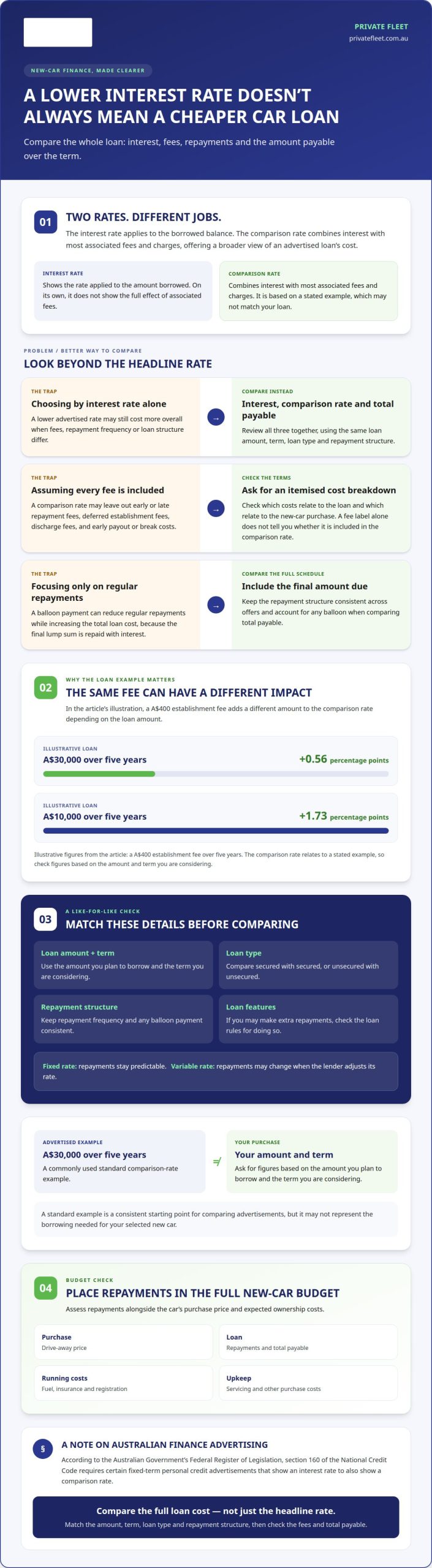
Depending on the loan, included costs can cover establishment fees and ongoing account charges, such as a monthly account fee. The comparison rate combines these costs with interest to show a broader cost figure than the interest rate alone. For example, a A$400 establishment fee adds about 0.56 percentage points to the comparison rate on an illustrative A$30,000 loan over five years. The same fee adds about 1.73 percentage points on an illustrative A$10,000 loan over five years.
Fees and penalties left out
A comparison rate may not include early repayment fees, late repayment fees or deferred establishment fees. These costs depend on what happens during the loan, rather than simply the advertised repayment schedule. Some loans also have a discharge fee when the account closes, or an early payout or break cost if you repay sooner than expected. Read the loan terms for these charges, as the comparison rate may not capture them.
Upfront, establishment, broker and dealership fees
An upfront establishment fee increases the cost of borrowing, even if it is paid separately from regular repayments. A one-off application fee may also apply when you apply. A fee labelled broker or dealership-related needs to be distinguished from a lender’s loan charges: the label alone doesn’t show whether it is included in the comparison rate. Ask for an itemised breakdown of costs linked to the loan and the new-car purchase.
Loan A’s lower rate doesn’t automatically make it cheaper overall; fees can change the comparison. A balloon payment can also reduce regular repayments while increasing total loan cost, because the final lump sum is repaid with interest.
| Illustrative loan | Interest rate | Upfront fees | What to compare |
|---|---|---|---|
| Loan A | 10% | A$500 | Interest and fees together |
| Loan B | 11% | Interest and fees together |
Choose by comparing the full loan costs and terms, not the interest rate alone.
How to Compare Car Loan Rates When Buying a New Car
Compare offers using the same loan amount, term and loan type. Interest rate, comparison rate and total payable each help assess a different part of the cost.
According to the Australian Government, Federal Register of Legislation, section 160 of the National Credit Code requires advertisements for fixed-term credit mainly for personal, domestic or household purposes that show an interest rate to also show a comparison rate.
Lowest interest rate versus total cost
A lower advertised interest rate doesn’t automatically make an offer cheaper. Fees, repayment frequency and the loan structure can change the total amount paid. For example, a hypothetical borrower taking a A$20,000 car loan should compare the total payable and repayment schedule, not just the headline rate. Comparing car loan comparison rates with interest rates helps reveal whether fees change the apparent ranking between offers.
Compare like with like: an unsecured loan against another unsecured loan, with matching amounts and terms. Then consider whether a fixed or variable rate suits your plans. Fixed-rate repayments stay predictable, while variable repayments may change when the lender adjusts its rate. If you expect to make additional payments, the loan’s rules for extra repayments also matter.
Standard comparison rate assumptions
Australian comparison rates use a standard loan amount and term, calculated with the time value of money in mind. A commonly used example is A$30,000 over five years. That standard gives you a consistent starting point for comparing advertisements, but it may not represent the borrowing needed for your selected new car.
For a more relevant comparison, ask for figures based on the amount you plan to borrow and the term you’re considering. For instance, an advertised rate based on A$30,000 over five years may differ from one for A$12,000 over three years. Keep the repayment structure consistent too, including any balloon payment, so the final amount due isn’t overlooked.
Use this checklist to compare offers:
- Match the loan amount, term and secured or unsecured type.
- Compare interest rate, comparison rate and total payable.
- Include repayment frequency and any balloon in your assessment.
- Consider how the repayment rules fit your plans for the vehicle.
For help coordinating your new-car choice and finance comparison, get help with your purchase.
How Loan Costs Fit Into Your New-Car Budget
Compare loans with different rates, fees and repayment terms by lining up the amount borrowed, repayment structure and total payable. Then assess the repayments alongside your new car’s purchase price and expected ownership costs.
Comparing total loan costs
The comparison rate helps assess loan costs, while the total payable shows the amount scheduled across the term. For an illustrative $30,000 loan at 8.25% p.a., monthly repayments are A$509.91 over five years, with total repayments of A$30,594.38. Treat these figures as an example, then compare each offer using its own amount, term and repayment schedule.
Keep the vehicle’s purchase price separate from the cost of borrowing. If you’re looking at a drive-away offer, use that figure to understand the amount required for the car, then account for the finance costs and charges separately. This makes it easier to see how the vehicle choice and loan affect the overall budget.
Loan affordability and ownership costs
A monthly repayment is only one part of affordability. Car ownership costs can include stamp duty, registration, insurance, petrol, servicing and road tolls. Add these recurring or purchase-related expenses to your budget alongside the loan, so the repayment figure doesn’t use money needed for the vehicle’s everyday running costs.
Build a simple monthly view: list the expected repayment, fuel, insurance and regular servicing, then include an allowance for tyres and registration costs. Your driving pattern and kilometres travelled can affect fuel and maintenance needs. Compare the resulting budget with your household expenses before settling on a loan amount.
Rates, fees and repayment terms
When interest rates, fees and terms differ, compare the total amount payable as well as each repayment. A longer term can reduce monthly repayments while increasing the total paid. For example, an illustrative $30,000 loan at 8.25% p.a. over a longer term will increase the total interest charged. A lower monthly figure alone may therefore hide a larger overall commitment.
Check whether the repayment schedule includes a balloon payment. A balloon lowers regular repayments but leaves a final lump sum to pay, so include that amount in your budget planning.
- Set the vehicle purchase price and intended loan amount.
- Compare repayment, total payable, fees and any balloon.
- Allow for ownership costs alongside repayments.
- Choose terms that fit your budget and plans for the car.
The suitable offer is the one whose full repayment schedule fits alongside the costs of owning the new car, backed by the expertise of Private Fleet.
Australian Rules for Car Finance Ads When Buying a New Car
When comparing new-car offers, you may also review finance advertised by a lender or on a comparison website. In Australia, certain fixed-term credit advertisements must show a comparison rate as well as an interest rate.
Under section 160 of the National Credit Code, advertisements for fixed-term credit mainly for personal, domestic or household purposes that show an interest rate must also show a comparison rate, according to the Australian Government, Federal Register of Legislation. For example, an advertisement for a personal loan to buy a car that displays an interest rate falls within this requirement when the credit meets those conditions.
The requirement is tied to the advertisement and credit type, not just the label “car loan”. A secured loan uses the vehicle as security; an unsecured personal loan does not. If either is advertised as fixed-term credit mainly for personal, domestic or household purposes, and the ad shows an interest rate, section 160 requires the comparison rate too. Check both figures when reviewing finance alongside the new-car price.
Comparison-rate warnings and examples
Section 163 of the National Credit Code and regulation 99 of the National Credit Regulations require an advertised comparison rate to carry a warning: it is accurate only for the example given. That matters because the example’s loan amount and term may differ from the amount you plan to borrow. Treat the displayed percentage as an illustration, not a personalised offer.
For instance, a website may place an advertised fixed-term car loan beside other finance offers. If the advertisement shows an interest rate, the comparison rate requirement applies when the credit meets section 160’s criteria. The ad must also carry the warning required under section 163 and regulation 99. Compare the stated example’s assumptions with your intended loan amount and term.
How comparison websites fit in
A comparison website can present lender advertisements, so read the rate details and warning attached to each offer. Don’t rely on a headline interest rate alone. Look for the comparison rate, the example it relates to, and whether the offer is secured or unsecured. Then compare like-for-like loan types and terms as one part of your new-car purchase decision.
Use this quick check when viewing an Australian car-finance advertisement alongside a new-car offer:
- Identify whether it shows an interest rate for fixed-term personal credit.
- Look for the comparison rate and the example-specific warning.
- Note the loan amount, term and security type before comparing offers.
These steps help you interpret advertised rates without treating a standard example as the cost of your specific borrowing. Consider finance alongside the new car’s price and the rest of the purchase terms.
Choosing Between Car Loan Offers for Your New-Car Purchase
Compare offers using the vehicle price, loan amount, comparison rate and total amount payable. The cheapest headline rate may not suit your budget if its terms or security requirements don’t fit.
Compare the full loan commitment
Start with the same new vehicle and borrowing amount for each offer. Compare the comparison rate, monthly repayment, total payable and any balloon payment. These figures show different parts of the commitment: a lower repayment can come with a longer term or a larger final sum. Focus on the cost across the complete loan, not one attractive figure.
Next, match the loan term and repayment structure. Check whether fees are included, whether extra repayments are allowed, and what happens if you repay early. A fixed rate keeps repayments predictable, while variable-rate repayments can change when the lender changes its rate. Those features matter if you plan to keep the vehicle for a particular period or pay the loan ahead of schedule.
Consider your credit profile and loan security
Your credit score can affect the interest rate you’re offered, alongside factors such as the vehicle and loan length. Australian credit scores range from zero to either 1,000 or 1,200, depending on the credit reporting agency. Treat the score as one part of the lender’s assessment, not as a promise of a particular rate or approval outcome.
A secured loan uses the vehicle as security. If repayments aren’t met, the lender can take and sell the vehicle. An unsecured loan doesn’t use the car as security, and its interest rate is often higher. Compare offers of the same type first, then decide whether the rate difference is worth the security arrangement for your circumstances.
- Match the vehicle, loan amount, term and repayment structure.
- Compare the comparison rate and total amount payable, including any balloon.
- Consider how your credit score and chosen vehicle may affect the offered rate.
- Weigh a secured loan’s terms against an unsecured option’s rate and conditions.
The best fit balances total cost, repayment flexibility and the consequences of using your new car as security. A cheaper offer isn’t automatically the right choice if its terms don’t match how you’ll pay.
How Private Fleet Can Help With a New-Car Purchase
Private Fleet is an independent new-car buying agency that tenders your chosen vehicle across a national network of authorised dealerships. Dealers compete for your business, while the team manages negotiation and paperwork for the vehicle you’ve selected.
This can help when you’re weighing a new car’s purchase price alongside finance repayments. Share your preferred make and model, postcode and buying timeframe, then Private Fleet can source the specified vehicle through its dealership network. You don’t need to begin with an open-ended search: a clear model, variant and budget gives the purchase process a practical starting point.
Private Fleet’s new-car buying process brings vehicle selection and purchase steps together. The tender process invites multiple authorised dealerships to compete for the buyer’s business. You can consider the vehicle offer alongside your finance needs, rather than treating the loan rate as separate from the car you plan to buy.
For the loan decision, focus on the figures that shape your commitment: comparison rate, repayment, loan term and total amount payable. Private Fleet offers Car Finance, which can form part of the wider new-car purchase. Consider how repayments fit your budget and ownership costs, and compare loan terms carefully before deciding. The aim is to keep the vehicle choice central while understanding the finance attached to it.
Private Fleet also offers Trade-In Assistance, which can be relevant if you’re replacing a vehicle as part of your new-car purchase. A trade-in may affect the amount you need to finance, so consider it alongside the vehicle price and loan figures. Private Fleet’s New Cars and New Car Buying Service support the purchase itself, while finance and trade-in assistance can address connected decisions.
After the purchase is underway, customers receive regular updates on delivery times. That helps you stay informed as the dealership progresses with your order, without assuming a particular delivery date. The process is designed around your chosen new vehicle and the decisions that affect its purchase.
If you’re ready to discuss your preferred make or model, postcode and buying timeframe, contact Private Fleet or call 1300 303 181.
Make Your Next Car-Buying Decision With Confidence
Before settling on finance, decide which new car, make and model suit your plans. Comparing car loan comparison rates with interest rates is most useful when the borrowing is tied to the vehicle you actually intend to buy. Consider your preferred variant, postcode and buying timeframe, then keep the purchase and finance decisions connected.
Private Fleet can help bring those decisions together through its New Cars and New Car Buying Service, with a tender for your chosen vehicle across its authorised dealership network. If you’re replacing a car, Trade-In Assistance can also form part of the purchase planning. Share your shortlist and priorities so the buying process can focus on the vehicle that fits your needs.
For help with your next step, contact Private Fleet or call 1300 303 181. A clear shortlist and buying timeframe can help start a practical conversation about your new-car purchase.
Take your time choosing the car and finance arrangement that work together, then move forward with a clear plan.
Frequently Asked Questions
How should I compare drive-away prices for a new car?
Compare written offers for the same make, model, variant and options, and check that each price covers the same on-road costs. Confirm whether accessories or other items are included, and whether the vehicle can be supplied within your preferred timeframe. Comparing like for like makes it easier to decide which offer best suits your budget and needs.
How do I choose the right new-car variant?
Start with how you will use the car, then compare the features that matter to you, such as safety equipment, comfort, storage and technology. Check that each offer is for the exact variant you want, as specifications and included features can differ between variants. A clear shortlist can help you avoid paying for features you do not need.
What is a good car loan rate?
There is no single interest rate, including 8%, that is right for every buyer. If you are considering finance for a new car, compare the written terms and total amount payable alongside the vehicle’s drive-away price. The offer may depend on your circumstances and the loan terms, so consider whether the repayments fit your budget before deciding.
What should I check before ordering a new car?
Confirm the make, model, variant, colour and any selected options in the order documents. Check the agreed price and what it includes, and ask how you will receive updates about delivery timing. Keep a copy of the paperwork so you can refer to the agreed vehicle and terms as the order progresses.
How can I compare two new-car offers in Australia?
Check that both offers cover the same vehicle specification and price components. Compare the drive-away price, included accessories and any conditions attached to each offer. If you are also considering finance, assess that separately using the amount borrowed, repayment schedule and total payable, rather than relying on a headline rate alone.
What should I consider when choosing a new car for my needs?
Think about your usual trips, passengers, luggage and parking situation. If possible, assess how comfortable the seats feel, how easy the car is to enter and exit, and whether the controls and visibility suit you. Compare those practical considerations with the vehicle’s specification and the written offer for the exact variant you are considering.
What costs should I consider beyond a new car’s drive-away price?
Allow for ongoing costs such as fuel or charging, servicing, tyres, insurance and registration when comparing vehicles. The costs will depend on the car and how you use it. If you are considering finance, check applicable loan charges and the total amount payable as well, so you can assess the purchase against your budget.
How can I compare a new car’s price with a finance offer?
First compare the vehicle’s drive-away price and specification. Then review any finance offer separately, including the amount borrowed, term, repayments, applicable charges and total payable. For example, an illustrative comparison-rate loan may use A$30,000 over five years. Your own offer may differ, so check its written terms before making a decision.