
Outstanding finance doesn’t automatically rule out a trade-in when you’re buying a new car. Private Fleet can help coordinate a trade-in as part of sourcing your chosen new vehicle through its national network of authorised dealerships. Before deciding, clarify how the vehicle will be assessed, what the offer covers and how the changeover fits your purchase.
When comparing new-car options, consider the trade-in alongside the vehicle’s drive-away price, model and variant. Ask how an inspection could affect the trade-in offer and how long the offer remains valid while you organise the purchase. Clear answers can help you compare the overall changeover rather than considering each decision separately.
This article explains how appraisals and inspections inform a trade-in offer, what to clarify about payment timing and costs, and how trade-in assistance can fit into buying a new car. Use these points to understand the terms and make an informed changeover decision.
Key Takeaways
- Learn what can affect whether a vehicle is considered as a trade-in towards a new-car purchase.
- See how an inspection can shape the final offer, and why the vehicle’s details matter.
- Understand how to compare appraisals and what to look for in an estimate’s validity period.
- Find out how sale proceeds may be directed to you or your financier after the final inspection.
- Discover how a new-car buying service can coordinate trade-in assistance alongside the purchase.
Vehicles accepted for trade-in
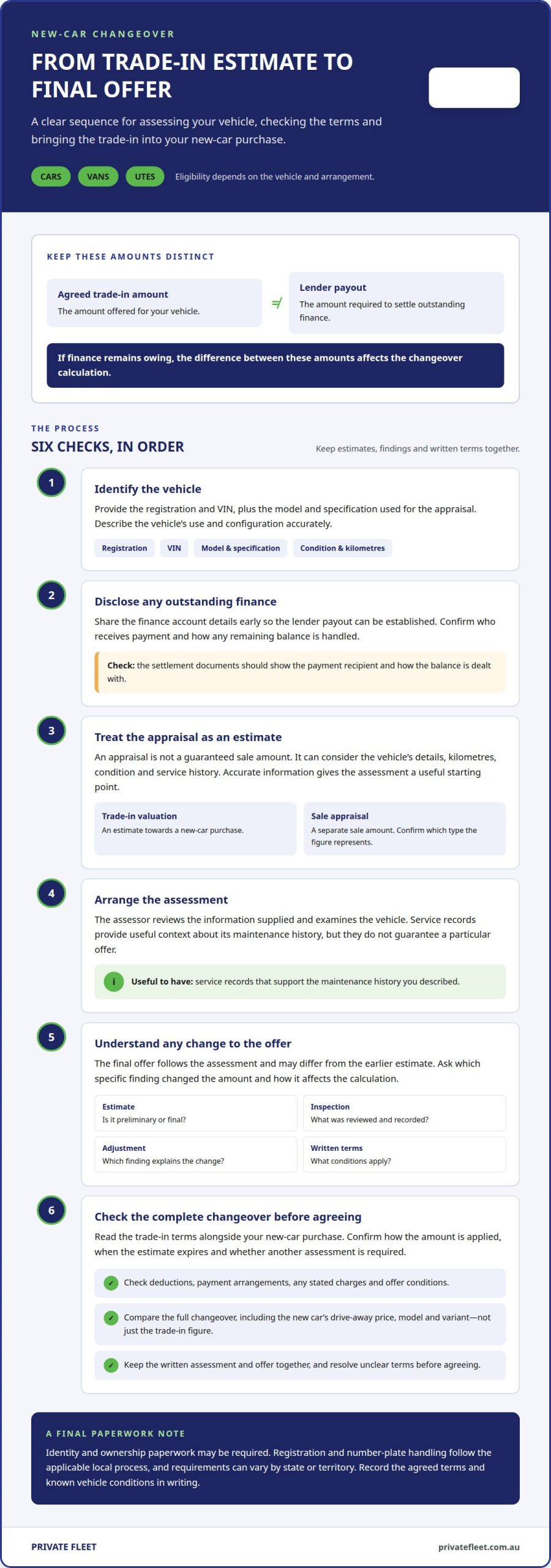
Cars, vans and utes may be considered as part of a new-car changeover. Eligibility depends on the vehicle and the arrangement, so identify the vehicle type and whether finance remains owing before planning your purchase.
Cars, vans and utes accepted
Trade-in discussions can cover passenger cars, vans and utes. The vehicle’s use and configuration help determine whether it suits the transaction. For example, someone replacing a family car may trade it towards a new SUV, while a tradesperson may ask about trading in a ute. Trade-in assistance can coordinate the changeover with the new-car purchase.
Trading in a vehicle with finance
A vehicle can still be considered when finance is outstanding. The finance account details help establish the lender payout, which is separate from the agreed trade-in amount. The difference affects the changeover calculation. Explain early that finance remains owing, then make sure the settlement documents show who receives payment and how any remaining balance is handled.
Trade-in offers towards a new vehicle
A trade-in amount may contribute towards a new vehicle. When buying a new car, compare the complete changeover terms rather than looking at the trade-in figure alone. A dealership trade-in brings the vehicle and purchase into one discussion. A managed arrangement coordinates those steps.
Trading through the dealership
To get started, provide the vehicle registration and VIN details, plus finance account information if relevant. The transaction may also require identity and ownership paperwork, with requirements varying by state or territory. The parties then agree on the trade-in terms, complete the sale documents and arrange registration and number-plate handling under the applicable local process.
Consumer rights and disclosure requirements depend on the transaction and jurisdiction. Describe the vehicle accurately and record agreed terms and known conditions in writing. Before signing, review the amount, deductions, payment arrangements and any stated charges. Clear itemisation helps you spot costs that might otherwise be overlooked.
When assessing a service and its offer, look for consistent business details, transparent written terms and a clear explanation of how the amount was reached. The usual steps are to provide vehicle details, review the proposed terms, arrange any required assessment and agree on the transaction paperwork. A managed arrangement can coordinate the trade-in with your new-car purchase.
Inspection and final offer
An inspection helps the assessor determine whether the initial estimate still reflects the vehicle presented. The final offer follows the assessment and may differ from the earlier figure. Treat an estimate as provisional until the inspection is complete and the terms are provided in writing.
The assessor reviews the information supplied, examines the vehicle and explains how the findings affect the offer. A complete, regular service history can make a vehicle more attractive to prospective buyers and help it achieve a higher price. Service records therefore provide useful context during an assessment.
Inspection findings should be tied to specific adjustments, not left as unexplained changes. If the final amount differs from the estimate, ask which finding changed the calculation and how it affects the offer. This makes the decision easier to understand before you accept the terms.
- Estimate: note whether the amount is preliminary or final.
- Inspection: understand what the assessor reviewed and recorded.
- Adjustment: ask for the reason behind any change to the amount.
- Written terms: check the offer’s expiry and any conditions before accepting.
For example, an assessor may find that the service records support the maintenance history described earlier. That information can inform the assessment, but it does not guarantee a particular offer. The final figure depends on the assessment and the transaction terms.
Read the offer as part of the new-car changeover. Confirm whether it is a trade-in amount applied to the purchase or a separate sale amount. Check when the estimate expires, whether another assessment is required and whether accepting the offer commits you to any stated conditions.
A clear explanation should show how the process moves from estimate to final offer. Keep the written assessment and offer together so you can compare the original amount with any revised figure. If a change is unclear, resolve it before agreeing to the transaction. This grounds your decision in the assessor’s findings and the terms presented.
Car trade-in and sale appraisals
A trade-in valuation is an estimate, not a guaranteed sale amount. According to the Australian Securities and Investments Commission (ASIC), book value is an estimated car value for trade-in or retail, determined by industry guides. An appraisal can also consider the vehicle’s details, kilometres travelled, condition and service history.
To request an initial assessment, submit the vehicle’s registration and VIN numbers, answer questions and upload images. These details help the assessor identify the vehicle and prepare an appraisal. Accurate information gives the assessment a useful starting point, while an inspection can reveal more about the vehicle’s actual condition.
Compare appraisals using consistent terms, not just the headline amount. Check that each assessment covers the same vehicle, condition and transaction type. Also confirm whether the figure is a trade-in value towards a new car or a separate sale appraisal. These distinctions help show whether an offer is competitive for your planned purchase.
- Vehicle identity: confirm the registration, VIN, model and specification used for each appraisal.
- Assessment basis: note whether the figure is preliminary or follows an inspection.
- Transaction: distinguish trade-in value from a separate sale amount.
- Offer terms: compare expiry dates, conditions and how the value applies to the purchase.
For example, two appraisals may use the same vehicle details but differ in their assessment of its condition or the transaction terms. Ask how each figure was reached and which information it relies on. If a final inspection changes an estimate, the reason should be explained in relation to the vehicle’s assessed condition.
Also consider how the appraisal fits into the complete new-car changeover. The trade-in figure is only one part of the decision; the new vehicle’s price and the timing of both transactions also affect the amount payable. Comparing the complete written terms helps you avoid assuming a higher appraisal is automatically better when the purchase arrangements differ.
Keep each appraisal and its supporting terms together while deciding. Check the validity period before relying on an estimate, because an expired offer may no longer apply. A useful comparison records the valuation, whether an inspection has occurred, any adjustments and how the agreed amount will be used. This gives you a practical basis for comparing appraisals without assuming a particular result.
A trade-in valuation is an estimate, not a guaranteed sale amount. If an inspection changes the estimate, the reason should be explained in relation to the vehicle’s assessed condition. The written offer should also make clear any conditions and how the value applies to the purchase.
Payment timing after a sale
Payment timing depends on the agreed sale terms and completion steps. After the final inspection, payment can be arranged directly to the seller or their financier. For a trade-in linked to a new-car purchase, confirm whether its value will be paid to you or credited towards the vehicle, and when that credit takes effect.
Before organising an upgrade, get the payment arrangement in writing. It should identify the final inspection as a step, state who receives payment and explain how the agreed trade-in value relates to the new-car purchase. This makes the changeover easier to plan without treating an estimate as available funds.
If finance remains outstanding, establish how the lender payout fits into settlement. The trade-in value and payout are separate amounts, and the difference affects the value remaining for the purchase. Confirm whether payment goes directly to the financier, whether you must pay any balance and what happens if the valuation changes after inspection.
- Confirm the trigger: identify whether payment follows the final inspection, completed paperwork or another agreed step.
- Confirm the recipient: record whether funds go to you, your financier or another named party.
- Confirm the purchase credit: check when the trade-in amount reduces the balance for the new vehicle.
- Keep the amounts distinct: compare the final trade-in value with any lender payout and remaining purchase amount.
For example, a buyer may hand over a vehicle while arranging a new-car purchase. The written terms should show whether the agreed value is transferred as payment or recorded as a credit against the new vehicle. If finance applies, they should also clarify how the financier receives its payout. These details distinguish sale proceeds from purchase funds.
Timing can depend on the final inspection, completed paperwork, payment destination and finance arrangements. Ask for the expected sequence rather than assuming a payment date. If the new vehicle handover and trade-in happen at different times, clarify how the gap affects the purchase balance and any amount you need to organise.
Keep the final valuation, payment instructions and purchase documents together. Before completing the sale, make sure each document shows the same agreed amount and recipient. Clear written terms help you plan the sale of your vehicle and purchase of an upgrade around the actual settlement steps.
Car trade-in management costs in Australia
The cost of a car trade-in management service depends on the arrangement and should be set out in a quote. There is no single amount that applies to every Australian transaction. The written terms should explain what the cost covers, how it is calculated and whether anything is deducted from the trade-in value.
Start by separating service costs from the vehicle appraisal and the new-car purchase. A trade-in valuation is the assessed vehicle amount; any service charge is a separate item. A lender payout is separate again when finance remains owing. Keeping these figures distinct makes the changeover easier to understand.
Review the terms for charges related to the work being arranged. For example, check whether the quoted amount covers appraisal coordination, inspection arrangements, sale paperwork or payment handling. These are questions about scope, not assumed inclusions. Any charge or deduction should be clearly identified before you agree to proceed.
- Scope: identify the tasks included in the quoted service.
- Calculation: check whether any charge is fixed, conditional or linked to the transaction.
- Deductions: distinguish service charges from adjustments to the vehicle valuation.
- Finance: keep any lender payout separate from the service cost and trade-in amount.
For a new-car changeover, compare the written trade-in terms with the purchase documents. Check how the trade-in amount is applied, whether a separate charge appears and when each amount is due. A higher appraisal does not show the full cost if the transaction also includes deductions or other charges.
Ask for a written breakdown before accepting the terms. It should state the service cost, any additional charges, the basis for deductions and whether amounts include applicable taxes. If a line item is unclear, get an explanation in writing before signing. This gives you a record of what the quoted cost covers.
When assessing the overall cost, consider the work involved and the value of coordinating sale arrangements with a new-car purchase. Compare the complete written arrangement, not an assumed fee or headline trade-in figure. Confirm the final cost and payment terms for your transaction before proceeding.
Private Fleet: New Car Buying Service
Private Fleet is an independent new-car buying service for Australians planning a vehicle changeover. Its new-car buying service works with a national network of authorised dealerships. Private Fleet does not hold its own vehicle inventory; instead, its tender process invites multiple dealers to compete for the buyer’s business.
You choose the vehicle, including your preferred make, model and variant. Private Fleet tenders that choice across its dealer network and manages the negotiation and paperwork. This helps keep the new-car purchase and trade-in discussion connected, rather than treating them as unrelated transactions.
Trade-in assistance is useful when you want to put your current vehicle’s value towards your next purchase. Private Fleet can coordinate the trade-in alongside the new-car buying process, including the appraisal and agreed transaction details. The inspection and final offer depend on the vehicle assessed and the terms agreed.
To tailor the process to your purchase, share your preferred make or model, postcode and buying timeframe. A clear shortlist helps define the vehicle being tendered. If you’re still deciding between models or variants, explain your priorities so the sourcing process reflects what you want to buy.
- Set your shortlist: identify the preferred make, model and variant, or describe the options you’re weighing.
- Explain the changeover: provide details about the trade-in you want considered alongside the new car.
- Review the arrangement: consider the proposed vehicle, purchase terms and trade-in details before proceeding.
Once purchase arrangements are underway, Private Fleet provides regular updates on delivery times. This helps you plan around the vehicle’s progress without relying on an assumed handover date. If finance is relevant to your new-car purchase, it can also be discussed as a supporting option alongside the vehicle and trade-in decision.
This service suits buyers who want help sourcing a specific new car and coordinating its purchase with a trade-in. Private Fleet sources vehicles through authorised dealerships rather than from its own stock. The focus is on your chosen new car and the purchase process.
To discuss your preferred vehicle, postcode and buying timeframe, contact Private Fleet or call 1300 303 181.
Frequently Asked Questions
Can I sell or trade in my car if it’s still under finance or has money outstanding?
Yes, a vehicle with finance owing can be traded in, but the lender payout must be included in the settlement. The payout and trade-in value are separate amounts. If the payout exceeds the vehicle’s value, understand how the remaining balance affects your next purchase. Confirm who receives payment and how any balance is handled before agreeing to the transaction.
How do I know the exact price for my trade-in?
You’ll know the final amount after the vehicle has been assessed and the offer terms are set out. An early estimate may not be the final figure, particularly if inspection findings differ from the details first provided. Ask for the agreed amount in writing, including any conditions and how long the offer applies. For a new-car changeover, also confirm how that amount affects your purchase balance.
How do I know if the price you’re estimating is fair?
Check that the appraisal uses accurate vehicle details and clearly explains the condition assessment. Compare like-for-like offers for the same vehicle and transaction type, then account for any deductions or conditions. A higher figure may not mean a better overall changeover if the new-car purchase terms differ. Before accepting an offer, ask the valuer to explain the basis for any adjustments.
What is the valuer’s role in the trade-in process?
The valuer assesses the vehicle’s identity, specification and condition to prepare an appraisal. They can compare the submitted details with the vehicle presented, then explain how inspection findings affect the proposed amount. Their role is to assess the vehicle, not guarantee a particular sale price. For example, if a feature or condition differs from the original description, the valuer can explain its effect on the offer.
What does a car trade-in management service do in Australia?
A car trade-in management service helps coordinate a vehicle appraisal and sale as part of a new-car purchase. Private Fleet’s independent new-car buying service tenders your chosen vehicle to authorised dealerships across its national network. It also provides trade-in assistance, so you can consider the changeover alongside the new-car transaction. Vehicles are sourced through dealerships, not from Private Fleet-owned inventory.
What consumer rights and disclosure rules apply to car trade-ins in Australia?
Consumer rights and disclosure requirements depend on the transaction and jurisdiction. Describe the vehicle accurately and record agreed terms and known conditions in writing. Requirements can vary by state or territory.