
The Tiggo name covers a wider price spread than an entry-level figure suggests.
Choosing between the Tiggo 4, Tiggo 7 and larger Tiggo 8 is about more than the starting price. Seats, powertrain and equipment vary by model and grade, so comparing the exact variants can make the costs and trade-offs clearer.
This guide explains how to compare Australian Tiggo variants and their listed prices, including the key engine and transmission differences. Use it to shortlist options that fit your budget, space needs and driving routine.
Key Takeaways
- Compare each Tiggo’s drive-away price by model and variant, and note any offer eligibility or expiry before weighing up the cost.
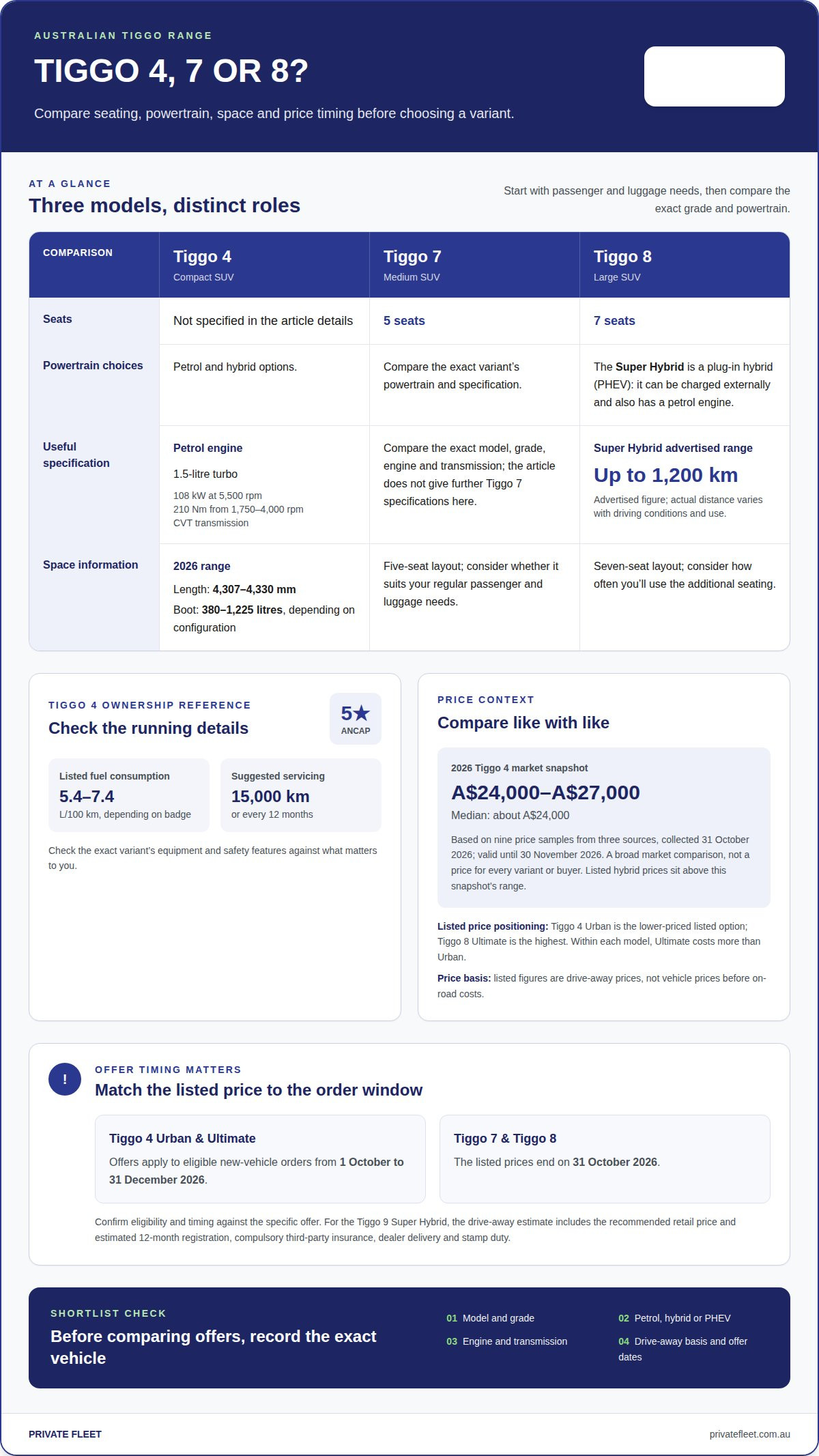
- Match the range to your space needs: the Tiggo 7 is a five-seat medium SUV, while the Tiggo 8 offers seven seats.
- Check the powertrain and transmission for the exact variant, including the Tiggo 4’s petrol and hybrid options.
- Use fuel consumption, service intervals and warranty terms alongside the purchase price to assess ownership fit.
- Compare Urban and Ultimate grades against the features you value, rather than assuming the higher trim is the right choice.
2026 Australian price range
The Tiggo 4 Urban is a lower-priced listed option. The highest is for the Tiggo 8 Ultimate.
These figures are drive-away prices, not just vehicle prices before on-road costs. A listed offer can also have an eligibility period, so its price is useful only when matched to the order timing. The Tiggo 4 Urban and Ultimate offers apply to eligible new-vehicle orders from 1 October to 31 December 2026. The listed Tiggo 7 and Tiggo 8 prices end on 31 October 2026.
Compare the powertrain and equipment, not just the headline price.
Within each model, the Ultimate grade costs more than Urban.
A separate market snapshot places the 2026 Tiggo 4 between A$24,000 and A$27,000, with a median of about A$24,000. It draws on nine price samples from three sources, collected on 31 October 2026, and is valid until 30 November 2026. Treat this as a broad market comparison, not a price for every variant or buyer. The listed hybrid prices sit above that snapshot’s range.
Use the figures to build a shortlist, then compare each offer on the same basis:
- Match the model and grade. A Tiggo 4 Urban is not directly comparable with a Tiggo 4 Ultimate or Tiggo 7.
- Separate petrol from hybrid. The Tiggo 4 Hybrid grades have different listed prices from the petrol grades.
- Check the offer window. The Tiggo 7 and Tiggo 8 listed prices end on 31 October 2026; the Tiggo 4 Urban and Ultimate offer dates run to 31 December 2026.
- Compare the drive-away total. For the Tiggo 9 Super Hybrid, the drive-away estimate includes the vehicle’s recommended retail price and estimated 12-month registration, compulsory third-party insurance, dealer delivery and stamp duty.
For buyers comparing the 2026 Chery Tiggo price in Australia, the exact variant and offer period shape the useful comparison. Put the same model, grade, powertrain and drive-away basis side by side. That makes the price differences clearer before you assess engine, transmission and equipment in the following sections.
Australian Chery Tiggo model range
The Australian Tiggo lineup spans compact, medium and large SUVs, with petrol, hybrid and plug-in hybrid choices. The Tiggo 4 is the compact option, the Tiggo 7 is a five-seat medium SUV, and the Tiggo 8 is a seven-seat large SUV. Begin with passenger and cargo needs, then narrow the shortlist by powertrain. This helps keep comparisons focused on vehicles designed for similar everyday use.
The Tiggo 4 range includes a 1.5-litre turbo petrol engine. It produces 108 kW at 5,500 rpm and 210 Nm between 1,750 and 4,000 rpm. Its listed transmission is a continuously variable transmission (CVT). These figures give you a useful starting point for comparing the petrol model’s engine and gearbox with other Tiggo variants.
For the 2026 Tiggo 4 range, lengths run from 4,307 to 4,330 mm. Depending on configuration, boot capacity ranges from 380 to 1,225 litres. Consider how those dimensions work with your garage, parking space and usual luggage. If possible, sit in the vehicle and assess the rear-seat and boot access for your regular passengers and belongings.
Seat count offers a straightforward way to separate the Tiggo 7 and Tiggo 8. The Tiggo 7 has five seats; the Tiggo 8 has seven. A five-seat layout may be a natural fit if extra passenger seating is rarely needed. If you regularly need more seats, include the Tiggo 8 in your comparison and consider how you’ll use its cabin.
Powertrain is another key distinction. The Tiggo 4 is available with petrol and hybrid options, while the Tiggo 8 Super Hybrid is a seven-seat plug-in hybrid (PHEV). A PHEV can be charged externally and also has a petrol engine. Chery lists a driving range of up to 1,200 km for the Tiggo 8 Super Hybrid. Treat this as an advertised range figure; the distance achieved in practice varies with driving conditions and use.
Use these criteria to create a practical shortlist before comparing individual grades:
- Start with seating: decide whether five seats meet your needs or whether a seven-seat Tiggo 8 belongs on your list.
- Match the powertrain to your routine: compare the Tiggo 4 petrol and hybrid options, and consider whether external charging suits your use of the Tiggo 8 PHEV.
- Check the vehicle’s fit: use the Tiggo 4’s length range and boot capacity to assess parking and luggage requirements.
- Compare exact specifications: identify the model, variant, engine and transmission before judging equipment or offers.
The Tiggo 4’s listed fuel consumption ranges from 5.4 to 7.4 L/100km, depending on badge. Its suggested servicing interval is every 15,000 km or 12 months, and it has a five-star ANCAP safety rating. Factor these details into your ownership comparison alongside seating, space and powertrain. Check the particular variant’s equipment against your priorities, including safety features and ease of use.
To discuss a Tiggo shortlist, contact Private Fleet, call 1300 303 181, or explore Chery buying support.
Prices by variant
A variant price is useful only when you know exactly which vehicle it covers. Before comparing offers, record the model, grade, powertrain and transmission for each option. This prevents differently specified Tiggos from looking like equivalent offers just because their model names match. Keep each configuration separate, particularly when a model is available with petrol and hybrid powertrains.
Next, compare the equipment that matters in your everyday driving. Look at features you’ll use regularly, such as driver assistance, parking support, cabin controls and seat adjustment. Check the exact variant specification rather than assuming a higher grade includes a particular feature. This makes the grade decision about your needs, not just the labels.
Create a shortlist with one row for each configuration. Record the advertised drive-away figure, model year, variant, powertrain and offer conditions. Note any equipment or ownership details that could affect your decision. If a price is described as indicative, keep that qualification in your notes rather than treating it as the same as a time-limited offer.
When comparing written offers, check that each covers the same vehicle configuration and purchase basis. Differences in grade, powertrain or included equipment can change an offer’s value. Compare what is included and the conditions attached, not just the headline figures. That gives you a clearer basis for deciding which variant to consider.
Use this checklist before choosing a grade:
- Confirm the configuration: record the exact model, variant, engine and transmission.
- List essential equipment: separate features you need from those that would simply be nice to have.
- Keep offer terms with the price: note whether the figure is drive-away, indicative or subject to a stated offer period.
- Compare matching vehicles: assess offers for the same configuration before weighing any difference.
- Consider your ownership routine: factor in the driving, passengers and everyday tasks the vehicle must handle.
This approach helps you distinguish a lower headline price from a better fit for your needs. Once you’ve chosen a preferred configuration, use its exact variant name when discussing the purchase. That keeps the conversation focused and reduces the risk of comparing different Tiggos by mistake.
For help progressing your Chery shortlist, contact Private Fleet, call 1300 303 181, or explore Chery buying support.
Take your shortlist and the exact variant name into the purchase discussion. Ask for the written specification and check that it matches the configuration you’ve assessed. Clarify any unclear details before comparing offers. This is especially useful when weighing a hybrid against a petrol option, as the powertrain can affect how well the vehicle suits your routine. Keep the discussion focused on your priorities: the equipment you rely on, the journeys you make and the conditions attached to the quoted figure. Record these details so you can revisit the comparison without relying on memory or assumptions. The aim is to understand what each vehicle offers and whether it meets your needs, rather than choosing a grade by name alone.
For the top 2026 Chery Tiggo 4 variant, the hybrid engine produces 71kW and the variant has 120Nm of torque. Keep those specifications alongside the variant name when comparing it with another configuration, rather than treating the figures as a complete measure of suitability. Consider them with the equipment and offer details you have already recorded, and confirm that the written information applies to the vehicle being discussed. If the configuration changes during the purchase conversation, revisit the comparison so that the price, equipment and powertrain still refer to the same option. That final check helps you make a decision based on a consistent set of details, and gives you a more useful basis for asking any remaining questions before proceeding.
Urban and Ultimate trim pricing
Urban and Ultimate are different grades, but the name alone won’t tell you which suits your routine. Compare the exact variant details and consider how you use an SUV: commuting, carrying passengers, loading shopping or taking longer trips. Your regular needs help separate essential features from extras you may rarely use.
Start with your preferred Tiggo model and powertrain, then assess Urban and Ultimate within that same configuration. Avoid comparing grades across different models as if they were equivalent. A Tiggo 4 grade comparison, for example, answers a different question from choosing between Tiggo 7 grades. Keeping the model fixed makes the equipment and driving assessment more relevant.
Use a showroom visit or test drive to assess what suits you. Check seat adjustment, ease of entry and exit, visibility and access to the controls. If touchscreen menus matter to you, try the functions you expect to use regularly. A feature list shows what’s included, but trying the vehicle gives you a better sense of whether its layout feels intuitive.
For either grade, consider how often you’ll rely on parking assistance and other driver-support features. Identify the functions you value, then compare the exact variant specifications for those items. Don’t assume that a grade name guarantees a particular inclusion across every model or powertrain. This is especially useful when comparing petrol and hybrid Tiggo 4 variants, which are separate configurations.
Before settling on Urban or Ultimate, make a short decision record:
- Name the vehicle: write the Tiggo model, grade and powertrain you’re considering.
- Set your priorities: note the comfort, visibility, access, control and assistance features that matter for your regular journeys.
- Compare the exact specifications: match each priority to the equipment listed for that specific configuration.
- Try the cabin: sit in the vehicle, adjust the seat and explore the controls you’ll use most.
- Revisit the choice: decide whether the higher grade adds features you genuinely value, rather than choosing by its name alone.
Keep your purchase comparison precise too. Make sure the written offer identifies your selected model, grade and powertrain. Treat any different configuration as a separate comparison, rather than assuming the same grade includes identical equipment. This makes your choice easier to explain and keeps the discussion centred on your preferred specification.
For a Tiggo 9 Super Hybrid comparison, keep the drivetrain and grade in view alongside the equipment. The Chery Tiggo 9 Super Hybrid Ultimate AWD has a stated combined range of up to 1,250 km and a stated NEDC electric range of 170 km. It is listed with maximum power and torque of 315kW/580Nm. These figures describe this specific configuration; use them as points to check against your own driving needs, rather than assuming they apply to another Tiggo 9 grade or drivetrain. If electric driving is a priority, consider how the stated range fits your regular journeys and whether the configuration you are considering is the one named in the specifications and written offer.
The Chery Tiggo 9 Super Hybrid has a 19 (Elite FWD) / 34 (Ultimate AWD) kWh battery, while its stated combined fuel consumption is 1.5 (Elite FWD) / 1.4 (Ultimate AWD) L/100km. Read those figures together with the matching grade and drivetrain, not as interchangeable figures for the range. Before deciding, confirm that the offer identifies Elite FWD or Ultimate AWD as applicable, and ask for clarification if any specification differs from the configuration you compared. This keeps the purchase decision grounded in the vehicle actually being offered. Consider the figures alongside your priorities for electric range, fuel consumption, power and drivetrain, then decide which differences matter for your use. A careful comparison avoids treating the Ultimate name as a substitute for checking the exact variant details. The same approach applies to any other model or powertrain you consider: compare its own specifications and offer separately.
Private Fleet: New Cars
Private Fleet can help turn your Chery shortlist into a new-car purchase plan. Its New Car Buying Service uses a nationwide network of accredited dealers, inviting them to compete for your business through a tender process. This can simplify comparing offers for the Tiggo variant that suits your needs.
Already have a vehicle to replace? Trade-In Assistance can support that part of the buying process. Car Finance is also available if you’re considering finance alongside your new-car purchase. Share your preferred Tiggo model, postcode and buying timeframe to get the conversation started.
For help comparing your next steps, contact Private Fleet or call 1300 303 181. You can also explore Chery buying support.
Turn your Tiggo shortlist into a buying plan
Make your next step specific to your day-to-day driving. Decide which model and powertrain you want to explore, then note the features you consider essential. A focused shortlist makes the buying discussion clearer and keeps attention on the details that matter to you.
For help progressing from research to purchase, Private Fleet’s New Car Buying Service can bring authorised dealerships into a tender process for your business. You can also discuss Trade-In Assistance if you’re replacing a current vehicle. The chery Tiggo 2026 price in Australia is one part of the decision; the right fit depends on the variant and your priorities.
Share your shortlist and postcode with Private Fleet, or call 1300 303 181. You can also explore Chery buying support.
With your priorities clear, contact Private Fleet to explore your preferred Tiggo and take the next step towards a new-car purchase.
Frequently Asked Questions
What Chery Tiggo models are available in Australia for 2026?
The Australian range includes the Tiggo 4, Tiggo 7 and Tiggo 8, plus the Tiggo 9 Super Hybrid. The Tiggo 4 has petrol and hybrid versions, while the Tiggo 8 includes a seven-seat plug-in hybrid. For a more precise shortlist, note the model, grade and powertrain together, such as Tiggo 4 Hybrid Urban or Tiggo 9 Super Hybrid Ultimate AWD.
What features and specifications come with each 2026 Chery Tiggo trim?
The petrol Tiggo 4 has a 1.5-litre turbo engine and CVT. The five-seat Tiggo 7 and seven-seat Tiggo 8 have Urban and Ultimate grades, but their trim-specific equipment is not detailed here.