
The biggest Silverado isn’t automatically the best fit for every Australian towing job. The Chevrolet Silverado 1500 LTZ Premium has a maximum braked towing capacity of 4.5 tonnes, while the Silverado 1500 range’s stated capacity varies by variant. Choosing well means looking beyond the headline towing figure to payload, combined mass and the towing setup.
For Australian buyers, the 1500 LTZ Premium and ZR2 pair a 6.2-litre petrol V8 with a 10-speed automatic transmission. The LTZ Premium suits buyers prioritising a well-equipped everyday ute, while the ZR2 adds off-road-focused hardware. Both seat five, but their different features and specifications can affect which one better fits your routine.
This guide compares the Chevrolet Silverado models and engines available in Australia, explains the towing figures and requirements to consider, and outlines how its camera views and driver-assistance features can help with manoeuvring. You’ll have a clearer basis for matching a trim to your passengers, driving and towing needs before deciding which new Silverado to buy.
Key Takeaways
- Compare the Silverado 1500 and 2500HD against your intended use, and factor in their substantial size as well as cabin and cargo needs.
- Understand how the Australian 2500HD trim range differs, including seating capacity, before choosing a configuration.
- Match the engine to your driving and towing needs; the Australian 1500 LTZ Premium and ZR2 use a 6.2-litre petrol V8.
- Assess towing capacity alongside payload, gross combination mass and hitch type, since the permitted setup can affect what you can tow.
- Explore how the camera system’s available views and driver assistance features can support visibility and manoeuvring.
How does the Chevrolet Silverado compare?
In Australia, the Silverado combines full-size pickup dimensions with locally re-engineered right-hand drive. Compare its Australian variants and measurements against your parking space, passengers and intended towing use.
Australian Availability and Vehicle Origin
The Silverado sold in Australia is built in Mexico, while the Silverado HD is built in Flint, Michigan. Both are re-engineered for right-hand drive in Clayton, Victoria. This local conversion is a key difference from overseas specifications, so compare the Australian model’s configuration rather than assuming an imported-market trim or feature list applies.
Australian buyers can compare the Silverado 1500 LTZ Premium and ZR2, while the 2500HD belongs to the heavy-duty range. Dealer availability can vary by model and location, so the practical comparison is between the exact Australian variants available to you. Check the stated transmission, seating, dimensions and towing capacity for that configuration before deciding whether it suits your regular driving.
Both listed 1500 variants use an automatic transmission. That supports straightforward day-to-day driving, but the pickup’s size still matters in shopping areas, residential streets and older car parks. Think about where it will be used, not just its factory features: comfort on longer trips and access to suitable parking can shape whether a full-size vehicle fits your routine.
Dimensions and Curb Weights
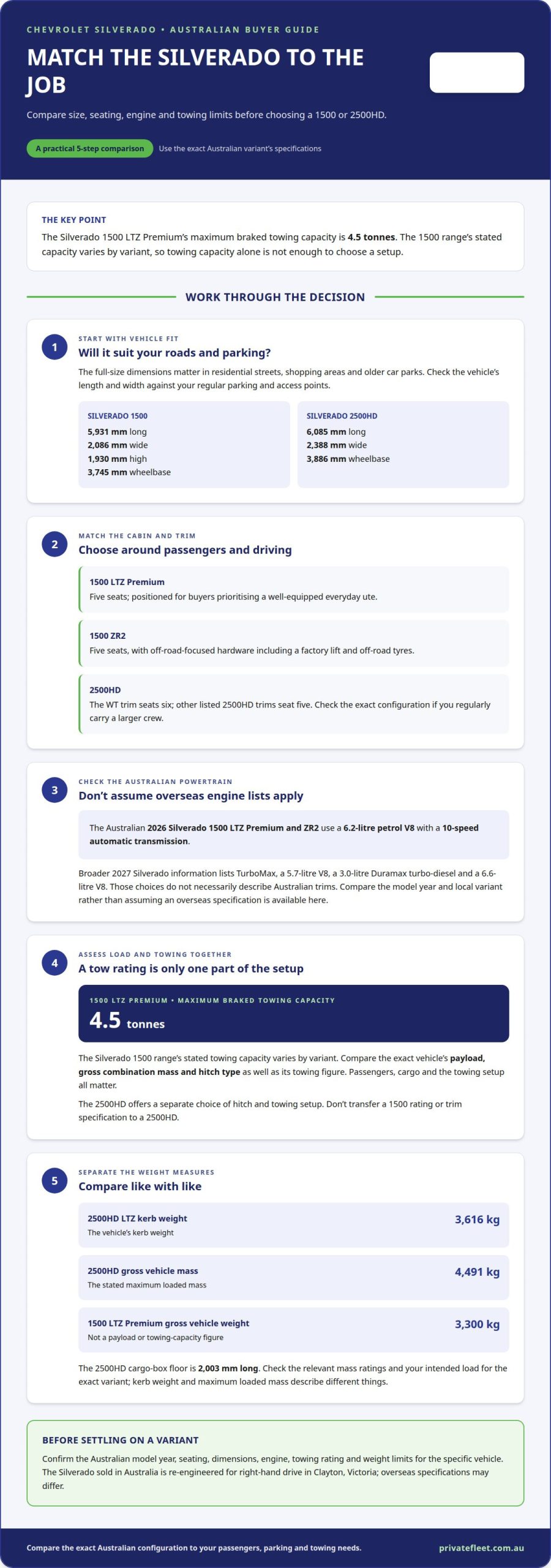
The base Silverado measures 5,931 mm long, 2,086 mm wide and 1,930 mm high, with a 3,745 mm wheelbase. These figures help you assess garage clearance and manoeuvring space. Its overall width is especially relevant when comparing tight parking bays or narrow access points. The measurements describe the vehicle, not extra clearance needed for mirrors or opening doors.
The 2500HD is larger: its stated length is 6,085 mm, width is 2,388 mm and wheelbase is 3,886 mm. Its cargo-box floor measures 2,003 mm long. The 2500HD LTZ has a kerb weight of 3,616 kg, while the 2500HD’s gross vehicle mass is 4,491 kg. These are different measures: kerb weight describes the vehicle, while gross vehicle mass is its maximum loaded mass.
For comparison, the Australian Silverado LTZ Premium has a gross vehicle weight of 3,300 kg. Don’t treat that figure as payload or towing capacity. A vehicle’s loaded mass, passengers and cargo all affect how it can be used. Compare the exact variant’s ratings with your intended load, rather than relying on the nameplate or overall size alone.
Problems, Recalls and Reliability
Common problems and recalls can depend on the model year and affected vehicle. A recall notice applies to the vehicles it identifies, rather than automatically describing every Silverado. Consider reliability concerns in relation to the exact Australian variant, its warranty and its scheduled servicing requirements.
When deciding on a new car, separate general reliability questions from a specific recall or fault. Identify the model and variant first, then establish whether a notice or concern applies to that configuration. Don’t treat a report about a different model year or market as evidence about the Australian vehicle you’re considering.
Practical use also affects what the Silverado is like to own. Its width and length may influence parking and daily access, while the chosen variant determines the relevant specifications. Consider those factors alongside comfort, transmission and towing capacity. This gives you a more useful comparison than relying on a broad reliability label alone.
Silverado 2500HD model range and trim levels
The Silverado lineup spans the 1500 pickup and heavy-duty 2500HD, with different priorities for everyday driving, off-road use and heavier towing work. Compare the Australian trim names and seating first, then match each model’s configuration to how you’ll use it.
In Australia, the Silverado 1500 LTZ Premium and ZR2 are distinct choices. Both are five-seat models with a 6.2-litre petrol engine, but the ZR2 is the off-road-focused option. Its factory lift and off-road tyres signal a different purpose from selecting an upgrade primarily for exterior appearance or cabin equipment. Compare the actual variant’s features against your regular routes, passengers and cargo needs.
The 2500HD sits in the heavy-duty part of the range. Its WT trim seats six people, while other listed 2500HD trims seat five. That difference can matter if you regularly carry a larger crew. For buyers focused on towing, the 2500HD offers a separate choice of hitch and towing setup, covered in the towing section. Don’t assume that a 1500 trim name or feature transfers directly to a 2500HD.
Model history helps explain why specifications can differ. The third-generation Silverado 1500 Crew Cab with a 6-foot-6-inch bed had a 153-inch wheelbase. The fourth-generation Silverado 1500 entered production in July 2018, and the fourth-generation 2500 and 3500 followed in May 2019. A generation change can affect dimensions, equipment and powertrain, so use the model year and exact variant when comparing specifications.
The 2026 Australian Silverado 1500 LTZ Premium and ZR2 use a 6.2-litre petrol V8. By contrast, 2027 Silverado information lists engines including TurboMax, a 5.7-litre V8, a 3.0-litre Duramax turbo-diesel and a 6.6-litre V8. Those listed engine choices describe a broader model range, not necessarily Australian trims. Treat them as a model-year comparison point, not an automatic upgrade available locally.
Choose by task rather than badge hierarchy. The 1500 LTZ Premium suits buyers prioritising a five-seat pickup for mixed everyday and towing duties. The ZR2 is aimed at buyers who value its off-road equipment. The 2500HD’s trim and seating options may better suit heavy-duty use or a larger crew. Compare exterior equipment, seating and the exact Australian specification before settling on a model.
Engine choices and performance figures
Australian Silverado engine choices depend on the model and variant. Separate local specifications from figures listed for broader 2027 models, then compare power, torque and fuel consumption against your driving and towing needs.
Petrol and Diesel Engine Choices
Australian Silverado 1500 LTZ Premium and ZR2 models use a 6.2-litre petrol V8 engine. The Australian 2500HD uses a 6.6-litre Duramax Turbo-Diesel V8. These options suit different priorities: the 1500 offers petrol V8 performance, while the heavy-duty model’s diesel V8 produces substantial torque.
Engine choice also shapes the rest of the vehicle. The Australian Silverado is equipped with a 10-speed automatic transmission, while 2500HD models use an Allison six-speed automatic. For owners comparing a pickup for regular travel and trailer duties, consider engine and transmission together, not just the V8 badge. Engine availability also varies between Australian specifications and the broader model range.
Listed 2027 Silverado engines include a Duramax 3.0-litre turbo-diesel, TurboMax, a 5.7-litre V8 and a 6.6-litre V8. Those figures describe the listed 2027 range; they should not be treated as Australian 1500 engine options. For an Australian purchase, anchor the comparison to the specific local model and variant.
Engine Performance
Australian 1500 variants produce maximum power of 313 kW and maximum torque of 624 Nm. The 2500HD’s 6.6-litre Duramax diesel V8 produces 332 kW and 1,234 Nm. That torque figure is useful context for buyers considering a heavy-duty vehicle and trailer, but towing capacity also depends on the vehicle’s ratings and setup.
For the broader 2027 lineup, the listed 6.6-litre V8 delivers up to 481 horsepower and 501 lb.-ft. of torque. The Duramax 3.0-litre turbo-diesel produces up to 305 horsepower and 495 lb.-ft. The listed 5.7-litre V8 offers up to 402 horsepower and 428 lb.-ft., while TurboMax produces up to 350 horsepower and 455 lb.-ft.
These figures use different units from Australian specifications, so avoid direct numerical comparisons without converting them. First identify the engine, model year and market. A higher maximum-power figure alone doesn’t establish which Silverado better suits your load or driving conditions.
Petrol Fuel Consumption
The Australian Silverado has a listed fuel efficiency of 12.8 L/100km. For the 2026 1500, the LTZ Premium is listed at 12.1 L/100km and the ZR2 at 12.7 L/100km. These variant figures provide a more specific comparison than treating every petrol V8 Silverado as identical.
Use the figure for the exact variant you’re considering, then factor in your own driving. Carrying people or cargo, travelling in varied conditions and towing a trailer can affect fuel use. The stated figures help you compare models, but they aren’t a promise of real-world consumption. For a fair decision, weigh fuel use alongside engine performance, transmission and intended use.
Towing capacity and towing requirements
The Australian Silverado 1500’s braked towing capacity is 4,200-4,500 kg, depending on variant. Compare that maximum with payload, gross combination mass, hitch type and the load you plan to carry.
Maximum Braked Towing Capacity
The 1500 LTZ Premium has a maximum braked towing capacity of 4.5 tonnes. The 2026 ZR2 is listed at 4,500 kg, with an unbraked capacity of 750 kg. Across Australian variants, payload ranges from 713-748 kg and gross combination mass from 6,851-7,160 kg. These figures work together, so the towing maximum alone doesn’t establish how much the vehicle can carry.
The Silverado 2500HD is also rated to tow 4.5 tonnes with a 70 mm ball. Its maximum is 3,500 kg with a 50 mm ball. A pintle hitch raises the listed maximum to 5,890 kg, with a gross combination mass of 9,801 kg at that towing load. The hitch changes the permitted capacity, so compare the specified coupling with your trailer and intended use.
Payload is the vehicle’s carrying allowance, not the trailer’s capacity. Passengers, cargo and tow-ball load all use available payload. For example, loading the cabin and tray leaves less capacity for the coupling load. Compare the fully loaded vehicle mass and combination limits, not just the advertised towing figure.
Towing Requirements and Owner Rules
In Australia, licence and registration requirements depend on the vehicle and combination, and rules vary between states and territories. Match the registered vehicle details and intended trailer combination to the requirements that apply in your jurisdiction. The vehicle’s GVM and the combined mass are key figures for that assessment.
For a 2500HD towing above 4,500 kg, stored-energy brakes and an ABS connection compliant with relevant state regulations are required. That requirement applies to the higher-capacity towing setup, not every trailer load. Confirm the trailer’s braking arrangement and coupling type against the intended mass before towing.
A practical comparison starts with the exact Silverado variant and trailer. Record the trailer’s loaded mass, then account for passengers, accessories and cargo in the vehicle. Check that the planned combination stays within the applicable towing capacity, payload, GVM and GCM. A 2500HD’s 5,890 kg pintle rating, for instance, applies with that hitch setup, not a 50 mm ball.
These figures help distinguish a suitable towing configuration from a headline maximum. A premium trim doesn’t automatically increase payload or combination limits. Match the rating, hitch and braking equipment to the job, then consider how much capacity remains for people and gear.
Camera systems and driver assistance technology
The Silverado’s camera system offers up to 15 unique views, helping drivers monitor different areas around the vehicle. Compare camera functions, screen layout and driver-assistance equipment on the exact Australian variant.
The available camera views can assist when positioning a large pickup, changing direction or manoeuvring with a trailer. Their usefulness depends on selecting the view that matches the task. Check the infotainment display layout when comparing variants, as it may affect how you view camera information and vehicle settings. A larger display doesn’t replace careful observation while driving.
For safety equipment, distinguish camera visibility aids from driver-assistance features. A camera shows selected areas around the vehicle; assistance technology may support other driving tasks. Compare the equipment fitted to the model and variant you’re considering, rather than assuming every Silverado has identical systems.
Local production details also matter when comparing specifications. Silverado vehicles for Australia are re-engineered for right-hand drive in Clayton, Victoria. The Silverado is built in Mexico, while Silverado HD production takes place in Flint, Michigan. This market-specific conversion is why Australian equipment and controls should be considered separately from overseas model descriptions.
Keep these price bases separate when comparing variants: a driveaway figure includes a different cost basis from an MRLP that excludes on-road costs.
Transmission and four-wheel-drive configuration are also practical comparison points. Australian Silverado models use a 10-speed automatic transmission, but buyers should compare drivetrain equipment against their intended roads and use. A powerful engine or camera system doesn’t determine whether a particular configuration suits your regular driving, parking or towing tasks.
The listed Australian warranty is 5 years with unlimited kilometres. Servicing costs depend on the maintenance required and where the vehicle is serviced; roadside assistance terms depend on the applicable assistance arrangement. Consider these ownership details alongside the camera system and variant equipment.
Get help buying my new car, call 1300 303 181, or explore Chevrolet offers.
Private Fleet
Private Fleet helps Australian buyers source a new Silverado through a national network of authorised dealerships. Its tender process invites multiple dealers to compete for your business, based on the model and variant you want. The team manages negotiation and paperwork, and can also assist with a trade-in or car finance. This is useful if you’ve narrowed your choice to a Silverado 1500 or 2500HD but want support coordinating the purchase. Private Fleet doesn’t hold its own vehicle inventory; it arranges the purchase through its dealer network.
To discuss your preferred model, postcode and buying timeframe, contact Private Fleet or call 1300 303 181, and explore Chevrolet discount options.
Take the next step with a clear shortlist
Before moving ahead, define the job your new ute needs to do. Write down your preferred cab and trim, regular passengers, typical cargo and trailer use, and where you’ll park it. That gives you a practical basis for deciding whether a Chevrolet Silverado configuration fits your routine. Include your postcode and buying timeframe when you get in touch, so the next conversation can focus on your requirements.
Private Fleet can help source new cars through its New Car Buying Service, with Trade-In Assistance available if you’re replacing your current vehicle. You can discuss the exact Silverado variant you’re considering and the details that matter to you. For a straightforward next step, call 1300 303 181 or use the contact link below.
Take your time with the shortlist, then move forward when the vehicle and purchase arrangements suit your plans.
Frequently Asked Questions
What Silverado models are available in Australia?
The Australian models covered here are the 1500 LTZ Premium and ZR2, along with 2500HD variants. The right fit depends on how you’ll use the vehicle: consider passenger needs, everyday driving and the work you expect it to handle. Compare the precise trim and model year in your shortlist, since equipment and specifications can differ between configurations.
What are the Australian prices for the 1500, 2500HD and 3500HD?
The price figures in this article apply to the 1500 LTZ Premium and ZR2 only. They don’t establish Australian purchase prices for the 2500HD or 3500HD, so don’t use the 1500 figures as a stand-in for those models. For a meaningful comparison, align the model, variant, location and price basis, including whether on-road costs are included.
What are the specifications, including engine, power, torque and towing capacity?
Specifications depend on the model and variant. The earlier engine and towing sections give the figures for the Australian models covered here. For your shortlist, record each vehicle’s engine, power, torque and towing rating against its exact variant. Then consider how those specifications match your regular driving and intended trailer use, rather than relying on a model-series name alone.
What is the fuel consumption in Australia?
Use the consumption figure for the exact Australian variant you’re considering, rather than assuming every model has the same rating. The engine section provides the figures covered in this article. To make the comparison useful for your driving, consider how often you travel with a load or tow, and whether your usual trips resemble the conditions behind the listed figure.
What are the dimensions, payload and cargo-bed capacity?
Check the precise cab and bed configuration before deciding whether a model suits your cargo. A cargo-bed measurement helps establish whether an item will fit, while payload concerns the total load carried by the vehicle. For a practical assessment, consider passengers, equipment and cargo together. Don’t assume a larger body automatically provides a higher payload.
How does it compare with the Ford F-150, Ram 1500 and Toyota Tundra?
Build a like-for-like shortlist using Australian variants, rather than comparing overseas specifications or trim names. Include the purchase configuration you want, the equipment that matters to you and your intended use. For towing, compare the permitted vehicle-and-trailer combination, not just a headline maximum. Also consider whether the vehicle’s size and cabin layout suit your regular driving and parking.
What safety features and ANCAP ratings does it have in Australia?
Assess driver-assistance equipment separately from crash-test ratings. A feature list describes equipment fitted to a vehicle; an ANCAP rating is a separate assessment. Compare information for the exact Australian model year and variant, and don’t infer a rating from the presence of cameras or assistance technology. This distinction helps make safety comparisons between different pickups clearer.
Where can you buy or service one in Australia, and what is the delivery wait time?
Private Fleet can arrange a new-vehicle purchase through its national authorised-dealership network. The time from purchase to delivery depends on the selected model and the supply arrangements for that vehicle. Servicing is a separate consideration from buying; plan it around the vehicle’s requirements and your location. To discuss purchasing a new Silverado, contact Private Fleet or call 1300 303 181.