
Australia has no specific lemon law. Consumer protection for new car buyers in Australia instead comes from the Australian Consumer Law (ACL) and state and territory rules. The ACL sets baseline expectations: a new car must be of acceptable quality, fit for a purpose disclosed before purchase, and match its description. These guarantees may still apply after the manufacturer’s warranty expires, so the warranty end date does not necessarily mark the end of your rights.
A fault in a new car can leave you weighing up what to do next. The available remedy depends on the fault and its effects. In some situations, you may be entitled to a repair, replacement or refund. Cancelling a sale contract raises separate questions about the agreement and the rules in your state or territory.
This article explains how protections apply to new cars bought from dealers, how to make a complaint and where to escalate it if the dealer does not resolve the issue. It also covers what to consider before seeking a remedy or trying to cancel a sale, so you can identify a practical next step for your circumstances.
Key Takeaways
- Put your complaint to the dealer in writing, describe the problem and state the outcome you want.
- Consumer guarantees are separate from a manufacturer’s warranty, so a warranty ending doesn’t automatically end your rights.
- Whether a fault is major or minor affects the remedy available and who chooses how it is addressed.
- Don’t assume you can change your mind after signing: contract cancellation rules vary between states and territories.
- Protections can depend on how and why the car was bought, including whether it was purchased for personal or business use.
Escalating a complaint about a new-car dealer
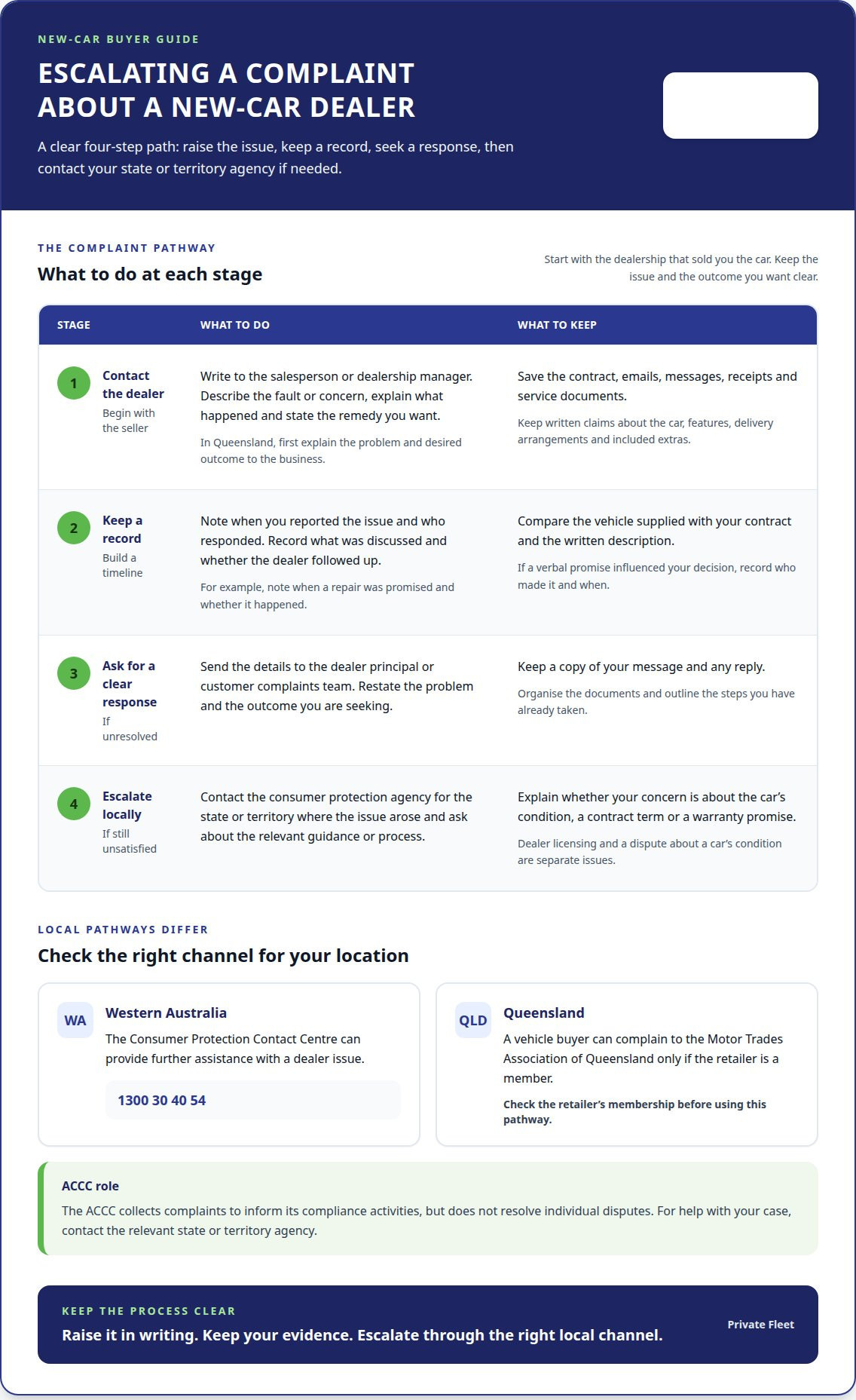
Start by raising the problem with the dealership that sold you the car. Explain what happened, what evidence supports your account and the outcome you want. Put the complaint in writing to keep the issue focused and create a record if you need to escalate it.
- Contact the dealer. Write to the salesperson or dealership manager, describe the fault or concern, and state the remedy you want. In Queensland, buyers should first explain the problem and desired outcome to the business.
- Keep a record. Save the contract, emails, messages, receipts and service documents. Note when you reported the issue and who responded. For example, record the date a promised repair was discussed and whether the dealer followed up.
- Ask for a clear response. If the first contact doesn’t resolve the complaint, send the details to the dealer principal or customer complaints team. Restate the issue and requested outcome, and keep a copy of your message.
- Escalate within your state or territory. Contact the relevant consumer protection agency for guidance if the dealer’s response remains unsatisfactory.
Keep copies of written claims about the car, its features, delivery arrangements and included extras. Compare them with your contract and the vehicle supplied. If a verbal promise influenced your decision, note who made it and when. This record can help show whether a specific representation was made and met.
Dealer licensing is administered by state and territory agencies. Identify where the dealership operates and contact the relevant consumer protection agency if you need to understand local licensing rules. A licensing concern and a dispute about a car’s condition are separate issues, so explain each one clearly.
In Western Australia, buyers can call the Consumer Protection Contact Centre on 1300 30 40 54 for further assistance with a dealer issue. In Queensland, a vehicle buyer can complain to the Motor Trades Association of Queensland only if the retailer is a member. Check membership before using that complaint pathway.
The ACCC collects complaints to inform its compliance activities, but it does not resolve individual disputes. For help with your case, contact the relevant state or territory agency. Organise your documents and outline the steps you have already taken.
The practical steps are the same across Australia: raise the issue with the dealer, keep a written record, then seek state or territory assistance if it remains unresolved. The complaint channels vary by location.
Australian Consumer Law and guarantees for new cars
Australian Consumer Law (ACL) guarantees set baseline rights for new-car buyers alongside manufacturer warranties. They apply to goods bought on or after 1 January 2011.
Where Australian Consumer Law protections apply
ACL consumer guarantees apply to new cars bought from licensed dealers, including purchases arranged online. Buying online does not by itself remove those protections. Check the contract to identify the dealer named as the seller. The guarantees apply whether you complete the paperwork in a showroom or electronically.
For business-use purchases, whether consumer guarantees apply depends on the transaction and the buyer’s circumstances. Queensland consumer guarantees apply to all new cars, regardless of price. Check who is named as the purchaser and how the car is being acquired. The ACL requires a car to be of acceptable quality, fit for a purpose disclosed before purchase, and consistent with its description or demonstration model. Acceptable quality includes being safe, durable and free from defects.
If an advertised new-car variant includes a particular feature, the supplied vehicle should match that description. Keep the advertisement with the contract if the specification is disputed.
Checking contracts and car details
Before signing, read the sale contract and check that it records the agreed car and terms. Licensed car dealers must provide a copy when the buyer decides to buy. At delivery, compare the model, variant, features and included extras with the contract and advertised specifications. Keep copies of the documents as evidence of what was agreed.
New-car buyers should receive the “Just bought a new car?” fact sheet at the point of sale. The manufacturer’s warranty is separate from ACL guarantees and cannot remove your automatic legal rights. Guarantees may remain relevant after a warranty expires, for a reasonable time, subject to exceptions such as abnormal consumer use.
Manufacturers and importers must provide spare parts and repair facilities for a reasonable time after purchase. Keep service records with the contract and delivery paperwork, particularly if a later repair depends on obtaining a replacement part.
State and territory protections
State and territory laws may add protections or provide different complaint and dispute processes. The relevant agency and pathway depend on the jurisdiction, so identify where the issue arose before escalating it. This explains why local procedures can differ despite a shared national ACL baseline.
Queensland applies consumer guarantees to all new cars, regardless of price. State and territory agencies administer dealer licensing, and local dispute processes can differ. If a dispute arises, identify whether it concerns an ACL guarantee, a contract term or a warranty promise. Keeping these issues distinct helps you explain the problem through the appropriate process.
Minor and major problems: available remedies
Under the Australian Consumer Law, the remedy for a new-car fault depends on its seriousness and effects. This distinction determines whether the supplier can choose the initial fix or you can reject the vehicle.
A failure may be major if it makes the car unsafe. A defect affecting braking or steering, for example, may create a serious safety risk. For a major failure, you can reject the car and choose a refund or replacement. You may also seek compensation for a drop in value or reasonably foreseeable loss or damage caused by the failure.
A minor failure is one the supplier can correct. A faulty component that can be repaired or replaced may be a minor failure, depending on its effects. The supplier can choose to repair or replace the car, or provide a refund. A repair for a minor failure must be free and completed within a reasonable time.
In Queensland, the business must attempt to correct a minor fault, deficiency or failure. If it is not fixed within a reasonable time, you may ask for a free replacement or refund. You may instead arrange a repair elsewhere and seek to recover its cost. Keep invoices and records showing what was repaired and when you gave the supplier an opportunity to respond.
- Describe what the fault does. Explain when it occurs, how it affects normal use, and whether it raises a safety concern.
- State the remedy you want. For a minor issue, explain the correction you’re seeking. For a major failure, say you’re rejecting the car and specify a refund or replacement.
- Keep supporting records. Save repair assessments, correspondence and receipts to show the fault’s history and consequences.
A manufacturer’s warranty does not determine whether an ACL failure is major or minor. Consumer guarantees may continue after the warranty expires, and an offer to repair under warranty does not remove those rights. Consider the defect and its impact, not just whether a warranty claim has been accepted.
Repeated repairs can help show how a fault affects the vehicle, but repetition alone does not automatically make it a major failure. A recurring issue affecting safe steering, for example, has different consequences from a component fault corrected promptly. Explain the problem clearly to the supplier and keep each repair record.
Consumer protection for new car buyers in Australia depends on the fault’s actual impact and the remedy available under the ACL. It also means distinguishing warranty processes from legal guarantees, then clearly explaining the problem and the outcome you want.
Cancelling a new-car sale contract
A signed new-car contract is generally binding, and changing your mind does not automatically cancel it. The rules vary across Australia, so your state or territory and the contract’s status matter.
In Western Australia, a vehicle sale contract with a licensed dealer becomes legally binding once both parties sign. There’s no cooling-off period for vehicle sales, but you can withdraw before you and the dealer have both signed. If you cancel after signing, the dealer can charge no more than 5% of the total purchase price as pre-estimated damages.
Queensland also has no cooling-off period for a new-car sale, and its vehicle sale contracts are legally binding. In Victoria, VCAT can hear cases where a buyer seeks to cancel a vehicle sale bought for A$40,000 or less. These examples show why location and the stage of signing matter; don’t assume one state’s process applies elsewhere.
Before signing, read every page and make sure the contract is complete. In Queensland, keep a copy of what you sign and do not sign an incomplete contract. Check that the vehicle, price, delivery terms, accessories and dealer add-ons are recorded accurately. If an accessory or protection product is optional, make sure its inclusion and cost are clear before agreeing.
Deposits and finance affect the practical steps, but they do not create a general right to cancel. In Queensland, pay only the minimum deposit the dealer will accept, understand whether and on what terms it is refundable, and get a receipt. Before agreeing to finance, read the written loan or lease terms, including the amount borrowed, repayments, interest and fees.
Dealers and credit providers arranging car finance must make sufficient enquiries, verify your financial situation and explain key loan or lease terms in writing. In Western Australia, understand the finance contract before agreeing. If the finance and vehicle contracts are separate, read how each treats cancellation. Do not assume ending one automatically ends the other.
- Before signing: resolve unclear terms and keep a copy of the completed contract.
- After signing: tell the dealer in writing if you want to cancel, and ask for the contractual basis and any claimed amount.
- If there’s a defect: distinguish a change-of-mind request from rejection based on a major Australian Consumer Law failure.
A cancellation dispute may need to follow a state-specific resolution process. Keep the contract, deposit receipt, finance documents and written communications together so you can explain exactly what was agreed and when.
Do Australian Consumer Law protections cover new cars bought through dealers, online, or for business use?
Australian Consumer Law protections can apply to a new car bought from a licensed dealer, whether the purchase is arranged in person or online. For business-use purchases, coverage depends on the circumstances, so do not assume every business transaction receives the same consumer guarantees.
The key issue is who sells the car and whether the buyer is covered as a consumer, not whether the paperwork is completed in a showroom. Buying through a dealer provides automatic consumer protections. If an online listing leads to a sale with a licensed dealer, keep the dealer’s identity and final contract clear. Buying online does not make the seller’s identity irrelevant.
Before paying or signing electronically, save the listing, written representations, contract and messages about the vehicle. If an online advertisement describes a particular variant or feature, for example, keep it with the sale documents. These records help show what was represented if the delivered car or paperwork differs.
For business use, consider the buyer’s purpose as well as the fact that the vehicle is new. An individual buying a car for personal use is in a different position from a buyer acquiring one for business. The buyer’s circumstances and transaction affect whether consumer guarantees apply. Check whose name appears as buyer, how the vehicle will be acquired and which contract terms govern the sale.
Business buyers should distinguish ACL consumer guarantees from a manufacturer’s warranty or written contract rights. A warranty does not replace automatic legal protections where they apply. Keep the warranty documents with the contract, but do not rely on the warranty wording alone to decide whether the ACL covers the purchase.
Use this practical sequence before completing a dealer purchase online or for business purposes:
- Identify the seller. Confirm the contract names the licensed dealer, not merely an online platform or intermediary.
- Confirm the buyer. Check whether the individual or business is recorded as the purchaser and how the car will be used.
- Keep the transaction record. Save the advertisement, agreed specifications, contract and delivery documents together.
- Separate the rights. Note which terms come from the contract, which come from a warranty, and whether ACL guarantees apply.
These distinctions help direct a complaint to the right issue. A private buyer disputing a dealer-supplied new car can raise applicable consumer guarantees with the supplier. A business purchaser should first establish whether the transaction qualifies for those protections, rather than assuming personal-buying rules apply unchanged.
Private Fleet: New-car buying support and protection products
Private Fleet can help when you’re ready to move from understanding your rights to arranging a new-car purchase. Its independent buying service works with a national network of authorised dealerships, inviting dealers to tender for your exact car. You choose the make, model and variant; the process supports a clearer path from your shortlist to an agreed purchase.
Private Fleet handles negotiation and paperwork, then provides regular delivery updates. This can suit buyers who want help coordinating the purchase, comparing offers for the vehicle they’ve chosen, or managing the steps involved in ordering. Explore the new-car buying service to see how it fits your plans.
Before the tender process, decide what matters most: your preferred make and model, variant, essential features, postcode and buying timeframe. A precise brief helps dealers respond to the same requirements, making the offers easier to assess. Consider the full terms, including what’s included, delivery arrangements and any extras, rather than focusing only on a headline figure.
Trade-in assistance can help coordinate your current vehicle as part of the new-car purchase. Keep the trade-in discussion separate from the new-car offer so you can understand each part of the transaction. Car protection products are optional and have their own terms. They do not replace your automatic rights under Australian Consumer Law.
- Share your shortlist: provide your preferred make, model and variant, plus any must-have features.
- Set your location and timing: include your postcode and buying timeframe so the request reflects your circumstances.
- Review the offer details: compare the vehicle specification, included items and purchase terms before proceeding.
- Plan related arrangements: raise trade-in assistance or protection products as separate parts of your decision.
Private Fleet is a practical next step if you’ve settled on a new car and want support coordinating the purchase through its dealer network. It doesn’t hold its own vehicle inventory; dealers supply the cars. You remain in control of the vehicle you choose and whether to proceed with an offer.
To discuss your preferred make and model, postcode and buying timeframe, contact Private Fleet or call 1300 303 181.
Frequently Asked Questions
Are there lemon laws for new cars in Australia?
Australia has no specific lemon law. New cars bought from licensed dealers can still be protected by Australian Consumer Law guarantees, while state and territory rules may add protections. For a new-car fault, describe the problem and its effects, then identify the relevant consumer guarantee rather than relying on the label “lemon”.
What if the car dealer or trader doesn’t fix the problem with my lemon car?
If the dealer does not resolve the fault, keep your complaint and the dealer’s response in writing, then contact your state or territory consumer protection agency about the dispute pathway. The remedy depends on whether the failure is major or minor and whether a reasonable time has passed. The ACCC collects complaints to inform compliance activity but does not decide individual disputes. Organised records help explain what happened and the outcome you want.
What is a lemon car?
“Lemon car” is an informal term for a vehicle with a serious or persistent problem, not a formal legal category in Australia. A new car that repeatedly develops the same fault, for example, may raise questions about whether it meets consumer guarantees. The label alone does not establish a right to reject the vehicle. Explain the specific defect, its effects and its repair history to the dealer.
What is a manufacturer’s warranty?
A manufacturer’s warranty covers specified vehicle faults or repairs for a stated period, subject to its terms. The warranty booklet explains what is covered, exclusions and any conditions attached to a claim. Keep it with your purchase and service records. If a dashboard warning appears, for example, the booklet can explain how the manufacturer’s warranty process handles it, while separate consumer rights may also apply.
What consumer guarantees apply when buying a new car in Australia under the Australian Consumer Law?
The Australian Consumer Law requires a new car to be of acceptable quality, fit for a purpose disclosed before purchase, and consistent with its description or demonstration model. Acceptable quality includes being safe, durable and free from defects. If you explained before buying that the car needed to perform a particular task, that disclosed purpose may be relevant. Keep a written record of the discussion and the vehicle’s advertised specifications.
What rights do new car buyers have if a vehicle is faulty, unsafe, or repeatedly needs repairs?
New-car buyers can seek a remedy from the supplier when a vehicle fails a consumer guarantee. An unsafe fault, such as a problem affecting braking or steering, may indicate a major failure. A fault that can be corrected may be minor. If the same problem returns, record each repair visit and its effect on the car. Recurring repairs do not automatically determine the legal classification, but the history helps explain the fault’s impact.
When is a new car fault considered major, and can the buyer reject the car or get a refund?
A failure may be major if it makes the car unsafe, such as a defect affecting steering or braking. For a major failure, you can reject the car and choose a refund or replacement, or seek compensation for a drop in value. Keep the dealer’s repair records and evidence of the safety issue. A minor problem has a different remedy process, so explain the fault’s actual consequences rather than relying only on its name.
What are the manufacturer’s new-car warranty terms in Australia, and how do they differ from consumer guarantees?
Manufacturer warranty periods and conditions depend on the vehicle and its warranty terms. Many major car brands in Australia offer a five-year warranty, while some offer seven- or ten-year warranties, subject to conditions. Electric vehicles may have separate warranties for the vehicle, battery and dash device. These commercial warranties do not replace Australian Consumer Law guarantees, which may apply beyond a warranty’s expiry for a reasonable time, subject to exceptions.