
Choosing a Corvette Stingray means looking beyond its headline price or performance figures. A useful comparison depends on what each offer includes, how the specifications are presented and which details matter to you. Assessing these points together helps you compare offers without assuming every car is configured the same way.
This guide brings key buying questions together. It explains Australian price references and the factors that shape an offer, then looks at the powertrain, acceleration claims and cabin technology. It also covers how model years and trim levels affect your shortlist, helping you focus on a configuration that fits your priorities.
Use these details to build a clearer picture before comparing offers. A price needs context, performance claims need a stated measurement and specification, and equipment should match the vehicle being considered. The sections ahead connect these details with practical new-car buying choices in Australia, so you can make a more informed shortlist.
Key Takeaways
- Compare coupe and convertible offers on an equivalent basis, including the same specification and price inclusions.
- Use acceleration and quarter-mile figures to understand performance, while keeping the stated test conditions in mind.
- Choose between trims by weighing the cabin features, seating and technology that matter most to your driving.
- Check how model year and equipment affect the car you’re considering before comparing new-car offers.
- Private Fleet can tender your chosen specification across its authorised dealer network and assist with negotiation and paperwork.
How much is a Corvette Stingray?
This price reference was checked in October 2026. It is an advertised listing, not a drive-away figure or a promise of availability. Registration, stamp duty and other government charges affect the total, so compare offers on the same price basis.
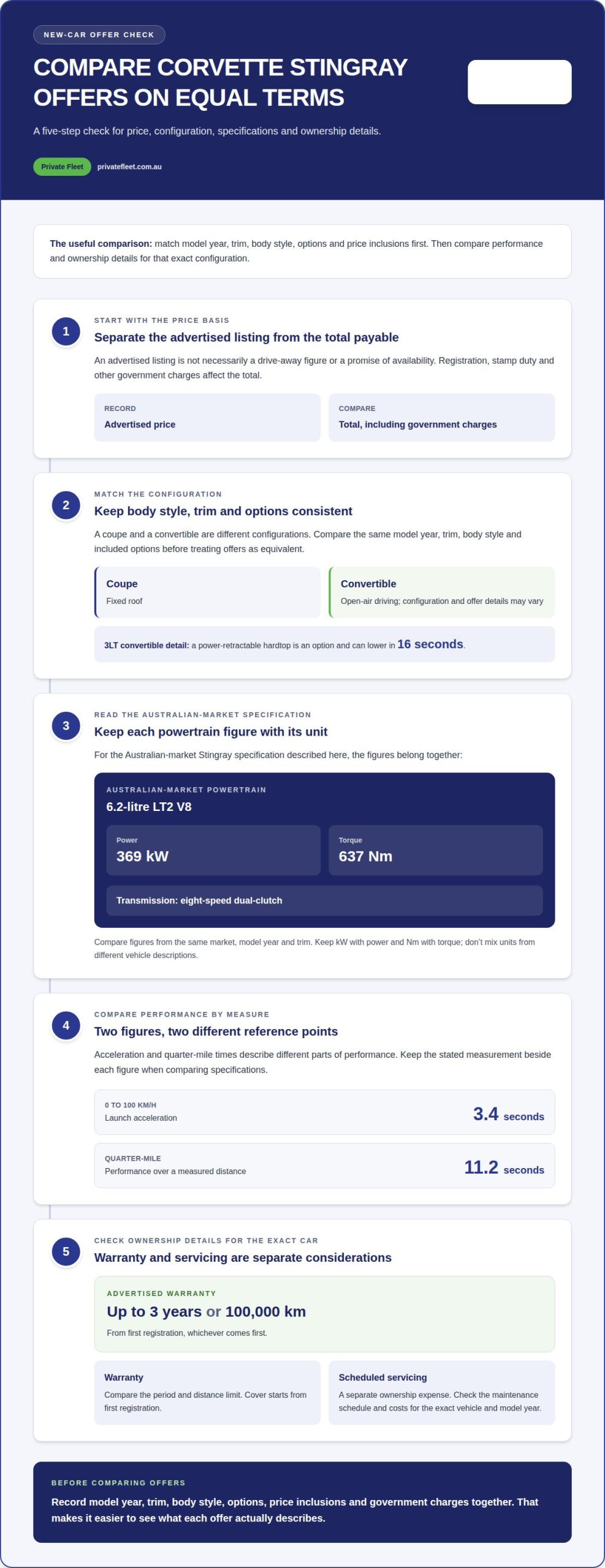
For a like-for-like new-car comparison, match the model year, trim, body style and included options. Compare the total amount, including government charges, for equivalent specifications. A coupe and a convertible are different configurations, so their offer details may vary. Check what each offer includes before treating advertised prices as directly comparable.
Coupe and convertible styles
The coupe has a fixed roof; the convertible offers open-air driving. A power-retractable roof is an option on the 3LT convertible, and its hardtop can lower in 16 seconds. Compare the body styles with equivalent trims and equipment. Then weigh the convertible roof’s appeal against its effect on the configuration and overall purchase budget.
What warranty and servicing costs apply in Australia? The advertised warranty covers up to three years or 100,000 km from first registration, whichever comes first. Servicing is a separate ownership expense; compare the applicable maintenance schedule and costs for the exact vehicle and model year.
Warranty and servicing costs
Warranty cover and scheduled servicing are separate considerations. Compare the warranty period, distance limit and maintenance requirements for the vehicle you’re considering. Since cover starts from first registration, both elapsed time and kilometres matter. Include scheduled servicing in your ownership budget; warranty cover does not replace maintenance.
What safety features and ANCAP rating does the Australian model have? Check the exact model year’s Australian-market safety equipment and published ANCAP result. Don’t infer a star rating from features alone.
What common problems and owner-reported reliability issues should buyers consider? Distinguish recurring concerns reported for the same model year from isolated experiences. Look for specific fault descriptions and reports identifying a shared component or operating condition, rather than treating every owner comment as proof of a widespread issue.
For a useful new-car comparison, record the model year, trim, body style, options, price inclusions and government charges together. This lets you compare coupe and convertible offers on equivalent terms and see which equipment is included. Keep the advertised price distinct from the total payable amount.
Engine and transmission details
The Australian-market powertrain combines a V8 engine with a dual-clutch transmission. The figures introduced earlier describe the engine’s capacity and outputs; here, the useful distinction is what each specification tells you. Read engine type, capacity, power and torque as separate details, rather than assuming one figure summarises the complete driving experience.
“LT2” identifies the engine family, while “V8” describes its cylinder arrangement. Capacity is measured in litres and indicates the volume displaced by the engine’s cylinders. These labels help you identify the specified powertrain when comparing vehicles. They don’t, on their own, establish how the car will feel in every driving condition.
Power and torque use different units and describe different aspects of engine output. Australian specifications express power in kilowatts and torque in newton metres; overseas listings may use horsepower or pound-feet. Keep the market and units beside each figure so a change in measurement isn’t mistaken for a different engine specification.
A transmission description has two parts. “Eight-speed” refers to the forward ratios, while “dual-clutch” identifies the transmission design. A listing that gives only the number of speeds leaves out this second detail. Compare both terms rather than assuming transmissions with the same gear count work in the same way.
Use the Australian-market specification for the precise model year and trim you’re considering. Vehicles from other markets may use different units or have a different configuration. Don’t combine an overseas power figure with an Australian torque figure. Compare figures from the same vehicle description, and note the stated engine and transmission.
Use this quick reading guide:
- Engine family: identify the engine designation shown.
- Configuration: note the cylinder arrangement.
- Output units: keep kW and Nm with their matching figures.
- Transmission: record both its gear count and design.
This approach keeps comparisons clear without relying on one headline number. The engine designation and configuration identify the powertrain, while the output figures describe separate measures. The transmission description adds another useful distinction. If listings seem inconsistent, first check that they refer to the same market, model year and trim.
The Australian-market Chevrolet Corvette Stingray has a 6.2-litre LT2 V8 engine, producing 369 kW of power and 637 Nm of torque. The 2027 Chevrolet Corvette Stingray has an LS6 6.7L V8 engine, producing up to 535 horsepower and 520 lb.-ft. of torque. These specifications belong to distinct versions, so keep their market and model-year labels with their respective figures.
Acceleration and quarter-mile performance
The Australian-market Chevrolet Corvette Stingray accelerates from 0 to 100 km/h in 3.4 seconds. Its quarter-mile time is 11.2 seconds. Together, these figures describe rapid launch acceleration and performance over a measured distance. They offer two useful reference points when comparing specifications, but each measures a different part of acceleration.
Zero to 100 km/h focuses on the time needed to reach a set road speed from a standstill. The quarter-mile figure measures elapsed time across a fixed distance. It also reflects how acceleration continues beyond the initial launch. For a buyer, the distinction matters: neither number alone describes every aspect of everyday driving.
The 2027 specification gives a separate benchmark. With the available Z51 Performance Package, the Stingray can reach 0 to 60 mph in as little as 2.8 seconds. Published quarter-mile figures can provide a useful point of comparison, but their test conditions and specifications should be checked. Keep those measurements in their original units when comparing them with Australian figures.
A 0 to 60 mph result is not the same test endpoint as 0 to 100 km/h. Likewise, the 2027 quarter-mile result and Australian-market time shouldn’t be treated as identical test results. The figures relate to different stated specifications and measurement details. Compare like with like wherever possible, including model year and equipment.
The Z51 package is relevant to the 2027 acceleration figure because that result specifically includes the package. Don’t assume the same time applies to every trim or configuration. If performance is central to your decision, identify the model year, package and measurement units alongside each published result. That makes the comparison more useful than relying on a headline time.
Use these steps to read a performance claim:
- Match the benchmark: compare 0 to 100 km/h with the same measure.
- Check the distance: quarter-mile times cover a different test from a standing-start speed run.
- Note the specification: the 2027 2.8-second figure includes the available Z51 Performance Package.
- Keep units clear: retain km/h and mph as stated.
For Australian buyers, the 3.4-second 0 to 100 km/h and 11.2-second quarter-mile figures provide locally relevant reference points. The 2027 figures add context, but use their stated mph units and package detail. Treating each result carefully helps distinguish the car’s published acceleration claims without confusing measurement methods or equipment.
Displays and performance technology
The 2026 Chevrolet Corvette Stingray has three display sizes. Its centre console display measures 12.7 inches diagonally. The Driver Information Center measures 14 inches diagonally. An auxiliary touchscreen measures 6.6 inches diagonally. These figures help describe the cabin layout, but screen size alone doesn’t show how easy each display is to use.
Each measurement refers to a different display. The 14-inch Driver Information Center is the largest, while the 6.6-inch auxiliary touchscreen is the smallest. The 12.7-inch centre console display sits between them by diagonal measurement. Comparing their positions and the information shown on each matters more than treating them as one combined screen.
For a practical assessment, consider the three displays separately. The centre console display is the largest touchscreen listed. The Driver Information Center is a separate display, not another name for the centre console. The auxiliary touchscreen is a third screen. When comparing vehicles, check which trim and model year the listed equipment applies to.
The 2LT specification also includes two wireless phone chargers. It has a 14-speaker Bose Performance Series sound system. Those details add useful context to the screen measurements: the cabin technology includes both display equipment and audio or phone provisions. Keep each item attached to its stated trim when comparing specifications.
- Centre console: 12.7-inch diagonal display on the 2026 model.
- Driver Information Center: 14-inch diagonal display.
- Auxiliary touchscreen: 6.6-inch diagonal display.
- 2LT equipment: two wireless phone chargers and a 14-speaker Bose Performance Series sound system.
These specifications give a clearer picture than a general claim about “large screens”. The diagonal measurements identify display size, while the 2LT equipment list names specific phone and audio features. They don’t establish how menus are arranged or which information appears on each screen, so avoid assuming a feature from screen size alone.
For a new-car comparison, match the model year and trim before judging technology. A 2026 specification and 2LT equipment detail are not interchangeable labels. Record the screen sizes, chargers and Bose system as separate items. This simple approach makes differences between vehicle specifications easier to identify without confusing trim equipment with standard cabin displays.
Stingray model years and trim levels
The eighth-generation Chevrolet Corvette Stingray arrived in 2020. Its model year and trim both matter when comparing Australian new-car offers. A generation identifies the broader design era; a trim identifies an equipment level within that era. Don’t treat those labels as interchangeable.
The Stingray name also spans earlier Corvette generations. The second-generation Corvette Sting Ray was introduced in 1963. The third-generation Corvette followed in 1968, and carried the Stingray name from 1969 through 1976. The seventh-generation Stingray arrived in 2014. These dates help distinguish modern specifications from historic models.
For current Australian comparisons, focus on the specific new vehicle and its stated model year. The 2LT and 3LT are two trim levels to compare. Their listed wheel sizes are 19-inch fronts and 20-inch rears. That shared specification means wheel size alone won’t distinguish these trims.
Seat specification offers a clearer distinction. The 2LT includes GT1 seats as standard, while the 3LT includes GT2 seats as standard. If seat design is important, compare the exact trim rather than assuming the higher number describes every feature. Also consider coupe or convertible configuration when reviewing an offer.
Use this practical comparison sequence:
- Identify the year: record the model year shown for each new vehicle.
- Match the trim: compare 2LT with 2LT, or 3LT with 3LT.
- Separate body styles: compare coupe offers with coupes, and convertibles with convertibles.
- Check equipment: note seat type, wheels and included options separately.
A familiar name doesn’t ensure identical equipment across years. For example, a 2020 eighth-generation car belongs to a different generation from the 2014 seventh-generation model. That distinction matters when interpreting specifications or comparing an older model year with a new-car offer.
Trim choice comes down to the equipment and seating that suit you. The 2LT’s GT1 seats and 3LT’s GT2 seats provide a concrete starting point. Confirm the precise model year, trim, body style and included options shown on each Australian offer. This gives you a like-for-like comparison, rather than relying on the Stingray badge alone.
Historical examples can also make the model-year label more useful: Rolf Sellentin’s Corvette Stingray is a 1980 model. That places the car outside the eighth-generation arrival discussed for current Australian offers, so its year should be read as an identifier, not as evidence that its equipment matches a modern Stingray. When a Stingray appears in a different context, keep its model year attached to the vehicle and avoid carrying trim assumptions from another year into the comparison.
Offer terms deserve separate attention alongside year, trim and body style. The advertised warranty covers up to 3 years or 100,000 km from first registration, whichever comes first. Read that limit independently of the vehicle’s badge or seat specification, and confirm that the warranty wording applies to the particular offer being considered. Keeping the warranty and equipment notes separate makes it easier to compare cars without treating a shared Stingray name as proof that the overall offers are alike. A clear record of the model year, trim, configuration, included options and warranty terms helps keep the comparison focused on the vehicle actually advertised.
Private Fleet
Private Fleet helps arrange new Chevrolet Corvette Stingray purchases through its national dealer network. Its independent new-car buying service takes your chosen model, trim and body style to dealers through a tender process, where dealers compete for your business on the specified car.
This can help when your shortlist is clear but comparing offers takes time. For example, you might want a particular model year, 2LT or 3LT trim, and coupe or convertible body style. Private Fleet can use those details to seek offers that match your preferred specification, rather than treating every Stingray as equivalent.
Clear details make the comparison more useful. Your preferred trim, body style, options, postcode and buying timeframe help define what you want. The team assists with negotiation and purchase paperwork, so you have support through the steps between agreeing on a vehicle and arranging its purchase. The process is explained in more detail in the new-car buying process.
Keep the comparison focused on the new car. A coupe offer and convertible offer are different configurations; so are 2LT and 3LT specifications. When terms vary, compare the model year, exact trim, included options and price basis. This helps you understand what each offer covers without assuming a particular price or vehicle availability.
Private Fleet provides updates as your purchase progresses, without promising a particular delivery date. If you have a car to trade in, trade-in assistance can be part of the process. Car finance is also available, while your chosen vehicle specification remains central to the decision.
You remain in control of the key choices: which Stingray configuration suits you, which equipment matters and when you intend to buy. Private Fleet takes your requirements to its dealer network, manages the tender and purchase paperwork, and keeps you updated during delivery. Once you know the model and trim you want, request a quote from Private Fleet.
For help with your preferred Chevrolet Stingray, share your model and trim, postcode and buying timeframe. Call 1300 303 181 or contact Private Fleet.
Frequently Asked Questions
What is the current Corvette Stingray price in Australia?
That listing is a price reference, not a national drive-away price. Account for the exact model year, trim, body style, options and government charges when comparing offers. Request prices on the same specification so you can assess their total price basis clearly.
Which Corvette Stingray models and trim levels are available in Australia?
Australian-market examples include 2LT and 3LT trims, offered in coupe and convertible body styles. The right comparison depends on the exact model year and configuration being offered. For instance, compare a 3LT coupe with another 3LT coupe before weighing price or equipment. A listed new 2026 3LT R coupe shows one specific configuration, rather than confirming every trim or body style is available at a given time.
Is the Corvette Stingray available with a manual transmission in Australia?
The Australian-market Corvette Stingray specification described here does not list a manual transmission. It uses an eight-speed dual-clutch transmission. If transmission choice is central to your decision, compare the specification for the exact model year and trim rather than relying on information from another market. Overseas specifications may differ, so make sure any quoted vehicle matches Australian-market equipment before comparing its price or features.
What are the Corvette Stingray’s dimensions, seating capacity and luggage space?
The Corvette Stingray is 182.3 inches long and seats two adults.
What are common Corvette Stingray problems and owner-reported reliability issues?
Look for recurring concerns reported for the same model year and distinguish them from isolated experiences. Give more weight to reports that identify a shared component or operating condition.