
When buying a new car, compare the drive-away price and the total cost of the purchase, not just the advertised finance rate. A dealer may arrange finance through a third-party lender, while a bank loan is a separate way to fund the purchase. Either could suit you, so compare the car price, total repayments, fees and any final balloon payment over the full loan term.
Finance arranged alongside a new-car purchase can be convenient, but a lower regular repayment may leave a larger amount due at the end. Fees can also change the total cost. A car loan is money borrowed to help buy a vehicle, then repaid over an agreed term with interest and any applicable charges.
This comparison explains how to assess new-car offers alongside interest rates, comparison rates, fees, balloon payments and repayment flexibility. Use the practical checks below to compare the purchase and finance costs, and decide whether dealer-arranged finance or a separate bank loan better fits your budget.
Key Takeaways
- Compare the car’s drive-away price, variant and included features to understand what each offer covers.
- Check the offer conditions and any fees that could affect the total purchase cost.
- Consider delivery timing, warranty and servicing alongside the vehicle’s price and specifications.
- If you use finance, compare the total repayment cost and any balloon payment as part of the broader purchase decision.
- A new-car buying service can coordinate dealer tenders, negotiation and finance assistance in one purchase process.
Are comparison rates more important than the headline interest rate?
When comparing new-car offers, the comparison rate can help you assess finance costs alongside the vehicle’s price and other purchase costs. It combines the advertised interest rate with certain fees and charges. Under the National Consumer Credit Protection Act 2009, lenders must display it beside the advertised rate.
With dealer finance, the dealership arranges an application through a third-party lender. With a bank loan, you apply directly to the lender. In either case, you submit an application, receive an assessment and offer, then review the loan details before signing.
Interest Rates and Comparison Rates
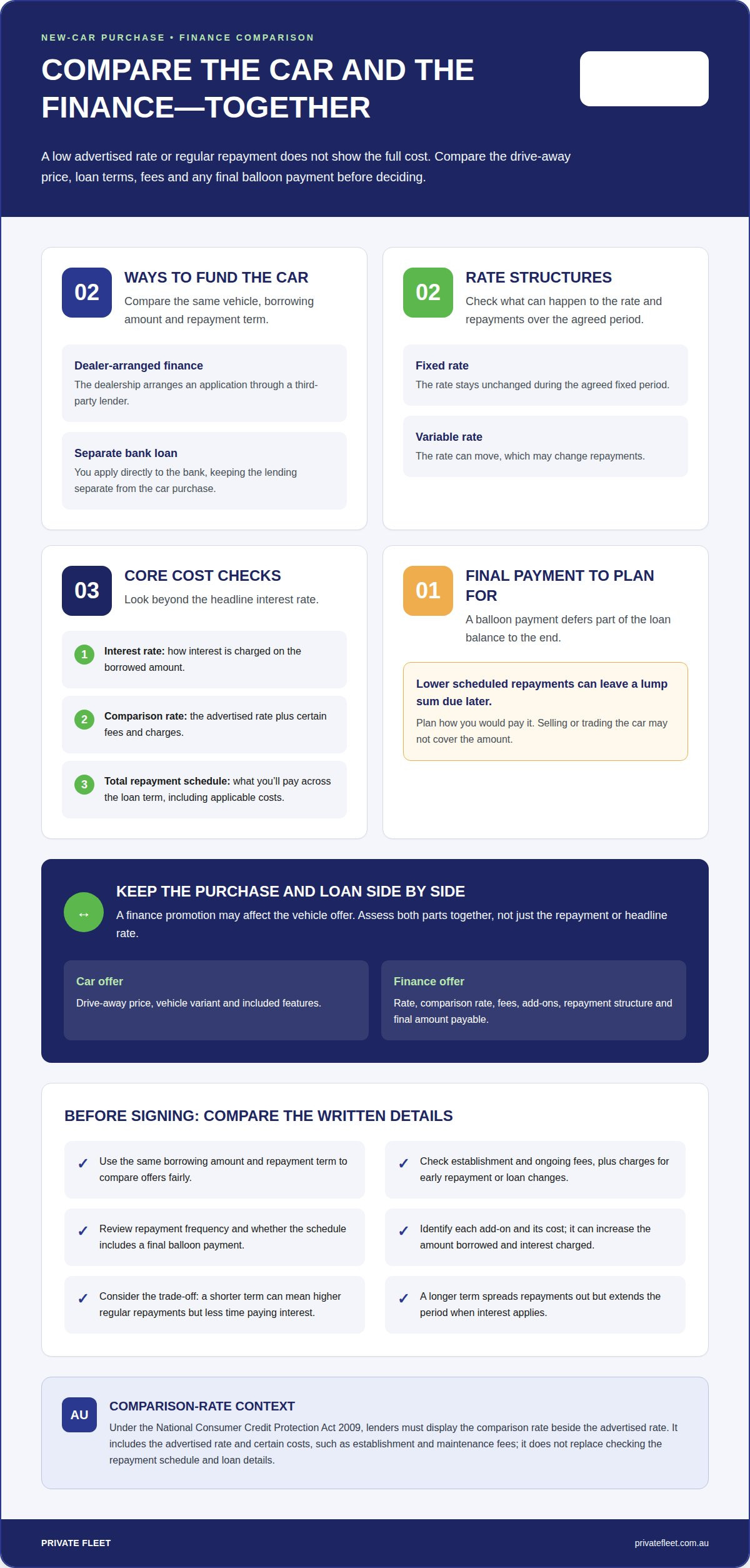
The interest rate determines how interest is charged on the borrowed amount. The comparison rate includes the advertised rate and certain costs, such as establishment and maintenance fees. Compare both rates for the same loan amount and term, alongside the new car’s purchase price. A low headline rate may look attractive, but fees can push the comparison rate higher. Fixed rates stay unchanged during the agreed period; variable rates can move.
| Option | Rate basis | What to compare | Useful distinction |
|---|---|---|---|
| Dealer-arranged finance | Fixed or variable | Interest, comparison rate and fees | The dealership arranges finance through a lender. |
| Bank car loan | Fixed or variable | Interest, comparison rate and fees | You apply to the bank directly. |
| Fixed-rate offer | Rate stays unchanged | Repayments and total cost over the term | Rate certainty during the fixed period. |
| Variable-rate offer | Rate can change | Repayments if the rate moves | Repayments may change with the rate. |
Australian loan offers vary by lender, borrower and loan structure. Treat advertised rates as a starting point, then compare written offers using the same borrowing amount and repayment term when assessing the overall cost of your new-car purchase. A secured car loan uses the vehicle as security; an unsecured personal loan does not.
Loan Costs and Total Repayments
A comparison rate reveals some costs beyond interest, but the repayment schedule shows what you’ll pay across the loan term. When weighing up a car and its drive-away price, check establishment and ongoing fees, repayment frequency, and charges for early repayment or loan changes. Compare the same amount and term so you’re assessing the offers, not different assumptions.
A shorter term can mean higher regular repayments but less time paying interest. A longer term spreads repayments out but extends the period when interest applies. Check how a fixed or variable rate could affect repayments, and whether the quoted schedule includes a final balloon payment. Read the offer before signing.
Choose a car and finance offer that suit your budget, considering the purchase price, repayments and total costs, not simply the lowest advertised interest rate.
Compare dealer finance with the new-car offer
Dealer-arranged finance can combine the car purchase and credit application, while a bank loan keeps the lending separate. Compare both finance terms and the new car’s drive-away price.
Fees or add-ons can increase the amount financed, while a balloon payment leaves a large final sum due. With a secured car loan, the vehicle acts as security for the lender, so missed repayments can put it at risk.
Rates and promotions to compare
Dealer finance is arranged through a third-party lender, so the dealership presents the lender’s offer rather than lending its own funds. A promotional rate may appeal, but its conditions and total cost matter more than the headline rate alone. The promotion may also affect the vehicle offer, so compare the drive-away price and finance terms together.
Don’t assume an interest rate or promotion is negotiable. Instead, compare the written offer with a separate bank loan for the same vehicle, borrowing amount and term. Check whether the promotion changes eligibility, fees, repayment structure or the final amount payable. That makes it easier to judge whether the finance suits your purchase.
Finance risks and add-ons
A balloon payment lowers scheduled repayments by deferring part of the loan balance, but leaves a lump sum due at the end. Plan how you’ll pay it, as selling or trading the car may not cover the amount. Add-ons can also increase the amount borrowed and the interest charged, so identify each product and its cost in the contract.
A secured loan links the debt to the car. If repayments fall behind, the lender may enforce its security rights under the loan agreement. Before signing, read the conditions, fees and repayment obligations, and consider how the agreement could affect your budget if circumstances change.
For either application, first choose the new car and work out how much you need to borrow. With dealer finance, provide the required details through the dealership so the lender can assess your application. For a bank loan, apply directly to the bank, then use its lending decision to set your purchase budget. In both cases, review the approved amount and contract before committing.
Compare a finance promotion with the full drive-away price and check the conditions attached to the offer. A lower repayment alone doesn’t show whether you’ll pay more over the loan term. Keep the car purchase and finance figures side by side, noting fees, add-ons and any final payment.
If you’re comparing a new-car offer and its finance, talk with Private Fleet about your buying options or call 1300 303 181.
How can repayments and loan terms fit your new-car budget?
Start by setting a realistic budget for the car and its ongoing costs. Treat repayments as one consideration when comparing new-car options, alongside the purchase price, running costs and your other household expenses.
Personal loans and car loans can work differently. A secured car loan uses the vehicle as security, while an unsecured personal loan does not. Secured car loans usually have lower interest rates than unsecured personal loans. IMB Bank says unsecured loans typically have higher rates and may have stricter approval criteria.
If you are considering a loan, compare the loan term, repayment frequency and total amount payable. Australian car loan terms can extend up to seven years, depending on the lender and borrower preference. A longer term spreads repayments over more time, but interest accrues for longer. A shorter term reduces the time interest applies, but means repayments are due sooner.
Build a realistic budget before settling on a new car. Allow for running costs such as registration, insurance, fuel and servicing, alongside household expenses. For example, if fortnightly repayments suit your pay cycle better than monthly ones, compare offers using that frequency.
- Set a total car budget that allows for purchase and running costs.
- Compare the same borrowing amount and loan term across offers.
- Check whether extra repayments are allowed and whether early payout costs apply.
- Review how repayment frequency affects each scheduled payment.
Flexibility matters if you expect your finances to change during the loan. Ask how the agreement handles additional repayments, repayment changes and early payout. Australian borrowers should factor in possible break costs or other charges for paying off a loan early. These terms affect how easily you can adjust the loan without unexpected costs.
If a loan includes a balloon payment, build the final amount into your budget rather than focusing only on regular repayments. Consider how you would meet it alongside your other financial commitments.
Choose a new car that fits your overall budget, including its purchase price and ongoing costs. If you use a loan, consider regular repayments, total cost, flexibility and the final amount due, not simply the smallest scheduled payment.
How do fees, loan terms and total repayment costs compare?
Keep the new car’s purchase price separate from the amount you need to finance. The drive-away figure describes the vehicle purchase; the loan principal is the amount funded through borrowing. A deposit or trade-in can change that amount, so use the same assumptions when comparing purchase options.
For each offer, set out the vehicle price, your contribution, the amount borrowed and the finance charges. This shows whether a difference comes from the car deal, the amount financed or the lending arrangement. It also makes optional products easier to identify instead of burying them in one combined figure.
Use a simple side-by-side worksheet:
- Vehicle details: record the exact model, variant and drive-away price.
- Buyer contribution: note any deposit or trade-in value used towards the purchase.
- Borrowing amount: write down the amount financed after that contribution.
- Separate products: identify optional items included in the amount borrowed.
- Payment obligations: record scheduled repayments and any final lump sum.
For example, if one offer includes an optional protection product in the finance amount and another does not, the initial figures aren’t directly comparable. Identify the product and its separate cost, then decide whether it belongs in your purchase. This prevents an added item from being mistaken for part of the new car’s price.
A trade-in can also affect how much you need to borrow. Treat its value as a separate part of the purchase calculation, rather than assuming it changes the vehicle’s drive-away price. If offers use different trade-in assumptions, compare the new-car prices first, then account for each trade-in separately.
Finally, check the payment schedule for charges that may arise outside regular instalments. Look for fees linked to account maintenance, changing the agreement or paying it out early. Note the conditions attached to those charges, as they can affect plans to adjust or finish the finance before the scheduled end.
This approach keeps the car’s price, your contribution and the borrowing arrangement visible as separate figures. Once you’ve clarified each component, you can judge how the offer fits your planned purchase instead of relying on a combined figure that obscures what it includes.
How should you compare new-car offers?
Start by comparing the drive-away price and terms for the exact new car you want. Finance promotions are a secondary factor: assess them alongside the vehicle offer rather than assuming a headline rate makes it the best deal.
Some Australian manufacturers offer promotional finance at 0% interest. Treat this as one offer to assess, not a conclusion about the best deal. Check which models and variants qualify, when the offer expires and what finance structure applies. A promotion may be relevant to one car on your shortlist but not another.
Compare vehicle offers first, then consider finance as a separate part of the purchase. A promotional rate may appeal, while another offer may better suit your preferred model or purchase terms. Assess how each offer works for the exact new car you want.
Use a consistent checklist for each offer:
- Vehicle: confirm the same make, model, variant and included equipment.
- Price basis: compare drive-away prices using the same location and purchase assumptions.
- Promotion: note eligible vehicles, expiry date and any stated conditions.
- Finance structure: record the proposed term, repayment arrangement and any final balloon payment.
- Written terms: keep the vehicle offer and finance offer available together for review.
For example, imagine two written offers for the same new-car variant. One includes a promotional interest rate; the other has different vehicle pricing. Compare the vehicle prices and terms first, then consider the finance attached to each offer. This helps you assess which conditions better match your preferred car and budget, without assuming either rate or vehicle price can be changed.
Negotiation may apply differently to the vehicle price and the finance arrangement. Don’t assume a promotional rate is adjustable or that the same change can be made to every offer. Focus on the written vehicle terms first, then decide whether the finance offer suits your chosen variant.
If you’re comparing dealer finance with a bank loan for a new car, line up the vehicle offers against the same shortlist and buying timeframe. Then compare the finance options separately, keeping the decision focused on the car you want rather than a headline promotion alone.
To discuss your options, call Private Fleet on 1300 303 181.
How Private Fleet can help with your new-car purchase
Private Fleet can coordinate your new-car purchase and finance, so you can assess the vehicle offer and borrowing costs as parts of one decision. Its independent buying service sources the car you want through a national network of authorised dealerships; it does not hold its own vehicle inventory.
Once you’ve settled on a make, model and variant, Private Fleet’s tender process invites multiple dealers to compete for your business. You can compare offers for the car you want rather than weighing finance in isolation. Dealer negotiations and purchase paperwork are handled as part of the buying process.
Consider finance alongside the purchase. Review the interest and comparison rates, fees, repayment term, total payable and any balloon payment. Private Fleet offers car finance assistance, connecting the finance discussion to your new-car decision. The right loan is the one whose full terms and repayments suit your circumstances.
If you’ve chosen a particular variant but are still weighing finance options, share your shortlist and buying timeframe. This gives the team a practical starting point for coordinating the vehicle purchase and discussing finance. You can also include your postcode to help frame the purchase details relevant to your location.
Trade-in assistance can also be part of the purchase if you have a vehicle to trade. Considering the new-car choice, trade-in and finance together can make it easier to understand the overall changeover and plan your budget. You remain in control of the vehicle and finance decisions as the offer details are worked through.
Private Fleet provides regular updates on delivery times during the purchase process. That keeps you informed as your new-car order progresses, without promising a particular delivery date. The service is useful if you want support coordinating dealer offers and purchase steps, while retaining a clear view of the terms you’re accepting.
To discuss your preferred make or model, postcode and buying timeframe, contact Private Fleet or call 1300 303 181.
Make your next car decision with confidence
Bring your vehicle choice and finance decision into the same plan. Whether you’re comparing dealer finance with a bank loan for a new car or narrowing down your shortlist, focus on the purchase that suits your needs and budget for as long as you expect to own it.
Private Fleet’s New Car Buying Service sources new cars through a tender process, inviting authorised dealerships across its national network to compete for your business. Trade-In Assistance can also help you consider your vehicle choice and changeover together. Share your preferred make or model, postcode and buying timeframe to start a practical conversation about your options.
A clear shortlist and realistic budget give you a strong starting point. When you’re ready, take the next step with support to keep your purchase moving at a pace that works for you.
Frequently Asked Questions
What should I compare when financing a new car?
Compare the loan’s total cost with your budget and the vehicle’s drive-away price. Check the amount borrowed, interest rate, repayment schedule and loan term. Depending on the product, the car may also secure the loan.
How does dealer finance fit into a new-car purchase?
Dealer finance is a loan arranged through a car dealership, with a third-party lender providing the credit. The dealership helps submit the application as part of the vehicle purchase. The lender assesses the application and sets the finance offer. Check the contract to identify the lender, repayments and whether the offer depends on a particular vehicle or promotion.
Can you get pre-approved before choosing a car?
Yes, you can apply for pre-approval before choosing a specific car. It can help you understand a potential borrowing limit and set a clearer purchase budget. Pre-approval isn’t the same as final approval for a particular vehicle: the lender may still assess the car, loan details and your circumstances. Read the approval conditions and expiry date before relying on it.
What car loan structure might suit your budget?
Choose a loan by matching its repayment structure to your budget and plans for the car. A secured loan uses the vehicle as security; an unsecured personal loan does not. Consider whether you value predictable repayments, flexibility to make extra repayments, or lower regular repayments with a balloon due later. Compare the contract terms, not just the payment amount that first catches your eye.
What loan features should I check?
Common options include secured car loans, unsecured personal loans, fixed-rate loans and variable-rate loans. These labels describe different features and can overlap: a secured loan may have a fixed or variable rate. Some agreements also include a balloon payment, leaving a lump sum due at the end. Read each offer to understand its security, rate structure and repayment obligations.
What should I check in a car finance agreement?
“Car loan” usually means the credit agreement used to borrow money for a vehicle. “Car finance” is a broader everyday term for ways to fund a car purchase, including a loan arranged through a dealership or directly with a lender. In either case, focus on the written agreement: identify the lender, repayment obligations, applicable charges and what happens if you miss a payment.
How should I compare dealer finance and a bank loan for a new car?
Dealer finance is arranged through a dealership with a third-party lender, while you apply directly to a bank for a bank car loan. For a new car, compare offers for the same model, variant, borrowing amount and term. Consider how each application fits the purchase process. The right choice depends on the written terms and how they suit your budget.
How do I compare interest and comparison rates for new-car loans?
No single rate applies to every Australian borrower or offer. Interest and comparison rates depend on factors such as the lender, loan structure, fees and applicant’s circumstances. A promotional dealer rate may not reflect the total borrowing cost. Compare current written offers for the same loan amount and term, using the comparison rate alongside the repayment schedule and applicable charges.