
The easiest paint-protection option at the dealership isn’t automatically the one that suits your new car. A dealer paint protection vs aftermarket Australia comparison is less about where you buy it and more about what’s applied, how the paint is prepared and what the written terms actually cover.
It’s understandable to value the convenience of arranging protection when you buy your car. But “paint protection” can describe different products and services, so a confident sales pitch alone won’t tell you whether the offer fits your driving or ownership plans. This guide explains the differences between dealer-arranged and aftermarket options, and shows you how to compare coverage, exclusions, maintenance requirements and transferability on a like-for-like basis.
You’ll also see why ceramic coatings and paint protection film aren’t interchangeable: a coating can make cleaning easier, while film is designed to provide a physical barrier against impacts such as stone chips. Use the practical comparison criteria to decide whether either option, or a combination, makes sense for your car. The aim is a clear decision based on written terms and your needs, not broad promises or pressure to add protection to the purchase.
Key Takeaways
- Compare the written offer, not just whether it comes through the dealer or an aftermarket business.
- Identify the treatment and the panels or surfaces it covers so you can see what’s included and excluded.
- Use the same criteria to assess dealer paint protection vs aftermarket australia, including preparation, maintenance and the claims process.
- Before deciding, consider your car’s colour, how long you expect to own it and how you’ll use it.
- Private Fleet’s tender process invites multiple authorised dealerships to compete for your new-car business, helping keep the wider purchase decision organised.
Dealer paint protection vs aftermarket: what is the real difference?
Compare the specific written offer, not the sales channel alone. Dealer-arranged paint protection is offered during the new-car purchase process; aftermarket protection is purchased separately from the vehicle transaction. Either route can involve different treatments and terms, so the channel by itself doesn’t establish product quality, coverage or suitability.
This is the key to a useful dealer paint protection vs aftermarket australia comparison: assess what the offer actually includes. A dealer’s package may use broad wording, while an aftermarket quote may describe a particular treatment. But neither format tells you enough on its own. Look for clear details about the treatment, the parts of the vehicle covered, preparation and ongoing conditions.
Don’t assume that two offers using the word “coating” or “protection” are equivalent. Their written scope may differ, even if the descriptions sound similar. Compare the details before adding protection to the new-car purchase or arranging it separately.
What does new-car paint protection usually refer to?
“Paint protection” is a broad category, not the name of one standard product or a promise of a particular result. It can refer to a surface coating or to paint protection film (PPF), which is a film applied to vehicle surfaces. These are distinct treatment types, so the label alone isn’t enough to compare them. Paint Protection Film (PPF) on Wikipedia provides an overview of the film category.
Ask for the exact treatment to be identified in writing, along with the vehicle areas it covers and any preparation included before application. That detail helps prevent a broad package description from being mistaken for full-vehicle coverage.
Who arranges dealer and aftermarket protection?
A dealer may present paint protection while discussing the new vehicle purchase, allowing the buyer to consider it alongside other offers. An aftermarket option is arranged separately from that transaction. The distinction is about when and how the purchase is organised, not an automatic difference in the treatment or who applies it.
Neither channel guarantees a particular product, installer or application process. Those details can vary between offers. Focus on what the document names and describes rather than relying on assumptions about dealer-arranged or aftermarket work.
For example, if a new-car offer describes “paint protection” but doesn’t identify the treatment or areas covered, it’s difficult to compare with a separate quote that specifies those details. The wording needs to be made clear before the two offers can be assessed fairly.
For either option, look for written information that identifies:
- The treatment type, such as a coating or film.
- The panels or surfaces included, and any exclusions.
- The preparation described before application.
- Any maintenance conditions and the process for making a claim.
Once those points are clear, you can judge whether the offer fits your car and ownership plans. If key details are absent, the sales channel won’t fill in the gaps.
What protection terms and product details should you understand?
A clear offer should name the treatment rather than rely on broad labels such as “protection” or “coating”. It should also specify the vehicle areas included. For film, that means identifying the panels or sections where it will be fitted; for a coating, it means stating which surfaces receive the treatment. Check whether areas such as trim, glass or wheels are included or excluded rather than assuming the package covers them.
Terms matter just as much as the product description. Read the supplied documents for what is covered, what is excluded, any required maintenance, how to make a claim and whether the terms can transfer if you sell the car. Written terms define the stated coverage, exclusions and maintenance obligations.
How do coatings and paint protection film differ?
A coating is applied to a surface, while paint protection film is a film fitted over specified vehicle areas. They’re different treatment types, not interchangeable labels. The name alone doesn’t establish expected performance, lifespan or coverage. For context on the occupation, the Australian Bureau of Statistics classification for car detailers describes car detailing as a recognised occupational category; it doesn’t assess an individual offer or its results.
Use only features stated in the particular offer. If it doesn’t explain the treatment or the areas covered, you can’t reliably infer those details from words such as “ceramic”, “premium” or “full protection”.
What should written warranty and maintenance terms say?
Separate three things: a product warranty, which relates to the product under its stated terms; an application warranty, which may address the application work; and the vehicle manufacturer’s warranty, which relates to the car under its own terms. Don’t treat one as a substitute for another. Read each document to see who provides it, what it covers and how to raise an issue.
Check for the named product, application scope, exclusions, maintenance schedule, claim steps and transferability. Note whether the terms require particular care or inspections, and whether missing a maintenance step affects the stated cover. Keep the documents with your vehicle records so you can refer to the actual wording later.
- Coverage: Match the listed panels and surfaces to the work described.
- Exclusions: Look for damage types or vehicle areas that aren’t covered.
- Maintenance: Record required care and any scheduled checks.
- Claims: Find the contact process, evidence needed and relevant time limits.
- Transfer: Check whether cover continues if the car changes hands.
These details make a like-for-like comparison more useful than a headline promise. If you’re also organising a new-car purchase, you can discuss your new-car plans with Private Fleet as part of the broader buying process.
Dealer-arranged vs aftermarket paint protection: how to compare offers
Put both offers side by side and compare what each one says it includes. For a useful dealer paint protection vs aftermarket australia comparison, use the same criteria for each: treatment, vehicle areas, preparation, exclusions, maintenance and claims. If an offer leaves a detail unclear, mark it as unresolved rather than assuming it matches the other offer.
Use this table to organise the information before weighing up convenience or price:
| Comparison point | Dealer-arranged offer | Aftermarket offer | Questions to resolve |
|---|---|---|---|
| Written scope | Record the stated vehicle areas and any exclusions. | Record the same details from the separate offer. | Are the same panels and surfaces included? |
| Treatment type | Note the product or treatment named in the terms. | Note the named coating or film, if specified. | Are these the same type of treatment? |
| Preparation | Write down the preparation described before application. | Capture the preparation stated in the quote. | Are the described steps comparable? |
| Exclusions | List excluded areas, damage or circumstances. | List the exclusions in the supplied terms. | Do exclusions materially change the stated cover? |
| Maintenance | Note any required care or scheduled checks. | Record any ongoing conditions or maintenance. | What must you do to maintain the stated terms? |
| Claims and price | Record the claim steps and full stated price. | Record the claim steps and full stated price. | Are the claim processes and offers genuinely comparable? |
Compare the full stated price only when you have current written offers for a sufficiently similar treatment and scope. If one includes different panels, preparation or maintenance conditions, a headline price comparison may not be like for like. Compare like-for-like written inclusions before comparing headline prices.
When might dealer-arranged protection suit a buyer?
This route may suit someone who prefers to consider protection during the new-car transaction and keep purchase decisions together. Convenience and timing can matter, but they don’t establish the terms or application process. Before accepting, check that the offer names the treatment, identifies the covered areas and explains the applicable conditions. Don’t assume the dealer itself applies the treatment.
When might a separate aftermarket purchase suit a buyer?
Arranging protection separately can give you space to assess it apart from the vehicle decision. That separation doesn’t automatically make the offer more suitable. Compare its treatment, scope, timing, preparation and written terms with the dealer-arranged option. If the car is new, also clarify when the work would take place in relation to delivery and how that timing fits your plans.
There’s no need to decide based on the channel alone. If one offer is clearer or better aligned with your priorities, use the written details to understand why. If important points differ, resolve those gaps before treating the offers as equivalent. This keeps paint protection in perspective while you make the larger new-car decision.
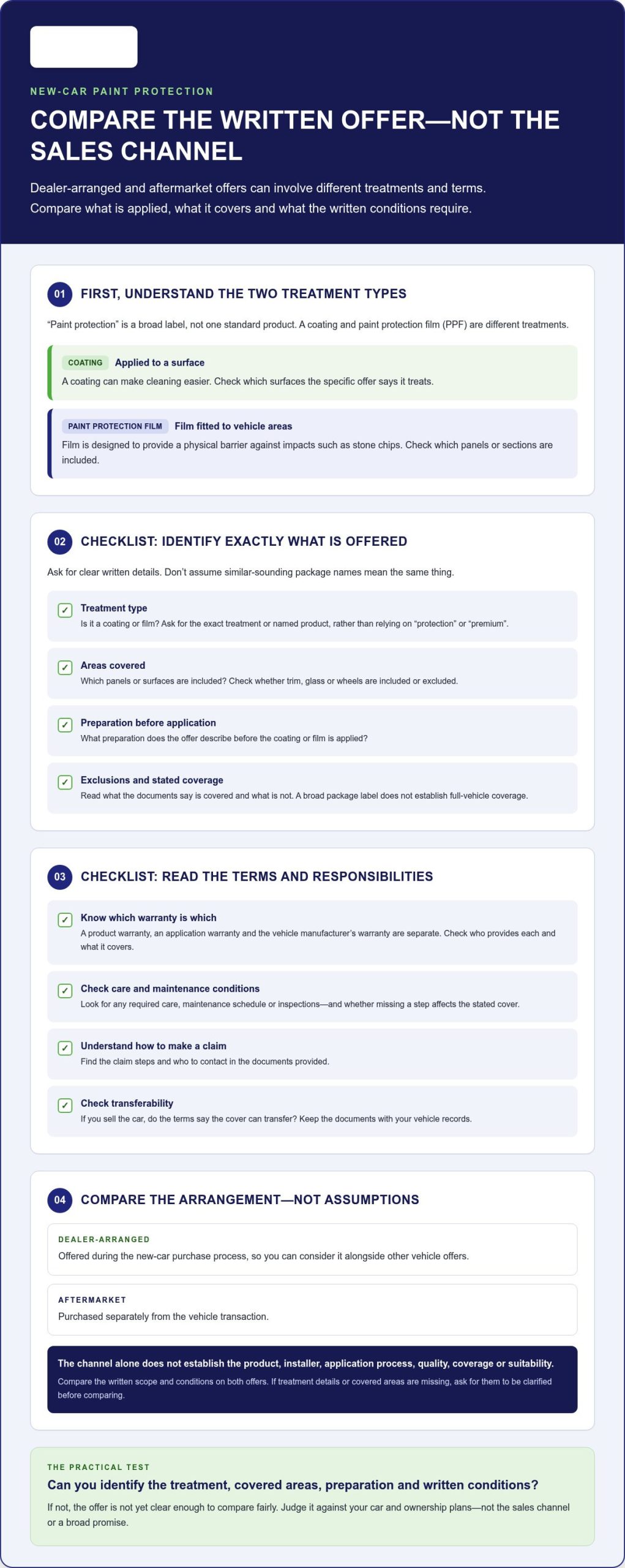
A practical checklist before accepting paint protection for a new car
Pause before adding paint protection to your new-car paperwork. A short, orderly review helps you understand the offer without losing sight of the bigger decisions about the car, its variant and the drive-away price. The same steps work whether protection is offered during the purchase or arranged separately.
- Identify the treatment. Check that the written description names the product or treatment, rather than relying on a general label such as “paint protection”.
- Check the scope. Match the listed panels and surfaces against what you expect to be treated. Note any exclusions, including areas that aren’t part of the offer.
- Read the terms. Review maintenance instructions, warranty wording, exclusions and the steps for making a claim. Keep the relevant documents with your vehicle paperwork.
- Compare offers. Assess current written offers with similar treatments and coverage before weighing up their full stated prices.
What should you check on the offer?
Make sure the product description matches the treatment being discussed, and that the offer says which vehicle surfaces are included. A document that identifies the bonnet and front bumper, for example, describes a different scope from one that lists the whole exterior. Don’t infer coverage from a package name.
Read the conditions at a comfortable pace. Check what maintenance is expected, which warranty applies to the product or application, what is excluded and how to start a claim. If a term is unclear, get the wording explained before deciding. Reviewing the paperwork calmly is particularly useful when several purchase documents are presented together.
How should the decision fit your ownership plans?
Think about the car you’re buying and how you expect to use it. Colour may influence how noticeable everyday marks seem to you, while regional travel, regular commuting or mostly short local trips may shape which concerns matter most. Consider how long you plan to keep the vehicle, too. These are personal factors, not a formula that dictates a particular treatment.
Don’t treat future resale value or the car’s eventual paint condition as guaranteed outcomes. Instead, decide whether the written inclusions, conditions and timing make sense for your plans. Keep this optional add-on separate from your choice of model, variant and drive-away offer; you can assess the vehicle purchase first, then consider protection on its own terms.
For a clearer view of how the wider purchase fits together, Private Fleet’s new-car buying process explains the steps involved. A considered review gives you room to make the protection decision without letting it distract from selecting the right new car.
How Private Fleet can help keep the new-car decision manageable
Paint protection is one part of buying a new car, not a substitute for choosing the right vehicle and understanding the purchase offer. Private Fleet is an independent Australian vehicle sourcing and car-buying service that works with a national network of authorised dealerships. Through its tender process, multiple dealerships are invited to compete for your business.
This gives you a way to approach the wider purchase with a clear shortlist and compare the vehicle offer separately from optional extras. Private Fleet doesn’t hold its own vehicle inventory, and the tender process doesn’t promise a particular price or outcome. Its role is to support the purchase process, with car protection products included as part of the broader service.
Where protection products fit in the new-car purchase
Keep three decisions distinct: which make, model and variant suit you; which vehicle offer meets your needs; and whether a protection product’s written terms make sense for your plans. That separation helps prevent an optional add-on from distracting from important vehicle considerations such as specifications, drive-away pricing, ordering and delivery arrangements.
If you’re still deciding what to buy, explore Private Fleet’s new-car buying service. Once you have a preferred vehicle, compare any protection offer on its own written scope and conditions. A careful dealer paint protection vs aftermarket australia comparison can sit alongside your new-car research without becoming the main decision.
Before you commit, organise the documents together. Keep the vehicle quote, purchase paperwork and protection terms easy to distinguish. That makes it simpler to review what relates to the car itself and what applies to an optional product. It also gives you a clearer basis for discussing the overall purchase and deciding which choices are important to you.
Take the next step with a clear shortlist
You don’t need to have every detail settled before starting a new-car enquiry. Sharing your preferred make or model, postcode and buying timeframe gives Private Fleet a practical starting point. If you’re weighing up more than one vehicle, include your shortlist so the purchase discussion can focus on the options you’re considering.
Bring your questions about the vehicle offer and any protection terms you’re reviewing. The aim is to keep the new-car decision organised, while leaving the final choice about optional protection grounded in the written offer and your ownership plans.
Make your next new-car decision with confidence
Before you decide, take a moment to consider how paint protection fits your plans for the car, rather than treating it as an automatic part of the purchase. A sound dealer paint protection vs aftermarket australia decision comes from weighing the specific written offer against your priorities and the time you expect to own the vehicle. If an offer doesn’t give you enough information to assess it, pause and resolve that gap before proceeding.
Keep the broader purchase moving on its own track, too. A clear shortlist of makes or models helps focus the next conversation on the vehicle that suits you. When you’re ready, share your preferred make or model, postcode and buying timeframe so your new-car plans have a practical starting point.
Get help buying my new car
Take the next step at your pace, with the information you need to make a decision that feels right for you.
Frequently Asked Questions
Is dealer paint protection better than aftermarket paint protection?
Neither option is automatically better. For dealer paint protection vs aftermarket australia, compare the actual treatment, scope, application details and written conditions, not just where it’s sold. A buyer who prefers to organise extras during the vehicle purchase may value the timing; someone who wants to consider protection separately may prefer that approach. In either case, make your decision from the documents rather than assuming one channel guarantees a better result.
Can I add paint protection after buying a new car?
Yes, you can consider arranging paint protection after buying your new car. This lets you separate the protection decision from choosing the vehicle and reviewing its purchase paperwork. Before booking, consider when the work will happen and how it fits around taking delivery and using the car. Keep any product and application documents with your vehicle records, so you can refer to the terms if you later have a question.
What is the difference between ceramic coating and paint protection film?
A ceramic coating is a treatment applied to a vehicle surface; paint protection film is a physical film fitted to specified areas. They’re different categories, so compare the exact features and coverage stated for each offer rather than treating them as equivalent. For example, a quote for film on selected panels doesn’t describe the same scope as a coating offer for listed exterior surfaces. The written description should make that distinction clear.
Does paint protection affect a new car’s manufacturer warranty?
Paint protection terms and the car’s manufacturer warranty are separate documents, and one shouldn’t be taken as a replacement for the other. The effect of an issue on vehicle warranty depends on the circumstances and the manufacturer’s terms. Keep the protection paperwork and application records, and if a concern arises, describe what happened and provide those records when discussing it with the manufacturer or its authorised dealer. Don’t assume every paint concern has the same outcome.
Should I include paint protection in my new-car finance?
That depends on your budget, finance arrangement and the protection offer’s written terms. If an optional product is added to a financed purchase, ask for the total amount financed and the repayment implications to be shown clearly, not just the change to a regular payment. Compare that total with paying separately, if that option is available to you. Keep the vehicle price and optional extras distinct in your own comparison.
How do I compare dealer paint protection offers?
Ask for each offer in writing and note the named treatment, covered areas, exclusions, maintenance conditions and claim instructions. Check whether the document identifies who provides the product terms and who is responsible for the application. If two offers use different descriptions, don’t assume they cover the same work. Compare total stated prices only after you’ve established that the treatment and included scope are sufficiently similar.