
End-of-month car sales tactics can make a new-car offer feel more urgent than it is. A dealership may be working towards monthly targets, and a short deadline or advertised discount can pressure you to decide quickly. But timing alone won’t tell you whether the vehicle’s total price and terms suit your needs.
It’s reasonable to expect dealerships to negotiate as the month ends. The key is to understand what’s behind the offer: vehicle availability, the price breakdown, accessories, and any finance or trade-in terms. Assessing each part separately helps you judge the deal, rather than relying on a headline discount or monthly repayment.
This article explains how stock and sales targets can affect negotiations, and how to respond to high-pressure claims and expiring offers. You’ll also learn how to compare drive-away prices, make a considered offer and keep it open while you weigh up your options. The aim is to decide based on the car and its written terms, not the calendar alone.
Key Takeaways
- Month-end targets and dealer stock can influence negotiating flexibility, but the calendar date alone doesn’t determine the offer.
- Assess the full vehicle price, trade-in and finance terms separately instead of judging a deal by its monthly payment.
- Pause when an offer comes with a deadline; take time to understand what expires and what the deal includes.
- Set a clear price and be prepared to leave an offer open while you consider your options.
- Private Fleet tenders your chosen new car across a national network of authorised dealerships and can assist with trade-ins and finance.
1. How dealer stock and financing affect end-of-month sales
End-of-month flexibility can reflect dealer stock financing and sales targets. Dealerships may finance new vehicles and face interest costs at month-end. Importers set monthly sales quotas, and bonuses may follow when a dealership meets them. These pressures can influence how a manager assesses an offer, but they don’t mean every vehicle has the same scope for negotiation.
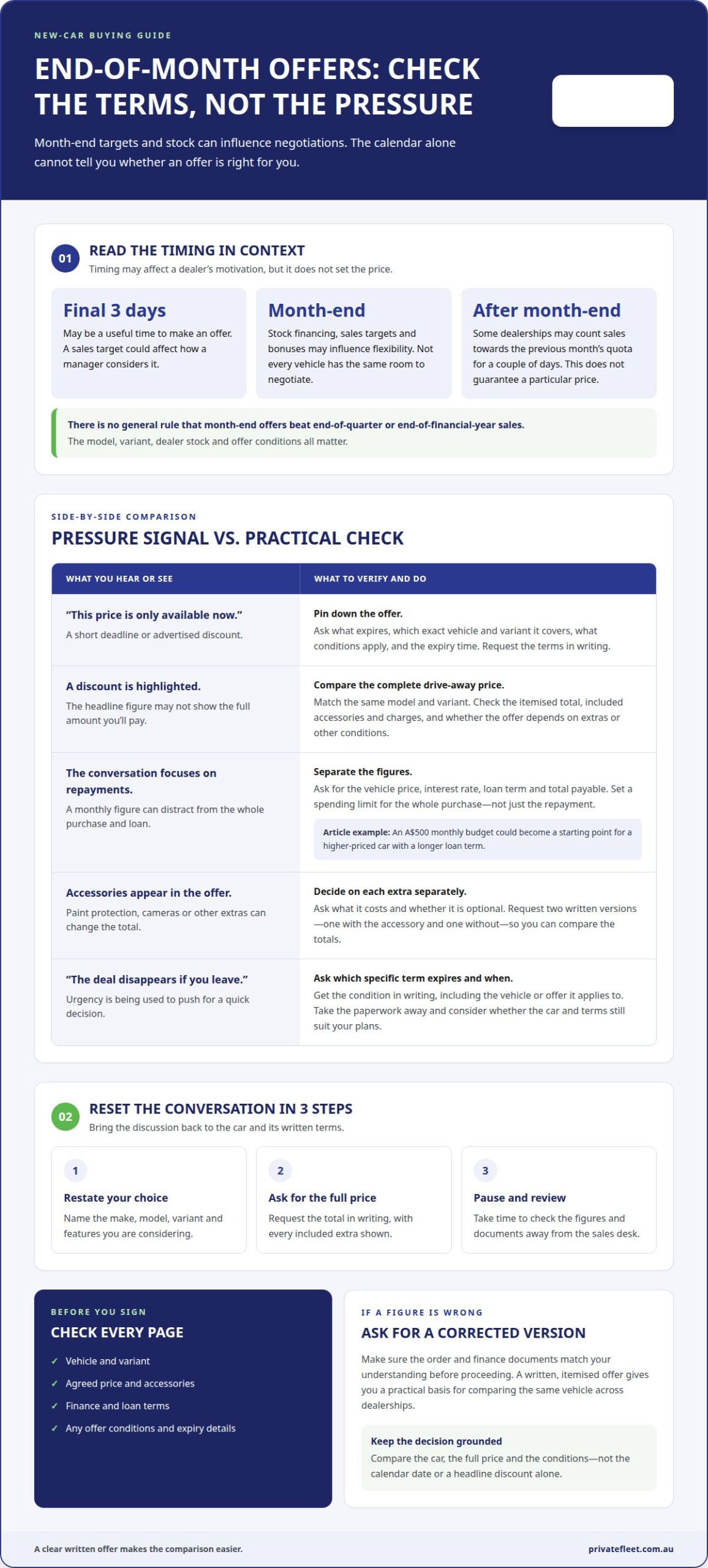
The final three days of a month may be a useful time to make an offer. For example, a manager who needs three more vehicle sales to meet a target may consider a deal they would have declined earlier. Some dealerships may also count sales towards the previous month’s quota for a couple of days after the calendar month ends. Neither timing practice guarantees a particular price.
There’s no general rule that end-of-month offers are better than end-of-quarter or end-of-financial-year sales in Australia. Monthly quotas can affect a dealership’s motivation, while stock, the specific vehicle and the offer’s conditions also shape negotiations.
There’s no fixed amount buyers can expect to save on a new car at month-end. Any price difference depends on factors such as the model, variant, dealer stock and offer terms. A dealer may advertise a low price, then include accessories that change the total. Compare the complete offer rather than assuming the advertised discount is your final saving.
To assess an advertised discount, identify the exact vehicle and compare its itemised drive-away price with offers for the same model and variant. Ask what accessories and charges are included, whether conditions apply, and when the offer expires. These details show what you’d actually pay and whether the discount depends on buying extras or meeting other terms.
Consumer guarantees apply to new cars bought from licensed dealers. According to the Australian Competition and Consumer Commission, if a manufacturing defect occurs, a buyer may be entitled to a repair, replacement or refund under consumer guarantees, even after the warranty expires.
When comparing dealerships, ask each to price the same vehicle specification and provide the full terms in writing. This gives dealers a clear opportunity to compete for your business and helps you distinguish a lower vehicle price from differences in accessories or conditions. Stock and target pressures may affect a response, but the written total is the practical basis for comparing offers.
2. Handling high-pressure sales claims
Some end of month car sales tactics make a quick decision sound essential. Before visiting a dealership, write down the make, model, variant and features you want. Use that shortlist to assess alternatives on their own merits. If a salesperson suggests another vehicle, compare its equipment and total cost with your original choice before changing direction.
Set a spending limit based on the whole purchase, not just repayments. If you mention an A$500 monthly budget, a salesperson could use it as a starting point and suggest a higher-priced car with a longer loan term. Ask for the vehicle price, interest rate, loan term and total payable separately, so each part is clear.
Keep accessories separate from your decision about the car. If the conversation turns to paint protection, cameras or another extra, ask what it costs and whether it’s optional. Decide whether you want each item before it appears on the order. For example, request two written versions, one with the accessory and one without, to see how it affects the total.
Set a time limit for your dealership visit and stick to it. Decide when to pause if the discussion runs long or the figures keep changing. Consumer Reports advises buyers to slow negotiations and set a departure time if they feel pressured. A planned break gives you time to review documents away from the sales desk.
If someone says, “the deal disappears if you leave”, ask which specific term expires and when. Request the condition in writing, including the vehicle or offer it applies to. An unclear deadline isn’t a reason to sign immediately. Take the paperwork away and consider whether the vehicle and terms still fit your plans.
Use a three-step reset if the discussion goes off track: restate your chosen vehicle, ask for its full written price, then pause to review it. For example, say, “I’m considering this variant. Please show the total and every included extra.” That keeps the conversation focused on the car and terms you’re actually assessing.
Before signing, read each page of the order and finance documents. Check that the vehicle, variant, agreed price, accessories and loan terms match your understanding. If a figure differs, ask for a corrected version before proceeding. Recognising end of month car sales tactics is easier when you decide based on written terms, not pressure to finish that day.
3. Manufactured urgency and expiring-deal pressure
A deadline can be genuine, but urgency alone doesn’t show whether a new-car offer suits you. An advertisement saying “sale ends in three days” should prompt specific questions, not an immediate deposit. Ask what expires, which vehicle and variant the offer covers, and whether the terms are available in writing. The answer helps separate a defined incentive from a broad sales message.
For example, imagine a salesperson says a rebate expires on Friday. Treat that as a claim to clarify, not proof that every offer for that make expires then. Ask for the rebate amount, eligible variant, purchase conditions and exact expiry time in writing. Then check whether the quoted drive-away price includes the same items as the offers you’re comparing.
Some sales scripts refer to a manufacturer rebate resetting on the first of the next month, or an incentive expiring on the 31st. Those dates may matter to a specific offer, but they don’t establish that the vehicle’s total price will rise afterwards. Keep the written offer and compare its full terms with the proposed replacement offer.
The main risk of rushing is accepting a vehicle or price before reviewing the details. Buyers may overlook a different variant, added accessories, finance conditions or a trade-in figure bundled into the offer. A short pause to review the paperwork can reveal whether the deadline applies to the whole deal or only one incentive.
Use a simple sequence before deciding: identify the exact offer, get its conditions in writing, and compare the complete vehicle price. Ask whether the deadline concerns a manufacturer incentive, dealership pricing or another component. If the salesperson says the terms can’t be documented, don’t treat the verbal claim as enough reason to sign.
Keep the offer date and expiry alongside the model, variant and included extras. If you’re comparing another dealership’s offer, use the same specification and price basis. Otherwise, the difference may reflect equipment or conditions rather than a better deal. This makes buying decisions clearer, even when a promotion has a short deadline.
Finally, separate time pressure from your decision criteria. Return to your shortlist and check that the vehicle still suits your needs, then review the written terms without a salesperson waiting for an answer. A genuine expiry can be relevant, but it doesn’t make an unsuitable variant, unclear finance arrangement or unwanted extra worthwhile.
4. Using price information when negotiating
Compare written, itemised offers for the same make, model, variant and included equipment. Ask each dealership for the complete drive-away price, with registration, compulsory charges, dealer delivery and accessories shown. This gives you a consistent basis for negotiation instead of comparing an advertised figure with a different vehicle specification.
Start with the manufacturer’s recommended drive-away price as a reference, then compare the actual offers available for your postcode. Those figures are an example, not a prediction of what any particular dealership will accept.
Set your maximum total spend before making an offer. If your ceiling is A$30,000, an opening offer below that limit leaves room to negotiate without committing to more than you planned. Make the offer for a clearly identified vehicle and state whether it includes accessories, delivery and other charges. Ask for the response in writing.
Compare dealer quotes side by side: vehicle and variant, drive-away total, included extras, conditions and expiry. If one quote is lower, check whether it assumes a particular finance arrangement or trade-in. Ask the dealership to explain any difference before treating the headline figure as comparable.
Keep finance separate from the vehicle price. A lower monthly payment can reflect a longer loan term, not a lower overall cost. Compare the amount financed, interest rate, loan term, fees and total payable, then assess that cost separately from the car’s drive-away price. This makes it easier to see what the vehicle itself costs.
Review dealer delivery as an individual line item. If a quote shows a charge around A$2,000, you could negotiate that item and ask whether it can be reduced below A$1,000. Treat this as a negotiating example, not a standard fee or promised outcome. Confirm any agreed adjustment appears in the revised written total.
For a fair comparison, ask each dealership to price the same vehicle and terms. Keep your preferred offer as a reference, then invite another dealership to improve its total without changing the variant or adding unwanted extras. This lets you negotiate using clear price information, not a monthly payment or an unitemised discount.
Consumer Reports advises obtaining an itemised out-the-door price, including taxes and vehicle fees, before visiting a dealership, and keeping discussions focused on the overall vehicle cost rather than monthly payments.
5. Walking away and leaving an offer open
Walking away is useful when the written offer doesn’t meet your requirements. Before leaving, state your firm price for the exact vehicle and explain that you’re not ready to proceed at the current figure. This gives the dealership a clear position to consider rather than leaving the discussion open-ended. Your advantage comes from being prepared to consider other options.
Keep your offer specific. Note the model, variant, included equipment, total price and any conditions, then ask the salesperson to record those terms. If the dealership responds with a different variant or adds accessories, treat it as a new offer. Don’t assume your original price still applies to the changed vehicle or package.
Decide how long you’re willing to keep the offer open. The recommendation here is to leave it open for a short time while continuing to consider alternatives. Write down the date you made it and when it expires. This helps you avoid treating a later conversation as acceptance of terms that have changed.
While the offer remains open, compare another dealership’s written proposal for the same new vehicle. Check whether the price, included items and conditions match. If another offer is clearer or better suited to your needs, reassess your position. Don’t sign simply because you’ve already spent time discussing the first offer.
If the original dealership returns with a revised figure, compare it against your written terms before responding. Look for changes to the vehicle, extras, trade-in arrangements or finance. A lower monthly payment, for example, doesn’t by itself show that the vehicle’s total price has changed. Ask for the revised offer in writing so you can review it away from the sales desk.
If month-end flexibility doesn’t lead to an agreement, follow up in two weeks. Refer to the earlier offer and ask whether the dealership’s position has changed. The time gap gives you a chance to consider other options without making a rushed decision. Reassess the vehicle and terms before reopening negotiations.
Walking away only helps if you’re genuinely willing to pause or choose another suitable option. If you’ve decided the offer doesn’t work, leave politely and keep your notes. You can return to the discussion later, but make a fresh decision based on the written price and conditions available then.
Private Fleet
Private Fleet is an independent new-car buying agency for people who want a clearer way to compare offers and negotiate. Rather than holding its own vehicle inventory, it takes your chosen make, model and variant to a national network of authorised dealerships. Its tender process invites multiple dealers to compete for your business, helping you assess offers for the car you actually want.
This approach can help if month-end deadlines or changing offers make proposals difficult to compare. Share your vehicle details and buying preferences, and Private Fleet manages the negotiation and purchase paperwork. That keeps attention on your chosen vehicle and its terms, rather than a rushed decision driven by a dealership’s sales target.
To make the tender relevant, be clear about the exact model and variant you’re considering, along with your postcode and buying timeframe. If you’re still choosing between options, explain what matters most, such as cabin space, comfort or how you’ll use the car. Clear preferences help focus the comparison across dealership offers.
Private Fleet can also assist with a trade-in as part of your new-car purchase. Keeping the trade-in discussion clear helps you understand how it relates to the new vehicle’s price. If you’re considering finance, the team can assist with that too, while keeping the car’s purchase terms central to your decision.
Once the purchase is progressing, Private Fleet provides regular updates on delivery times. You can follow the steps in the new-car buying process and understand how the tender and purchase are managed. Delivery timing can matter when planning around an existing vehicle, work or travel, so updates help you stay informed as the order progresses.
Private Fleet may suit you if you know what new car you want but would prefer support coordinating dealer competition, negotiation and paperwork. It’s also an option if a trade-in or finance forms part of your plans. Share your preferred vehicle, postcode and timeframe to get started.
Contact Private Fleet to discuss buying your new car, or call 1300 303 181.
Frequently Asked Questions
What end-of-month car sales tactics do Australian dealerships use?
Dealerships may highlight a short sale deadline, focus on vehicles already in stock or contact previous buyers as monthly targets approach. An advertised low price may be paired with accessories, while finance discussions can focus on a manageable monthly payment. Treat each part as a separate claim: identify the exact vehicle, included items, price conditions and expiry. This makes the offer easier to assess without relying on urgency alone.
How can I negotiate a car price with an Australian dealer at the end of the month?
Choose the exact new-car model and variant, then make a clear offer for that vehicle. Ask for the dealership’s response in writing and compare it with another offer using the same specification and conditions. Decide in advance what terms you’ll accept and what would make you pause. If the dealership won’t meet your position, leave the offer open while considering alternatives, then follow up later if you’re still interested.
What fees and add-ons should I watch for in an Australian car deal?
Look closely at dealer delivery, accessories, paint protection and any other products added to the order. Ask whether each item is included in the advertised figure, optional or required for that offer. If finance is involved, check for fees in the loan documents and compare the total payable, not only the repayment amount. Your written order should clearly show which items you’ve accepted and the complete amount due.
Do sales targets or commissions affect end-of-month car pricing in Australia?
Monthly sales targets can influence a dealership’s willingness to consider an offer, since meeting targets may affect staff pay or bonuses and dealership incentives. That doesn’t mean every salesperson has the same commission arrangement or can approve a particular price. A manager may control deal approval, while stock and the vehicle’s terms also matter. Focus your negotiation on the written offer rather than trying to estimate an individual salesperson’s earnings.