
What if you could spend less time co-ordinating dealer quotes without giving up control of your new-car choice? An end to end car buying service can organise the sourcing and comparison work, while you decide which vehicle suits you and whether to proceed.
Comparing offers can be difficult when specifications, inclusions and drive-away pricing aren’t presented on the same basis. Private Fleet is an independent vehicle sourcing and car buying service that works with a national network of authorised dealerships. Its tender process invites multiple dealers to compete for your business, helping bring options together without requiring you to manage every enquiry yourself.
This guide explains what support may cover, how the process differs from buying alone, and which decisions remain yours. You’ll also learn how trade-in assistance and optional finance support can fit into the purchase, and what to prepare before seeking help, including your preferred make or model, postcode and buying timeframe. The aim is a clearer path from shortlist to purchase, with you in control of the final decision.
Key Takeaways
- An end to end car buying service coordinates new-car sourcing and purchase tasks, while you assess the options and choose whether to proceed.
- A clear brief helps organise the process from sourcing through to comparing dealer offers and making a decision.
- Compare how much time, dealer contact and trade-in coordination you want to manage yourself; buying directly can suit people who enjoy those tasks.
- Use the checklist to weigh up your available time, how settled your shortlist is and how comfortable you are dealing with dealerships.
- Private Fleet’s tender process invites dealers in its national authorised-dealership network to compete for your business.
What does an end-to-end car buying service cover?
An end to end car buying service coordinates support for sourcing and buying a new car. It can help organise suitable vehicle options, dealer offers and related purchase steps, so you’re not left co-ordinating every enquiry yourself. The service supports your decision; it doesn’t make it for you.
You set the brief: your budget, preferred make and model, must-have features and intended timeframe. You then review the options and purchase details, decide what meets your needs and choose whether to proceed. A clear brief helps keep the search focused, whether you have a firm shortlist or are weighing up a few possibilities.
Which parts of a new-car purchase can be managed?
Sourcing starts with your preferences and requirements. Private Fleet is an independent Australian vehicle sourcing and car buying service that works with a national network of authorised dealerships. Its tender process invites multiple dealers to compete for your business, giving you dealer responses to consider without requiring you to approach each one separately. You can explore the new-car buying service as part of that journey.
When you compare proposed offers, look beyond the headline figure. Check that the make, model, variant, included features and delivery-related details match your brief. Compare drive-away pricing on the same basis, and note any differences in what each offer includes. This makes it easier to judge whether an option suits your needs, rather than choosing on a figure that may not represent the same vehicle or terms.
A trade-in is a separate part of the transaction from buying the new car, but assistance with it can be included in the broader process. A trade-in estimate concerns the value of your current vehicle; it isn’t the new car’s price. Understanding general car valuation methods can help you make sense of how a vehicle’s market value is estimated. You can consider the trade-in separately while assessing the new-car offer.
Finance support may also sit alongside sourcing and trade-in assistance. It’s an optional consideration, not a condition of getting help to find a new car. Keep the vehicle choice and offer comparison at the centre of your decision, then consider finance separately if it’s relevant to your purchase.
What remains the buyer’s decision?
Managed support doesn’t remove your approval or choice. Before proceeding, review the proposed vehicle and purchase details carefully, including:
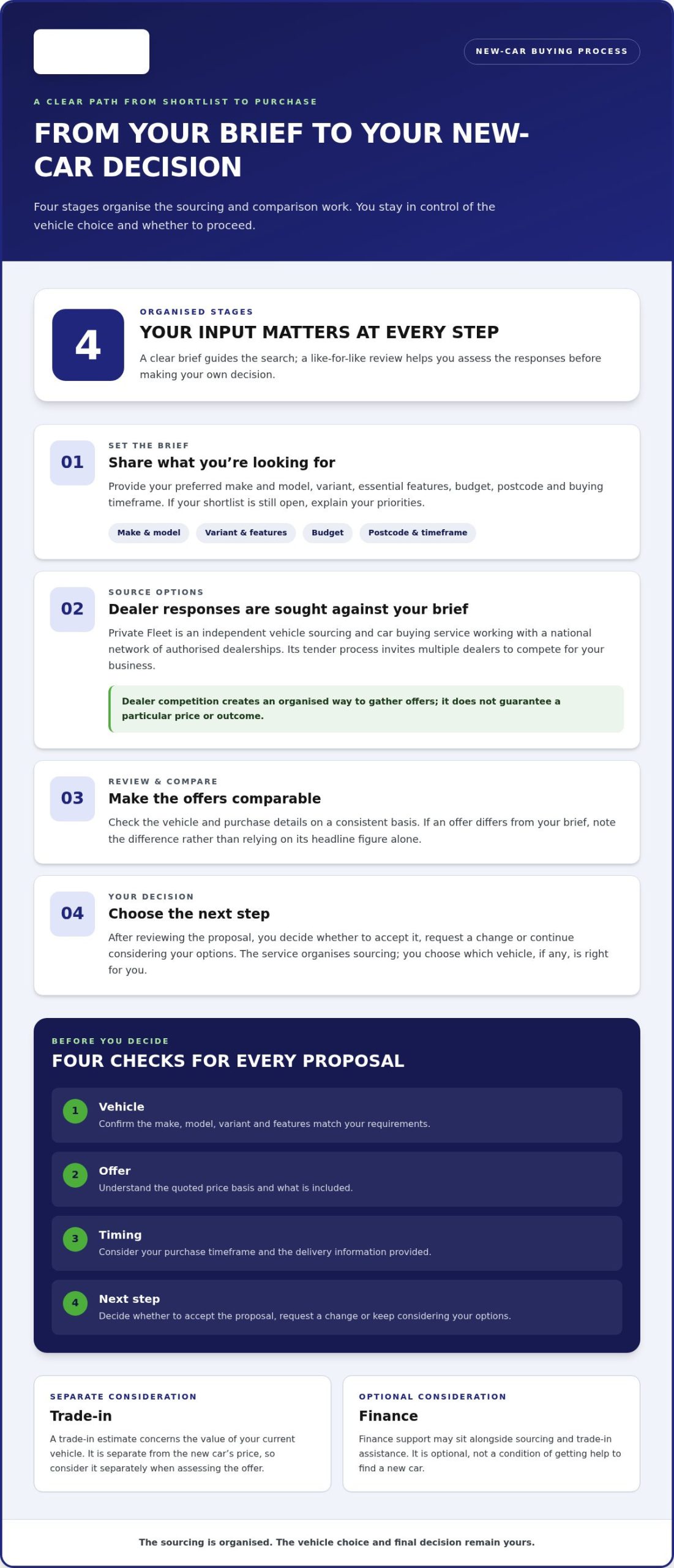
- Vehicle: Confirm the make, model, variant and features match your requirements.
- Offer: Understand the quoted price basis and what’s included.
- Timing: Consider the purchase timeframe and delivery information provided.
- Next step: Decide whether to accept the proposal, request a change or continue considering your options.
You remain in control from the initial brief through to the final decision. The service organises the sourcing process; you decide which vehicle, if any, is right for you.
End-to-end new car buying: from brief to purchase
A clear sequence helps you see what’s being organised and when your input matters. With an end to end car buying service, the journey moves from your requirements to sourced options, a like-for-like offer comparison and your decision to proceed. You stay involved at each important choice, without having to co-ordinate every dealer conversation yourself.
Start with a clear brief and shortlist
Begin with what you know. Share your preferred make and model, the variant you’re considering, essential features, budget, postcode and intended buying timeframe. If you’re still deciding between options, say so; identifying what matters most can help shape the sourcing brief and keep unsuitable vehicles out of the comparison. Private Fleet’s new-car buying service uses your requirements to source options through its network of authorised dealerships.
Be specific about the details that affect your choice. For example, distinguish a must-have feature from a preference, and explain whether you’re set on a particular variant or open to alternatives. This helps make dealer responses more relevant and gives you a clearer basis for comparing vehicles that genuinely fit your needs.
Compare dealer responses before deciding
Once the brief is understood, the tender invites multiple authorised dealerships to compete for your business. Their responses can then be considered against your requirements. Dealer competition creates an organised way to gather offers; it doesn’t guarantee a particular price or outcome.
Compare like with like. Check that each response refers to the same make, model and variant, then review the quoted price basis and what is included. If one offer differs in specification or purchase details, note the difference rather than treating the headline figures as directly comparable. The buyer’s review is essential: you decide whether the proposed vehicle and terms suit you before taking the next step. The car-buying process explains how the journey is organised.
- Share your requirements. Set out your shortlist or priorities, budget, postcode and timeframe.
- Source options. Suitable dealer responses are sought against the brief.
- Review and compare. Check vehicle, variant and purchase details on a consistent basis, and raise any points that need clarification.
- Choose whether to proceed. You make the final decision; receiving an offer doesn’t commit you to accepting it.
After you choose to proceed, the purchase moves forward with the dealership. Delivery timing can depend on the vehicle and circumstances, so no date should be assumed from the sourcing stage. Private Fleet provides customers with regular updates on delivery times, helping keep you informed as the process continues.
If you’re ready to outline your preferences, you can share your new-car requirements, including your preferred make or model, postcode and buying timeframe.
Managed car buying versus doing it yourself: what should you compare?
Both approaches can lead to a new car that suits your needs. The difference is mainly who co-ordinates the research, dealer contact and offer comparison. If you enjoy managing those tasks, buying directly may suit you. If you’d rather have support bringing the steps together, a managed service can reduce the administration while leaving the choice yours.
| What to compare | Buying it yourself | Co-ordinated support |
|---|---|---|
| Buyer effort | You research models, contact dealers and keep track of responses. | Support helps organise sourcing and dealer responses around your brief. |
| Dealer contact | You lead discussions and follow up with dealerships yourself. | Dealer responses are brought together through a managed process. |
| Offer comparison | You collect quotes and check that vehicle specifications and price details align. | You receive help co-ordinating options so you can review comparable details. |
| Trade-in co-ordination | You handle the new-car purchase and your existing vehicle separately or together. | Trade-in assistance can sit alongside new-car sourcing as a separate part of the purchase. |
When self-managed buying may suit
Prefer doing your own research? Buying directly can be a good fit if you like comparing models, arranging dealer conversations and keeping notes on quotes. It may also suit you if you already have time to follow up and feel confident checking that each offer covers the same make, model, variant and price basis. You retain control throughout, just as you do with managed support.
To keep your comparisons clear, record each dealer’s offer in the same format. Note the exact variant, included features, quoted price basis and any purchase details that differ. This makes it easier to spot where an apparent price difference reflects a different vehicle or offer, rather than a directly comparable quote.
When co-ordinated support may be useful
Support can be useful if you’d rather not manage several dealer enquiries or want help gathering responses against your requirements. Private Fleet is an independent vehicle sourcing and car buying service working with a national network of authorised dealerships. Its tender invites multiple dealers to compete for your business. That organises the sourcing process, but it doesn’t promise a particular price or result.
It can also help bring a new-car search and trade-in considerations into the same buying journey. Your existing vehicle remains a separate consideration from the new-car offer, so review each on its own terms. Most importantly, managed support doesn’t mean surrendering your decision. You can assess the proposed vehicle and details, then choose whether to proceed.
Consider which approach fits your time and preferences:
- Choose self-managed buying if you enjoy direct research and dealer discussions.
- Consider co-ordinated support if you want help bringing sourcing and responses together.
- Either way, compare matching vehicle specifications and offer details before deciding.
If support sounds useful, share your preferred make or model, postcode and buying timeframe to start a new-car buying conversation.
Is an end-to-end car buying service right for you?
An end to end car buying service may suit you if you want support with the work around a new-car purchase, while staying in charge of what you buy. Think about which tasks you’re comfortable managing and which would be easier with assistance. You don’t need a perfect shortlist or a trade-in to make use of buying support.
Use this checklist to weigh up your preferences:
- Time: Do you have enough time to keep track of the tasks involved in a purchase alongside your other commitments?
- Shortlist: Are you confident about the type of car you want, or would you like help exploring alternatives that fit your priorities?
- Dealer contact: Would you rather handle discussions yourself, or have support co-ordinating the buying process?
- Trade-in: Is replacing an existing car part of your plans, or are you buying without a trade-in?
- Decision-making: Do you want to review options at your own pace and approve the vehicle and purchase details yourself?
Questions to clarify before starting
Note your preferred make or model, any acceptable alternatives and the features you consider essential. If you’re undecided, describe the type of driving you do and what you want the car to make easier. An approximate budget helps set a practical boundary, while your intended buying timeframe provides context without locking you into an assumed delivery date.
Also consider whether an existing vehicle is relevant. If you want trade-in assistance, include that in your priorities, but keep the trade-in decision distinct from choosing the new car. You can seek help with sourcing whether or not you have a vehicle to trade.
Make the comparison fit your ownership plans
Consider how the car will work for you in ordinary use, not just on the day you compare offers. If these factors matter to you, assess seat adjustment and comfort, ease of getting in and out, visibility and whether the controls feel intuitive. Think about who usually travels with you, the space you need and the journeys you expect to make. A vehicle that suits your routine is more useful than one that simply has a longer feature list.
Look beyond the purchase offer when judging whether a vehicle fits your plans. Compare manufacturer warranty terms and servicing schedules for the exact Australian model and variant, using current manufacturer information. Then consider likely ownership costs such as scheduled servicing, fuel or charging, tyres, insurance and registration. These depend on the vehicle and how you use it, so use your own circumstances rather than assuming one model will cost less overall.
Finance is separate from selecting and sourcing the car. If you’re considering it, assess the finance terms against your budget and circumstances after you’ve identified a suitable vehicle. Buying support doesn’t require you to accept a particular car or finance option; you decide what works for you.
What happens next with Private Fleet’s new-car buying service?
To begin, give Private Fleet a practical picture of the new car you’re considering and what matters most in the purchase. Private Fleet is an independent Australian vehicle sourcing and car buying service. It works with a national network of authorised dealerships, and its tender invites multiple dealers to compete for your business. Private Fleet doesn’t hold its own vehicle inventory; you review the available options and decide whether to proceed.
What to include in an enquiry
A useful enquiry doesn’t need to be a long specification. Prioritise the details that will make one option more suitable than another, and note where you’re open to alternatives. For example, you might prefer a particular model but be flexible about the variant, or have firm requirements for passenger space and only a preference about colour.
- Preferred vehicle: Name a make or model, or describe the kind of new car you’re considering.
- Budget: Give an approximate budget and clarify whether you’re thinking about the total drive-away price.
- Postcode: Include this to help frame the sourcing discussion around your location.
- Timeframe: Say when you hope to buy, especially if you have a date or event influencing your plans.
- Priorities: Separate essential features from preferences so the brief can reflect where you’re willing to compromise.
- Trade-in: Mention whether you have an existing car to consider alongside the new-car purchase.
If you’re unsure about a variant, explain what you need the car to do rather than guessing at a specification. A clear distinction between “must have” and “nice to have” helps keep later comparisons focused on your priorities.
Take the next step with confidence
When you receive options, take time to check that each one responds to your brief. Confirm the model and variant, then compare the quoted price basis and stated inclusions. Note any differences rather than treating offers as equivalent when they cover different vehicles or terms. If an important detail isn’t clear in the proposal, get that detail clarified before making a decision.
Consider the whole fit, not just the headline offer. Does the vehicle meet your essential requirements? Are you comfortable with the purchase details and timing information provided? If you’ve included a trade-in, keep its proposed value distinct from the new-car price as you assess the overall arrangement. You can ask for an option to be reconsidered or decide not to proceed; receiving a proposal doesn’t remove your choice.
Your preferred make or model, postcode and buying timeframe are enough to start a focused enquiry. Add your budget, alternatives and any trade-in considerations to give the discussion more context, then review the options at your own pace.
Make your next car decision with confidence
A useful next step is to decide what a good outcome means for you before you compare proposals. It might be finding a car that feels comfortable on your usual journeys, keeping within a firm spending limit, or avoiding features you’re unlikely to use. Write down your priorities in order, then use them to judge whether an option fits your life, not simply whether it looks attractive on paper.
You can also note what would make you pause: an unclear inclusion, a variant that misses an essential requirement, or terms you need more time to understand. That gives you a simple way to stay focused while an end to end car buying service helps organise the buying work. There’s no need to rush a decision before you’re comfortable with the details.
When you’re ready, share your preferred make or model, postcode and buying timeframe. A clear starting point can turn your research into a more focused next conversation, while you remain free to decide what suits you.
Get help buying my new car
Frequently Asked Questions
Is Private Fleet a car dealer?
No. Private Fleet is an independent Australian vehicle sourcing and car buying service, not a manufacturer-owned or authorised brand dealer. It works with authorised dealerships and invites multiple dealers to compete for a buyer’s business through a tender. Private Fleet doesn’t hold its own vehicle inventory. You can outline what you’re looking for, assess the dealer options presented and decide whether to proceed with a purchase.
Can I use an end-to-end car buying service if I already know which car I want?
Yes. Knowing your preferred make or model gives the sourcing brief a clear starting point. You can also specify a variant, essential features, approximate budget and purchase timing. For instance, if you’ve chosen a model but are unsure which variant suits you, explain which features matter most. The service can help organise the buying process, while you choose the vehicle and decide whether to accept an offer.
Does an end-to-end car buying service include a trade-in?
Trade-in assistance can be part of Private Fleet’s new-car buying service, but a trade-in isn’t required to get help sourcing a new car. If you have an existing vehicle, describe it separately from your new-car requirements. Details such as its make, model, kilometres and condition can help frame the discussion. Treat the trade-in and new-car offer as related but distinct decisions, and don’t assume a trade-in value before receiving an assessment.
Can an end-to-end car buying service help with finance?
Private Fleet offers car finance as a supporting part of its new-car buying service. Finance is separate from selecting a vehicle, so first be clear about the car and purchase details you’re considering. If you explore finance, review the terms, costs and repayment commitments in light of your own circumstances before agreeing to anything. No particular rate, approval outcome or finance arrangement should be assumed.
Does an end-to-end car buying service handle used-car purchases?
Private Fleet’s buying service focuses on new cars for private individuals, rather than sourcing used vehicles. If you currently own a car, trade-in assistance may be relevant to your new-car purchase, but it doesn’t change the service’s focus. For a new-car search, share your preferred models, key requirements and any acceptable alternatives so the sourcing discussion is centred on the vehicle you want to buy.
Will I receive updates while waiting for a new car?
Yes. Private Fleet customers receive regular updates on delivery times as the purchase progresses. These updates are intended to keep you informed, not to guarantee a particular arrival date. Timing can depend on the vehicle and circumstances of the order, so avoid making firm plans based on an assumed delivery day. Use the updates you receive to understand the latest timing information for your purchase.