
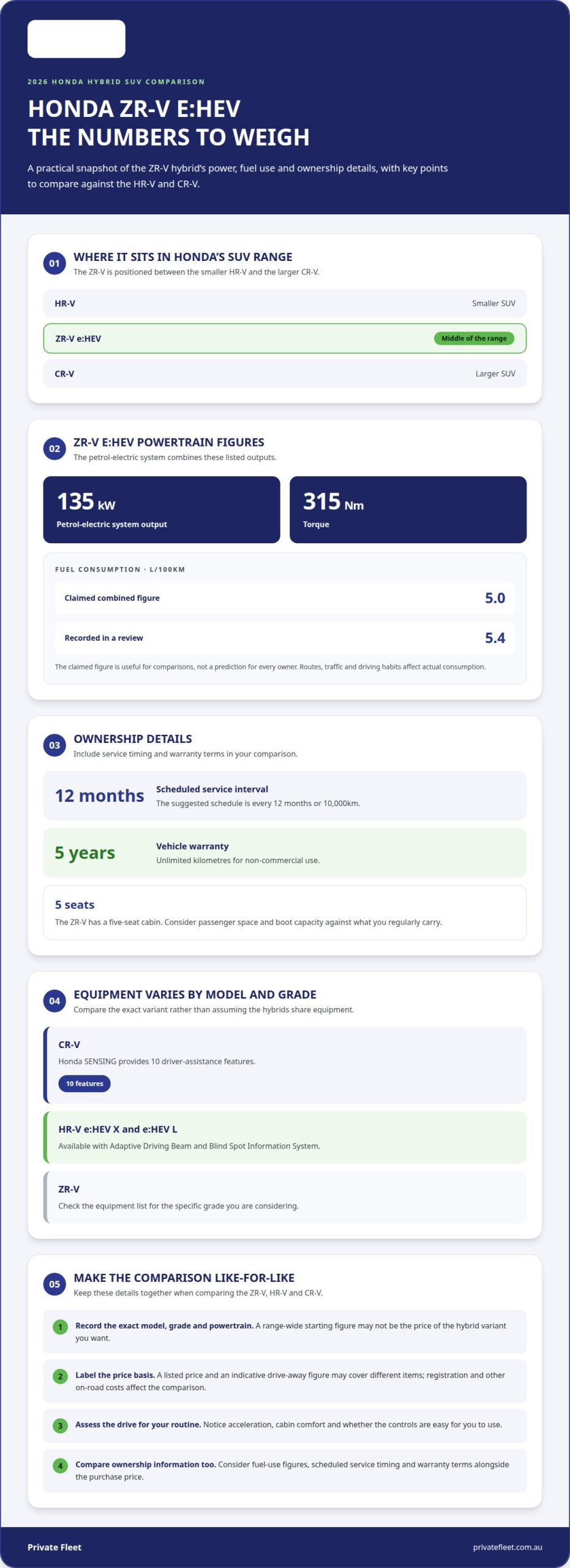
The Honda ZR-V e:HEV makes a practical case for a hybrid SUV: its petrol-electric system produces 135kW and 315Nm, with claimed combined fuel consumption of 5.0L/100km. For the 2026 Honda CR-V, ZR-V and HR-V hybrid comparison in Australia, it sits between the smaller HR-V and larger CR-V in Honda’s SUV range.
Choosing between them involves more than fuel use. Cabin space, boot capacity, safety equipment, comfort and how each hybrid fits your regular driving all matter, especially if you plan to keep your next car for years.
This comparison looks at how the ZR-V hybrid drives, what its five-seat cabin and boot offer, and how its powertrain and drive-away pricing compare with the CR-V and HR-V. It can help you work out which model suits your needs, from a smaller SUV for everyday trips to a roomier option for family travel.
Key Takeaways
- See how the ZR-V hybrid’s driving character and fuel use compare with the CR-V and HR-V, so you can match a powertrain to your regular trips.
- Compare the three SUVs by model grade and indicative drive-away pricing to narrow your shortlist around budget and features.
- Understand what the ZR-V’s four-star ANCAP rating means alongside its safety equipment when weighing up your options.
- Use the boot and cabin measurements to judge which model better suits passengers, luggage and everyday errands.
- Learn which hybrid specifications matter most, including fuel consumption, power and torque, before choosing a variant.
Is the Honda ZR-V safe?
The 2026 Honda ZR-V has a four-star ANCAP safety rating. Its reported scores are 79 per cent for adult occupant protection and 88 per cent for child occupant protection. Consider these results alongside the safety equipment fitted to your preferred grade. The scores describe different occupant groups, so families carrying children may weigh the child-protection result particularly closely. A rating is one part of choosing a vehicle, not a substitute for comparing the specific variant.
That puts the LX at the top of the hybrid grades by price, while the X is the entry point. Compare each grade alongside its price: a higher figure alone doesn’t show which equipment or features matter most to you.
The AWD names distinguish two grades in this range. When comparing them with a ZR-V, identify the model, grade and drivetrain first, then note whether each figure is a listed price or an indicative drive-away price.
Price basis matters because a listed price and a drive-away figure aren’t necessarily like-for-like. Registration and other on-road costs affect the comparison. Record the basis beside each figure, rather than comparing one model’s indicative drive-away price with another’s listed price as though they cover the same items. This makes it easier to assess the grades on equal terms.
Safety is another reason to keep the exact variant visible in your comparison. The ZR-V’s four-star ANCAP rating and occupant-protection scores give you model-level information. Honda SENSING provides 10 driver-assistance features in the CR-V, while the HR-V e:HEV X and e:HEV L are available with Adaptive Driving Beam and Blind Spot Information System. Compare these details by model and grade, rather than assuming the hybrids share identical equipment.
To narrow your options, record your preferred grade, its price basis and the safety information relevant to your passengers. Then compare the ZR-V’s ANCAP result with that of the specific CR-V or HR-V grade you’re considering. This separates the safety rating from the equipment list and price, so you can assess each part of the decision on its own merits.
How does the Honda ZR-V drive?
The ZR-V e:HEV combines a petrol engine and electric motor, and its fuel-use figures offer one practical way to assess everyday running. Its claimed combined consumption is 5.0L/100km; a review recorded 5.4L/100km in real-world driving. That difference shows why the official figure is best used for comparisons, not as a prediction for every owner. Your routes, traffic and driving habits influence actual consumption.
A test drive can show you more than a specification sheet about whether the ZR-V suits your routine. Where practical, try it on the roads you commonly use, including in slower traffic and on faster stretches. Notice how it responds when accelerating, whether the cabin feels comfortable at your usual speed, and whether you can use the controls without distraction. These personal observations complement, but don’t replace, the listed specifications.
Price helps place the ZR-V within Honda’s SUV range. Compare equivalent grades and price bases before deciding which SUV fits your budget.
For ongoing costs, the ZR-V’s suggested service schedule is every 12 months or 10,000km. These details let you consider service timing and scheduled costs alongside the purchase price. The stated vehicle warranty is five years with unlimited kilometres for non-commercial use, which is another ownership term to include in your comparison.
Keep the price basis clear: a starting price and an indicative drive-away price may not represent the same total. Registration and on-road costs can affect the amount payable. When comparing a ZR-V with an HR-V or CR-V, write down the exact grade, powertrain and price type. This avoids treating a range-wide entry figure as the price of the hybrid variant you’re considering.
For a balanced decision, consider three things together: how the ZR-V feels on your regular roads, the grade-specific purchase figure and scheduled ownership costs. A test drive helps you judge comfort and controls, while listed consumption and service information can help you assess running costs. Together, these give you a more useful basis for choosing between Honda’s SUVs than any single figure.
ANCAP safety rating and safety equipment
Use the ZR-V’s four-star ANCAP rating as one part of a safety comparison, then consider the protection scores and equipment separately. Its reported ANCAP results are 79 per cent for adult occupant protection and 88 per cent for child occupant protection. These figures describe different assessment categories, so the higher child score doesn’t mean every safety consideration is covered by that result alone.
Equipment also differs in how it supports the driver. Honda SENSING provides 10 driver-assistance safety features in the CR-V. The HR-V e:HEV X and e:HEV L are available with Adaptive Driving Beam and Blind Spot Information System. These named systems give you specific items to compare, but they aren’t interchangeable measures of crash protection or ANCAP performance.
For a useful comparison, write down the exact model and grade first. Then separate your notes into three areas: ANCAP rating, occupant-protection results and driver-assistance equipment. This helps you avoid mistaking a feature list for an overall safety rating, and makes differences easier to spot between the CR-V, ZR-V and HR-V.
- ZR-V: note its four-star ANCAP rating and the separate adult and child occupant scores.
- CR-V: identify the 10 Honda SENSING driver-assistance features as equipment information.
- HR-V e:HEV X and L: include Adaptive Driving Beam and Blind Spot Information System in the grade comparison.
During a vehicle assessment, take time to locate the relevant controls and understand the alerts. Check, for example, where driver-assistance settings appear and whether the instructions are clear before you drive. If a system activates during the test drive, note whether its warning is easy to recognise and respond to. This practical usability check doesn’t replace the published rating or equipment details.
Passenger needs can shape how you weigh the information. If children regularly travel in the vehicle, the ZR-V’s child occupant protection score may be especially relevant. If you often change lanes in busy traffic, note the HR-V’s Blind Spot Information System availability by grade. For CR-V shoppers, Honda SENSING is a separate equipment point to examine. Match each consideration to your routine rather than assuming one measure answers every safety question.
Keep the distinctions clear as you narrow your shortlist. ANCAP results describe assessed protection, while driver-assistance names identify technology fitted to particular models or grades. The ZR-V’s rating and occupant scores, the CR-V’s Honda SENSING features and the HR-V e:HEV X and L equipment offer different kinds of information. Comparing them in separate columns gives you a more considered view of each Honda SUV’s safety features.
Boot space and dimensions
The ZR-V e:HEV LX has 370 litres of boot space with its rear seats upright, increasing to 1,302 litres with the seatbacks folded. Those figures help frame the choice, but the best fit depends on what you carry. A pram, luggage or roadside emergency kit can occupy space differently, so assess the shape and access as well as capacity.
At 4,568mm long and 1,840mm wide, the 2026 ZR-V is a mid-sized SUV to consider for daily parking and passenger use. Its height is listed between 1,610mm and 1,620mm, depending on variant. Those exterior measurements can help you judge whether it suits your garage or regular parking space, but they don’t tell you how easily passengers can get in or out.
The CR-V offers a different arrangement for buyers needing extra seating. The seven-seat CR-V VTi L7 petrol has 150 litres of boot capacity with all seats in use. That is a useful reminder to compare luggage space with the intended passenger count. A seven-seat layout may suit occasional extra passengers, while a five-seat ZR-V gives its rear area to luggage instead.
The HR-V’s Magic Seats offer 18 seat combinations, giving buyers multiple ways to arrange the cabin for passengers or items. Compare that flexibility with the ZR-V’s published boot measurements and the CR-V’s seven-seat layout. A litre figure alone won’t show how well a bulky item fits, or how much room remains for passengers.
- ZR-V e:HEV LX: 370 litres with rear seats up, or 1,302 litres with seatbacks folded.
- CR-V VTi L7 petrol: 150 litres when all seven seats are in use.
- HR-V: Magic Seats provide 18 seating combinations.
For a practical comparison, bring items you regularly carry and check each shortlisted SUV with its seats in your usual position. Try the boot opening, loading height and rear-seat access, then see whether folding the seats leaves enough room for passengers. This is especially useful before a long trip, when luggage space and passenger comfort both matter.
Also consider where smaller items will go during everyday driving. A boot that fits larger luggage may still need to accommodate shopping or a roadside kit. Check how the rear seats fold and return, and whether the resulting layout suits your routine. The HR-V’s 18 combinations make seat flexibility a key point to explore; the ZR-V e:HEV LX provides clear capacity figures for both seating configurations.
Choose by the space you’ll use most often, not only the maximum capacity. A family comparing the CR-V VTi L7, five-seat ZR-V and HR-V should weigh passenger numbers, regular luggage and how often flexible seating matters. That makes the published figures a starting point for a more useful, hands-on fit assessment.
Hybrid powertrain specifications
The ZR-V e:HEV combines 135kW of hybrid power with 315Nm of torque. Its claimed combined fuel consumption is 5.0L/100km. One review recorded 5.4L/100km in real-world driving, illustrating how actual use can differ from the laboratory figure. Treat the claimed figure as a comparison point, not a prediction for every trip.
The CR-V e:HEV X has listed fuel consumption of 5.5L/100km. For the all-wheel-drive CR-V e:HEV LX, the figure is 5.7L/100km. These specifications help separate the ZR-V and CR-V options, but grade and drivetrain matter: the CR-V LX figure applies to the AWD variant, not every CR-V hybrid.
Honda describes the HR-V e:HEV as using an intelligent two-motor i-MMD hybrid system that switches between three driving modes. This gives buyers another detail to weigh alongside the ZR-V’s power and torque figures and the CR-V’s grade-specific consumption. The figures available here don’t support a direct fuel-consumption ranking across all three models.
- ZR-V e:HEV: 135kW, 315Nm and claimed consumption of 5.0L/100km.
- CR-V e:HEV X: listed consumption of 5.5L/100km.
- CR-V e:HEV LX AWD: listed consumption of 5.7L/100km.
- HR-V e:HEV: two-motor i-MMD system with three driving modes.
For an updated 2026 comparison, keep each figure attached to its exact model and grade. The ZR-V’s 5.0L/100km is a claimed combined result; the 5.4L/100km figure comes from real-world review driving. The CR-V figures are listed separately for the X and LX AWD. Comparing unlike measures or overlooking drivetrain can make a small difference appear more decisive than it is.
Power and torque describe different things. The ZR-V’s 135kW figure indicates the hybrid system’s power output, while 315Nm is its torque figure. The consumption number answers another question: the listed fuel used over a distance. For everyday buyers, consider all three alongside your typical routes, passenger load and ownership priorities instead of choosing on one specification alone.
Before settling on a grade, note its powertrain, drivetrain and consumption figure together. Then compare the ZR-V’s hybrid output with the CR-V’s two stated grade figures and the HR-V’s system design. This keeps the specifications useful without treating different measurements as interchangeable.
Private Fleet
Private Fleet can help turn your Honda hybrid shortlist into a new-car purchase plan. Its New Car Buying Service tenders your preferred model and grade across a national network of dealers, with dealers competing for your business. Private Fleet manages the purchase process, including negotiation and paperwork, so you can focus on choosing the CR-V, ZR-V or HR-V that suits your priorities. Trade-In Assistance can help if you’re replacing a vehicle, and Car Finance is available if you’re considering finance as part of the purchase.
Share your preferred Honda model, postcode and buying timeframe to start a conversation about your options. Contact Private Fleet or call 1300 303 181.
Choose the Honda hybrid that fits your next chapter
Before deciding, picture the journeys you expect this vehicle to handle. Your regular routes, passenger needs and luggage habits can clarify which compromises matter most. The model that suits your daily commute may not be the one you prefer for longer family trips.
As you compare Honda CR-V, ZR-V and HR-V hybrids in Australia for 2026, turn your shortlist into a clear buying brief. Note your preferred model and grade, postcode and timeframe. That gives Private Fleet a practical starting point for helping you consider your new-car options.
For a conversation about your next Honda, call 1300 303 181.
A considered shortlist makes the next step easier. Take the time to choose the vehicle that fits your plans, and move ahead when you’re ready.
Frequently Asked Questions
How much does the Honda ZR-V cost?
What are the Honda ZR-V 2026 dimensions?
The 2026 Honda ZR-V measures 4,568mm long and 1,840mm wide. Its height ranges from 1,610mm to 1,620mm, depending on variant. These measurements help you assess whether it suits your garage or usual parking space. For a practical fit check, consider the vehicle’s height alongside any roof accessories you plan to use, and allow room to open doors and load the boot.
What do you get?
The ZR-V range offers a choice of grades. All are five-seat SUVs, while the e:HEV LX includes a 9.0-inch multimedia touchscreen. Grade choice affects the price and equipment, so compare the exact variant rather than assuming features are shared across the range. A useful shortlist records the grade, powertrain and features you value before weighing up the drive-away figure.
What is the Honda ZR-V like on the inside?
The ZR-V provides seating for five, and the e:HEV LX has a 9.0-inch multimedia touchscreen. Its boot holds 370 litres with the rear seats upright, or 1,302 litres with the seatbacks folded. For a more personal fit assessment, sit in both rows and try the controls. Check whether the seat position, visibility and screen layout work comfortably for your regular driving and passengers.
What’s under the bonnet?
The ZR-V e:HEV hybrid system combines a petrol engine and electric motor, producing 135kW and 315Nm of torque. Its claimed combined fuel consumption is 5.0L/100km. The system doesn’t require plugging in, unlike a plug-in hybrid. For comparison, the HR-V e:HEV uses Honda’s two-motor i-MMD system, which switches between three driving modes. These differences help distinguish the models’ hybrid systems.
What are the Australian prices for the 2026 Honda CR-V, ZR-V and HR-V hybrids?
Check the price basis carefully: listed and drive-away figures aren’t automatically equivalent.
What is the fuel consumption of the 2026 Honda CR-V, ZR-V and HR-V hybrids?
The ZR-V e:HEV has claimed combined consumption of 5.0L/100km; a review recorded 5.4L/100km in real-world driving. The CR-V e:HEV X is listed at 5.5L/100km, while the e:HEV LX AWD is listed at 5.7L/100km. These figures apply to named variants and different measurement contexts. Compare like with like, and treat claimed consumption as a comparison measure rather than a promise for every journey.
How do the 2026 Honda CR-V, ZR-V and HR-V hybrids compare in size and boot space?
The ZR-V e:HEV LX offers 370 litres behind its rear seats, expanding to 1,302 litres with seatbacks folded. The CR-V VTi L7 petrol has seven seats and 150 litres of boot space with all seats in use. The HR-V’s Magic Seats have 18 seating combinations. For hybrid buyers, compare the intended passenger layout and luggage needs; the CR-V boot figure here is for its petrol VTi L7.