
What if the same model could be ready from dealer stock or take months to arrive, depending on the exact variant and order? How long does new car delivery take Australia? There’s no single timeframe: many mainstream cars are available in stock or within a shorter wait, while popular models, hybrid grades and specific colours may require a factory order.
It’s understandable that a changing estimate makes it harder to plan a trade-in, arrange transport or decide when to replace your current car. A model-level wait time is only a guide; your order’s specification, status and latest dealership information matter more.
This article explains what can affect delivery timing, what details make an estimate more relevant to your order and how to stay informed as you wait. Private Fleet is an independent car buying service that works with authorised dealerships across Australia. Its tender process invites multiple dealers to compete for your business, and you receive regular delivery-time updates. While Private Fleet doesn’t control dealership stock or delivery schedules, it can help you understand the buying process and keep track of updates, so you can plan with greater confidence.
Key Takeaways
- There’s no single answer to “how long does new car delivery take australia”; use an estimate tied to your exact model, variant, colour and order status.
- Separate vehicles available through an authorised dealership from factory orders, as they can follow different timelines.
- Compare estimates by recording who provided them, when they were checked and which vehicle specification they refer to.
- Keep a clear record of order details and delivery updates, and leave flexibility in trade-in and transport plans while timing remains uncertain.
- Private Fleet’s regular delivery-time updates can help you stay informed while you wait for your new car.
How long does new car delivery take in Australia?
How long does new car delivery take Australia? There’s no single reliable timeframe for every order. Timing depends on the vehicle and variant you choose, whether it’s available through an authorised dealership or needs to be ordered, and how far the order has progressed. A broad published estimate can help set expectations, but it may not reflect the latest position for your specific car.
That distinction matters when you’re planning a trade-in, arranging transport or deciding when to make other commitments. Treat an estimate as a guide to discuss and track, not a date to build firm plans around.
Why a single Australian delivery-time average can mislead
An average blends together orders with different circumstances. One buyer may be considering a vehicle already available through a dealership; another may have ordered a particular variant and colour that isn’t currently available. Those situations can have different timelines, even if the vehicles share a model name.
Supply can also change, so a model-level figure may not describe your order by the time you read it. Check when the estimate was published or updated, and note what it covers: a particular model, a specific variant, available stock or factory orders. The Automotive industry in Australia page offers broad industry context, but it isn’t a source for current order-specific delivery estimates.
What a delivery estimate can, and cannot, tell you
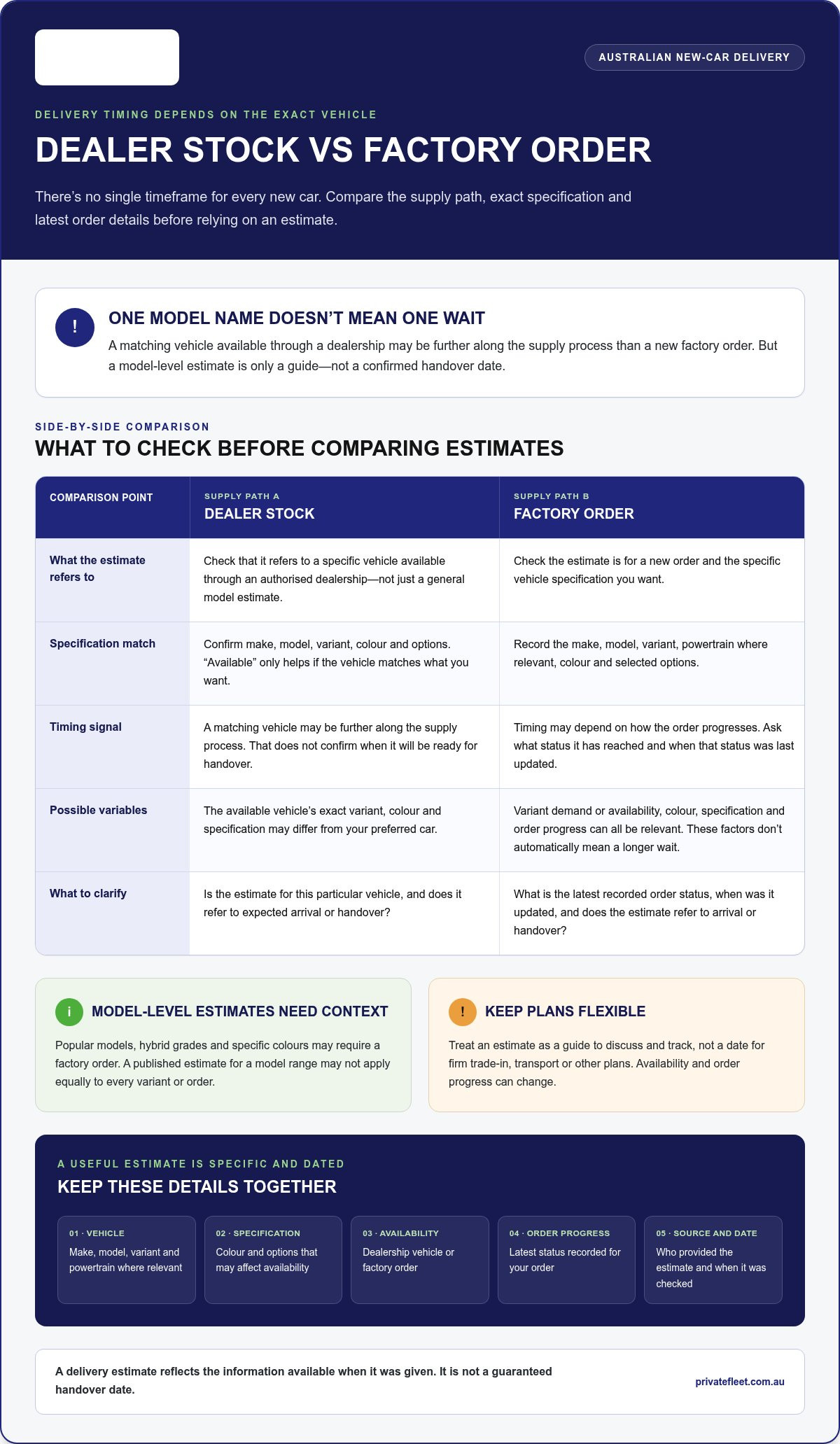
An estimate indicates a possible timeframe based on the information available when it was given. It isn’t confirmation of when your car will be ready for handover. Even a recent estimate may change as availability or order progress changes, so it’s useful to find out what information it reflects and when it was last checked.
- Vehicle: make, model, variant and, where relevant, powertrain.
- Specification: selected colour and any options that may affect availability.
- Availability: whether the estimate concerns an available vehicle or a factory order.
- Order progress: the latest status recorded for your particular order.
- Source and date: who provided the estimate and when it was checked.
Keep these details together when comparing information from different sources. A manufacturer or authorised dealership estimate may relate to a broader group of vehicles, while a third-party list or personal account may describe a different order, specification or point in time. Those sources can provide context, but they shouldn’t be treated as a live update on your car.
A delivery estimate is an indication based on available information, not a guaranteed handover date. That distinction lets you use the estimate sensibly while staying ready to adjust plans if the order’s timing changes.
What affects new-car delivery times in Australia?
Delivery timing can change with the exact vehicle you want and the way it is being supplied. A car already available through an authorised dealership follows a different path from one that still needs to be built or allocated. The order’s progress matters too, so a broad estimate may not reflect a later update on a particular vehicle.
That’s why the answer to how long does new car delivery take australia depends on more than the model name. Check the vehicle specification, its availability and the latest recorded order status together. Industry-wide information, such as the ABS Motor Vehicle Census, Australia, provides market context, but it does not show the supply position of an individual order.
Does the model, variant or colour change the wait?
It can. A published estimate for a model range may not apply equally to every variant: different versions can have different demand or availability. A particular colour or specification may also affect whether a matching vehicle is available. These are possible variables, not automatic reasons for a longer wait, so avoid assuming a change will speed things up or cause a delay.
For a current model-specific example, rely on a dated estimate from the manufacturer or an authorised dealership and note exactly which variant and order type it covers. If no current source states those details, don’t treat an older model-level figure as a forecast for your own order.
Is a dealer-stock vehicle different from a factory order?
A matching vehicle already available through a dealership may be further along the supply process than a new factory order. But “available” only helps if the vehicle matches what you want. Check the model, variant, colour and specification, then establish whether the estimate relates to that specific vehicle or to a new order.
For a factory order, the estimate may depend on how the order progresses through the relevant stages. Ask what status has been reached, when that status was last updated and whether the timing refers to an expected arrival or handover. Those details make updates easier to compare without treating an estimate as a promise.
Before changing your shortlist, consider which details are essential and which you could be flexible about. For example, if your preferred colour isn’t available in a matching vehicle, compare the timing information for that car with the estimate for your original specification. Keep the alternatives clear; a different variant or colour is a different vehicle, and its delivery estimate may not be interchangeable.
For help weighing up a preferred make, model and timeframe, you can share your new-car buying details with Private Fleet.
How should you compare new-car delivery estimates?
Compare estimates side by side, but only after checking what each one describes. A manufacturer’s published guidance, an authorised dealership’s update, a third-party wait-time list and another buyer’s personal account can refer to different dates, vehicles and order situations. Treat them as separate pieces of information, not interchangeable promises.
For a fair comparison, match the make, model, variant, colour and requested specification. Then check whether each estimate concerns a vehicle available through a dealership or a factory order. If those details differ, the estimates may offer context, but they can’t tell you which order is likely to arrive sooner. Knowing how long does new car delivery take australia for your particular order starts with comparing like with like.
Which questions make an estimate more useful?
Record the exact vehicle details, whether the estimate is for an available vehicle or factory order, and when the information was last updated. Also note who supplied it and what stage the order has reached. These simple checks make it easier to see whether an update reflects your circumstances or a broader indication.
Use a simple record for each estimate. Fill in the details rather than relying on memory or a model name alone.
| Source | Date checked | Vehicle specification | Order status or scenario |
|---|---|---|---|
| Manufacturer or authorised dealership | Record the date | Make, model, variant, colour and options | Available vehicle or factory order; note known progress |
| Third-party estimate | Record publication or update date | Check which version it covers | Note the source’s stated scope |
| Personal account | Record when it was shared | Compare the person’s vehicle with yours | Note any details given about their order |
How should you assess published wait-time lists?
Check when a list was published, how it gathered its estimates and whether it covers Australia generally or a particular location. If its methodology or scope isn’t clear, treat the figure as indicative. A useful reference can still be out of date or describe a different specification and order scenario from yours.
When you compare sources, give the most weight to recent information that clearly identifies the vehicle and order status. Manufacturer or authorised dealership guidance may offer a more direct reference for a particular order, while third-party lists can help you see broader patterns. Personal anecdotes are useful context, but one person’s timeline doesn’t establish yours.
Keep your notes alongside your order details and update them when new information arrives. Understanding the new-car buying process can also help you distinguish an early estimate from a later update as your purchase progresses. A consistent record gives you a clearer basis for planning and for comparing any revised timing.
How can you plan while waiting for a new car?
Waiting is easier to manage when the key details are in one place and your plans can adapt to new information. For buyers asking how long does new car delivery take australia, the practical answer is to track the estimate and order status, then use each update to review trade-in and transport arrangements rather than treating an early estimate as a fixed handover date.
A simple checklist for tracking your order
Keep a short record you can update whenever you receive new information. This gives you a clear reference point and helps you spot what has changed, without relying on memory or searching through old messages.
- Save the order details. Record the confirmed make, model, variant, colour and options so each update refers to the same vehicle.
- Note the latest estimate. Write down the timeframe you were given, who provided it and the date you received it.
- Record the order status. Include any information provided about the vehicle’s progress, keeping confirmed details separate from expectations.
- Review after an update. If the estimate changes, add the new information and date rather than replacing your earlier note. That preserves a useful timeline.
If an update shifts the expected timing, take a moment to clarify what has changed. Ask for the latest status, the date the information was checked and whether the estimate still relates to your exact vehicle and order. A revised estimate is a reason to reassess your plans, not necessarily a signal that something has gone wrong.
Planning your trade-in and vehicle handover
Keep trade-in and transport arrangements flexible while handover timing remains uncertain. If you rely on your current car, avoid making plans that assume you can be without it on an estimated date. If you’re arranging transport or coordinating the handover with other commitments, build in room to adjust once you receive a firmer update.
Think through the sequence that suits your circumstances: when you need your current vehicle, what arrangements depend on the new car arriving, and which plans can wait for clearer timing. If the estimate changes, revisit only the arrangements affected and update them using the latest information. This keeps the process manageable without requiring you to reorganise everything at once.
A shortlist and a realistic buying timeframe can also help clarify your next steps. Private Fleet can assist with the new-car buying process, while delivery timing remains dependent on dealership stock and the progress of the order.
How Private Fleet helps you navigate new-car delivery updates
Private Fleet is an independent Australian vehicle sourcing and car buying service that has operated since 1999. It supports private buyers through the purchase process, helping bring vehicle selection and dealership discussions together. The service is independent, not a manufacturer-owned or authorised brand dealership.
Private Fleet doesn’t hold its own vehicle inventory or set dealership delivery schedules. That distinction helps keep expectations clear: it can support your buying process, while the dealership manages the vehicle and its delivery.
What support does a car buying service provide?
Vehicle sourcing can help you organise the steps involved in buying a new car, from setting out your preferred vehicle details to progressing the purchase with a dealership. The new-car buying service is an option for buyers who’d like support comparing their choices and working through the purchase.
As you weigh up your options, make a note of what matters most: the model and variant, the features you want and your preferred buying timeframe. A clear brief helps keep the discussion focused on vehicles that suit your needs, without confusing the buying process with a promise about when a car will arrive.
What information should you share when seeking help?
To start the conversation, provide details that make your preferences and plans clear:
- Your preferred make and model, including a variant if you’ve chosen one.
- Your postcode.
- Your buying timeframe and any timing considerations.
- Other vehicles on your shortlist, particularly if you’re open to alternatives.
Your shortlist doesn’t need to be final. If you’re still deciding, describe the features or priorities guiding your choice. That gives the buying discussion a practical starting point, whether you’re comparing a couple of models or have already settled on a particular vehicle.
Sharing your details gives Private Fleet a clearer picture of what you’re looking for and helps you take the next step in the new-car buying process.
Take the next step towards your new car
Use your preferred make or model, shortlist and buying timeframe to shape a decision that suits your plans. Ask yourself: how long does new car delivery take Australia for the vehicle and timeframe I have in mind? If timing is a priority, note where you have flexibility, such as considering another variant or colour, and what matters most in your final choice.
When you’re ready to explore your options, share your preferred make or model, postcode and buying timeframe. A clear starting point makes it easier to discuss the vehicles you’re considering and the next steps in your purchase with Private Fleet.
Get help buying my new car
Your next car should fit both your needs and your plans. Take the time to choose with confidence, knowing you can approach the buying process one step at a time.
Frequently Asked Questions
How long does it usually take to get a new car delivered in Australia?
There’s no single usual timeframe that applies to every buyer. Start with the date you need the car, then identify how much flexibility you have around that date. If timing is critical, explain that before settling on a vehicle and ask what planning assumptions the estimate depends on. This helps you decide whether the proposed timeframe fits your circumstances, rather than relying on a broad figure alone.
Why are some new cars delivered sooner than others?
Differences can reflect how far a particular vehicle has progressed towards handover, as well as the buyer’s chosen specification. If timing is one of your priorities, compare a shortlist using the same questions for each option: what is the expected timing, what does it depend on, and what would you need to change in your selection? This makes the trade-offs clearer without assuming one model or brand will always be quicker.
Can I get a new car sooner if I choose a different colour or variant?
Changing your preference may create another option, but it doesn’t ensure an earlier arrival. Before switching, list the features you consider essential and those you could compromise on. Then compare the alternatives against that list, including equipment and suitability for your needs. A possible timing advantage may not be worthwhile if the change means giving up something important in the vehicle you’ll use every day.
Are new-car delivery wait-time estimates guaranteed?
No. An estimate isn’t a promise of a particular delivery date. As well as noting the expected timing, read your purchase paperwork carefully so you understand the terms recorded for your order. Keep copies of relevant documents and written communications together. If anything is unclear, raise the question through the appropriate purchase contact before making plans that depend on a particular date.
Does buying a vehicle already in stock mean faster delivery?
Not necessarily. Even if a vehicle is described as available, ask what remains before it can be handed over and what timing applies to that specific car. Clarify whether the vehicle matches your agreed specification, and make sure the expected handover process is understood before arranging your schedule. The useful comparison is not just whether a car is available, but whether it suits your needs and is ready on a timeframe that works for you.
How can I keep track of my new-car delivery while I wait?
Choose one place to keep correspondence, such as a dedicated email folder, and save messages alongside your order documents. If you speak by phone, note the date, the person or team you spoke with, and any next step discussed. You can also agree on a suitable time to follow up if you haven’t received further information. A tidy record makes it easier to keep conversations clear and consistent.
Should I delay trading in my current car until my new one arrives?
There’s no single right choice; consider how essential your current car is and what alternatives you have for getting around. Before agreeing on trade-in timing, discuss what happens if the planned handover shifts and whether you can keep using your vehicle in the meantime. If you depend on it for work, appointments or family commitments, plan a backup before confirming arrangements that could leave you without transport.