
The monthly repayment isn’t the whole cost of a new car. Avoiding buyer’s remorse on a new car starts with choosing one that fits your real priorities, not just the excitement of something new. Take time to think through what matters so you can feel more certain before you commit.
It’s easy to become attached to a particular model, focus on one appealing feature or feel pressured to decide quickly. But the right choice should make sense beyond the showroom: on an ordinary commute, a long weekend drive and days when you’re carrying passengers or luggage. Build your shortlist around how you expect to use the car, not an idealised version of your routine.
This guide gives you a clear process for making that decision. You’ll learn how to assess your options, understand the commitment and identify details to review before signing. Use the practical advice to choose a car that suits your circumstances and gives you confidence to move forward.
Key Takeaways
- Shortlist one or two models, then compare the variants, features and running costs that matter to your regular driving.
- Look beyond the monthly repayment: compare loan terms and the total amount you’ll repay.
- Negotiate the complete drive-away price and consider each optional extra separately.
- Use a test drive to assess comfort, visibility, controls and how the car feels on roads like the ones you use most.
- Set a firm budget around your needs and ownership plans, so a tempting upgrade doesn’t lead to a purchase you later regret.
1. Researching and comparing car models
Buy now if a suitable Australian-market model meets your needs and the written offer fits your budget. Wait if an announced update could change features you need, or if you can comfortably delay while comparing current offers and availability. Don’t rely on a possible discount alone.
Start with one or two models, then compare equivalent variants. A Toyota RAV4 and Mazda CX-5, for example, may suit similar needs, but their dimensions, equipment and powertrains differ by variant. Check each model’s current Australian specifications and price basis through the manufacturer or an authorised dealer. Compare drive-away quotes for the same location, variant, paint and included equipment, rather than judging a headline price in isolation.
Turn your everyday driving into a practical checklist. Note whether you mostly commute, travel regional distances, carry passengers or need boot space for regular activities. Compare fuel efficiency and likely running costs, including fuel, scheduled servicing, tyres and insurance. A luxury vehicle or imported model can cost more to run, service and repair, so weigh those costs against the features you value. Check the warranty booklet and service schedule for each shortlisted variant, not just the model name.
- Compare cabin space, visibility and ease of entry and exit in person.
- Check whether the controls and infotainment suit your preferences.
- Compare safety equipment and parking assistance on the exact variant.
- Review the manufacturer’s listed fuel consumption alongside your driving pattern.
- Ask current owners about practical details, then separate personal opinion from specifications.
Research the dealer as well as the vehicle. Read recent reviews across more than one platform, looking for repeated themes about communication, quote clarity and delivery updates. Treat isolated comments as individual experiences. Search Australian Government vehicle recall information using the exact make and model, then ask the authorised dealer whether any recall applies to the vehicle you’re considering. Search the model name alongside terms such as “common problems”, and assess whether reports concern the same generation and variant. Private Fleet’s car reviews can also help you build a shortlist.
Cooling-off and cancellation rights depend on the circumstances and applicable state or territory rules. In Australia, you may have one day to cancel a dealership purchase when the dealer arranges the car loan or supplies a credit application or referral. After a cooling-off period, cancelling a purchase may still have financial consequences. Check whether your deposit is refundable before paying it.
Australian Consumer Law provides consumer guarantees for new cars. If a fault appears, document it, keep relevant records and contact the seller promptly to request a remedy. The available remedy depends on the fault and circumstances; a fault does not automatically entitle every buyer to cancel the contract.
2. Loan terms and monthly payments
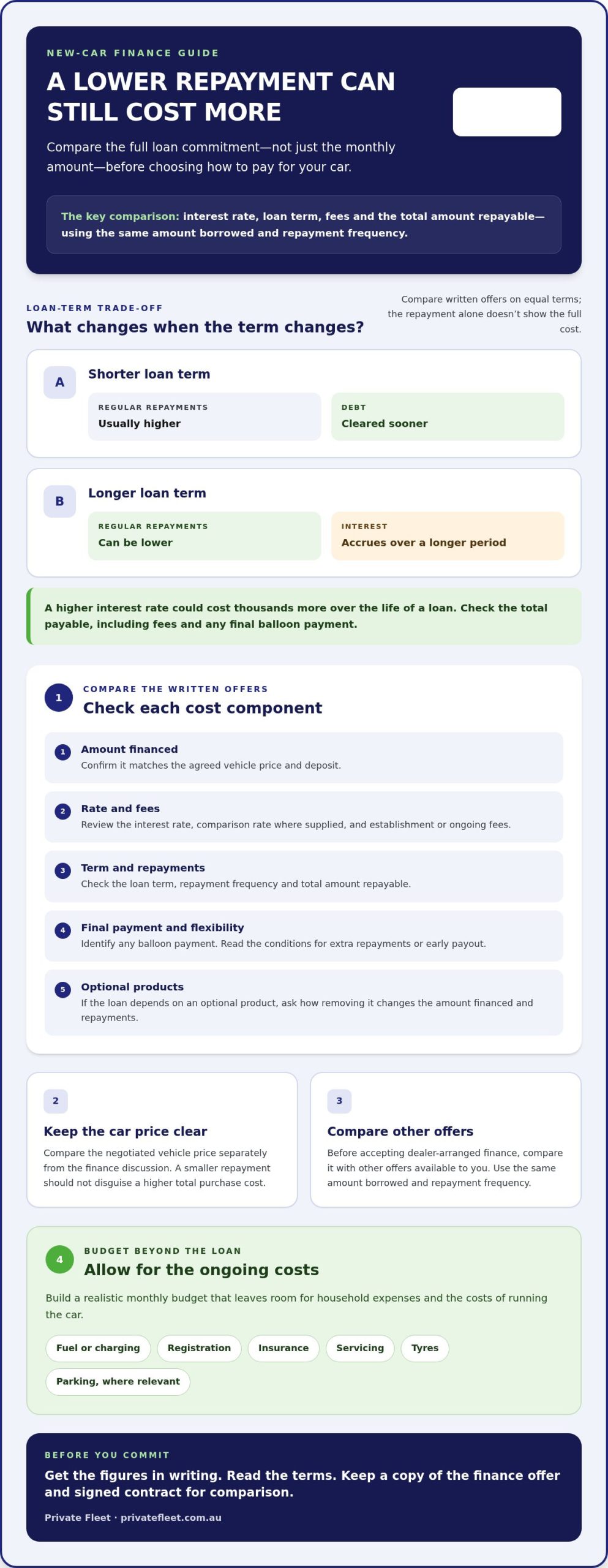
A repayment that fits your budget today can still make a car costly overall. Compare the interest rate, loan term, fees and total amount repayable, then consider whether repayments would remain manageable if household expenses changed. A longer loan with a higher interest rate could cost thousands more over its life. To avoid buyer’s remorse on a new car, assess the full commitment, not just the instalment.
Compare finance offers using the same amount borrowed and repayment frequency. A shorter term usually means higher regular repayments, but clears the debt sooner. A longer term can reduce each repayment while extending the period in which interest accrues. Compare the total payable, not just the monthly amount.
Before accepting a dealer-arranged loan, compare it with other finance offers available to you. Review the written terms side by side, including the interest rate, comparison rate where supplied, establishment or ongoing fees, repayment schedule and any final balloon payment. A low advertised rate may not show the full cost if fees or conditions increase the amount payable.
Ask how the figures change if you adjust the deposit, term or amount financed. Keep the car’s negotiated price separate from the finance discussion, so a smaller repayment doesn’t disguise a higher total purchase cost. If you’re trading in a vehicle, make sure the final figures clearly show its value and any existing loan payout.
Build a realistic monthly budget that includes more than the loan. Allow for fuel or charging, registration, insurance, servicing, tyres and parking where relevant. For example, a repayment that leaves no room for regular servicing or household costs may make an otherwise suitable model feel like a burden. Consider whether the payment would still work in a month with higher bills.
- Confirm the amount financed matches the agreed vehicle price and deposit.
- Check the loan term, repayment frequency and total amount repayable.
- Read the conditions for extra repayments or early payout.
- Identify any balloon payment and plan how you’ll meet it.
- Keep a copy of the finance offer and signed contract for comparison.
Don’t sign based only on a verbal estimate or weekly repayment. Ask for the written figures and take time to read them before committing. If the loan depends on an optional product, confirm how removing it would affect the amount financed and repayments. Avoiding buyer’s remorse on a new car means choosing finance that supports the purchase without stretching your budget.
If you’d like help considering finance alongside your new-car shortlist, share your purchase plans and preferred models.
3. Negotiating the vehicle’s total price
Negotiate the complete drive-away price, not a monthly repayment or attractive headline figure. Ask for a written, itemised quote for the exact make, model, variant and colour. This gives you a consistent basis for comparing offers and spotting charges or extras before agreeing. Keep each quote so you can refer to its inclusions and conditions during discussions.
A drive-away quote should show the vehicle price and applicable on-road costs, which can include registration, compulsory third-party insurance, stamp duty and dealer delivery. Details vary by state or territory, so compare quotes for the same registration location and ask what each total covers. Don’t count an item twice if it’s already included in the total.
Pay particular attention to dealer delivery. Ask what the charge covers and whether it is already included in the drive-away total. An itemised quote helps distinguish this charge from optional accessories or other separately listed items.
Prepare a like-for-like comparison before negotiating. Match the variant, factory-fitted options, paint, delivery location and offer conditions. Then ask whether the dealer can improve the total price or adjust an included extra. A lower vehicle price may not be better value if another offer includes equipment or costs yours excludes. Check the offer expiry to know how long its terms apply.
Keep the vehicle price separate from finance and trade-in discussions. A small monthly repayment can obscure the total paid, while a trade-in figure can make the deal harder to assess. Ask for the new-car price and trade-in value to appear separately in the paperwork. This lets you compare each part and understand how any outstanding loan payout affects the trade-in calculation.
- Request the exact variant and drive-away total in writing.
- Check registration, insurance, stamp duty and delivery entries.
- Compare equivalent offers for the same location and equipment.
- Ask for separate prices for accessories and optional add-ons.
- Review the contract against the agreed quote before signing.
Accessories, paint protection and other add-ons can raise the total without changing the car itself. Decide which options meet a real need, and ask for each price separately. Some extras may be purchased later, so assess their individual value rather than accepting a package by default. If an offer includes an accessory, check its exact description and whether fitting is included.
Use comparable written quotes to make a specific, respectful request. You might ask the dealer to match an equivalent offer or revise an item you don’t need. Assess the revised total, inclusions and conditions together. The aim is a clear agreement you understand and can afford, not simply the lowest figure on the page.
4. Test-driving before buying
A test drive shows how a car feels to drive, beyond its showroom features. Drive the exact variant you’re considering, since equipment and controls can differ across a model range. Before booking, ask the dealership about the available route and drive duration. If a short drive won’t cover your usual conditions, ask whether a longer test drive can be arranged.
Plan a route around the journeys you actually make. Include a quiet street to assess low-speed steering, stop-start traffic to check visibility and a faster road to gauge cabin noise. If your commute includes steep roads, try a safe hill. A tight turn or car park entrance can also show how the vehicle’s size feels in confined spaces.
Set up the driving position before moving off. Adjust the seat, steering wheel and mirrors, then check that you can reach the pedals and see the instruments comfortably. Try getting in and out more than once if access matters to you. A tall SUV and a low hatchback can feel quite different, so compare them in person rather than relying on photographs.
- Check the driver’s seat adjustment and support.
- Assess forward, side and rear visibility.
- Try the indicators, wipers and climate controls.
- Listen for road and wind noise at cruising speed.
- Use the reversing camera and parking sensors in a safe space.
- Check rear-seat access and boot loading with your usual items.
Test the controls you’d use during an ordinary trip. Set the cabin temperature, change the audio and follow a navigation instruction if the car has navigation. While parked, see whether common functions are easy to reach. If you use a phone connection, ask to pair your phone and try a familiar task before driving.
Compare shortlisted cars under similar conditions. For example, drive a Toyota and a Mazda on a similar route, then record your impressions straight afterwards. Note seat comfort, the view over your shoulder, road noise and how naturally the controls fall to hand. This keeps the comparison focused on your experience, not just brochure features.
Notice small frustrations as well as obvious concerns. Can you see the bonnet edge when parking? Is the boot opening practical for your shopping or luggage? Do touchscreen menus make simple tasks difficult? If something feels awkward, ask the salesperson to explain or demonstrate it while parked, then decide whether that resolves the issue.
Don’t treat a positive first impression as the only test. Review your notes after the drive and identify any unanswered questions about comfort, visibility or controls. A considered follow-up drive can help resolve uncertainty before you choose.
5. How to decide what car suits your needs and budget in Australia
Choose a car around the trips, passengers and tasks you expect it to handle. A hatchback may suit regular city commuting, while a larger vehicle could be more practical for frequent regional travel or carrying several passengers. Write down your usual journeys and must-have features before comparing variants.
Separate essential needs from occasional preferences. If you tow, carry bulky items or regularly travel long distances, compare the exact Australian variant’s specifications with those demands. A model name alone doesn’t tell you its towing capacity, boot space or equipment. Use manufacturer information for the variant you’re considering.
Make comfort part of the decision, whatever your age or household. Check whether the seat adjusts to a comfortable position, getting in and out feels easy, and you can see clearly in traffic. Try the controls you’ll use often. A car may have appealing technology, but its menus might feel less intuitive than simple physical controls.
Set a firm spending limit before choosing optional upgrades. Include the purchase and running costs in your own budget, then leave room for other household commitments. If a preferred variant costs A$2,000 more than planned, treat that difference as a reason to review your priorities, not as an automatic small upgrade.
- Match vehicle size to passengers and everyday parking.
- Check comfort, visibility and access during a test drive.
- Compare standard equipment with the features you’ll actually use.
- Review the exact variant’s specifications for regular loads or towing.
- Keep your spending ceiling separate from the dealer’s suggested options.
Choose a powertrain based on where and how you drive. If you’re considering an electric vehicle, plug-in hybrid or conventional hybrid, think about charging access, daily trips and longer journeys. A plug-in hybrid needs charging to make use of its electric driving capability; a conventional hybrid doesn’t plug in. Match the choice to your routine rather than assuming one type suits every Australian driver.
Be clear about why you’re buying new. A new car may suit buyers who value choosing a specific variant and receiving a new vehicle, but it can cost more than a used alternative. If the price exceeds your limit, consider a more affordable model or variant, or reassess whether buying new is essential. Don’t stretch your budget to keep a particular badge or feature.
Choose with your intended ownership period in mind. Check the warranty terms and servicing requirements for the selected model, then consider whether its comfort, space and controls will suit your expected use. A needs-based shortlist makes it easier to reject attractive extras that don’t solve a real problem.
Private Fleet: New Cars
Private Fleet can help turn your shortlist into a more organised new-car purchase. Its New Car Buying Service works independently with a national network of authorised dealerships. A tender process invites multiple dealers to compete for your business, helping you compare offers for the model and variant you want.
Consider this support if you’d like help sourcing a new car and comparing dealership offers. Trade-In Assistance can help if you’re replacing your current vehicle, and Car Finance is available if you want to consider funding alongside the purchase. Private Fleet sources vehicles through its dealership network rather than holding its own vehicle inventory.
Share your preferred make or model, postcode and buying timeframe to discuss your next step.
Make your decision with confidence
Before committing, write a short decision note: why this car fits your plans, which compromises you’ve accepted and what would make you pause. It gives you a clear reference point if excitement, a new offer or someone else’s opinion starts pulling you towards a different choice.
Avoiding buyer’s remorse on a new car isn’t about finding a flawless vehicle. It’s about choosing one that makes sense for your priorities and accepting the trade-offs with open eyes. Once your key requirements are met and the written agreement matches your understanding, you can move forward without reopening every decision.
If you’d value support with the next steps, Private Fleet can help you progress your new-car purchase and trade-in plans.
Take the time to make a considered choice, then look forward to enjoying the car you’ve selected.
Frequently Asked Questions
What is the total cost of owning a new car in Australia, including insurance, fuel, servicing and registration?
Estimate ownership cost by adding the purchase price minus expected resale value, fuel or electricity, insurance, registration, servicing, tyres and finance interest or fees. Use your planned ownership period and annual kilometres to make the estimate relevant. Insurance depends on the vehicle and your circumstances, while registration charges vary by state or territory. For an electric car, include charging costs and any home charging installation.
How do you compare new car prices and negotiate with Australian dealerships?
Compare written offers for the same vehicle specification, then check each quote’s expiry date, delivery conditions and included accessories. Ask whether the offer applies to a vehicle already available or one that must be ordered. Use another dealership’s comparable offer as a reference when requesting a revised quote. Before signing, make sure the contract records the agreed specification and any promised inclusions.
What should you check during a new car test drive before buying?
Bring the passengers and everyday items you expect to carry, such as a child seat or regular luggage. Check that they fit comfortably and are practical to load. If possible, drive at a time that reflects your usual traffic conditions. Afterwards, consider whether an annoyance, such as hard-to-reach storage or awkward boot access, could become a daily frustration.
How do you compare new car models, safety ratings, reliability and resale value in Australia?
Compare ANCAP safety information for the specific model generation and variant, as equipment and ratings can differ. For reliability, review the warranty and scheduled servicing information, and distinguish reports about older versions from those about the current model. Resale value is uncertain, so consider comparable used vehicles and how specification, powertrain and condition could affect future buyer interest. Treat resale estimates as planning assumptions, not guaranteed outcomes.