
What if you didn’t have to decide everything about your next car at once? If you’re wondering how to avoid car buying anxiety 2026, begin by separating the big purchase into manageable steps. Too many models, variants and offers can make it hard to know where to start, while dealer discussions, finance choices and trade-ins can add pressure.
It’s understandable to worry about making the wrong choice. A calm plan gives you room to focus on what matters, compare options on consistent terms and pause before committing. This guide will help you turn your needs into a shortlist, assess vehicles and drive-away offers without relying on sales pressure, and work out which decisions you can handle yourself.
For example, consider how you’ll use the car, how comfortable it feels to get in and out, and whether its controls and visibility suit you. Then compare your preferred options against the same criteria. If managing dealer conversations feels like extra work, an independent car buying service such as Private Fleet can source vehicles through its authorised-dealership network and invite multiple dealers to compete for your business. You stay in control of your preferences, with support available where you want it.
Key Takeaways
- To understand how to avoid car buying anxiety 2026, focus on one decision at a time instead of trying to resolve every question at once.
- Set your priorities and a workable budget before building a shortlist, so each option has a clear reason to stay in the running.
- Compare models and variants using the same criteria, and record missing offer details as questions rather than making assumptions.
- Prepare for test drives, take notes straight afterwards and give yourself a pause to review the offer before deciding.
- If dealer discussions feel like extra effort, learn how an independent car buying service can manage sourcing and invite dealers to compete for your business.
Why can buying a new car feel so stressful, and what can you control?
To reduce car-buying anxiety, limit the decisions in front of you, set clear criteria and choose a pace that gives you time to think. A new car is a significant purchase, so it’s understandable to feel uncertain, even after doing careful research. The aim of how to avoid car buying anxiety 2026 is not to find a flawless car or predict every outcome. It’s to make a considered choice based on what you know matters to you.
Some parts of the process are within your control: how you’ll use the car, which features matter, which models make your shortlist and when you’re ready to proceed. Other things, such as a car’s future resale value or how your needs may change, can’t be known with certainty. You can consider them, but you don’t need to solve every unknown before making progress.
Which parts of buying a new car commonly create pressure?
Choice can quickly become a task of its own. Several models might suit your needs, each with different variants, powertrains and equipment. Offers may also differ, making it harder to tell whether you’re comparing the same vehicle and terms. Instead of researching every possibility, start with the factors that affect your everyday use, such as passenger space, comfort, visibility, kilometres driven and access to charging if you’re considering an electric vehicle.
Fear of regret can make even a well-researched decision feel difficult. You might wonder whether another variant would have been better, or whether a future offer will be more appealing. No comparison can remove all uncertainty. Set a reasonable standard: the car should meet your important needs, fit your budget and feel suitable after you’ve reviewed the details.
Some buyers also find negotiation or unfamiliar purchase steps uncomfortable. That doesn’t mean you’re making a poor decision. The car dealership environment involves sales discussions and decisions, so it can help to prepare questions and take time to read an offer. You can also decide in advance which parts of the process you’d prefer to manage yourself.
How can you tell what needs an answer before you proceed?
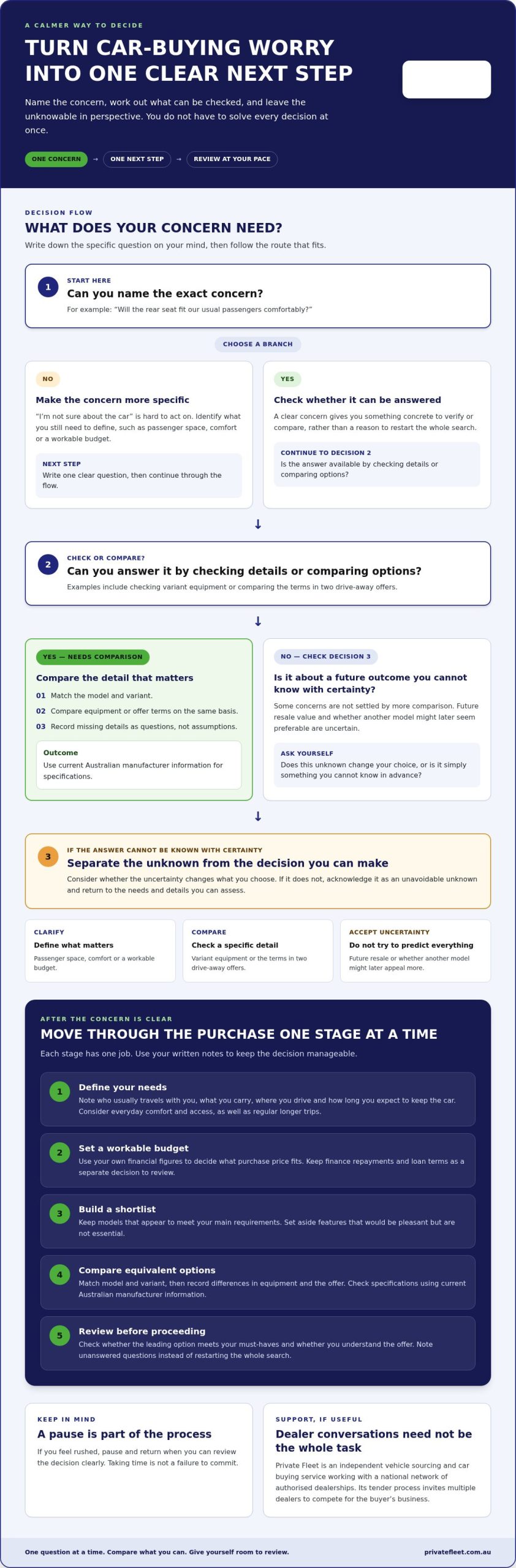
Write down the specific concern that’s on your mind. “I’m not sure about the car” is difficult to act on; “I don’t know whether the rear seat will fit our usual passengers comfortably” points to a useful next step. Then sort each concern into one of three groups:
- Needs clarification: You’re still defining what matters, such as passenger space, comfort or a workable budget.
- Needs comparison: You need to compare a particular detail, such as variant equipment or the terms in two drive-away offers.
- Cannot be known with certainty: You’re trying to predict future resale or whether a different model will later seem preferable.
Work through the first two groups one question at a time. For the last, decide whether it changes your choice or is simply an unavoidable unknown. If you feel rushed, pause and return to the decision when you can review it clearly. Taking time is part of the process, not a failure to commit.
How can you make a new-car decision feel smaller and clearer?
Give each stage one job: work out what the car needs to do, decide what you can spend using your own figures, create a shortlist, compare equivalent options, then review before committing. This makes how to avoid car buying anxiety 2026 a practical process, not a demand to predict every future need. Keep a written checklist so you can return to the facts instead of trying to hold every detail in your head.
- Define your needs. Note who usually travels with you, what you carry, where you drive and how long you expect to keep the car. Consider everyday comfort and access, as well as regular longer trips.
- Set a workable budget. Use your own financial figures and decide what purchase price fits. If you’re considering finance, keep repayments and loan terms as a separate decision to review, rather than letting them obscure the car’s price.
- Build a shortlist. Keep only models that appear to meet your main requirements. Set aside features that would be pleasant but aren’t essential.
- Compare equivalent options. Match model and variant, then record differences in equipment and the offer. Use current Australian manufacturer information for specifications.
- Review before proceeding. Check whether the leading option meets your must-haves and whether you understand the offer. Note any unanswered questions instead of treating them as reasons to restart the whole search.
This sequence doesn’t require you to settle every question at once. A shortlist answers “which cars deserve a closer look?” Your offer comparison answers “what exactly is included?” Each step narrows the task.
How do you turn a long list of cars into a realistic shortlist?
Start with the driving you actually do: daily kilometres, commuting or regional travel, passenger numbers and the space you need for luggage or other regular cargo. Think about the ownership period you have in mind, too. Then separate must-haves, such as enough usable space, from preferences, such as a particular interior finish. Compare models and variants using the same priorities, and check the relevant Australian specifications rather than assuming similar names mean identical equipment.
What information should you gather before comparing offers?
For each quote, record the exact model and variant, listed inclusions, whether the price is drive-away or another price basis, and when the offer expires. Keep vehicle details separate from questions about your trade-in, finance or delivery, so one part of the deal doesn’t blur another. A written new-car buying process overview can help you see how the steps fit together.
- Vehicle: model, variant, powertrain and included equipment.
- Offer: price basis, inclusions and expiry date.
- Other decisions: trade-in, finance and delivery questions.
When comparing costs, enter your own figures rather than relying on supposed average savings or generic budgets. If you’d like support organising vehicle sourcing and dealer discussions around your preferences, Get help buying my new car is an option.
How to compare new cars without over-analysing?
Use one comparison sheet and a clear stopping point. Compare only cars on your shortlist, check factual details against current Australian sources, then decide whether the differences affect your needs. This keeps research useful without turning it into an endless search for a car that has every possible advantage.
Set a research window that suits your buying timeframe, then choose a date to review your shortlist. Add a model only if it meets a must-have your current options don’t. At the review point, check whether any unanswered question could change your decision. If not, further searching may add noise rather than clarity.
Which real-world checks can make a shortlist more useful?
Use a test drive to assess how each shortlisted car suits you, not just how it looks on paper. Try adjusting the seat, getting in and out, checking visibility and noticing ride comfort and cabin noise. Explore the controls and parking assistance that matter to you. If you regularly carry passengers, travel long distances or tow, assess those needs against the exact variant and its verified Australian specifications.
Keep observations distinct from preferences. “The seat adjustment was easy to use” is an observation; “I prefer the other cabin layout” is a personal preference. Both are relevant, but labelling them helps you see whether you’re comparing evidence or taste. For features such as safety equipment, towing capacity or parking assistance, use the Australian manufacturer’s information for the exact model and variant rather than assuming all versions are alike.
How can you compare offers without making price the only test?
First check that each offer relates to the same model and variant. Record the stated price basis, inclusions and expiry date, then note anything missing as an open question. A lower figure may not describe the same vehicle or terms, so don’t treat unlike offers as a direct comparison.
| Comparison point | What to record |
|---|---|
| Model and variant | Exact name, powertrain and version |
| Fit for purpose | How it meets your regular driving and passenger needs |
| Comfort and controls | Seat, entry, visibility, ride, cabin noise and ease of use |
| Offer details | Price basis, inclusions and expiry date |
| Open questions | Any detail that needs clarification before comparing |
Keep trade-in and finance details in separate rows or notes. That way, the value assigned to your current car or a repayment discussion doesn’t obscure the new car’s quoted price. If you’d prefer support with the purchase process, Private Fleet’s new-car buying service is an option to consider.
A steady comparison is a practical way to approach how to avoid car buying anxiety 2026: use the same criteria, mark what you know and stop when the remaining differences don’t alter your priorities. If you’d like help with your next step, you can Get help buying my new car.
What practical steps can calm nerves before a test drive or decision?
A little preparation can make a test drive and the decisions around it feel more manageable. Decide what you want to learn, take notes straight afterwards and give yourself time to review the written offer. You don’t need to make a purchase decision in the car or during a dealer conversation. A clear pause protects your ability to choose at your own pace.
How should you prepare for a test drive when you feel nervous?
Before the appointment, write down your key questions and the features you want to assess. Pick a few practical checks, such as adjusting the seat, checking visibility, trying the controls and noticing how easy it feels to get in and out. Where practical, plan a familiar route that reflects your usual driving. Keep the drive focused on those observations, rather than trying to judge every detail at once.
- Before: Note your questions and the specific variant you’re driving.
- During: Focus on your chosen checks and ask for clarification if something isn’t clear.
- After: Write down what you observed before discussing or comparing the car.
Record observations separately from assumptions. For example, “I had to look down to find this control” describes what happened; “I’ll never get used to the technology” predicts the future. Both may matter, but separating them helps you decide whether you need another look or simply prefer a different layout. Don’t feel obliged to decide during the drive. Review your notes later, when you’re no longer trying to remember how the car felt.
What can you do when the decision still feels too big?
Choose one small next task instead of asking yourself to settle the whole purchase. You could clarify a variant, compare the written inclusions on two offers or write down a question about delivery. If it helps, ask someone you trust to listen or review your notes. Their role is to help you think, not to choose on your behalf.
For a clearer view of the steps involved, the car buying service process explains how a purchase can be organised from sourcing through to delivery. An independent service may also reduce the amount of dealer coordination you handle directly. That support is optional; you remain responsible for deciding which car and offer suit you.
Before accepting an offer, read the written details at a time when you can concentrate. Check that the model, variant, price basis and inclusions match what you discussed, and note any questions that still need an answer. Asking for time to review those details is a reasonable way to stay in control. A pause isn’t a failure to commit; it’s part of making an informed decision and a practical step in how to avoid car buying anxiety 2026.
If anxiety feels severe, persists beyond the purchase or affects your broader wellbeing, consider speaking with your GP or an appropriately qualified mental health professional. You don’t have to manage ongoing distress alone.
Get help buying my new car with Private Fleet
When can a car buying service make the process feel more manageable?
An independent car buying service may help if sourcing a vehicle and managing dealer discussions feels like more work than you want to take on. It can coordinate parts of the purchase around your preferences, while you remain in control of which car and offer you choose. Support with the process doesn’t mean handing over the decision.
What does support with sourcing and dealer discussions involve?
Private Fleet is an independent vehicle sourcing and car buying service. You can share your preferred make, model and requirements, then receive support with finding a suitable vehicle and handling dealer discussions. You still review the options and decide whether an offer meets your needs.
There’s no guaranteed price, saving, vehicle availability or delivery date. Review the written offer and its details before proceeding. Private Fleet doesn’t hold its own vehicle inventory; vehicle sourcing is part of the buying service.
Trade-in assistance can be considered separately if you’re also replacing your current car. Finance is another option, but it needn’t determine which vehicle you choose. Keep your preferred model and variant at the centre of the decision, then consider whether help with these additional steps would make the purchase easier.
A service may suit you if you’ve narrowed down your choices but would rather not coordinate every dealer conversation yourself. If you’re still working out what you need, take time to clarify your preferences first. The aim is to make the process manageable, not to add pressure or rush you towards a purchase.
How can you take a next step without feeling rushed?
Start with a simple outline: your preferred make or model, postcode and buying timeframe. If you’re flexible, mention that; if you have a particular variant in mind, include it. You don’t need to have every detail settled before asking about support.
Customers receive regular updates on delivery times as the purchase progresses. These updates don’t guarantee a specific delivery date, but they help keep you informed. You can review the information at your own pace and decide whether you’re ready for the next step. Making an enquiry doesn’t commit you to buying.
Share your preferred make or model, postcode and buying timeframe when you’re ready to explore support with your new-car purchase.
Get help buying my new car
Make your next step one you choose
A confident purchase doesn’t depend on knowing exactly what you’ll want years from now. It comes from choosing a car that suits the life you have planned, understanding the offer in front of you and feeling comfortable with the decision today. If a question remains, make it the next item to resolve rather than a reason to reopen your entire search.
That’s a practical way to approach how to avoid car buying anxiety 2026: let your priorities guide the decision, and use support where it makes the process easier. Private Fleet has operated since 1999, helping Australian buyers with new-car sourcing and the buying process. You can take the next step when you’re ready, with your preferred make or model, postcode and buying timeframe in mind.
Get help buying my new car
You don’t need a perfect prediction of the future to make a thoughtful choice. Take the process at your pace, and move forward when the car and the terms make sense to you.
Frequently Asked Questions
Is it normal to feel anxious about buying a new car?
Yes, it’s understandable to feel uncertain about a major purchase, especially if you’re weighing several models or making a decision you expect to live with for years. Feeling nervous doesn’t mean you’re making a poor choice or that something is wrong. Try identifying the specific concern, such as affordability or choosing a variant, so you can decide whether it needs an answer or is simply part of making a considered decision.
How can I stop overthinking which new car to buy?
Give your research a clear finish line. For a practical approach to how to avoid car buying anxiety 2026, keep a shortlist, decide which differences could genuinely affect your choice and stop adding options that don’t meet a specific need. If you’re stuck between two variants, write down the one feature driving the hesitation and compare that detail directly. A focused comparison is more useful than restarting your search each time doubt returns.
What if I regret my new-car decision after buying it?
First, separate a temporary adjustment period from a specific problem that needs action. Write down what you’re concerned about, when it occurs and whether it differs from what you understood before purchase. Review your order and purchase documents, then contact the relevant dealership about practical questions. If your concern involves your rights or the terms of the transaction, seek guidance from an appropriate Australian consumer advice service for your state or territory.
Can I ask for more time before accepting a new-car offer?
Yes, you can ask for time to read the offer and consider it before accepting. Request the terms in writing, including the offer’s expiry and any conditions that apply, so you know what you’re reviewing. Don’t assume an offer will remain available beyond its stated terms. If you need clarification, ask about the specific item that’s holding you back, then decide once you understand the details.
How do I feel more confident before a new-car test drive?
Make the appointment about gathering information, not proving you must buy the car. Before setting off, ask for a moment to adjust the seat and understand any controls you’ll need. If possible, include a familiar type of road and a parking manoeuvre that reflects your usual driving. Afterwards, note what felt comfortable, awkward or unclear. You can then compare that experience with your priorities without relying on memory alone.
Should I take someone with me when buying a new car?
If having company would help, take someone you trust. Agree beforehand on how they can support you, such as listening, noting answers or reminding you of questions. Explain that the final choice is yours. This can be especially useful if you find it difficult to take in information during a detailed conversation. If you’d rather attend alone, bring written questions and take time to review the information afterwards.
Can a car buying service help reduce the stress of buying a new car?
Yes, it may help if coordinating the purchase feels like a burden. Before getting support, decide which tasks you’d like help managing and which choices you want to handle yourself. You’ll still need to assess whether the vehicle and written terms suit you. A service can make the process feel more organised, but it can’t remove every uncertainty or guarantee a particular outcome.