
What if a private buyer can’t simply ask a dealer for the wholesale price? If you’re wondering how to get wholesale car price on a new car, the practical answer is to invite competition between authorised dealers, rather than look for a secret price list. Wholesale pricing is generally for businesses acquiring vehicles to sell or hold as stock.
It’s easy to be unsure what a dealer means by “wholesale” or “fleet” pricing. And a low advertised figure may not tell you what you’ll pay once delivery, registration, compulsory third party insurance and other charges are included. The useful comparison is between clear, like-for-like drive-away offers for the same model and variant.
This guide explains what wholesale pricing does and doesn’t mean for private buyers, what to check when comparing quotes, and how dealer competition can make the process simpler. Private Fleet is an independent car buying service that uses a tender process to invite multiple dealers to compete for your business, so you can consider competing offers without handling every negotiation yourself.
Key Takeaways
- Learn how to get wholesale car price through realistic competing offers, rather than relying on a supposed public wholesale price.
- Compare written quotes for the same make, model, variant, powertrain and options to make the figures meaningful.
- Separate the vehicle offer from accessories, trade-in value and finance so each part is easier to assess.
- Use a simple request-and-compare process, with your preferred model, variant, postcode and buying timeframe ready.
- See how Private Fleet’s dealer tender process can help bring competing authorised dealership offers together without you managing each enquiry yourself.
What does a wholesale car price mean for an Australian private buyer?
For a private buyer, “wholesale price” isn’t one guaranteed public price you can request for any new car. It usually describes the price at which dealers, wholesalers or other industry businesses acquire vehicles for stock. You can still seek competitive offers, but the useful goal is a clear, comparable buyer’s offer, not a label that may mean different things to different sellers.
A dealer’s acquisition cost doesn’t automatically determine what they’ll offer you. The final quote can reflect the particular vehicle, the buying channel and the terms of a current offer. That’s why asking how to get wholesale car price is best answered by comparing written offers for the same vehicle and checking exactly what each includes.
Is wholesale pricing actually available to private car buyers?
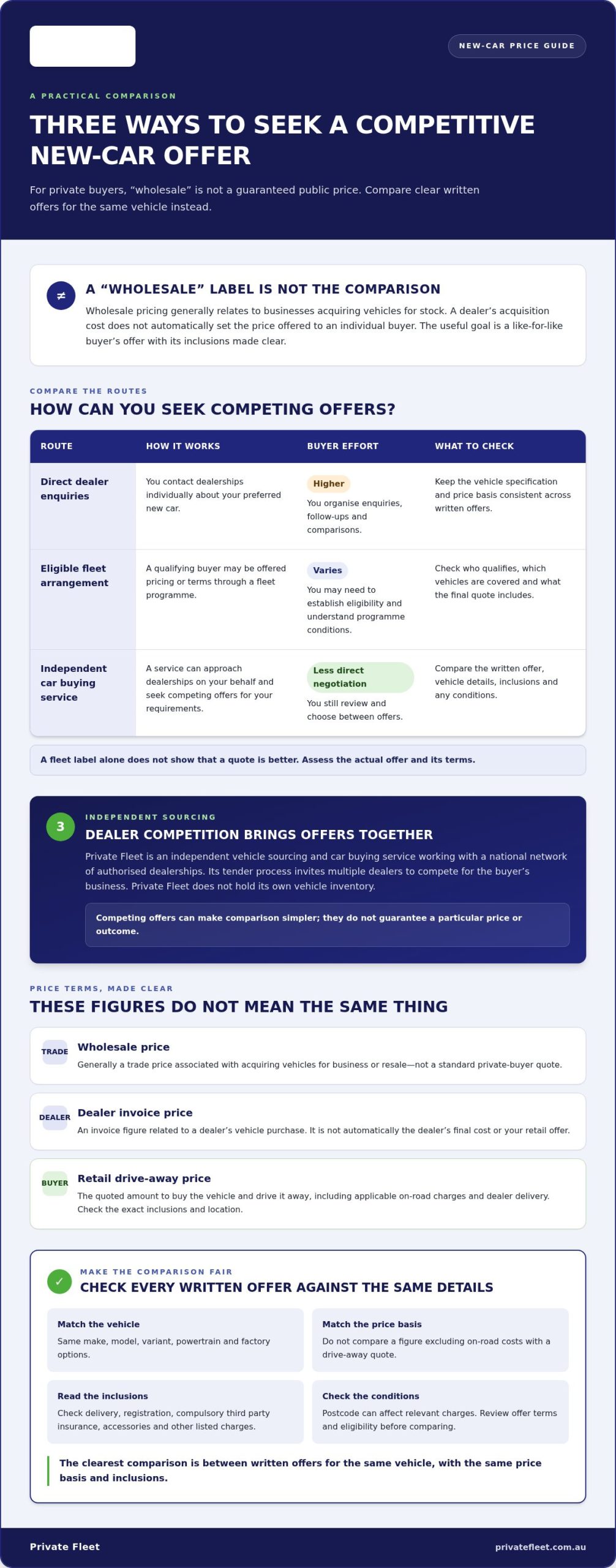
Wholesale transactions are generally part of the trade, rather than a standard retail option for a private buyer purchasing one new car. Fleet arrangements or other offers may be available through particular channels, but eligibility and terms can depend on the vehicle and offer. A fleet label alone doesn’t show that a quote is better. Compare the actual price and inclusions instead.
For context on how vehicle manufacturing, importing and distribution fit into Australia’s market, see this Australian automotive industry overview. It provides industry background, not a current price list or a measure of what a particular dealer will offer.
Wholesale, invoice and drive-away prices: what’s the difference?
These terms describe different things. A wholesale price generally refers to a trade-level vehicle acquisition price. A dealer invoice price usually refers to the amount invoiced for a vehicle to a dealership. Neither figure is automatically the price available to an individual, and neither tells you the complete cost of buying and registering a new car.
- Wholesale price: A trade price associated with acquiring vehicles for business or resale, rather than a standard private-buyer quote.
- Dealer invoice price: An invoice figure related to the dealer’s vehicle purchase. It should not be treated as the dealer’s final cost or your retail offer.
- Retail drive-away price: The quoted amount for buying the vehicle and driving it away, including applicable on-road charges and dealer delivery. Check the quote for its exact inclusions and location.
Price basis matters. A figure that excludes on-road costs can’t be fairly compared with a drive-away quote, even if it appears lower. Postcode can also affect the relevant charges. Check whether offers cover the same make, model, variant, powertrain and factory options, then compare any listed delivery, accessories or other charges. A written, like-for-like offer gives you a more useful basis for deciding than an undefined “wholesale” claim.
Wholesale car prices: how to get a sharper deal
There are three practical routes to explore: approach dealerships yourself, see whether you’re eligible for a fleet arrangement, or use an independent car buying service to seek competing dealer offers. Each can help you assess the market, but none makes a “wholesale” label proof of a better final price. The right route depends on how much of the research and negotiation you want to manage personally.
| Route | How it works | Buyer effort | Comparison points |
|---|---|---|---|
| Direct dealer enquiries | You approach dealerships individually for offers on your preferred new car. | Higher. You organise enquiries, follow-ups and comparisons. | Keep the vehicle specification and price basis consistent across written offers. |
| Eligible fleet arrangement | A qualifying buyer may access pricing or terms offered through a fleet programme. | Varies. You may need to establish eligibility and understand the programme’s conditions. | Check who qualifies, which vehicles are covered and what the final quote includes. |
| Independent car buying service | A service can approach dealerships on your behalf and seek competing offers for your requirements. | Less direct negotiation to manage; you still review and choose between the offers. | Compare the written offer, vehicle details, inclusions and any conditions. |
Can individuals access fleet pricing without owning a business?
Sometimes an individual may qualify for a particular fleet arrangement, but eligibility rules vary between offers and buying channels. Don’t assume that being a private buyer automatically qualifies you, or that a fleet rate is the final drive-away price. Read the offer conditions and compare the resulting written quote with other offers for the same vehicle. The Federal Chamber of Automotive Industries provides an industry perspective on Australia’s new-vehicle distribution sector, but individual offer terms still need to be assessed on their own merits.
What changes when dealers compete for your business?
Rather than contacting dealerships one at a time, a buyer can provide their requirements through a tender process, inviting multiple dealers to submit offers. Private Fleet is an independent vehicle sourcing and car buying service that works with a national network of authorised dealerships. Its tender process brings dealer offers together for the buyer to consider; Private Fleet doesn’t hold its own vehicle inventory.
Dealer competition creates comparable offers, not a guaranteed outcome. It can reduce the legwork of making separate enquiries, while giving you a clearer basis for deciding which offer suits your needs. You remain in control of whether to proceed. If you’d like support seeking competing new-car offers, share your preferred make or model, postcode and buying timeframe.
How to compare wholesale car quotes fairly before choosing an offer
A fair comparison starts with offers for the same vehicle, not simply similar-looking models or headline prices. Match the make, model, variant, powertrain and factory options. Then check what each written quote includes, when it was issued and whether it has an expiry date. These details help you judge the offer itself rather than a price claim with a different basis.
What should a comparable new-car quote include?
Check the vehicle description, requested colour and options, quoted price basis, inclusions and any assumptions. Make sure the quote is for the variant you intend to buy, not a base model or a different powertrain. For Australian offers, distinguish a drive-away figure from a price that excludes on-road costs. If a detail is unclear, get the offer clarified in writing before comparing.
- Vehicle: make, model, variant, powertrain, colour and factory-fitted options.
- Price: whether it’s drive-away, and which on-road charges or dealer costs are included.
- Extras: accessories, their stated cost and whether they’re optional.
- Timing and conditions: quote date, expiry, delivery estimate and any conditions attached to the offer.
Offers can change, so check current prices and promotions against Australian manufacturer or authorised dealership sources. Record any assumptions, such as whether an offer depends on a particular purchase method or vehicle specification. Don’t treat an advertised figure as a confirmed quote if the written terms differ.
How should you treat trade-ins and finance in the comparison?
Assess the new-car price separately from your trade-in valuation and any finance arrangement. A trade-in can affect the amount you need to pay, but it doesn’t change the quoted price of the new vehicle. Likewise, a repayment figure alone doesn’t show the full finance cost or explain how the vehicle price, deposit, loan term and other terms contribute to it.
For a clear comparison, note the new-car offer first, then record the trade-in amount and finance details as separate items. This makes it easier to see which part of one package differs from another and to compare the vehicle offers on their own merits. Avoid choosing solely on the apparent value of a combined deal.
Delivery timing may also influence your decision. Compare any stated estimate and the conditions attached to it, especially if you’re replacing a car by a particular date. Estimates aren’t guarantees, so consider whether the timing suits your plans without assuming a vehicle will be ready on a specific day.
If you’re weighing up a new-car offer alongside a trade-in, you can get help with your new-car purchase by sharing your preferred make or model, variant, postcode and buying timeframe.
How to request and assess competing new-car offers step by step
A clear request makes it easier to receive offers you can assess side by side. If you’re working out how to get wholesale car price, focus on giving each dealer the same requirements and asking for the offer in writing. This keeps the process organised without relying on discount labels or memory.
- Shortlist the car. Choose your preferred make and model, then decide whether you’re comparing one option or a small shortlist. Consider what matters for your use, such as cabin space, powertrain or features, so you can narrow the choice before requesting offers.
- Specify the vehicle. State the exact variant, powertrain, colour and factory options you want. Include your postcode, preferred buying timeframe and any delivery requirements. If you’re open to alternatives, identify what can vary and what must stay the same for a fair comparison.
- Request written offers. Send the same brief to each dealer or use a buying service that can seek competing offers on your behalf. Ask for the quoted price basis, inclusions and conditions to be stated clearly. Mention if you have a trade-in, but request its valuation separately from the new-car price.
- Compare the offers. Check that each quote refers to the vehicle you specified. Compare the total quoted price and included items, not just headline discount language. Note differences in accessories, on-road inclusions, delivery estimates and any conditions that could change the amount or terms.
- Clarify anything unclear. If a quote leaves out a charge, refers to a different variant or depends on a condition you don’t understand, ask for written clarification. Check the quote date and expiry, and compare the timing stated by each dealer against your plans. Treat delivery estimates as estimates, not a confirmed date.
- Verify and decide. Before committing, check current vehicle details and offer terms against Australian manufacturer or authorised dealership sources. Make sure the written offer matches the car you want and that you understand what is included. Then decide which offer best fits your requirements, not simply which uses the strongest discount claim.
Keep your notes together, including the vehicle specification, each written quote and any clarifications. If your shortlist changes, update the request before comparing again; an offer for a different variant or set of options won’t give you a reliable comparison. The new-car buying process can also help you understand the steps involved in moving from a preferred vehicle to a purchase.
For assistance seeking competing offers, share your preferred make or model, variant, postcode and buying timeframe.
How Private Fleet helps private buyers seek a wholesale-like new-car offer
Private Fleet helps private individuals source a new car and consider dealer offers without holding its own vehicle inventory or acting as a manufacturer-owned or authorised brand dealer. The service can suit buyers who want support organising the purchase while keeping the final decision in their hands.
What happens when Private Fleet manages the buying process?
You share your vehicle preferences and buying plans, then Private Fleet supports the sourcing process and brings offers together for you to assess. This can reduce the need to coordinate every enquiry yourself. Offers and terms can differ, so you can review the details and decide whether an option suits your requirements. There’s no guaranteed price or outcome.
Support can also include trade-in assistance. Keeping that valuation separate from the new-car offer helps you assess each part of the purchase clearly. Finance support may be relevant too, but it’s best considered separately from the vehicle price. The new-car buying service is designed to help private buyers manage sourcing and make the purchase process more straightforward.
You remain in control of which vehicle and offer to pursue. If your preferences are still taking shape, you can share a shortlist and note where you’re open to alternatives. This gives the sourcing request room to reflect what matters to you, whether that’s a particular variant, a preferred feature or a set buying timeframe.
What details should you share to get the process started?
A clear starting brief helps focus the search. You don’t need to have every decision finalised; explain what you know and where you’d welcome options.
- Preferred make or model: Include a shortlist if you’re weighing up alternatives.
- Variant and features: Note your preferred powertrain, colour or factory options if known.
- Budget: Share the amount you’re comfortable considering for the new-car purchase.
- Postcode and timeframe: These help frame your request around your location and intended buying period.
- Trade-in details: Mention your current vehicle if you’d like trade-in assistance, keeping its valuation separate from the new-car offer.
With these details, you can take a more considered next step and review options that reflect your priorities.
Take the next step with confidence
The most useful starting point is a clear sense of what matters most in your next car. Decide which features and requirements are essential, where you can be flexible, and what would make an offer feel right for your circumstances. That gives you a stronger basis for choosing than a wholesale label alone.
If you are still considering how to get wholesale car price, you don’t need to manage every dealer conversation on your own. Share your shortlist, budget, postcode and buying timeframe with Private Fleet to explore a practical path to competing offers. You can then review the options at your own pace and choose the one that best fits your needs.
Get help buying my new car
A considered decision starts with the right car and clear terms. Take the next step when you are ready.
Frequently Asked Questions
Can a private buyer get a wholesale price on a new car?
A private buyer can seek competitive new-car offers, but a trade-only wholesale price isn’t usually a standard retail price for an individual purchase. A practical approach to how to get wholesale car price is to compare written offers through available buying channels. For example, request a quote for a specific variant and check whether it’s drive-away, what it includes and what conditions apply. That gives you a clearer decision than relying on a wholesale label.
Do I need an ABN to access fleet pricing in Australia?
Not necessarily, but eligibility depends on the particular fleet programme and its conditions. Some arrangements may be limited to businesses or other qualifying groups, while others may include eligible individuals. Don’t assume an ABN is always required or that having one automatically qualifies you. Check the rules for the specific offer, including eligible vehicles and any purchase conditions, then assess the resulting written quote against other options.
Is a wholesale car price the same as a dealer invoice price?
No. A wholesale price generally refers to a trade transaction, while a dealer invoice price refers to an invoice associated with the dealership acquiring a vehicle. Neither figure alone tells you the final amount a private buyer will pay. For your decision, focus on the written retail offer and its price basis. For instance, a quote excluding on-road charges shouldn’t be compared directly with one that includes them.
How much can I save by getting a wholesale car price?
There’s no reliable saving amount to assume in advance. The difference between offers can depend on the vehicle, variant, offer terms and buying channel, and a wholesale or fleet label doesn’t guarantee a particular result. Compare current written quotes for the same vehicle and check inclusions and conditions before deciding. Treat any claimed saving cautiously unless it’s based on a clear comparison with the same price basis.
Should I negotiate directly with a dealer or use a car buying service?
Either route can suit you. Contacting dealers directly gives you control, but you’ll need to organise enquiries, follow-ups and comparisons yourself. A car buying service can manage sourcing and seek competing dealer offers on your behalf, which may suit buyers who prefer less direct negotiation. Consider how much time you want to spend and whether you’re comfortable checking written terms before choosing.
Can I get a wholesale price if I have a trade-in?
You can still seek competitive offers on a new car if you have a trade-in. To understand the deal, assess the new-car price and the trade-in valuation as separate figures. For example, compare the new-car offer before accounting for the amount offered for your current vehicle, then consider the trade-in on its own merits. This helps you see whether a change in the combined amount comes from the new car or the trade-in.