
Walking onto a dealership floor to haggle is the single most expensive way to buy a new car. If you want to get dealers competing for your business, the secret isn’t spending exhausting weekends trapped in showroom sales offices or trying to outsmart a career salesperson. Most Australian buyers find the traditional buying ritual thoroughly draining; between murky dealer delivery fees, uninvited aftermarket add-ons, and sales staff who refuse to put binding driveaway figures in writing, it’s easy to worry you’re paying far more than the next customer.
True leverage doesn’t come from aggressive counter-offers; it comes from structured competition. In this 2026 guide, you’ll learn how to flip showroom dynamics on their head and force dealerships to tender their sharpest driveaway prices directly to you. Ahead, we reveal a proven framework to solicit competitive bids without setting foot across multiple showrooms, giving you complete confidence that you’ve secured the keenest deal available from quotation right through to delivery.
Key Takeaways
- Shifting negotiations outside the showroom floor neutralises high-pressure sales tactics and places market leverage firmly back in your hands.
- Structuring a detailed vehicle specification with a strict deadline is the proven way to get dealers competing for your business on binding driveaway terms.
- Proven counter-strategies help you bypass common dealership deflections, eliminate unexpected aftermarket charges, and secure transparent written offers.
- Tapping into an established tender network unlocks commercial fleet pricing that individual buyers simply cannot command on their own.
- A rigorous pre-delivery verification process protects your purchase by confirming build dates, factory warranty terms, and final paperwork before handover.
The Dealer Dynamic: Why Showrooms Win When Buyers Shop Alone
Walk onto a dealership forecourt unaccompanied, and the commercial playing field tilts immediately against you. Dealerships operate as finely tuned retail environments where sales staff undergo rigorous training to control every variable, from emotional attachment to financial positioning. When you negotiate as an isolated purchaser, you lack visibility over current wholesale market fluctuations, monthly manufacturer factory incentives, and volume bonuses. Dealerships use this isolation to protect retail profit margins on every individual unit sold.
Every dealership operates under intense pressure to hit internal targets. Monthly volume bonuses paid by vehicle distributors frequently outweigh the front-end gross margin on a single car. An isolated retail buyer rarely knows whether a dealer is two sales short of a substantial quarterly bonus or sitting comfortably ahead of quota. To truly get dealers competing for your business, you must invert this dynamic. Replacing individual showroom visits with a structured procurement model strips away retail sales control, turning an emotional sales interaction into an objective commercial transaction.
The Information Asymmetry in Traditional Showrooms
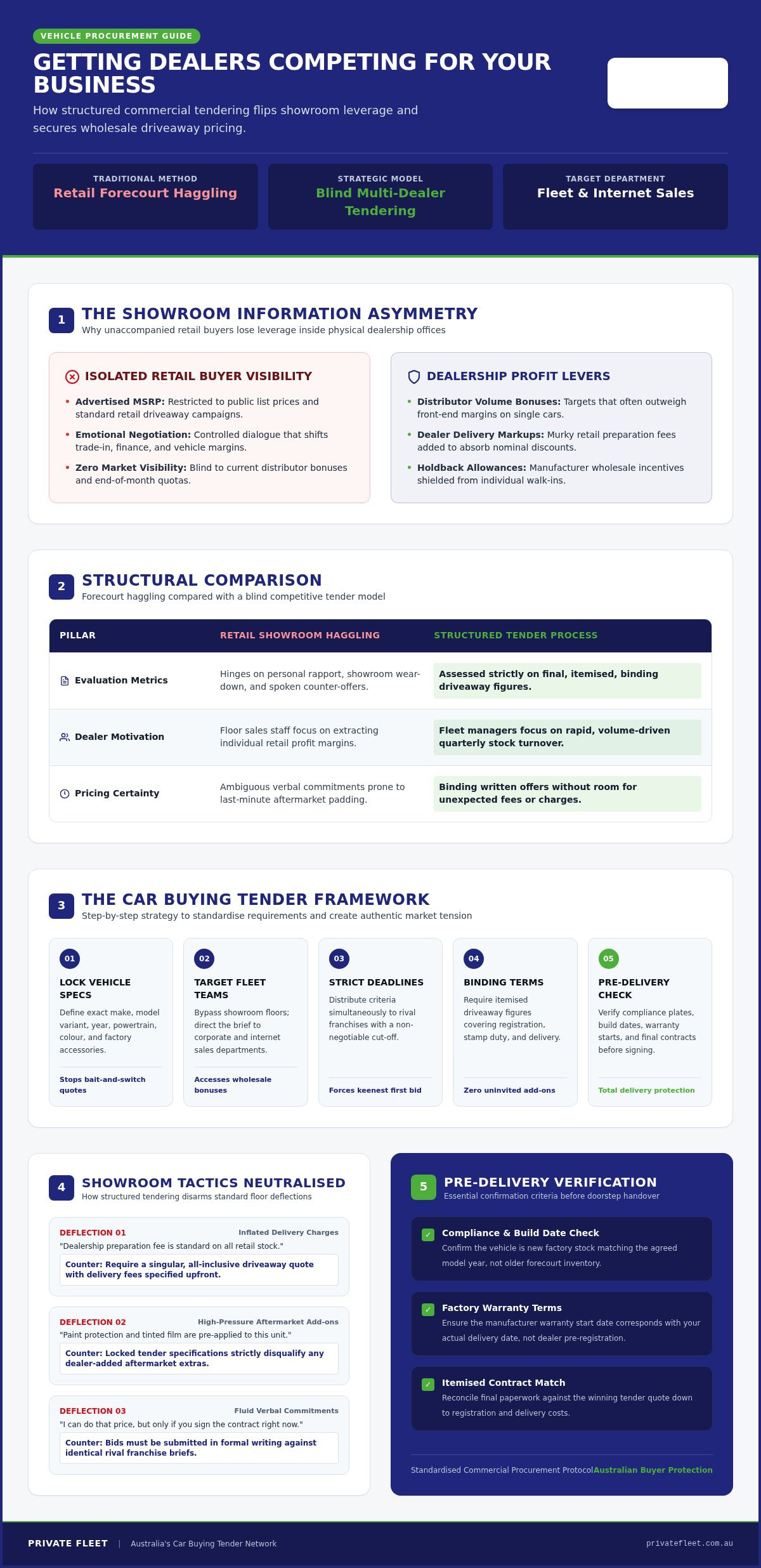
Dealership profitability relies heavily on information asymmetry. Retail buyers typically see only the manufacturer’s suggested retail price and advertised driveaway promotions, while dealerships protect holdback figures, dealer delivery markups, and factory volume allowances. Walking into a physical showroom forfeits your greatest tactical advantage: detachment. Once you sit across a desk, sales managers control the dialogue, keeping trade-in valuations, finance terms, and vehicle pricing fluid to absorb discounts elsewhere in the contract.
Retail Haggling vs. Structured Dealer Tendering
Retail haggling is exhausting, unpredictable, and inherently weighted toward the house. In contrast, running a formal car buying tender replaces spoken showroom friction with precise written criteria. When dealers tender blindly against rival franchises, showroom performance tactics disappear. Key structural differences between these two approaches include:
- Evaluation Metrics: Traditional negotiation hinges on personal rapport and showroom pressure, whereas tendering assesses bids strictly on final, itemised driveaway numbers.
- Dealer Motivation: Walk-in shoppers are viewed as retail margin opportunities. Structured tenders are directed straight to fleet and internet sales managers who focus on fast, volume-driven stock turnover.
- Pricing Transparency: In-person bargaining yields ambiguous verbal figures; competitive tendering produces binding, written quotes without room for hidden delivery fees.
By forcing dealerships to bid blindly within set timeframes, you get dealers competing for your business on your terms, unlocking wholesale-level pricing typically reserved for corporate buyers.
How to Structure a Car Buying Tender: A Step-by-Step Guide
To get dealers competing for your business effectively, you must abandon ad-hoc phone calls and informal showroom chats. A formal procurement tender standardises your requirements into a uniform brief sent simultaneously to multiple dealerships across Australia. By defining identical criteria upfront, you create genuine commercial tension and force sales teams to submit their keenest figures without days of counter-negotiation.
Step 1: Lock Down Exact Vehicle Specifications
Precision protects your bottom line. Specify the exact make, model variant, model year, powertrain, exterior colour, interior trim, and factory-fitted accessories in your brief. Ambiguity allows dealerships to tender older stock, display models, or mismatched specifications to make their quotes look artificially low. Once your request is issued, keep these parameters locked. Changing your preferences halfway through invalidates previous quotes and stalls dealer momentum.
Step 2: Target Fleet and Internet Sales Managers
Bypass the showroom floor and send your tender straight to fleet and corporate sales departments. Fleet managers operate on volume targets and lower profit margins per unit, meaning their compensation favours swift turnover over lengthy bargaining. Distributing your brief simultaneously across accredited dealerships signals that you are ready to sign a contract as soon as the sharpest bid arrives. If managing dozens of dealership contacts feels overwhelming, engaging an independent new car buying service gives you direct access to an established commercial tender network without the administrative legwork.
Step 3: Mandate Transparent Driveaway Terms
Every tender submission must be a comprehensive, binding driveaway price. Require dealers to itemise statutory costs, including registration, compulsory third-party insurance, and stamp duty, alongside freight and pre-delivery preparation fees. Emphasising written accountability aligns with proven consumer protection advice on holding dealers to transparent quotes, ensuring dealerships cannot introduce surprise line items later. Set a firm closing deadline of 48 to 72 hours, which creates urgency and prevents sales staff from dragging out discussions.
Defeating Showroom Tactics: Holding Dealers to Transparent Quotes
Issuing a formal tender changes the dynamic, but retail dealerships frequently deploy tactical objections to drag discussions back into the showroom. Sales managers know that face-to-face conversations restore their home-ground advantage, where personal persuasion can erode your resolve. Maintaining commercial discipline is critical; you must hold every dealer accountable to your written rules if you want to get dealers competing for your business on equal terms.
Neutralising the ‘Come In and We Will Talk’ Objection
Dealerships routinely reply to tender requests with vague messages asking you to drop by the showroom to “work out numbers.” This tactic aims to regain psychological control. Politely decline these requests in writing, stating clearly that only written, itemised proposals will be considered before the tender closing deadline. A dealership unwilling to commit a driveaway price to paper usually knows its pricing is uncompetitive against rival bids. Buyers who want to avoid car dealership negotiation entirely will find that insisting on written submissions is one of the most effective boundaries to set from the outset.
Eliminating Padded Delivery and Accessory Fees
Scrutinise every line item closely when quotes arrive. Dealerships often offset discounts by inflating dealer delivery charges or slipping in expensive vehicle accessories without approval. Industry guides outlining how to negotiate a car’s price stress the necessity of verifying all figures against statutory costs. Protect your bottom line by checking for the following inclusions:
- Dealer Delivery Charges: Ensure delivery charges are capped and fully disclosed rather than added as an open-ended handling expense.
- Statutory Registration Fees: Confirm registration, compulsory third-party insurance, and stamp duty reflect official government rates rather than rounded estimates.
- Unsolicited Fitments: Reject pre-applied treatments like fabric sprays, electronic rust units, or window tints unless explicitly requested in your tender brief.
Unbundling Trade-Ins and Vehicle Finance
Showrooms love the “four-square” method because bundling transactions lets them hide where your money goes. If a salesperson drops the new vehicle price, they often recover that margin by undervaluing your trade-in or raising the interest rate on in-house dealer finance. Treat each component as a completely independent transaction. Evaluate the new car tender solely on its driveaway figure, benchmark your existing vehicle against third-party wholesale trade valuations, and secure loan pre-approval independently so showroom finance managers cannot recoup their vehicle discounts through higher credit margins. Buyers who want to buy a new car without negotiating will find that keeping these transactions separate is one of the most effective ways to protect their overall savings.
DIY Dealer Bidding vs. Professional Procurement Networks
Running an independent tender process is entirely feasible, but managing it properly demands rigorous administrative discipline. While taking the DIY route gives you direct control over communications, it also exposes you to persistent dealership sales follow-ups and hours of administrative coordination. Understanding the practical differences between solitary retail bargaining and commercial procurement scale helps determine whether managing the tender yourself delivers the best return on your time.
The Time, Effort, and Privacy Costs of DIY Tendering
Coordinating ten to twenty dealership submissions involves continuous spreadsheet tracking, cross-checking itemised fees, and screening persistent phone calls. The moment you distribute your details across multiple dealer websites, your name and phone number enter various customer management databases. Sales representatives will follow up aggressively, attempting to pull you off your structured timetable. Learning how does a car broker work highlights how an independent intermediary shields your personal contact information entirely, filtering out noise and presenting only verified, compliant bids for your review.
Volume Fleet Leverage: Why Scale Changes Dealer Behaviour
An individual buyer purchasing one vehicle every four or five years represents a single transaction to a franchise. Commercial procurement networks, on the other hand, purchase hundreds of vehicles annually, creating institutional relationships that carry immense commercial weight. Aligning with an established car broker australia allows private buyers to tap directly into genuine fleet-level discounting without needing corporate buying power.
Fleet departments consistently tender their keenest figures to commercial partners who deliver repeat business every month. Here is how volume procurement alters dealer responsiveness:
- Margin Structure: Fleet directors submit wholesale-level margins to institutional buyers because customer acquisition costs are virtually zero.
- Allocation Priority: High-volume brokers work across national dealer groups to source suitable vehicles, and keep you updated regularly on delivery timing.
- Complete Independence: Professional networks operate without dealer bias, evaluating bids purely on pricing efficiency and client value.
A private tender is an effective way to get dealers competing for your business, but backing that tender with collective purchasing scale drives pricing down even further. If you prefer to bypass the phone calls and administrative overhead entirely, you can request a tender quote through Private Fleet to let seasoned advocates secure your next vehicle.
Securing Your Vehicle: From Winning Tender to Doorstep Handover
Selecting the winning bid is an exciting milestone, but your diligence shouldn’t stop once the tender closes. Securing the transaction requires thorough contract verification to ensure that every figure, vehicle specification, and delivery detail matches the agreed terms. When you get dealers competing for your business, the ultimate goal is not merely winning a pricing contest; it is securing a seamless, stress-free path to physical handover.
Verifying the Contract Against the Tender Terms
Before signing any formal contract or placing a holding deposit, examine the dealer sales agreement line by line. Dealership administrative offices often draft paperwork from standard retail templates, which can inadvertently reintroduce pre-delivery charges or adjust statutory registration figures. Protect yourself by confirming these crucial details:
- Vehicle Identification and Build Plates: Confirm the contract specifies the exact model year, compliance plate date, and Vehicle Identification Number (VIN) if the car is already in stock.
- Exact Driveaway Reconciliation: Check that the final payable figure matches the winning tender quote to the cent, without added handling fees or revised delivery fees.
- Factory Warranty and Delivery Schedules: Ensure that factory warranty commencement aligns with vehicle registration and that an estimated delivery date is documented in writing.
The End-to-End Advantage of Managed Car Procurement
Cross-referencing contracts, verifying compliance plates, and arranging transport across dealerships can be demanding for an individual buyer. Understanding why a new car buying service is your best move in 2026 clarifies how end-to-end advocacy protects your interests through to the final handover. Rather than coordinating between dealerships, transport carriers, and state registration bodies yourself, a complete service oversees the entire post-tender timeline on your behalf.
This comprehensive oversight is where Private Fleet transforms the car acquisition journey. Operating as an independent car broker since 1999, the service handles vehicle sourcing, trade-in assistance, car finance, and direct door-to-door delivery. Combining an accredited nationwide dealer network with dedicated contract management ensures you get dealers competing for your business while enjoying total peace of mind from quotation right through to delivery.
Flip the Showroom Advantage in Your Favour
Negotiating from a showroom desk is no longer the smartest way to buy a new vehicle. Shifting your purchase into a structured tender immediately neutralises retail pressure tactics, eliminates inflated delivery markups, and establishes total pricing transparency. Creating a formal request for quote remains the most reliable strategy to get dealers competing for your business, ensuring you evaluate binding driveaway figures rather than verbal showroom promises.
Operating as an independent Australian car brokerage since 1999, Private Fleet harnesses institutional buying scale to pit hundreds of accredited dealerships against each other nationwide. Our complete service manages the entire journey on your behalf, coordinating trade-in assistance, car finance, and direct door-to-door delivery. Ready to let hundreds of dealers fight over your next car? Let Private Fleet run your national dealer tender today and enjoy complete confidence from initial quotation to final handover.
Frequently Asked Questions
Can an individual really get dealers competing for your business without visiting showrooms?
Yes, private buyers can solicit bids remotely by distributing a structured written tender directly to fleet and internet sales managers. When you define exact vehicle specifications and set a firm deadline, dealerships understand you’re a qualified buyer ready to transact immediately. This format bypasses showroom floor negotiations entirely, forcing franchises to submit their sharpest driveaway proposals in writing so you can review them from home.
Why do many car dealerships refuse to give competitive quotes over email or phone?
Dealerships resist providing remote quotes because written figures eliminate their psychological advantage and can be shopped to rival showrooms. Retail sales consultants are trained to secure foot traffic, knowing that buyers on the showroom floor are far more susceptible to emotional persuasion and add-on sales. When dealerships refuse to quote in writing, it usually indicates they rely on showroom pressure rather than transparent, competitive pricing to win deals. Buyers who want to avoid car dealership negotiation can use this refusal as a clear signal to redirect their enquiry to more transparent, competition-driven channels.
What is the difference between a driveaway price and a dealer list price in Australia?
A dealer list price or manufacturer’s list price covers only the bare vehicle itself, omitting mandatory statutory on-road costs. In contrast, an Australian driveaway price includes vehicle registration, compulsory third-party insurance, state stamp duty, and dealer delivery charges. Always insist on driveaway figures during negotiations. List prices create an artificial sense of value that quickly disappears once standard government charges and dealer delivery fees are added.
How many dealerships should I include when running an independent vehicle tender?
Targeting eight to fifteen franchised dealerships provides sufficient competition to uncover true wholesale market pricing without creating an unmanageable administrative burden. Including too few stores limits your price discovery, especially if local franchises belong to the same dealer ownership group. Casting a wider net across multiple independent dealership groups generates genuine bidding tension, helping you get dealers competing for your business on identical terms.
What stops car dealers from adding extra delivery charges after winning a tender?
Clear tender documentation prevents secondary markups by explicitly stating that accepted bids represent final, all-inclusive driveaway agreements. If an invoice or dealer contract arrives with unexpected vehicle detailing charges, administrative fees, or unrequested accessories, you should reject the document immediately. Dealers know that attempting to inflate charges after a tender has been accepted breaches the initial agreement and will cause them to forfeit the sale entirely.
How does a car broker obtain better dealer prices than an individual buyer?
Car brokers command wholesale pricing because they represent steady, high-volume transactions for fleet departments across Australia. Dealerships view an individual buyer as a one-off retail margin opportunity, whereas brokers supply hundreds of sales annually. Fleet directors willingly discount their margins to minimal levels for brokers because client acquisition costs are negligible, giving everyday private buyers access to commercial fleet terms they could never negotiate alone.
Can I include my trade-in vehicle as part of a competitive dealer tender?
Yes, but you must treat your trade-in as a separate transaction to keep your pricing clean. Request tenders on the new car’s driveaway price first, then solicit competitive trade-in valuations across dealers or independent wholesale buyers. Bundling both together allows sales teams to hide low trade values behind vehicle discounts, eroding your financial advantage. Keeping them separate guarantees full transparency across both sides of the deal.