
The advertised price isn’t always the final word. Yes, you can negotiate a dealer’s total drive-away price in Australia. Ask whether there’s flexibility and focus on the full amount payable, not just the advertised price.
It makes sense to want a clear figure before you commit. Comparing offers is useful only when they cover the same make, model, variant and inclusions, with optional extras and charges clearly identified.
This article explains how to open negotiations, compare dealer offers and agree on a total drive-away price. You’ll also learn what to get in writing and how to arrange payment, so you can assess the full purchase before deciding.
Key Takeaways
- Ask whether the dealer has flexibility on the total drive-away price, and make any offer clear and considered.
- Compare like-for-like offers, including the exact model and variant, selected options, charges and inclusions.
- Keep the new-car price, trade-in value, optional extras and finance costs separate so each part is easier to assess.
- Before agreeing, make sure the final price, inclusions and payment arrangements are recorded in writing.
- A car-buying service can tender your chosen new car across a dealer network, helping you compare competing offers without managing each negotiation yourself.
Negotiating a dealer’s total drive-away price
Yes, you can negotiate a dealer’s total drive-away price on a new car. Focus on the final amount for the exact vehicle, then have the agreed price and conditions recorded in writing.
-
How a car-buying service checks what the drive-away price includes
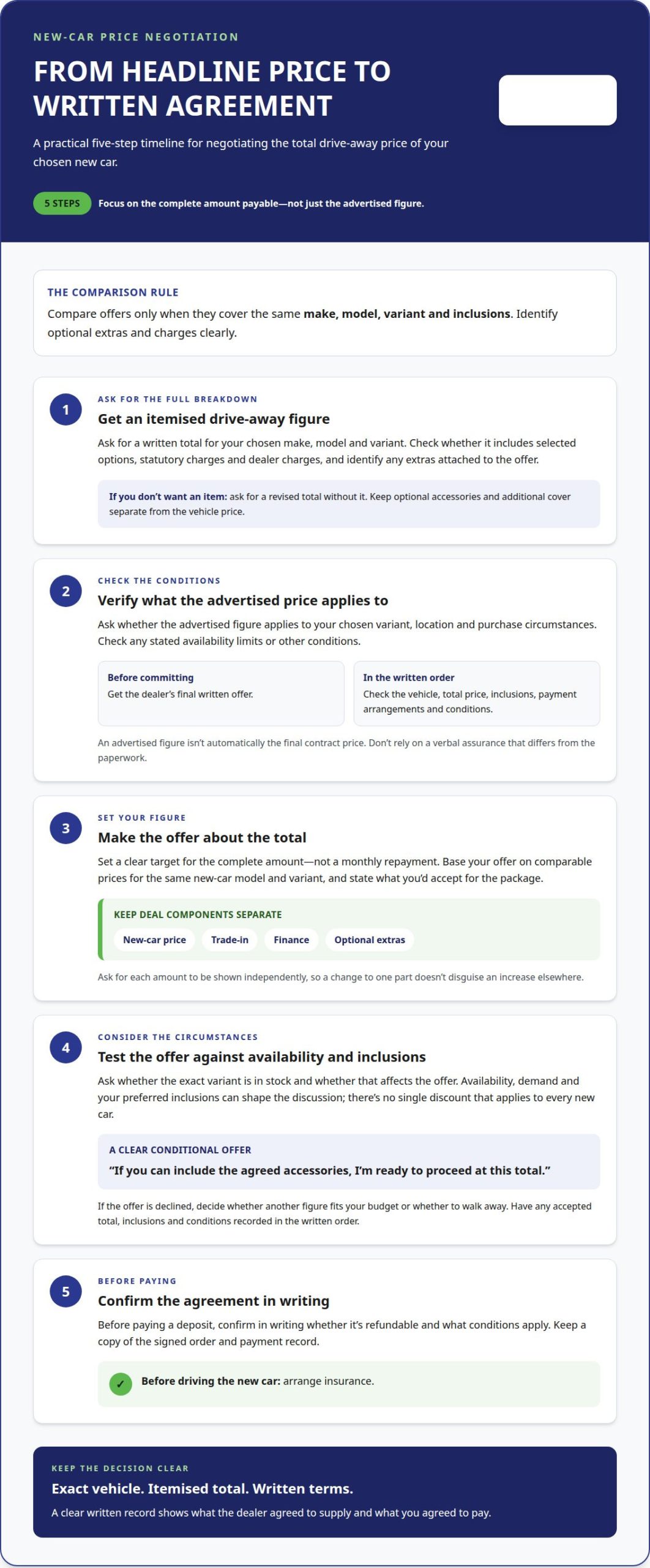
Ask the dealer for a written breakdown of the total for your chosen make, model and variant. Check whether it includes selected options, statutory charges and dealer charges, and identify any extras attached to the offer. Compare offers only after confirming they cover the same vehicle and inclusions.
Separate optional accessories and additional cover from the vehicle price. If you don’t want an item, ask for a revised total without it. An itemised offer shows what you’re paying for and prevents an appealing headline price from obscuring the amount you’ll actually pay.
-
How a car-buying service assesses whether advertised prices are binding
Ask the dealer to confirm the advertised price’s conditions and whether it applies to your chosen variant, location and purchase circumstances. An advertised figure isn’t automatically the final contract price. Whether it is binding depends on the advertisement’s wording and conditions, so get the dealer’s final written offer before committing.
Check that the written order records the vehicle, total price, inclusions, payment arrangements and any conditions attached to the offer. If the advertisement mentions limited availability or specific terms, ask for those terms in writing. Don’t rely on a verbal assurance that differs from the paperwork.
- Set a clear target for the total, not a monthly repayment. Explain your offer using comparable prices for the same new-car model and variant, then state what you’d accept for the complete package. This gives the dealer a specific figure to consider and keeps the discussion focused on the car’s total cost.
Discuss any trade-in and finance separately from the new-car price. Ask the dealer to show each amount independently, along with the cost of optional extras. That way, a change to one part of the deal won’t disguise an increase elsewhere.
-
How a car-buying service assesses the potential discount
Ask whether the exact variant is in stock and whether that affects the dealer’s offer. Existing stock may give a dealer a reason to negotiate, while demand, availability and your preferred inclusions also shape the discussion. There’s no single discount that applies to every new car.
Make a conditional offer: “If you can include the agreed accessories, I’m ready to proceed at this total.” If the dealer declines, decide whether another figure fits your budget or whether to walk away. Have the accepted total, inclusions and conditions recorded in the written order.
- Before paying a deposit, confirm in writing whether it’s refundable and what conditions apply. Keep a copy of the signed order and payment record, and arrange insurance before driving the new car. These steps give you a clear record of what the dealer agreed to supply and what you agreed to pay.
Preparing a negotiation opening
Prepare a specific offer based on the new car, its availability and your preferred purchase terms. A focused opening gives the dealer a clear proposal to consider.
There’s no single best time to negotiate a new-car price in Australia. Dealers may have more flexibility towards month-end or financial year-end, and an in-stock vehicle may also provide room for discussion.
-
When a car-buying service may negotiate a new-car price
Ask the buying service to consider timing alongside the exact vehicle you want. Dealers may be more flexible towards the end of the month or financial year, but the outcome depends on the offer and circumstances. A car already in stock may also be easier to negotiate if the dealer wants to move it.
Timing is one factor, not a reason to accept an unsuitable variant or unwanted extras. A negotiator can weigh availability against your preferred specification and buying timeframe, then decide whether to open discussions or keep looking for a suitable offer.
-
How a car-buying service prepares a negotiation opening
Give the negotiator your preferred make, model, variant, postcode and buying timeframe. They can use those details to approach dealers with a precise request, rather than a broad enquiry that leaves the vehicle or location unclear. A vehicle valuation tool can also help establish an estimated value before negotiations begin.
Your opening should state the vehicle you want and the proposed total price, with any required options clearly identified. A buying service can support its offer with comparable prices and explain how the figure was reached. Setting a maximum also helps keep the discussion within your budget.
- Set your limit before the first offer goes to a dealer. Tell the negotiator how much you’re prepared to pay and which inclusions matter most. If a particular accessory is essential, include it in the proposal; if it’s optional, keep it separate.
Make a firm but courteous offer. A clear figure gives the dealer something to accept, reject or counter, while a polite tone keeps the discussion practical. Be prepared to decline if the final terms exceed your limit.
- Keep the new-car negotiation separate from finance and any trade-in. Ask for the vehicle price on its own, so a repayment amount or trade-in allowance doesn’t obscure the total. If you’re considering finance, compare the overall borrowing terms as well as the purchase price.
Gather more than one valuation for your trade-in before negotiations begin. This gives the negotiator a better basis for assessing the allowance without blending it into the new-car offer. Apply the same approach to warranty cover and accessories: identify what you want, then assess each item on its own merits.
- Agree on a walk-away point before discussions start. If the dealer’s response exceeds your limit, the negotiator can make a considered counteroffer or politely decline, rather than increasing the figure under pressure. If you’re ready to proceed at a particular total, state that condition plainly.
To have a professional prepare an opening around your preferred vehicle and timing, share your buying details for assistance or call 1300 303 181. That helps keep the discussion centred on the car you actually intend to buy.
Comparing offers from several dealerships through a car-buying service
A car-buying service can invite several dealerships to compete for your business. Compare written offers for the same new car, then assess the total package rather than choosing on headline price alone.
- Give the service a precise brief. Include the make, model, variant, colour, required accessories and postcode, as well as your buying timeframe and any delivery requirements. An offer for a base variant isn’t comparable with one for a higher specification, even if they share the same model name.
A clear brief lets the service give its dealer network the same request. That makes responses easier to compare and reduces the risk of a dealer pricing a different vehicle or adding options you didn’t ask for.
- Ask for competing written offers, ideally from three dealerships. If three aren’t available, one other offer can still provide a useful comparison. Check that every figure is a total drive-away price for the same variant and postcode, with the included options and charges identified.
Record the date and any expiry or other conditions stated on each offer. A price tied to a particular vehicle or timeframe may not match an offer for a different configuration. Keep the dealer’s written terms with the figure so your comparison reflects what each offer actually covers.
- Compare the details line by line. Note the vehicle specification, paint choice, accessories, dealer extras and stated charges. If one dealership includes an accessory and another doesn’t, ask for the offers to be put on the same basis before deciding. Otherwise, the lower total may simply reflect fewer inclusions.
Also note differences in vehicle availability and delivery estimates, especially if you need the car by a particular time. Treat an estimate as part of the offer’s conditions, not as a reason to assume every dealership can supply the same vehicle on the same schedule.
- Keep the car price separate from finance, a trade-in and optional products. A repayment figure alone doesn’t show the total payable, while a trade-in allowance can make the vehicle price harder to compare. Ask for each element to be shown separately, including finance costs and optional extras.
Compare drive-away totals first, then assess the finance terms separately if you plan to borrow. Review warranty extensions and accessories as individual choices, rather than treating them as mandatory parts of the deal. This keeps your decision centred on the new car and the terms you actually want.
- Use the strongest like-for-like offer as the basis for a clear counterproposal. State the vehicle and total you’re considering, then invite the dealership to improve its offer or explain the difference. A service coordinating a tender can take competing responses back to dealers, giving them a chance to present their best terms.
Once you choose an offer, have the final vehicle, total price, inclusions and conditions recorded in the order paperwork. Check that written record before proceeding with payment.
What does drive-away price include in Australia?
In Australia, a drive-away price can combine the new car, selected options, and statutory and dealer charges in one total. Ask for an itemised written figure so you can see what the dealer has included.
- Ask for the on-road price for the exact new car you’re considering. Specify its make, model, variant, colour and any options, because a figure for a different configuration may not match your intended purchase.
If one offer includes an accessory and another doesn’t, their totals aren’t like-for-like. Ask the dealer to show selected options separately from the vehicle price. This makes clear which items are included and which can be removed or changed.
- Request a breakdown of the statutory and dealer charges included in the total. These charges form part of the on-road figure, but the offer should identify them rather than leaving you to guess what the headline amount covers.
Check that the written figure applies to your postcode and the vehicle you intend to buy. If a charge or condition changes between the advertisement and the offer, ask for the updated total in writing before proceeding.
- Separate included options from optional extras. A dealer may present accessories or additional products alongside the car, but you can ask which items are included and which are optional. If you don’t want an attached accessory, request a revised total.
Review each extra’s price and terms before agreeing. An add-on isn’t necessarily a statutory charge simply because it appears in the same offer. Keeping the categories distinct helps you understand the actual drive-away amount.
- If you’re trading in a vehicle, ask for the changeover price as well as the new car’s on-road price. The changeover figure is the amount payable after the trade-in allowance is applied, so it answers a different question from the car’s total price.
Have the new-car price and trade-in value shown separately. A larger allowance, for example, can make the changeover price look lower without reducing the vehicle’s price. Separate figures let you assess both parts of the transaction clearly.
- Before agreeing, compare the final written offer with the original advertisement. Check the vehicle, selected options, statutory charges, dealer charges and any attached extras. If the advertised figure doesn’t cover the configuration you want, ask for the complete price for that specification.
Keep the accepted total and inclusions with the order paperwork. This gives you a clear record of the agreed amount and what it covers, rather than relying on a verbal summary or advertisement alone.
How much discount can a car-buying service negotiate off a new car in Australia?
There’s no standard discount for every new car in Australia. The result depends on the exact vehicle, its availability, dealer offers and the terms you’re seeking.
- Compare the same make, model and variant before judging a discount. A lower total for a different specification, colour or set of inclusions may not be a better offer. A car-buying service can tender your exact vehicle to multiple authorised dealerships, then assess their responses against the same brief.
That comparison shows the difference between each offer and the relevant advertised or quoted price. It also helps separate a genuine reduction from a changed configuration or removed inclusion.
- Consider whether the vehicle is already in stock. A dealer may have more reason to negotiate on an available car they want to move, while demand and the specific model can affect flexibility. Stock status alone doesn’t determine the discount, so assess it alongside the written offer and required specification.
An in-stock vehicle with the right variant and options may suit your timing. A different car that doesn’t match your needs isn’t a useful comparison, even if its headline reduction looks larger.
- Factor timing into the buying process. Dealers may have more flexibility towards the end of a month or financial year, though timing alone doesn’t determine the outcome. A service can include timing in negotiations while keeping your chosen model and target price at the centre.
Don’t commit to an unsuitable car just to take advantage of a timing opportunity. Compare the complete offer, including inclusions and conditions, before deciding whether it meets your needs.
- Keep the discount separate from finance and trade-in figures. You can still negotiate the vehicle price if you’re using a loan. Ask for the car price, trade-in allowance, finance terms and optional extras to be shown independently.
A lower repayment, for instance, may reflect different loan terms rather than a lower vehicle price. Assess the total payable and the car’s price separately, so one figure doesn’t disguise another.
- Use dealer responses to guide a clear counteroffer. A car-buying service can present the same vehicle requirements across its dealer network, compare competing terms and return to dealers with a considered proposal. The outcome depends on the particular car, offers and conditions, so focus on the written total rather than an assumed discount percentage.
Before accepting, confirm the chosen vehicle, final price and inclusions in the order paperwork. This lets you see exactly what the negotiated figure covers.
Get help buying my new car or call 1300 303 181.
Private Fleet
Private Fleet can help if you want dealers to compete for the exact new car you’ve chosen. Its independent car-buying service tenders your requirements across a national network of authorised dealerships, then manages the negotiation and purchase paperwork. You choose the make, model and variant; the team coordinates dealer offers so you can assess the complete drive-away terms. Private Fleet doesn’t hold its own vehicle inventory.
If you’re also trading in a car or considering finance, Private Fleet’s Trade-In Assistance and Car Finance can support those parts of the purchase. You’ll receive updates on delivery times as your order progresses.
To discuss your new-car purchase, contact Private Fleet or call 1300 303 181.
Set your next step with confidence
Your next step is to turn your preferred car into a clear buying brief. Decide which model and variant suit your needs, what matters most in the final offer and when you want to buy. If you’re considering whether you can negotiate a drive-away price, clear priorities help keep discussions focused on the vehicle and terms that matter to you.
Private Fleet’s new-car buying service can tender your chosen vehicle across its authorised dealer network. It also offers new cars and Trade-In Assistance, so you can discuss the parts of your purchase that affect your decision. Share your preferred make and model, postcode and buying timeframe to get the conversation started.
You can also call Private Fleet on 1300 303 181 to discuss your plans and take the next step at a pace that suits you.
Frequently Asked Questions
How does a car-buying service negotiate the price when buying a car?
A car-buying service represents your requirements in discussions with dealers and brings their responses back for you to consider. You choose the car and decide whether an offer suits you. This can help if you’d rather have someone else manage dealer conversations while you focus on selecting the right vehicle and deciding which terms matter most.
Can a car-buying service negotiate with a dealer?
Yes. A car-buying service can negotiate with authorised dealers on your behalf. Private Fleet is an independent service, not a vehicle manufacturer or dealership, and it doesn’t hold its own car inventory. Dealers are responsible for supplying the vehicle. This clarifies who you’re dealing with at each stage and who will provide the new car.
How do I know if the final price is fair?
There isn’t one price that makes every new-car offer fair for every buyer. Consider whether the offer suits your chosen vehicle, budget and priorities, and whether you’re comfortable with its conditions. A competing offer can provide useful context, but your decision also depends on what each package includes and whether those inclusions matter to you.
How does a car-buying service make an offer?
The service presents dealers with a proposal based on the vehicle and purchase terms you want. Explain which features are essential and where you have flexibility, such as colour or accessories. This helps distinguish must-haves from preferences. Before a proposal is made, be clear about the terms you’d consider acceptable and whether you’re ready to proceed if they’re met.
I’m trading in my present car, is it possible to get a discount?
You can discuss the new-car price while arranging a trade-in, but the trade-in allowance isn’t a discount on the new vehicle. Consider whether the full changeover amount works for you, alongside the separate figures for the car and trade-in. Private Fleet can help with your trade-in as part of your purchase.
What information should I provide before a car-buying service negotiates?
Provide your preferred vehicle and any priorities that could affect the offer, such as colour, essential accessories or flexibility on specification. A realistic budget ceiling can also help keep proposals within your intended spending limit. If someone else will help decide, include their requirements early so the service can consider them before dealer discussions begin.
What does a car-buying service do after the price is agreed?
After you accept an offer, the service can help progress the order. Keep copies of your purchase documents and note any handover questions, so you know what to expect as the order progresses.
Can you negotiate a car’s drive-away price in Australia?
Yes, you can ask a dealer to negotiate the drive-away price of a new car in Australia. You can make an offer directly or have a car-buying service handle dealer discussions for you. The dealer may respond with another proposal, which you can assess against your budget and priorities. There’s no single discount that applies to every vehicle.