
Pre-approval can clarify your budget, but it doesn’t set the car’s price. When negotiating a car price with pre-approved finance, treat the lender’s conditional offer as a funding ceiling, not a spending target. Keep the vehicle price separate from your repayments and finance terms.
Arranging finance before you shop can help you focus on cars within your budget and compare offers with confidence. But a lower monthly repayment doesn’t necessarily mean a better deal overall: the loan terms or added products may increase the total cost.
This guide explains how pre-approval works in Australia and what to review before relying on an offer, including its conditions and expiry date. You’ll learn how to compare drive-away prices, keep finance separate from price negotiations, and assess extras before deciding on a new car.
Key Takeaways
- Use pre-approval to shape a realistic new-car budget, not as a target to spend up to.
- Compare finance offers by looking beyond the interest rate to fees, loan features and total interest costs.
- Review the approval conditions and expiry date so your finance still fits when you’re ready to buy.
- Compare written drive-away prices and assess extras separately to keep the full deal within budget.
- See how Private Fleet’s tender process can help negotiate your chosen new car while keeping the vehicle price separate from finance.
Use pre-approval to set a new-car budget
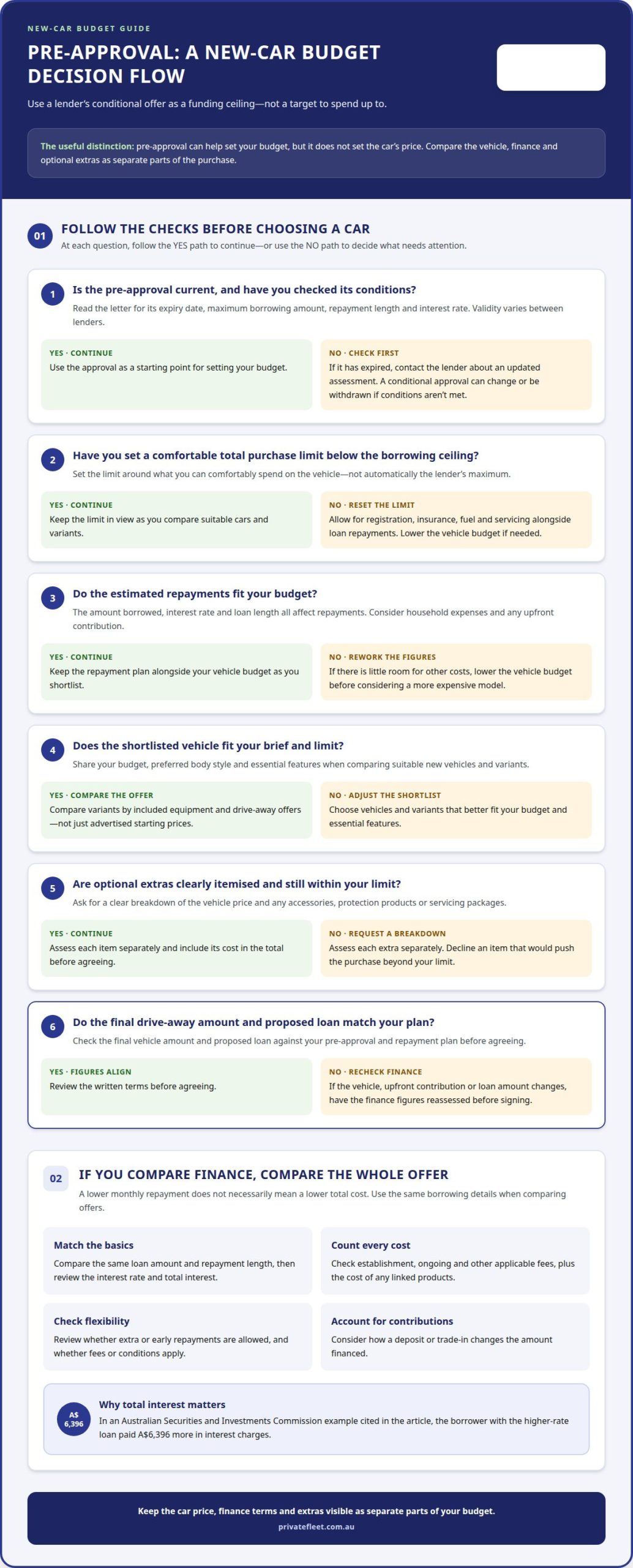
In Australia, car finance pre-approval is a conditional offer from a lender. The letter sets out the maximum borrowing amount, repayment length and interest rate, giving you a starting point for setting a new-car budget. Treat the approved amount as a ceiling, not a target, and allow for costs beyond the loan.
Australian Consumer Law, in Schedule 2 of the Competition and Consumer Act 2010 (Cth), provides consumer protections for purchases, including consumer guarantees. Consumer credit is regulated under the National Consumer Credit Protection Act 2009 (Cth), which includes the National Credit Code. Contract and deposit terms can also depend on the agreement and applicable state or territory laws.
Pre-approval validity varies by lender. Check the letter for its expiry date and conditions. If it expires before you’re ready to buy, contact the lender about an updated assessment.
- Set a total purchase limit. Start with what you can comfortably spend on the vehicle, rather than automatically using the lender’s maximum. Allow for registration, insurance, fuel and servicing alongside loan repayments. A car-buying service can use your approved limit and preferred repayment length to focus the search on a realistic overall budget.
- Translate the limit into a repayment plan. Compare estimated repayments with your household budget, regular expenses and any upfront contribution. The amount borrowed, interest rate and loan length all affect repayments. If the estimate leaves little room for other costs, lower your vehicle budget before considering a more expensive model.
- Shortlist vehicles that fit the brief. Give the car-buying service your budget, preferred body style and essential features. It can compare suitable new vehicles and variants within that limit, rather than starting with a model that encourages you to borrow the full approved amount. For example, compare two variants by their included equipment and drive-away offers, not just their advertised starting prices.
- Keep optional extras separate. Ask for a clear breakdown of the vehicle price and any accessories, protection products or servicing packages. Assess each item separately, then include its cost in the total before agreeing. This makes it easier to decline an extra that would push the purchase beyond your limit, even if it’s presented as part of the deal.
- Recheck the figures before proceeding. Compare the final drive-away amount and proposed loan with your pre-approval and repayment plan. If the vehicle, upfront contribution or loan amount changes, have the finance figures reassessed before signing. This keeps your car choice, borrowing and ongoing budget aligned.
Compare car-loan rates, features and fees
Dealer finance isn’t automatically more expensive than a bank or credit union offer. The risk is accepting a higher rate or bundled finance without comparing the total cost. Your pre-approval gives you a useful benchmark.
In an example from the Australian Securities and Investments Commission, the borrower with the higher-rate loan paid A$6,396 more in interest charges. That difference shows why the rate and full loan cost matter, not just the repayment amount.
- Compare the same borrowing details. Put each offer side by side using the same loan amount and repayment length. A dealership offer and lender pre-approval aren’t directly comparable if one finances a different amount or runs for longer. Include the interest rate and total interest to compare the cost across the loan.
- Include every fee. Check the lender’s documents for establishment, ongoing and other applicable fees. Charges can offset a lower advertised rate, while a higher rate can add interest over the repayment period. Compare the total payable rather than judging an offer by its rate alone.
- Check the loan features. Compare whether the terms allow extra or early repayments, and whether fees or conditions apply. Consider how a deposit or trade-in changes the amount financed. Include these details alongside the rate when assessing a car loan, as they affect its flexibility and total cost.
- Assess dealership finance against pre-approval. Ask for the dealership’s complete written finance terms and compare them with the lender’s offer. A dealership may mark up the interest rate on an in-house finance offer. The lender, rate, fees and loan conditions determine whether that offer suits your purchase better.
- Compare offers through the buying process. A car-buying service can consider your pre-approval alongside finance options available through its finance providers. It can compare the proposed lender, rate, fees, repayment length and features, while keeping the vehicle price separate from finance. This helps you see whether a change in repayments reflects a different loan or a different car deal.
- Choose based on total cost and suitability. Review the written terms before agreeing, including any linked products and their costs. If two offers have similar repayments, compare total interest, fees and flexibility to understand what drives the difference. Choose finance that fits your budget and purchase, not simply the offer presented at the dealership.
Check pre-approval conditions and expiry dates
Yes. A conditional pre-approval can change or be withdrawn before purchase if its conditions aren’t met. Check the lender’s terms and expiry date before relying on it to buy a new car.
Check approval timelines and conditions
Read the approval letter first. Note its expiry date, maximum borrowing amount, repayment length and interest rate. Validity periods vary between lenders, so don’t assume another lender’s timeline applies. Identify any conditions to meet before final approval, and allow time for the lender to assess your chosen vehicle and complete its process.
Check whether approval can change or be withdrawn
Review what could affect approval before committing. Pre-approval is conditional, not a promise that every later application will be accepted on the same terms. Changes to your financial circumstances, credit information or application details may affect the lender’s decision. Read the conditions carefully and don’t treat the approval letter as final finance approval.
- Record the key dates and terms. Keep the expiry date and conditions with your buying notes. If you’re comparing new vehicles over several weeks, align your shortlist and purchase timing with the lender’s stated validity period. This helps you spot timing issues before choosing a car or signing an agreement.
- Keep your application details consistent. Tell the lender if your intended borrowing amount or vehicle choice changes significantly. A different purchase price can change how much you need to borrow, while changes to your circumstances can affect the assessment. Don’t assume the original approval automatically covers a revised application.
- Act before the approval expires. If your purchase is approaching the expiry date, ask the lender about refreshing the approval. A Lend Finance advises buyers to seek an updated approval rather than assume it renews automatically. The lender can explain what information or applications it needs for its current assessment.
- Recheck the updated terms before proceeding. Compare the refreshed approval with your chosen vehicle’s price and the finance amount required. Confirm the new expiry date and any remaining conditions in writing. If the approval has expired, treat it as expired until the lender issues updated terms, rather than relying on the earlier letter.
Research drive-away prices and negotiate extras
A car-buying service can compare written offers for your chosen new car and negotiate the complete purchase. Compare the drive-away total and each extra separately to keep the deal within budget.
-
Compare the car price with the drive-away price through a car-buying service
Match written offers for the exact vehicle. Compare the same model, variant, powertrain and included equipment. A listed car price may differ from the drive-away price, which reflects the total payable for the purchase. Get the drive-away amount in writing before comparing offers, so you’re assessing like for like.
A car-buying service can seek offers for your chosen specification and compare their totals. If one offer lists only the vehicle price while another includes on-road costs, the figures aren’t directly comparable. Keep the model and variant consistent, as a different specification can change both the price and what’s included.
-
Check included fees and on-road costs with a car-buying service
Review an itemised breakdown of each total. Check whether registration, stamp duty, delivery fees and add-ons are included in the drive-away figure or listed separately. A lower vehicle price may not mean a lower amount payable if extra costs are added later. Compare fees using the same purchase location and vehicle specification.
A car-buying service can identify differences between offer breakdowns and seek clarity from the dealership. Keep optional products separate from on-road costs so you can see which items are required for the stated total and which are choices. This gives you a clearer basis for deciding what to include in the purchase.
-
Negotiate extras and contract terms through a car-buying service
Decide which extras you want considered. Assess accessories, paint protection, servicing packages and extended warranties separately from the vehicle price. Ask for each item’s cost and whether it’s optional. A car-buying service can negotiate requested inclusions with the dealership without letting an added package obscure the total.
Before signing, compare the written contract with the negotiated offer. Confirm that the vehicle and variant, drive-away amount, fees and accepted extras match. If an amount or inclusion differs, have it corrected in the paperwork before signing. Don’t rely on a verbal change alone: the written contract should reflect the agreed terms.
How pre-approval affects new-car price negotiations
Pre-approval can give you confidence when negotiating a new-car purchase because your finance has been conditionally assessed. The key is to keep the funding decision separate from the vehicle offer, so each part of the deal stays clear.
-
Decide whether to disclose pre-approved finance with guidance from a car-buying service
Choose when to mention your approval. Sharing that your finance is organised can show you’re ready to proceed, but you don’t have to accept a dealership’s finance offer. When negotiating car price with pre-approved finance, show you’re ready to buy without presenting your maximum approved amount as your budget.
-
Negotiate the car price separately through a car-buying service
Settle the vehicle price before discussing finance. Get an offer for your chosen model and variant on its own, then consider the loan separately. Keep any trade-in valuation separate too. This makes it easier to see whether a proposed change affects the car price, finance costs or trade-in amount.
- Compare the complete finance offer afterwards. Once the vehicle price is clear, assess the loan’s interest rate, fees, repayment length and total interest against your pre-approval. A different monthly repayment may reflect changed finance terms rather than a lower car price. Keep the figures separate to see what has actually changed.
- Watch for a concession being offset elsewhere. A lower vehicle price can look appealing while finance or other products increase the total cost. The Australian Competition and Consumer Commission notes that dealers may sell cars at lower mark-ups to sell higher-mark-up services such as finance. Compare the written car offer and loan terms independently before deciding.
- Use pre-approval as context, not a spending target. It shows you have a funding pathway, but the approved amount remains a limit. Keep your preferred drive-away budget in view. If an updated offer adds accessories or other products, assess their costs separately before agreeing to the total. This helps you stay within your planned spending.
- Review the final figures together before signing. Check that the contract reflects the agreed vehicle price, trade-in value, finance terms and selected extras. Negotiating car price with pre-approved finance works best when each amount remains visible through to the final paperwork. Resolve any difference between the contract and negotiated offer before signing.
How Private Fleet can help with your new-car purchase
Private Fleet manages your new-car purchase by tendering your chosen vehicle to a national network of authorised dealerships. Multiple dealers compete for your business, while the team handles negotiation and purchase paperwork. You choose the vehicle, and Private Fleet doesn’t hold its own car inventory.
This support suits you if you have a preferred make, model or variant and want help coordinating offers and purchase details. Share your preferred vehicle, budget, postcode and buying timeframe, along with the features that matter most. A clear brief keeps the process focused on the car you intend to buy.
Pre-approved finance can inform your purchase without setting the vehicle price. Private Fleet can assist with car finance while keeping the proposed loan distinct from the car offer. Consider the vehicle price and drive-away total separately from the loan’s interest rate, fees and repayment terms.
If you have a vehicle to trade in, Trade-In Assistance can be part of the buying process. Review the new-car offer and trade-in value as separate figures before considering their combined effect. This shows how each part contributes to the overall purchase and whether it fits your budget.
The new-car buying service brings vehicle sourcing, dealer negotiation and purchase paperwork together, with you involved in decisions about the model, terms and final offer. Private Fleet also provides regular updates on delivery times as the purchase progresses.
For help with your chosen new car, contact Private Fleet or call 1300 303 181. Include your preferred make and model, postcode and buying timeframe so the team can understand what you’re looking for.
Frequently Asked Questions
Can pre-approval help me negotiate a better price?
Yes, pre-approval can strengthen your position by showing you’ve arranged a way to fund the purchase. It doesn’t set the car’s value or guarantee a lower offer. For example, compare written drive-away offers for the same new-car variant, then assess finance separately. This keeps the discussion centred on the vehicle and makes it easier to judge whether a revised offer genuinely improves the overall deal.
How can a car-buying service help me get a better deal on my car?
A car-buying service can take your chosen new car to a network of authorised dealerships through a tender process. Private Fleet invites dealers to compete for your business, then manages negotiation and purchase paperwork. A clear brief, including your preferred model, variant and essential features, helps keep offers comparable. This can suit you if you want help coordinating dealer offers while you focus on choosing a vehicle that meets your needs.
Should I get pre-approval before looking at cars?
Arranging pre-approval before shopping can help you understand your borrowing limit and set a sensible vehicle budget. Treat the approved amount as a ceiling, then consider how ongoing costs such as insurance, fuel and servicing fit your finances. For instance, if two vehicles meet your needs, compare their drive-away totals rather than choosing a more expensive model simply because the lender’s maximum allows it.
What’s the difference between pre-approved car loans and fully approved car loans?
Pre-approval is conditional: the lender gives an initial indication of finance based on the information assessed so far. Full approval follows the lender’s assessment of the completed application and relevant purchase details, confirming the final loan terms. Before relying on either decision, read the lender’s written conditions, check the amount and repayment terms, and note any expiry date. Terminology and process can vary between lenders.
How does a car-buying service negotiate a car price in Australia with pre-approved finance?
A car-buying service can use your pre-approval as context while seeking offers for your chosen new car through its dealer network. It can keep the vehicle price separate from finance terms, so a change to the loan doesn’t disguise a change to the car offer. You can then assess the written drive-away price, optional extras and finance terms as separate parts of the purchase before deciding.