
The sticker price is only one part of what makes a new car affordable. To research a new car purchase thoroughly, compare like-for-like drive-away offers and consider how each model, variant and powertrain fits your driving needs, not just its advertised price.
Look beyond the upfront cost. Fuel or charging, servicing, insurance, registration, tyres, finance and depreciation can all affect what you spend while you own the car.
This guide explains how to compare new-car prices, safety ratings and efficiency, assess comfort and controls on a test drive, and check the vehicle at delivery. You’ll also learn to estimate ownership costs and compare warranty and servicing terms, so you can make a considered choice that suits your budget and everyday driving.
Key Takeaways
- Compare like-for-like drive-away offers, including the same model, variant and fitted options, to see what each price covers.
- Weigh safety features, efficiency and charging access against the way you actually drive.
- Use a test drive to assess comfort, access, visibility, controls and ride quality before choosing.
- Estimate ownership costs across your intended ownership period, including depreciation, energy or fuel, servicing, tyres, insurance, registration and finance costs.
- Private Fleet’s dealer tender process can help source your chosen new car through its national authorised dealer network, with support for negotiation, paperwork and trade-ins.
How to compare new-car offers and assess whether you’re getting a good deal
Compare the same vehicle, variant and fitted options, then assess each offer by its total drive-away price. The right deal should also suit your driving patterns, charging access and ownership priorities.
-
How a car-buying service researches vehicle information and compares new-car prices
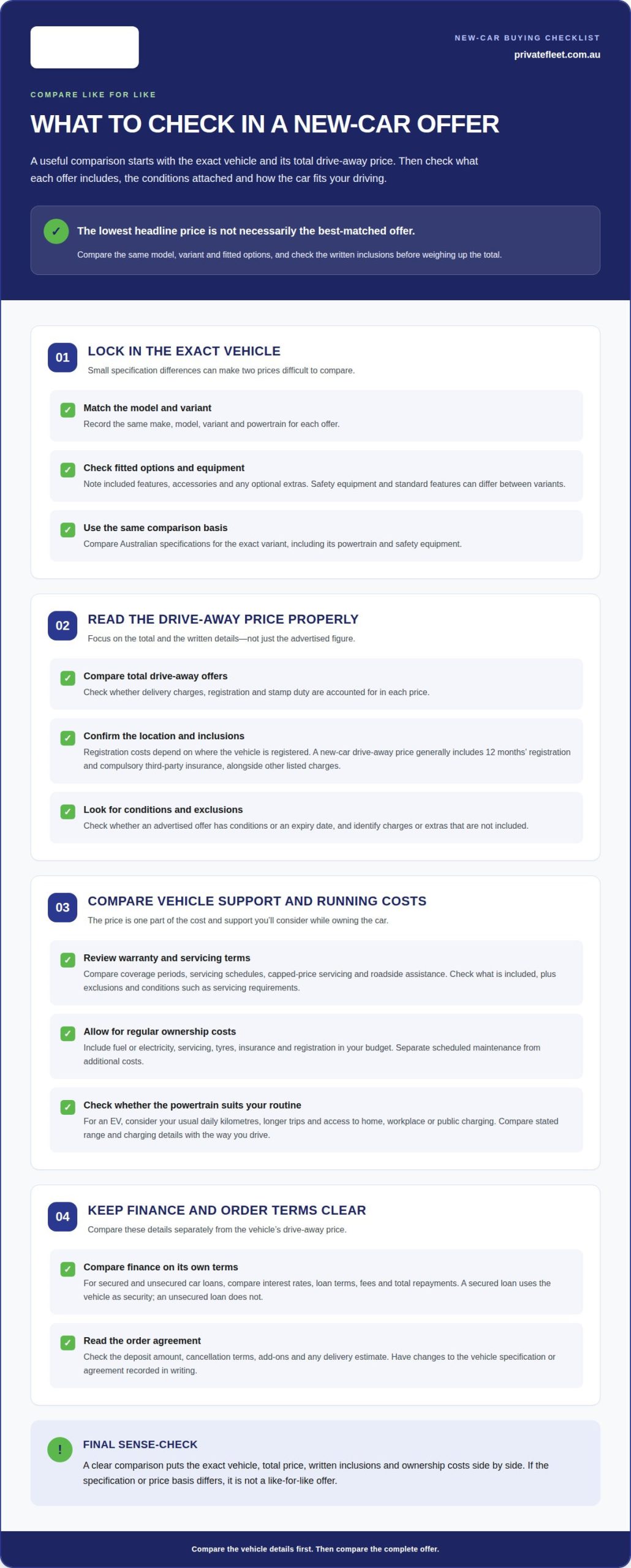
Give the buying service your preferred models, budget, postcode and key requirements. It can compare Australian manufacturer specifications for the exact variant, including powertrain, safety equipment, dimensions and standard features. Ask for like-for-like drive-away offers that include delivery charges, registration and stamp duty. Compare the written inclusions, not just the headline price, and note any optional extras or conditions.
-
How a car-buying service negotiates new-car prices and assesses available options
List the features that matter most, such as cabin space, easy access or a particular powertrain. A buying service can present your requirements to dealers in its network and invite competing offers. It can then compare the proposed variant, colour, accessories, price basis and ordering terms. This helps distinguish useful inclusions from unwanted extras while keeping the comparison focused on your shortlist.
- Assess the market value using current offers for the same make, model and variant. Compare equivalent drive-away prices in your location, and check whether an advertised offer has conditions or an expiry date. Australian car advertising requires the total price to be prominent and accurate. Treat a lower figure cautiously if it excludes charges or applies to a different specification. Manufacturer information clarifies what each variant includes, so an apparent price gap doesn’t hide equipment differences.
- Test whether an electric vehicle (EV) suits your routine before prioritising its purchase price. Consider your usual daily kilometres, longer trips, access to home or workplace charging, and whether public charging fits your travel. A local driver with convenient charging may assess an EV differently from someone who regularly drives long distances without reliable charging stops. Compare the vehicle’s stated range and charging details with those needs. Explore electric vehicle information as part of your shortlist research.
- Keep your comparison focused on new vehicles. For each candidate, record the exact variant, drive-away offer, included equipment and manufacturer specifications. Then rank the options against your budget and intended use. A good deal is not simply the lowest advertised price; it covers the right vehicle, with costs and inclusions clearly set out.
Comparing vehicle safety, fuel efficiency and emissions
Compare the exact Australian variant across safety, efficiency, emissions, warranty support and ownership costs. A car-buying service can compare warranty periods, capped-price servicing and roadside assistance by reviewing each brand’s current terms, including conditions and exclusions. It can also explain delivery estimates, dealer add-ons, and the deposit and cancellation terms in the order agreement.
- Compare safety and emissions for the same variants. Match the model year, powertrain and specification before comparing safety information. Check the ANCAP rating and which safety features are standard on each variant, rather than assuming equipment is the same across the range. Compare published fuel-consumption and emissions figures on the same measurement basis. Use these figures to compare vehicles, then consider how your usual routes, traffic and load may affect real-world use.
- Check the support attached to each vehicle. Compare warranty coverage, servicing schedules, capped-price servicing and roadside assistance side by side. Check the covered period, included work, exclusions and conditions, such as servicing requirements. A lower servicing offer may not cover every item, so separate scheduled maintenance from additional costs. This gives you a clearer view of the ownership support each brand provides.
- Compare complete dealer offers. Ask for equivalent drive-away prices for the same variant and equipment. In Australia, a new-car drive-away price generally includes 12 months’ registration and compulsory third-party insurance, alongside other listed charges. Make sure delivery charges and stamp duty are accounted for, and identify accessories or dealer add-ons separately. Compare the final amounts and written inclusions, not just a headline offer.
- Compare finance and order terms separately. For secured and unsecured car loans, compare interest rates, loan terms, fees and total repayments. A secured loan uses the vehicle as security; an unsecured loan does not. Before signing, read the order agreement for the deposit amount, cancellation terms, add-ons and any delivery estimate. Get any changes to the vehicle specification or agreement recorded in writing.
- Allow for regular running costs. Add registration, insurance, servicing, tyres and fuel or electricity to your budget. Registration costs and requirements depend on where the vehicle is registered. For an EV, compare home and public charging needs with your driving pattern; electricity is usually cheaper than petrol for charging, particularly at home or during off-peak hours. Include these costs in your comparison alongside the purchase price.
Coverage periods, included servicing work, exclusions and conditions, including servicing requirements, can differ. Compare each brand’s current terms side by side, and separate scheduled maintenance from additional costs.
Test-driving and assessing a new car before you buy
Use a test drive to assess how the exact new-car variant feels in everyday conditions. Check comfort, access, visibility, controls, ride and safety equipment before deciding.
-
How a car-buying service can help assess a new car before purchase
Share your shortlist and priorities, such as easy entry, supportive seats or clear visibility. A car-buying service can identify the exact variants to assess and coordinate a test drive through a dealership. Before driving, compare the vehicle’s equipment with the specification you’re considering, as features can differ between variants. This helps you assess the model you’re actually considering, rather than a better-equipped trim.
- Choose a useful test-drive route. Include familiar roads, a slower street and a stretch where you can drive steadily. This helps you notice ride comfort, steering response, braking feel and cabin noise in different conditions. If you regularly park in tight spaces, assess how easily you can judge the car’s edges and use its parking assistance. Follow the dealership’s instructions and drive within the road rules.
-
How a car-buying service can help arrange a test drive
Ask to drive the model and variant on your shortlist, not a similar vehicle with different equipment. A car-buying service can coordinate a test drive with a dealership and help you focus on the features that matter. Before setting off, adjust the seat, steering wheel and mirrors. Check that key controls are within easy reach, while keeping your attention on driving.
- Check comfort, access and visibility. Get in and out several times, then adjust the seat to a comfortable position. Check your view through the windscreen and side windows, including over your shoulder. Try the touchscreen, climate settings and physical controls while parked. Consider whether the menus feel intuitive and whether passengers have enough room for regular trips. These checks can reveal differences that specifications alone don’t show.
- Assess safety features and the drive. Confirm which safety features are fitted to the exact variant, then notice how alerts and driver assistance operate during the test drive. Pay attention to acceleration, braking, suspension over familiar road surfaces and visibility when changing lanes. Note any features that interest you, along with sounds or controls that distract you. After the drive, consider whether the car suits the journeys and passengers you expect it to carry.
Match new car options to your lifestyle and driving needs
- Describe how you’ll use the car. To research a new car purchase thoroughly, start by setting out your needs. A car-buying service can turn your priorities into a focused shortlist of suitable models and variants. Include your usual passengers, luggage needs, commute, regional trips and parking situation. For example, someone downsizing from a large SUV may value easy entry, a comfortable ride and useful boot space more than extra seating.
- Match the powertrain to your driving pattern. A battery electric vehicle (BEV) runs on electricity; a plug-in hybrid electric vehicle (PHEV) can be charged and also uses petrol. A conventional hybrid (HEV) combines a petrol engine and electric motor without plugging in, while a mild hybrid uses electric assistance for the engine. Consider daily kilometres, longer journeys, charging access and towing needs before comparing options.
- Prioritise the features you’ll use often. For regular school pick-ups, check rear-seat access, child-seat space and boot practicality. For commuting, consider cabin noise, seat adjustment and controls you can use easily. If you park on narrow streets, visibility and parking assistance may matter more than a larger engine. A needs-based list helps separate essential features from appealing extras.
- Set a realistic purchase and ownership budget. Allow for the drive-away price, fuel or charging, servicing, tyres, insurance and registration. If you’re considering finance, compare interest rates, loan terms, fees and total repayments. Loan pre-approval can help clarify your budget before you settle on a variant. Keep the vehicle choice within a comfortable repayment range rather than stretching for features you may rarely use.
- Rank the shortlist against real situations. To research a new car purchase thoroughly, compare each candidate against your regular week and occasional trips. A driver who often travels long distances may prioritise comfort and convenient refuelling or charging; someone who drives in a city may value easy parking and manageable dimensions. If you tow, compare the exact variant’s Australian specifications with your requirements. Keep a shortlist and assess the trade-offs instead of choosing by badge alone.
How to estimate depreciation and total ownership costs
- Set the ownership period and drive-away purchase price. To research a new car purchase thoroughly, define how long you expect to keep the vehicle. Use the written drive-away price for the exact variant, including applicable charges and chosen accessories. Compare every shortlisted vehicle over the same ownership period. For example, a hypothetical five-year estimate needs a consistent five-year timeframe across all options, rather than mixed periods that distort the comparison.
- Estimate depreciation with resale scenarios. Subtract estimated resale value from the purchase price to estimate depreciation. Future resale is uncertain, so build low, base and high scenarios rather than relying on one prediction. Consider the model, variant, powertrain, kilometres travelled and condition when setting assumptions. These estimates show how resale may affect the overall cost, but they don’t promise what the vehicle will sell for later.
- Calculate energy or fuel for your driving. Record expected annual kilometres and use Australian consumption information for each shortlisted variant. For an electric vehicle, include your expected mix of home and public charging, energy prices and charging losses. For a plug-in hybrid, estimate the share of kilometres driven electrically, then account for petrol use when the battery is depleted. Keep your assumptions consistent so you compare each vehicle on the same basis.
- Add predictable running costs. Include scheduled servicing, tyres, insurance and registration over the same ownership period. Use the vehicle’s servicing schedule and capped-price servicing terms to estimate maintenance, and account for excluded items separately. Registration and insurance depend on the vehicle and your circumstances, so use estimates relevant to your location and cover. Listing each cost separately makes the budget easier to review.
- Include finance costs without counting the car twice. If you borrow, include interest and applicable fees over the loan term. Don’t add the loan principal to the purchase price again, as this would count the vehicle twice. Compare financed and cash-purchase scenarios using the same model, variant and ownership period. To research a new car purchase thoroughly, make these assumptions visible and consistent.
- Review the complete estimate against your budget. Add depreciation, energy or fuel, servicing, tyres, insurance, registration and finance costs. A car-buying service can help organise these figures alongside vehicle offers, making it easier to see which assumptions drive the difference. Revisit your estimate if annual kilometres, charging access or your planned ownership period changes. The lowest drive-away offer may not result in the lowest overall ownership cost.
How Private Fleet can help with your new-car purchase
Private Fleet can help turn your research into a clear buying brief, then source your chosen new car through a national network of authorised dealerships. Its independent car buying service suits buyers who have a shortlist but want support comparing dealer offers, negotiating and managing purchase paperwork.
- Share your requirements. Provide your preferred make and model, variant, postcode and buying timeframe. Include the features that matter, such as easy access, cabin space, a particular powertrain or a comfortable ride. If you’re still deciding, describe your budget and driving needs so the options can be narrowed to vehicles that fit your priorities.
- Compare suitable offers. Private Fleet’s tender process invites dealers to compete for your business on the vehicle you want. Compare offers against your required specification and inclusions to assess them on a like-for-like basis. This supports an informed decision without promising a particular price or outcome.
- Move through the purchase process. Once you decide how to proceed, Private Fleet handles negotiation and paperwork in connection with the purchase. You receive regular updates on delivery times, so you can stay informed as the order progresses. The new-car buying process brings the key stages together, from sharing your requirements through to purchase.
- Consider your trade-in and finance. If you’re replacing a vehicle, Trade-In Assistance can be part of the buying process. Car Finance is also available if you want to consider borrowing alongside your new-car purchase. Keep both decisions within your overall budget, and weigh finance terms against the vehicle and ownership costs you’ve already compared.
This support is useful if you want an independent representative to coordinate dealer competition and purchase details rather than manage each part of the process yourself. It can also help if you know what type of vehicle you need but want assistance refining the model or variant before proceeding.
To discuss your shortlist, budget, postcode and buying timeframe, contact Private Fleet or call 1300 303 181.
Frequently Asked Questions
How can a car-buying service help estimate the full cost of owning a new car?
A car-buying service can make an estimate more useful by setting out its assumptions. For example, compare shorter and longer ownership periods, or different annual kilometre estimates, to see which assumptions change the result most. Keep the model and variant consistent across scenarios. This gives you a clearer basis for deciding whether the estimate still fits if your plans or driving routine change.
How can a car-buying service help choose the right new car for me?
A car-buying service can turn your priorities into a brief that separates essentials from preferences. Note who needs to get into the cabin regularly, what you carry and which controls you prefer. A model may suit your needs while a particular variant does not, so compare its equipment with your brief. This can narrow a broad range without assuming one type of car suits every buyer.
What ownership costs can a car-buying service help me factor in when buying a new car?
A car-buying service can help identify cost details that depend on the exact vehicle and your circumstances. Tyre replacement costs, for example, can differ with wheel and tyre specifications, while insurance estimates depend on the vehicle and cover selected. Use the same variant and comparable assumptions for each estimate. This makes it easier to identify which details need closer attention in your ownership budget.
What can a car-buying service do to negotiate a new-car price?
A car-buying service can handle discussions with dealers about your specified vehicle, including clarifying its proposed configuration and written terms. Before accepting an offer, ensure any agreed changes to the variant, accessories or order details appear in the paperwork. This gives you a record of what you’re purchasing and avoids relying on a verbal understanding when reviewing the final documents.
What should I budget for when buying a new car in Australia, including on-road costs and taxes?
Allow for the vehicle’s drive-away amount and check how its on-road costs are presented. Registration, compulsory third-party insurance, stamp duty and delivery charges may apply, with amounts depending on the vehicle and registration jurisdiction. Also consider chosen accessories and when your first insurance cover begins. A written breakdown helps you understand what’s included before committing to the order.
How can a car-buying service compare new-car prices and negotiate with Australian dealerships?
For a useful comparison, keep the vehicle specification and price basis consistent, and record each offer’s validity period and conditions. If an offer changes after you adjust the variant or accessories, treat it as a revised comparison rather than assuming the original terms still apply. A car-buying service can manage discussions with dealers and help you track the latest written offer and the vehicle it covers.
How can a car-buying service use independent new-car reviews and reliability information?
Reviews can add context about everyday details that specifications may not convey, such as how clearly the cabin layout works or how comfortable a vehicle feels on a typical drive. Check that a review concerns the same model generation and powertrain you’re considering. Reviews and reliability information can inform questions for your shortlist, but they can’t guarantee how an individual vehicle will perform over time. Australian car reviews can support your research.
How can a car-buying service compare fuel efficiency, running costs and emissions across new cars?
A car-buying service can help ensure the figures you compare use the same basis and relate to equivalent variants. Pay particular attention to plug-in hybrids: their quoted fuel consumption can reflect charging, so it isn’t directly comparable with a conventional hybrid’s figure. Consider a plug-in hybrid’s fuel use both with a charged battery and when depleted. This helps you judge whether the published figures align with your charging access and likely driving pattern.
To discuss your preferred make or model, postcode and buying timeframe, get help from Private Fleet, or call 1300 303 181.