
For 2026 Hyundai Santa Fe Hybrid and KONA prices in Australia, the key comparison is how the KONA’s variants and running range stack up against the larger Santa Fe Hybrid, including its front-wheel-drive and all-wheel-drive options.
Choosing between them involves more than comparing starting prices. Weigh each variant’s features, fuel use and cabin space against how you drive, from daily commuting to longer trips.
This guide covers the KONA Hybrid’s drive-away offer, variant differences and stated fuel consumption, then compares the Santa Fe Hybrid’s FWD and AWD prices. Use it to narrow your shortlist and identify what to check when comparing new-car prices.
Key Takeaways
- See how the KONA Hybrid’s advertised drive-away offer compares with indicative pricing across its variants.
- Learn how to interpret the stated fuel-consumption figure and what it can tell you about your driving range.
- Compare KONA Hybrid variants by price positioning and features to narrow down a practical shortlist.
- Explore the Santa Fe Hybrid’s FWD and AWD pricing, and the factors to weigh when choosing between them.
- Find out how Private Fleet’s new-car buying service and dealer tender process can help simplify your Hyundai purchase.
2026 Hyundai KONA Hybrid drive-away price
Treat this as a dated offer for comparison, not a price that automatically applies to every Hybrid grade. Before deciding, match the exact variant name and offer period to the written price. This helps distinguish an advertised entry offer from indicative estimates for other grades.
Indicative drive-away prices vary across the Hybrid variants. These ranges are estimates, so compare like with like rather than treating each range as a guaranteed quote.
Keep grade names distinct when building your shortlist. For example, record Premium and Premium N Line separately, with the price for each, then decide whether the equipment differences suit your driving needs.
This price covers the full range, not just Hybrid grades, so it is not a direct comparison between Hybrid variants. Check that a price applies to a petrol-electric Hybrid before using it to set expectations for a new KONA Hybrid.
Compare each figure on the same basis. Record the variant, whether the amount is an advertised offer or an indicative estimate, and the applicable dates. Keep finance repayments separate from the vehicle’s drive-away price so they do not obscure the amount being compared. This makes differences between variants easier to assess.
A careful, like-for-like comparison creates a more useful shortlist than relying on a single headline price.
Fuel efficiency and driving range
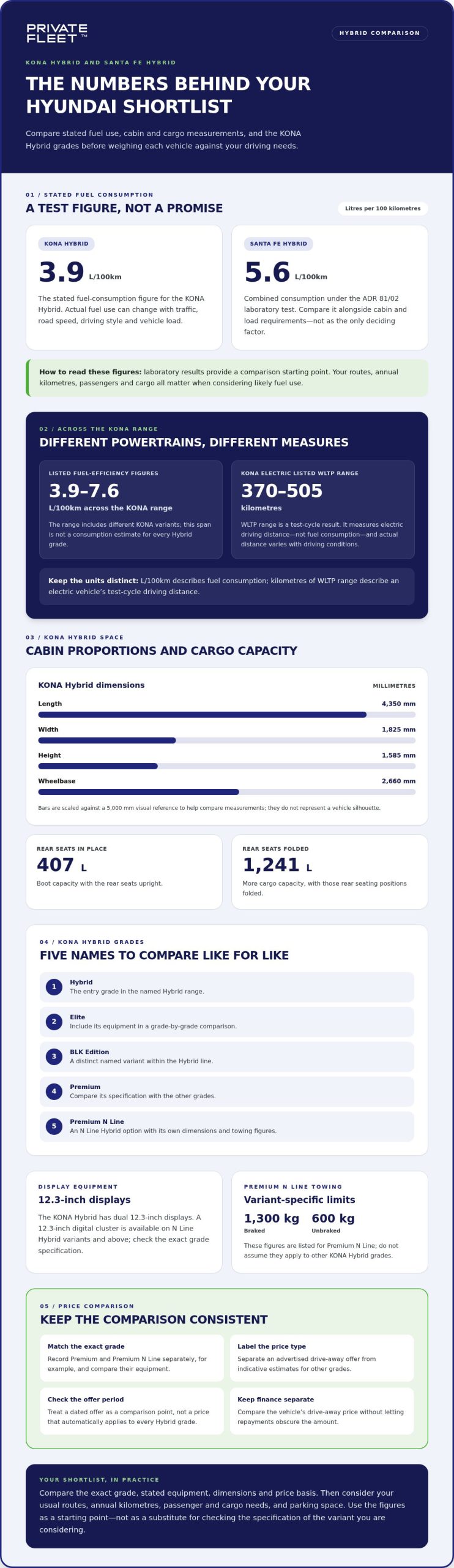
The KONA Hybrid’s stated fuel consumption is 3.9 litres per 100 kilometres. Treat this as a laboratory comparison figure, not a prediction of every trip’s result. Traffic, road speed, driving style and how much the vehicle carries can change fuel use. Comparing vehicles on the same test basis gives a more meaningful starting point than comparing separate real-world anecdotes.
The 2026 KONA range spans different powertrains, so check which version each figure describes. Listed fuel-efficiency figures across the range run from 3.9 to 7.6 L/100km. The lower end matches the Hybrid’s stated consumption, while the overall range includes other KONA variants. It isn’t a consumption estimate for every Hybrid grade.
To compare likely ownership costs, first consider your regular driving pattern. Stop-start trips can differ from regular highway driving. Note your usual routes, passenger and cargo loads, and annual kilometres. Compare the same pattern across your shortlist, keeping laboratory figures separate from estimates based on your own driving.
- KONA Hybrid: stated fuel consumption of 3.9 L/100km.
- 2026 KONA range: listed fuel-efficiency figures span 3.9 to 7.6 L/100km.
- KONA Electric: listed WLTP driving range is 370 to 505 kilometres.
The KONA Electric’s WLTP range measures distance for an electric vehicle, while L/100km describes fuel consumption. These figures can’t be compared as though they use one unit or describe the same powertrain. WLTP range is a test-cycle result; actual distance varies with driving conditions. Keep the Electric’s charging needs separate from the Hybrid’s petrol use when choosing a version.
The Santa Fe Hybrid’s combined consumption figure is 5.6 L/100km under the ADR 81/02 laboratory test. It and the KONA Hybrid’s 3.9 L/100km provide a reference for comparing their stated fuel use. When comparing them, consider cabin and load requirements alongside consumption rather than treating the lower figure as the only decision point.
Neither published figure guarantees the fuel use you’ll achieve. Use your typical routes and annual kilometres to judge which vehicle best fits your routine. If you’re comparing the Hybrid and Electric KONA or weighing a Santa Fe Hybrid against it, talk through your new-car shortlist with your driving needs in mind.
KONA Hybrid model range and variants
Compare KONA Hybrid grades by their dimensions and equipment, rather than assuming they differ only in trim. The Australian Hybrid line includes Hybrid, Elite, BLK Edition, Premium and Premium N Line. Match the exact variant to your shortlist, then check the cabin layout, boot capacity and dimensions against your passengers, luggage and parking space.
- Hybrid: the entry grade in the named Hybrid range.
- Elite: a higher grade to include in a like-for-like equipment comparison.
- BLK Edition: a distinct named variant within the Hybrid line.
- Premium: compare its specification with the other grades.
- Premium N Line: an N Line Hybrid option with its own dimensions and towing figures.
The KONA Hybrid measures 4,350 millimetres long, 1,825 millimetres wide and 1,585 millimetres high. Its 2,660-millimetre wheelbase offers another useful measurement when considering cabin proportions. The N Line Hybrid is 4,385 millimetres long and 1,592 millimetres high. If garage clearance or parking space is tight, compare these measurements with the space you regularly use instead of relying on the model name alone.
Boot capacity is 407 litres with the rear seats in place, extending to 1,241 litres when folded. Think through a specific loading example before choosing: regular luggage with all seats in use needs a different arrangement from carrying a larger item with the rear seats folded. The extra cargo capacity comes at the cost of those rear seating positions while folded, so consider how often you need both passenger and luggage space.
Cabin displays also provide a concrete comparison point. The KONA Hybrid has dual 12.3-inch displays, and a 12.3-inch digital cluster is available on N Line Hybrid variants and above. If you prefer driving information in a separate instrument display, that distinction may help narrow your choices. Compare the selected grade’s stated display equipment rather than assuming every Hybrid variant has the same cluster.
The Hybrid’s powertrain combines a 1.6-litre GDi petrol engine with a six-speed dual-clutch transmission and front-wheel drive. For towing, the Premium N Line specification lists 1,300 kilograms braked and 600 kilograms unbraked. Those limits apply to that named variant, so don’t transfer them to other KONA Hybrid grades. Match the variant, dimensions, cabin needs and any towing requirement before settling on a shortlist.
2026 Hyundai Santa Fe Hybrid FWD and AWD prices
The offer period runs from 1 October to 31 December 2026. It gives buyers a concrete AWD reference, but it shouldn’t be treated as the FWD price or as a price for every Santa Fe Hybrid variant.
This range covers different models and specifications, so it does not isolate the Hybrid or distinguish FWD from AWD pricing.
Keep price bases distinct when building a shortlist. A drive-away amount helps compare the stated purchase outlay, while a listed starting price may be calculated differently. Compare written breakdowns for the same variant and drivetrain, including registration and applicable charges. On-road costs can vary by location, so use the same postcode and timing when comparing offers.
The AWD offer identifies the hybrid powertrain, but check the vehicle specification against the price document. The Australian performance specification lists 172 kW and 367 Nm. These details identify the powertrain attached to the advertised AWD offer; they don’t establish a matching FWD price. FWD sends drive to the front wheels, while AWD can direct drive to all wheels. Choose based on your usual roads and conditions, not a price assumption.
Hyundai’s standard new-car warranty is 5 years. The SANTA FE Hybrid also has two 12.3-inch displays, 20-inch alloy wheels and a full-size spare wheel. Those details help frame the vehicle comparison, but the selected drivetrain and grade should still match the price document. Check that the quoted vehicle and displayed specification use the same variant name.
Use this simple comparison before deciding:
- Match the Santa Fe Hybrid grade and FWD or AWD drivetrain.
- Compare drive-away figures on the same price basis and offer dates.
- Check how registration and other applicable charges appear in each total.
- Review the specified powertrain, equipment and warranty alongside the payment.
Keep those comparisons separate to avoid treating a broad range or starting price as a direct FWD-versus-AWD calculation. To discuss a preferred configuration, share your Santa Fe Hybrid shortlist.
KONA Hybrid price information in Australia
Compare the KONA Hybrid’s listed starting price with drive-away figures carefully. They use different price bases, so the difference is not a like-for-like measure of a discount. The first figure excludes on-road costs; the second gives indicative drive-away pricing across grades.
For buyers comparing Hyundai Santa Fe Hybrid and KONA 2026 prices in Australia, keep each model’s price basis clear. Compact hybrid SUVs were typically priced between A$40,000 and A$46,000, with a median near A$43,000. This market band is based on six price samples from three sources, collected on 28 October 2026 and valid until 27 November 2026. It offers context, not a Hyundai-specific quote or a price for every KONA Hybrid grade.
Build a practical comparison in three steps. First, identify the exact KONA Hybrid variant. Then check whether its price is before on-road costs, an indicative drive-away figure or a dated advertised offer. Finally, compare equivalent variants using the same price basis. This prevents a starting price from appearing lower simply because registration and other costs are excluded.
Variant choice changes the budget. The Hybrid and Elite indicative ranges begin below the BLK Edition and Premium ranges; the Premium N Line has a separate advertised drive-away figure. Compare the equipment you value against the price difference, rather than assuming a higher grade automatically suits your needs. Consider cabin displays, boot space, seating comfort and regular journey lengths. Those priorities help turn the Hyundai Santa Fe Hybrid and KONA 2026 price comparison for Australia into a decision based on your own requirements.
Keep timing and location in view. The advertised KONA Hybrid offer runs from 1 October to 31 December 2026, while indicative prices are estimates rather than one fixed national amount. A written comparison should identify the vehicle, variant, price basis and offer period. If you’re comparing the KONA Hybrid with another compact hybrid SUV, use the same details for both vehicles.
A focused shortlist might include your preferred grade, a lower-priced KONA Hybrid variant and an alternative model. Record each vehicle’s listed price, drive-away amount and included costs separately. Then weigh the difference against the features you will use during ownership. Treat a market median as a snapshot of sampled prices, not a target or promised outcome.
For Hyundai buying information, visit Hyundai new-car offers, or call 1300 303 181.
Private Fleet: New Cars
Private Fleet helps buyers source new Hyundai vehicles through its New Car Buying Service. Its national tender process invites dealers to compete for your business, while you compare suitable vehicle options and purchase terms. Private Fleet manages the buying process rather than holding its own vehicle inventory.
If you’re weighing a KONA Hybrid against a Santa Fe Hybrid, share your preferred model, variant, postcode and buying timeframe. Trade-In Assistance can support buyers replacing a current vehicle, and Car Finance is available for those considering purchase funding. Explore Hyundai new-car buying information or call 1300 303 181.
Make your Hyundai shortlist work for you
For a clear Hyundai Santa Fe Hybrid and KONA 2026 price comparison in Australia, start with the vehicle that best fits your regular journeys. Decide which variant and drivetrain belong on your shortlist, then consider how the purchase fits your budget, trade-in plans and intended ownership period. A focused shortlist makes the next steps easier to discuss.
Private Fleet can help you work through new-car options. Share your preferred Hyundai model, variant, postcode, buying timeframe and annual kilometres, so the conversation starts with your priorities. You can also explore Hyundai new-car buying information or call 1300 303 181.
Get help buying my new car
Your next car should suit the way you plan to use it, not just look right on a price list. Take the next step when you’re ready, with your shortlist and key requirements in hand.
Frequently Asked Questions
How much does the KONA Hybrid cost in Australia?
These are separate price references, so compare the exact variant and offer terms. When assessing a written price, keep the vehicle grade, postcode and buying timeframe together. This makes it easier to compare the same configuration consistently.
What is the Australian price of the 2026 Hyundai Santa Fe Hybrid?
For an FWD-versus-AWD comparison, match both the drivetrain and grade. The AWD offer is not the FWD price.
What is the Australian price of the 2026 Hyundai Kona Hybrid?
Use the exact variant name when comparing these figures, as they do not all describe the same grade or price basis.
What are the 2026 Hyundai Kona Hybrid trim levels and prices in Australia?
The listed Hybrid grades are Hybrid, Elite, BLK Edition, Premium and Premium N Line. Compare the equipment and price of your preferred grade before deciding.
What are the powertrain and fuel-consumption figures for the 2026 Santa Fe Hybrid and KONA Hybrid?
The KONA Hybrid uses a 1.6-litre GDi hybrid engine, six-speed dual-clutch transmission and front-wheel drive. Its stated fuel consumption is 3.9 L/100km. The Santa Fe Hybrid uses a 1.6-litre turbocharged hybrid powertrain, with listed output of 172 kW and 367 Nm. Its combined fuel-consumption figure is 5.6 L/100km under the ADR 81/02 laboratory test. Laboratory figures provide a comparison basis, not a guaranteed real-world result.