
The Hyundai Tucson and Kia Sportage are close alternatives, but they aren’t identical. The better choice depends on the Australian variant and how it fits your priorities, not just the badge or headline offer. Start by deciding what matters most in your next SUV, then use that shortlist to guide a fair comparison.
It’s easy to compare model names and overlook the details that shape everyday ownership. A particular trim’s equipment, cabin layout and driving feel may suit you better, while the purchase offer needs to match the exact vehicle you plan to order. Consider both together to judge each car as a whole, not by one attractive feature.
This guide covers practical differences to weigh before choosing, including variants and offers, comfort, fuel use, warranty and servicing. It also explains what to consider when ordering and planning delivery. By the end, you’ll have a clearer way to decide which SUV belongs on your shortlist and what to settle before buying.
Key Takeaways
- Compare equivalent Tucson and Sportage variants so the price, equipment and powertrain differences are clear.
- Judge cabin and boot space in person, including seat comfort, access, visibility and how easy the controls are to use.
- Match fuel use and driving feel to your usual trips, rather than relying on one figure for every version.
- Compare warranty, scheduled servicing and likely ownership costs across the period you plan to keep the SUV.
- Assess each drive-away offer on the same specification, and factor in your trade-in, ordering and delivery arrangements.
Compare Tucson and Sportage variants and drive-away offers
Start with the versions you would genuinely consider buying. For a fair comparison, pair vehicles with the same powertrain type and a similar equipment level, rather than comparing one model’s entry trim with the other’s premium version. For example, compare the Tucson Elite Hybrid with the Sportage SX Hybrid if those are the hybrid grades on your shortlist. Confirm each vehicle’s model year and Australian specification before comparing offers.
Trim names don’t guarantee matching equipment. Make a side-by-side list of the features you value, such as driver-seat adjustment, parking assistance, phone connectivity and cabin controls. Note where the variants differ. This keeps a long equipment list practical: focus on features you’ll use rather than treating every extra as equally important.
To compare current drive-away offers, match the vehicle specification and location. A drive-away figure can depend on the variant, buyer’s postcode and offer conditions. Record the offer period, inclusions and eligibility terms alongside the amount, so your comparison remains useful if a promotion changes. The Hyundai discount page and Kia discount page can help you explore each brand’s buying options.
- Exact vehicle: Write down the model year, trim, powertrain, drivetrain, colour and selected options.
- Drive-away basis: Make sure both figures apply to your postcode and clearly state the on-road inclusions.
- Offer terms: Note the applicable dates, conditions, accessories and any eligibility requirements.
- Trade-in: Keep the new-car offer separate from your current vehicle’s trade-in value.
Ask for a written breakdown of the vehicle amount and included items. If one offer includes accessories and another doesn’t, compare what’s actually included rather than relying on the headline figure. Keep finance and optional products separate so you can see which costs relate to the vehicle and which are separate choices.
Once the specifications and offer terms match, consider whether any difference matters to you. A higher trim may include equipment you value, while a lower-priced variant may better suit a straightforward brief. The goal isn’t simply to find the smallest figure. Compare equivalent new vehicles and understand what each offer covers before choosing.
Boot space, cabin comfort and safety
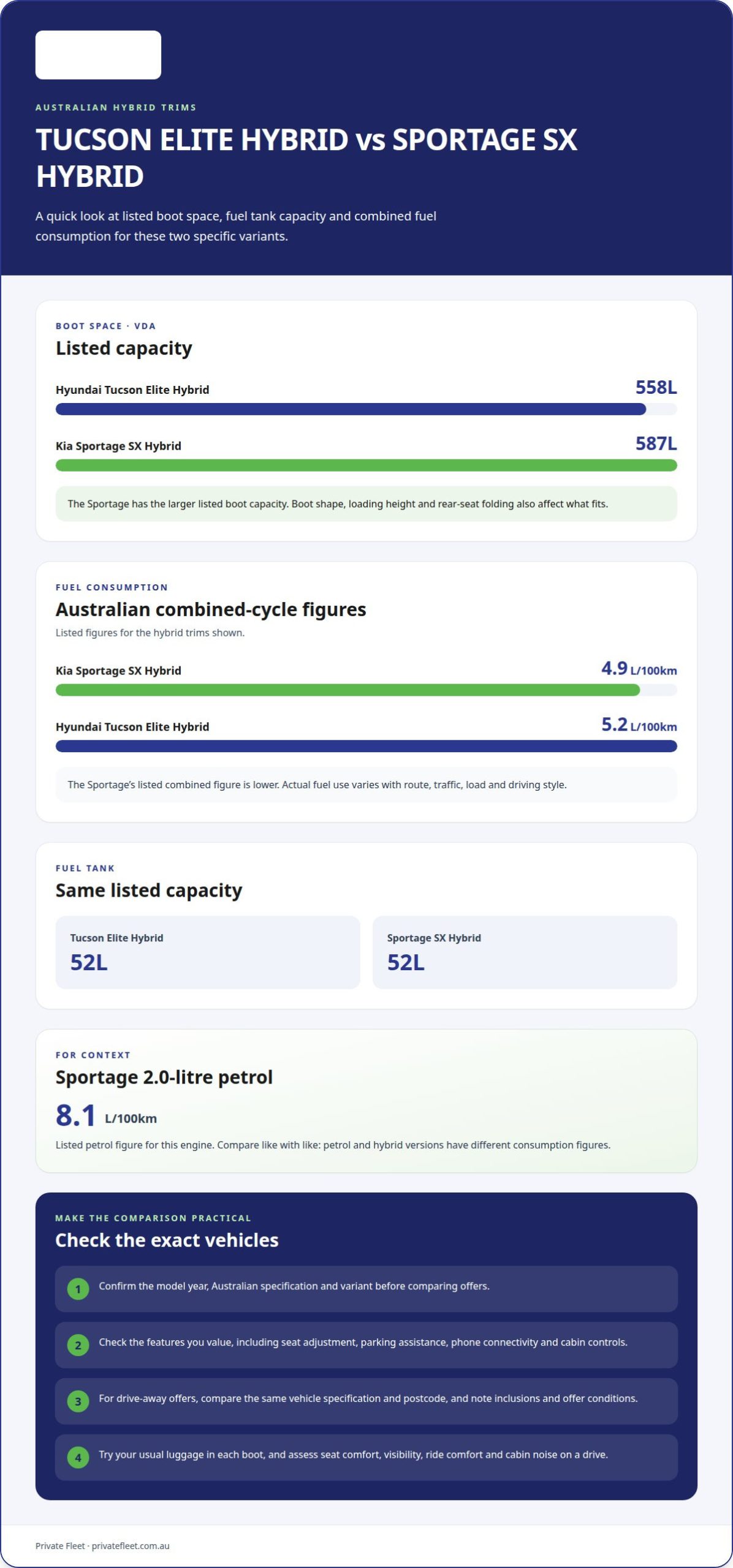
For the hybrid trims compared here, the Sportage SX Hybrid has more listed VDA boot space, while both SUVs have the same fuel tank capacity. Judge cabin comfort, visibility and controls in the exact Australian variants you’re considering.
Cabin comfort and passenger space
Try each vehicle from the driver’s seat and the rear passenger seat. Adjust the driver’s seat and steering wheel, then check your view through the mirrors and windows. Notice the step-in height and door opening, especially if passengers will get in and out often.
While parked, explore the touchscreen and physical controls. Check whether Apple CarPlay and Android Auto are included on your preferred trim, and whether commonly used functions are easy to reach. During a test drive, assess seat support, cabin noise and ride comfort on roads you regularly use.
Boot space and fuel tank capacity
Boot space figures can vary by model and measurement method, so check the figures for the exact versions you are comparing. Both compared hybrid SUVs have a 52L fuel tank. The Sportage has the larger listed boot capacity, but the shape of the space and loading height also affect what fits.
Bring a regular suitcase or another bulky item to see how it fits in each boot. Check the opening, floor height and rear-seat folding arrangement. Capacity figures help frame the comparison, but loading your usual luggage shows whether the space works for your passengers and needs.
| Australian hybrid trim | VDA boot space | Fuel tank | ANCAP rating |
|---|---|---|---|
| Hyundai Tucson Elite Hybrid | 558L | 52L | Five stars, tested in 2021 |
| Kia Sportage SX Hybrid | 587L | 52L | Five stars, earned in 2022 |
ANCAP awarded the Tucson rating after testing in 2021 and the Sportage rating in 2022. Ratings and driver-assistance equipment can depend on the model and variant, so compare the exact Australian vehicle’s safety features. Look at the available braking and parking assistance, how alerts are presented, and whether the systems feel clear to you.
Choose by balancing cabin fit, boot usability and the equipment on your preferred trim. Explore the Hyundai discount page and Kia discount page as part of your shortlist, or contact Private Fleet or call 1300 303 181 to discuss your options.
Powertrain, fuel consumption and driving range
Australian figures vary by engine and trim. The Kia Sportage SX Hybrid is listed at 4.9L/100km combined, while the Hyundai Tucson Elite Hybrid is listed at 5.2L/100km. Petrol and diesel versions have different consumption figures, so match the powertrain before comparing.
These are Australian combined-cycle figures, not overseas EPA estimates. They help compare variants, but actual fuel use and the distance between refills depend on your route, traffic, load and driving style.
| Powertrain | Australian combined consumption | Comparison note |
|---|---|---|
| Kia Sportage SX Hybrid | 4.9L/100km | Listed figure for the front-wheel-drive hybrid |
| Hyundai Tucson Elite Hybrid | 5.2L/100km | Listed figure for this hybrid trim |
| Kia Sportage 2.0-litre petrol | 8.1L/100km | Petrol figure for this engine |
| Petrol versions, both models | About 7.7 to 8.1L/100km | Varies by version |
| Diesel versions, both models | About 6.3L/100km | Compare the exact variant |
How do Tucson and Sportage engine options and fuel consumption compare in Australia?
Both models have petrol and hybrid choices, and diesel versions also appear in the comparison data. The Sportage SX Hybrid’s listed combined figure is slightly lower than the Tucson Elite Hybrid’s. The exact engine and trim matter.
The compared hybrid SUVs use a 1.6-litre turbo-petrol hybrid system and a six-speed automatic. Combined output can vary by exact hybrid variant. That gives you a useful starting point, but a test drive can reveal how each vehicle responds during traffic starts, merging and overtaking.
Mostly urban driving may make a hybrid worth comparing, while regular regional trips call for attention to comfort, refuelling and the exact engine option. Don’t assume one consumption figure predicts every journey. Driving range on a full tank also changes with actual fuel use, so tank capacity doesn’t guarantee a particular distance.
Fuel economy is only one ownership factor. Compare scheduled servicing, including any capped-price program, separately for the exact variant and service interval. Android Auto availability and interior technology can also vary by trim, so check them against your shortlist rather than assuming every version has the same equipment.
For a broader look at hybrid choices, explore hybrid vehicle comparisons. If you’d like help narrowing the vehicle shortlist to your driving needs, get in touch about your preferred models.
Warranty, servicing and ownership costs
Warranty length and scheduled servicing both affect the Tucson and Sportage’s running costs. Australian Tucson models are offered with a five-year, unlimited-kilometre warranty, while the Sportage has a seven-year warranty.
For hybrid models, compare the vehicle warranty separately from any battery warranty, capacity guarantee, exclusions and transfer conditions. The warranty booklet for the exact model and variant sets out the applicable terms. A longer vehicle warranty doesn’t mean every component has identical coverage.
Hyundai Tucson servicing is required every 12 months or 10,000km, whichever occurs first. The Sportage Hybrid also requires servicing every 12 months or 10,000km, whichever comes first. These matching intervals make scheduled service frequency easy to compare for these hybrid models.
To answer the servicing question, both listed hybrid schedules use the same 12-month or 10,000km interval. Warranty duration differs: five years and unlimited kilometres for the Tucson, compared with seven years for the Sportage.
- Scheduled servicing: Compare the service schedule for the exact engine and variant, including the required interval and listed capped-price servicing terms.
- Warranty conditions: Read the booklet for coverage, exclusions, servicing conditions and whether coverage transfers with the vehicle.
- Ownership period: Map warranty years and scheduled services against how long you expect to keep the car.
For a useful ownership-cost comparison, add the drive-away price to scheduled servicing, fuel, tyres, insurance and registration over your intended ownership period. If you’re considering finance, include interest and fees separately, without counting the loan principal twice. Base estimates on your annual kilometres and likely use, rather than treating one driver’s costs as universal.
Resale value is uncertain. It can change with the vehicle’s condition, kilometres, specification and market demand when you sell. Rather than assuming either SUV will retain more value, compare low, middle and high resale estimates in your budget. See how each scenario changes the overall cost of keeping the vehicle.
Hyundai offers a longer unlimited-kilometre term than a kilometre-capped warranty, while Kia’s stated seven-year term extends further by time. Your priorities may depend on annual driving and planned ownership length. A personalised new-car comparison can help you weigh the warranty and servicing details alongside your shortlist.
How to compare offers, order and plan delivery
A clear comparison starts with an exact vehicle specification. Decide between the Tucson and Sportage, then identify the model year, trim, powertrain, drivetrain, colour and essential options. This gives a buying service a precise brief, so offers can be assessed against the same vehicle rather than similar-sounding variants.
Dealer and broker routes arrange the purchase differently. A dealer makes an offer through its own dealership. An independent buying agency can invite dealerships in its network to compete for your chosen vehicle, then help manage the purchase and paperwork. Compare the written vehicle price, inclusions, conditions and who handles each step. An advertised figure is comparable only when the specification and price basis match.
Keep the new-car amount separate from any trade-in. If you have a vehicle to trade, establish its offered value and how it affects the total payable. This makes it easier to spot whether a change in trade-in value is masking a difference in the new-car offer. List accessories and other optional products separately too.
Before committing, make sure the written order records the selected model and variant, agreed inclusions, price basis, any trade-in arrangement and the process for changes. Read the paperwork carefully, especially clauses about specification or timing. If an alternative colour or vehicle is proposed, compare it with your original choice before agreeing.
Delivery planning starts with clear communication, not an assumed date. Ask how updates will be provided and what happens if the timing or vehicle specification changes. Build flexibility into plans that depend on delivery, and avoid making arrangements around an unconfirmed handover date. A buying agency can keep you updated as the order progresses.
For a like-for-like comparison, keep a short record of the chosen specification, written offer, inclusions, trade-in terms and delivery updates. Private Fleet’s tender process invites dealerships in its national network to compete for your chosen car, with negotiation and paperwork assistance. For brand-specific buying information, see the Hyundai discount page and Kia discount page, or call 1300 303 181.
How Private Fleet can help you buy a Tucson or Sportage
Private Fleet is an independent new-car buying service for Australians choosing between a Hyundai Tucson and Kia Sportage. It puts your preferred specification to a national network of authorised dealerships through a tender process, inviting them to compete for your business.
This can help if you’ve shortlisted a model but want support arranging dealer offers and managing the purchase. Share your preferred model and variant, postcode, buying timeframe and budget, along with essential options, preferred colour and whether you’re considering a hybrid, petrol or diesel. A clear brief keeps the comparison focused on the vehicle you actually want.
Private Fleet manages the purchase process and paperwork. You remain involved in choosing the vehicle and deciding whether an offer suits your needs. The team can also assist with a trade-in, keeping its value distinct from the new-car purchase so you can understand each part of the arrangement.
Ordering and delivery planning are part of the process. Private Fleet provides updates on delivery times as your order progresses, so you stay informed without relying on an assumed handover date. Availability and timing can vary, so plan around the updates you receive rather than treating an estimate as a promise.
If you’re still weighing the two models, explore the Hyundai discount page and Kia discount page as you refine your shortlist. If you’ve chosen, include the exact variant and any trade-in details in your enquiry. You can also consider car finance as part of your purchase, keeping the vehicle offer and finance details clear and separate.
This approach suits buyers who value support coordinating dealer offers, negotiation and paperwork, while retaining control of the final decision. It also gives you one point of contact for progress updates during the order, rather than leaving you to coordinate each step independently.
To discuss your Tucson or Sportage shortlist, contact Private Fleet or call 1300 303 181.
Choose the next step that suits you
In a Tucson vs Sportage decision, the better fit is the one that suits your routine, preferred specification and buying plans. Once you’ve settled on a shortlist, move from comparing features to confirming the exact vehicle and purchase details you want.
Private Fleet can help you source a new car through its independent buying service, with a tender process that invites authorised dealerships in its national network to compete for your business. It can also assist with trade-ins, keeping that discussion alongside your new-car purchase. Share your preferred model, variant, postcode and buying timeframe to help make the next steps relevant to you.
Explore the Hyundai discount page and Kia discount page as you decide which brand to pursue. When you’re ready, use the contact option below or call 1300 303 181 to discuss your shortlist with Private Fleet.
Your next step is straightforward: choose the vehicle that suits your needs, then get support to progress the purchase.
Frequently Asked Questions
Are the Kia Sportage and Hyundai Tucson the same car?
No. They’re separate SUVs from different manufacturers, although both compete in the broad family-SUV category. Their similar size and available hybrid options make them natural alternatives, but equipment, cabin layout, powertrain and warranty terms depend on the Australian model and trim. Compare the exact variants you’re considering rather than assuming they share parts or specifications because they serve a similar purpose.
What’s the difference?
The differences depend on the variant and what matters to you: exterior styling, cabin layout, standard equipment, powertrain and purchase terms. One trim may suit your preferred technology or seating position better, while another may match your driving pattern more closely. Compare each Australian vehicle’s equipment list and order specification, then see how each feels on a test drive.
Which drives better?
There’s no universal winner because ride comfort, steering response and cabin noise are personal priorities. Drive both on a familiar route, including slower streets and faster roads. Notice how smoothly each accelerates, brakes and responds in traffic, and whether the seat and steering adjustments help you find a comfortable position. A passenger’s view of rear-seat comfort can also help distinguish them.
Which is cheaper to run?
For the hybrid variants compared in this article, the Sportage SX Hybrid has the lower listed combined fuel consumption. That doesn’t automatically make it cheaper to own overall: servicing, insurance, tyres, registration and purchase price also matter. Estimate these costs for your planned ownership period and annual kilometres. Use your own fuel-price assumptions and compare the full picture rather than relying on one consumption figure.
Which is more practical?
Practicality depends on what you carry and who travels with you. The Sportage hybrid’s stated boot capacity is larger in the variants discussed, but the opening shape, loading height and rear-seat arrangement may matter more for your luggage. Try loading a regular suitcase, pram or other bulky item into each vehicle. Check rear-seat access and passenger comfort with the people who’ll use it most.
Which looks better?
Looks come down to personal taste, not a measurable advantage. Compare the actual trims you’d buy, since wheel design, exterior details and available colours can change their appearance. See each vehicle in person from different angles, then consider whether you’ll enjoy its look in everyday use. If other priorities are close, preferring one design is a valid reason to choose it.
Which one should you choose?
Choose the Tucson if its exact variant, driving feel and equipment better suit your priorities; choose the Sportage if its specification and ownership terms make a stronger fit. Before deciding, write down your must-haves, preferred powertrain and buying timeframe. Then compare equivalent offers and test-drive both. In a Tucson vs Sportage decision, the right choice is the vehicle that suits your routine, not a universal winner.