
What if the best deal isn’t the one with the lowest headline price, but the one that makes the buying process easier and the offer clearer? Is a car broker worth it in Australia? The answer depends on what you value in your new-car purchase.
It’s sensible to weigh the potential support against questions about fees, commissions and whose interests a broker represents. A broker may suit you if comparing dealer offers or negotiating feels like a burden; if you’re comfortable doing that work yourself, buying direct may be a better fit.
This guide explains what to compare in new-car offers, what to clarify about payment and representation, and how to decide whether broker support suits your priorities and available time. It also outlines how Private Fleet’s independent service helps buyers source and compare new-car offers through authorised dealerships.
Key Takeaways
- Decide whether is a car broker worth it australia by weighing sourcing support and reduced negotiation work against your own priorities and the service terms.
- Compare the same make, model, variant and options, then check what each drive-away offer includes.
- Buying direct gives you direct contact with the dealer; broker-assisted buying can reduce the work of comparing offers and coordinating the purchase.
- Set your preferred vehicle, budget and buying timeframe before comparing broker and dealer options.
- Private Fleet’s tender process invites multiple authorised dealerships to compete for your business, helping you compare new-car offers.
Is a car broker worth it in Australia? Start with what you need
A car broker may be worth considering if you want help sourcing a new vehicle, comparing dealer offers or reducing the time spent on negotiation and coordination. Whether a broker is worth using in Australia depends on your priorities, the service terms and the offers available to you. There’s no universal answer; the right choice is the one that fits how you want to manage your purchase.
A broker arranges or assists with a purchase through dealerships; they don’t necessarily sell a car from their own stock. For example, Private Fleet is an independent vehicle-sourcing and car-buying service that works with a national network of authorised dealerships. It doesn’t hold its own vehicle inventory.
What does “worth it” mean for a new-car buyer?
Assess value in two parts: what the offers include, and what the buying process asks of you. A lower headline price may not represent a better overall offer if it relates to a different variant, omits options you want or doesn’t cover the same on-road items. Compare like for like before deciding whether one route offers better value.
Then consider your own time and confidence. Are you comfortable contacting several dealers, keeping track of changing quotes and discussing the details? Or would you prefer support bringing those offers together? A broker’s value may be practical even when there’s no obvious price difference, but that depends on the service scope and terms. Be clear on what assistance is included and how the broker represents your interests before proceeding.
Who may benefit most from a car broker?
Broker support may suit buyers who are balancing work, family or other commitments with a shortlist and a purchase deadline. It can also help if you’d rather not manage several dealer conversations yourself, or if you want assistance comparing offers while arranging a trade-in.
That doesn’t mean a broker is necessary for every buyer. If you’ve already chosen a vehicle, enjoy negotiating and are happy to contact dealers directly, you may prefer to manage the process yourself. Your age, budget or comfort with technology doesn’t determine the answer; what matters is the kind of support you want and how much time you’re willing to spend organising the purchase.
- A broker may suit you if: sourcing, comparing offers or coordinating a trade-in feels like a significant task.
- Buying direct may suit you if: you prefer direct dealer contact and want to handle the comparisons yourself.
Start with your preferred make, model and variant, then think about your timing and the tasks you’d like help with. That gives you a clearer basis for judging whether broker assistance adds enough practical value for your purchase.
How to judge a car broker’s value without assuming savings
A sound comparison looks beyond a promised or headline saving. Check whether the broker’s offer is genuinely comparable with the dealer quotes you could obtain yourself, what tasks the service covers and what time or coordination it may take off your hands. A broker’s value depends on verified offers and clearly understood service terms.
For a useful comparison, write down your preferred vehicle and the work you’d want help with before reviewing any offer. A new-car buying service can involve different kinds of sourcing and purchase support, so the service scope matters as much as the quoted price.
What should you compare between offers?
Make sure each quote refers to the same make, model, variant and options. A quote for a different trim, accessory package or vehicle configuration isn’t a direct comparison, even if the model name is similar. Check the offer’s conditions too, including any expiry date or requirements that could affect whether it applies to your purchase.
Next, compare the price basis. A drive-away quote should be considered against another drive-away quote for the same location, rather than against a price that excludes on-road costs. If the breakdown is available, compare registration, compulsory third party (CTP) insurance, stamp duty and dealer delivery on the same basis. These items and charges can differ according to location and offer, so don’t assume two headline figures cover identical costs.
Vehicle specifications, prices and dealer offers can change. Check current details against the manufacturer’s Australian information or an authorised dealer, and record when each quote was provided. That gives you a clearer view of what is being offered, rather than relying on an old advertisement or an informal estimate.
- Vehicle: same make, model, variant and options.
- Price: comparable drive-away basis and location.
- Conditions: offer inclusions, expiry and any applicable requirements.
- Service: tasks covered, coordination involved and your responsibilities.
How do fees and broker payment affect the decision?
Broker payment arrangements and service terms vary. Before proceeding, understand whether a charge applies to you, how the broker is paid and what work the arrangement covers. Don’t assume that a service described as having no direct buyer charge has no payment arrangement behind it; focus on what has been disclosed and how it relates to the offer.
Assess any disclosed service charge separately from the overall value. A charge alone doesn’t show whether the service is worthwhile, just as a lower vehicle price alone doesn’t establish that an offer is better. Consider the offer’s full inclusions alongside the sourcing, comparison and coordination work you’d otherwise manage yourself.
To decide whether using a car broker is worthwhile in Australia, consider whether the offers are comparable and the service terms are clear. The answer depends on what the evidence shows and how much you value the support. If you’d like help with a new-car shortlist and offer comparison, get help with your new-car purchase.
Car broker vs buying direct: compare control, effort and clarity
Both routes can lead to a new-car purchase through a dealership. The main difference is who manages the sourcing and comparison work. Buying direct keeps dealer conversations in your hands; broker assistance may reduce the number of tasks you manage, while leaving you to decide which vehicle and offer suit you.
| What to compare | Buying direct | Broker-assisted buying |
|---|---|---|
| Effort | You contact dealers, request quotes and organise comparisons. | The broker may assist with sourcing and comparing offers, depending on the service scope. |
| Control | You deal directly with the dealership and manage each discussion. | You retain your say over the vehicle and whether to proceed, while the broker assists with parts of the process. |
| Coordination | You track quotes, follow up and coordinate purchase details yourself. | A broker may act as a coordination point, reducing the number of tasks you handle directly. |
The table describes common differences, not a guarantee of what every broker includes. Compare the actual service scope and responsibilities, then consider how much control you want over each conversation. In either case, you make the final choice about the car and whether to accept an offer.
When buying direct may suit you
If you enjoy speaking with dealers and have time to request and organise quotes, buying direct may feel straightforward. You can ask questions directly, manage the pace of discussions and decide how you want to negotiate. A confident negotiator may prefer this control rather than delegating any part of the process.
Direct buying still takes careful comparison. Keep a record of each quote and check that it covers the same make, model, variant, options and drive-away basis. Self-negotiation isn’t automatically easy, and it isn’t ineffective; the experience depends on your preparation, priorities and comfort with dealer discussions.
When broker support may be useful
If contacting several dealers or keeping track of competing offers would take time you’d rather spend elsewhere, broker assistance may be useful. A broker can help source vehicles through a dealer network and coordinate parts of the purchase, depending on the service. That support may simplify the process, but it doesn’t guarantee a particular price or delivery date.
Private Fleet’s independent service works with a national network of authorised dealerships. Its tender process invites multiple dealers to compete for the buyer’s business. The buyer still chooses which vehicle and offer to pursue. For a clearer view of each stage, see how the car-buying process works.
So, is a car broker worth it australia? If you value direct dealer contact and prefer to manage comparisons, buying direct may suit you. If you’d value help sourcing and coordinating offers, broker support may be a better fit. The useful question is which route gives you the right balance of involvement, clarity and effort.
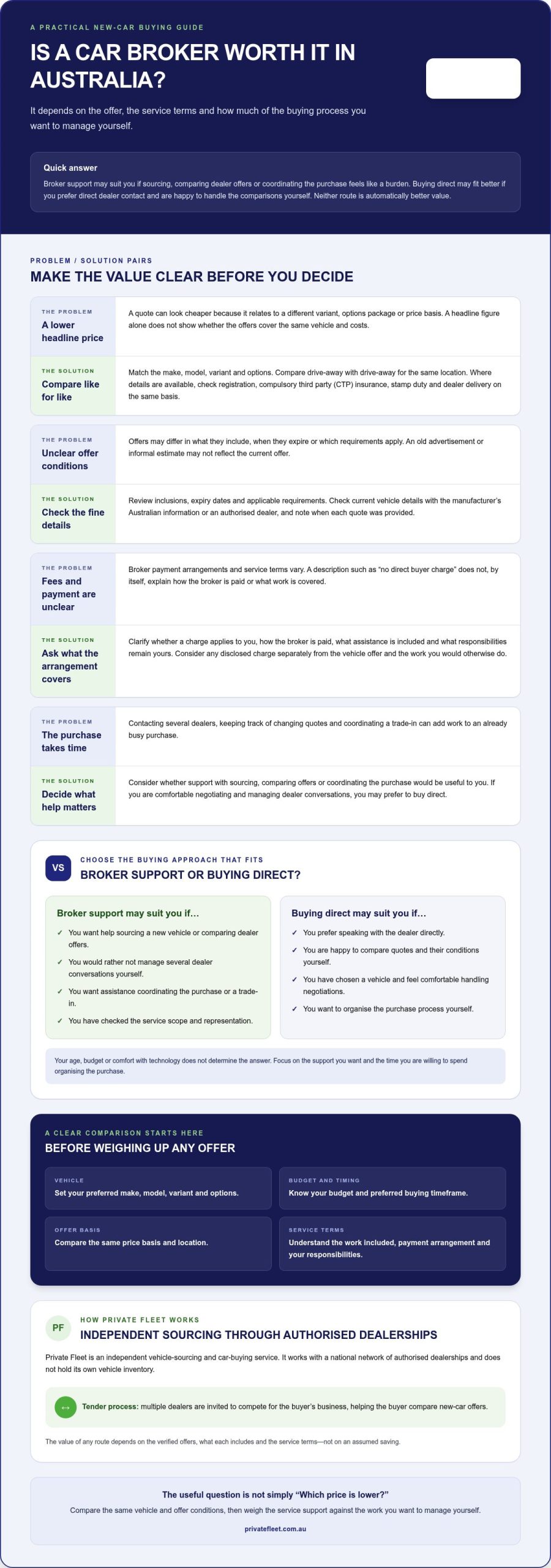
Use this checklist to decide whether a car broker suits your purchase
A useful decision starts with your needs, not a general promise about price. Consider how much time you can give the purchase, how comfortable you are comparing offers and speaking with dealers, and whether coordinating a trade-in adds another task. A broker may make the process more convenient, but direct buying may suit you just as well if you prefer to manage each step.
What should you have ready before seeking help?
Prepare the details that will keep your search focused: preferred make or model, postcode and intended buying timeframe. Note your budget parameters, must-have variant and options, plus any vehicle you may trade in. Separate essentials from preferences, so the comparison stays centred on suitable cars rather than expanding into choices that don’t meet your needs.
- Set your brief. Record your preferred make, model and variant, your postcode, budget parameters and when you’d like to buy. If you’re open to alternatives, note what matters most, such as cabin space or ease of parking.
- Sort requirements from preferences. List the options you need separately from those you’d like but could do without. This helps keep comparisons relevant if offers differ in their inclusions.
- Assess the workload. Estimate the time you can give to requesting quotes, following up and comparing details. If you’re comfortable handling those tasks, direct buying may suit. If they feel difficult to fit around other commitments, support could be useful.
- Consider your trade-in. Note the vehicle you may trade and whether you want help coordinating that part of the purchase. Decide how much of the process you’d prefer to manage yourself.
- Compare the offers and service. Check that quotes match your chosen specification and use the same drive-away basis. Weigh their inclusions against the service scope, payment arrangements and coordination you’d receive.
Which questions help reveal whether the service fits?
Before proceeding, get a clear picture of the working arrangement and your role. Straightforward answers make it easier to decide whether the support will genuinely reduce your workload, rather than simply adding another step to manage.
- What parts of sourcing, offer comparison and purchase coordination does the service handle?
- How are competing dealer offers compared, including vehicle specification and drive-away inclusions?
- What payment arrangements apply, and what service work do they relate to?
- What happens at each stage, from sharing your brief through to progressing a selected offer?
- How will you receive updates about the purchase and delivery timing?
Use the answers to judge convenience alongside price. Clear terms and a process that fits your preferences can matter; no single buying route suits every buyer. The question of whether is a car broker worth it australia is best answered by matching the service to your shortlist, available time and confidence managing the purchase.
How Private Fleet helps you decide and buy a new car
Private Fleet is an independent Australian vehicle-sourcing and car-buying service. It works with a national network of authorised dealerships to source new cars, rather than selling vehicles from its own inventory. That distinction matters: the dealer supplies the vehicle, while Private Fleet helps bring suitable offers together for you to consider.
If you’re weighing up whether a car broker is worth it in Australia, consider how much support you want with sourcing, comparing offers and coordinating the purchase. The service may suit buyers who value help managing those steps, while the final choice of vehicle and offer remains theirs.
What happens when dealers compete through a tender?
Your requirements shape the sourcing process. Share your preferred make, model, variant and any important options, along with your location and buying timeframe. Private Fleet invites multiple dealers to compete for your business through a tender process, creating an opportunity to compare offers against your brief.
Dealer competition can support comparison, but it doesn’t guarantee the lowest price or a particular saving. Review each offer’s specification, price basis and inclusions before deciding. You remain in control of whether to proceed with an offer and which vehicle best fits your needs.
What support can make the purchase easier?
Sourcing and purchase coordination can reduce the number of separate tasks you need to manage. Trade-in assistance may also help bring your current vehicle into the new-car purchase process. Finance and car protection products can be considered as additional options, but the central decision remains the car, its specification and the dealer offer.
Customers receive regular updates on delivery times, which can help you stay informed as the purchase progresses without assuming a fixed delivery date. Understanding each stage can also make it easier to know what decisions are yours and what coordination is being handled. The new-car buying process explains how the purchase journey is organised.
What is the next step if you want help?
To make the first conversation useful, share your preferred make or model, postcode and buying timeframe. You can also outline your budget, preferred variant and whether you have a vehicle to trade in. A clear brief helps focus the sourcing and offer comparison on what matters to you, without committing you to a particular vehicle or outcome.
Make your next car-buying step a clear one
For anyone still wondering whether a car broker is worth it in Australia, the answer depends on the level of support you want and how you prefer to manage your purchase. Private Fleet has operated since 1999, helping Australian buyers source new cars through its independent buying service. The next step is to turn your priorities into a clear brief, so the options you consider fit the vehicle you want, your location and your timing.
Share your preferred make or model, postcode and buying timeframe to start a focused conversation about your new-car purchase. If you have a shortlist, include it; knowing what matters most helps make the next step practical and relevant to you.
Get help buying my new car
A well-informed purchase starts with the right questions and a decision that feels comfortable for you. Take the next step when you’re ready.
Frequently Asked Questions
Is a car broker worth it when buying a new car in Australia?
A car broker may be worthwhile if the support saves you time or makes comparing new-car options easier. If you’re weighing whether a car broker is worth it in Australia, consider your own situation: for example, a buyer with a firm deadline and several shortlisted models may value help gathering comparable offers. If you’re happy to contact dealers and organise quotes yourself, buying direct could suit you better.
Can a car broker get a better price than buying directly from a dealer?
A broker may source competitive offers, but a better price isn’t guaranteed. Compare written quotes for the same vehicle specification, options and drive-away basis, then check conditions such as offer expiry and location. For example, a lower figure may not be better value if it excludes an option included in another quote. Use current manufacturer or authorised dealer information to verify specifications and offer details before deciding.
How does a car broker make money in Australia?
Payment arrangements differ between brokers. Some may charge the buyer for a service, while others may receive payment connected with a dealer transaction; arrangements and disclosures vary. Before proceeding, understand how the broker is paid, whether you pay a charge, and what work the arrangement covers. This helps you assess the service terms and consider whether any payment relationship could affect how offers are presented.
Do you buy the car from the broker or an authorised dealer?
With Private Fleet, the new car is sourced through an authorised dealership, rather than from broker-owned inventory. The broker assists with sourcing and the purchase process; the dealership supplies the vehicle. Before committing, read the offer and purchase paperwork so you understand which business is supplying the car, what specification is included and which conditions apply to your order.
Can I still choose the make, model and dealer when using a car broker?
Yes, you can tell the broker which make, model and variant you want, and identify any acceptable alternatives. You can also share a dealer preference as part of your brief. For example, you might specify a particular trim and essential option, while remaining open to another colour. Review the sourced offer against your requirements and decide whether to proceed; don’t assume every preference will appear in every offer.
Is using a car broker better than negotiating with dealerships yourself?
Neither approach is automatically better. Managing negotiations yourself can suit you if you enjoy direct dealer discussions and have time to follow up and organise quotes. A broker may be more helpful if you’d rather spend less time coordinating several conversations. Think about what you want to handle personally, then compare the broker’s service scope with the effort you’d take on by buying direct.
Can a car broker help with a trade-in when buying a new car?
Trade-in assistance may be available as part of a new-car buying service. To judge the overall deal, look at the new-car offer and the trade-in value as separate figures, even if they’re presented together. This makes it easier to see how each part contributes to the changeover cost. Share accurate details about your current vehicle so the trade-in discussion starts from a clear description.