
The exact figure depends on the model, variant, engine and drivetrain. This guide puts the Isuzu D-MAX and MU-X 2026 prices in Australia into context, so you can compare options against your needs.
It’s sensible to look beyond a headline price before settling on a ute or SUV. Advertised figures can use different price bases, and a change in cab style, grade or drivetrain can shift the comparison. Knowing which details to line up makes your shortlist more useful and your budget planning clearer.
The guide also explains how diesel engine options differ, what fuel consumption figures mean for everyday ownership, and which servicing, warranty and roadside assistance terms to review. Weigh these details against how you plan to use the vehicle, whether for commuting, family travel or carrying equipment. You’ll have a practical framework for comparing variants and deciding what to look at next.
Key Takeaways
- Compare D-MAX and MU-X drive-away offers by exact variant, drivetrain and included charges to understand what each price covers.
- Use your passenger, load and towing needs to narrow the choice between the two diesel engines and available configurations.
- Compare claimed fuel consumption for the specific variant, then consider how your regular driving could affect real-world fuel use.
- Check the scheduled servicing interval and the warranty and roadside assistance terms as part of your ownership-cost comparison.
- Explore how the MU-X range spans different grades and drivetrains before deciding which version belongs on your shortlist.
2026 Isuzu D-MAX indicative drive-away price range
That span covers different body styles, grades, engines and drivetrains, so the entry figure won’t represent every buyer’s preferred ute. Compare the exact configuration first. The Australian D-MAX and MU-X 2026 price comparison is most useful when each figure identifies the model, variant and price basis.
Selected 25.5MY D-MAX offers show how configurations compare. These listed offers run from 1 July to 31 October 2026.
Recommended retail price (RRP) and drive-away price are different comparison points. Keep the price basis visible in your notes so you don’t compare an RRP with a drive-away total.
- Match cab style, engine and drivetrain.
- Record whether the figure is RRP or drive away.
- Note the offer period and paint choice.
The listed offers include one year of registration, CTP insurance, dealer delivery and statutory charges. Include paint in your comparison, as it can affect the advertised total. Check that each offer covers the same vehicle configuration and price components.
New MU-X listings give context across the two Isuzu models. These offers also run until 31 October 2026.
These ranges reflect different listings, so compare their stated variants and price basis. The Australian Government Vehicle Emissions Star Rating (VESR) gives the Isuzu MU-X RJ 4×4 AT SUV Auto (2021-2025) a 1.5-star vehicle emissions rating out of 6.
2.2-Litre and 3.0-litre diesel engines
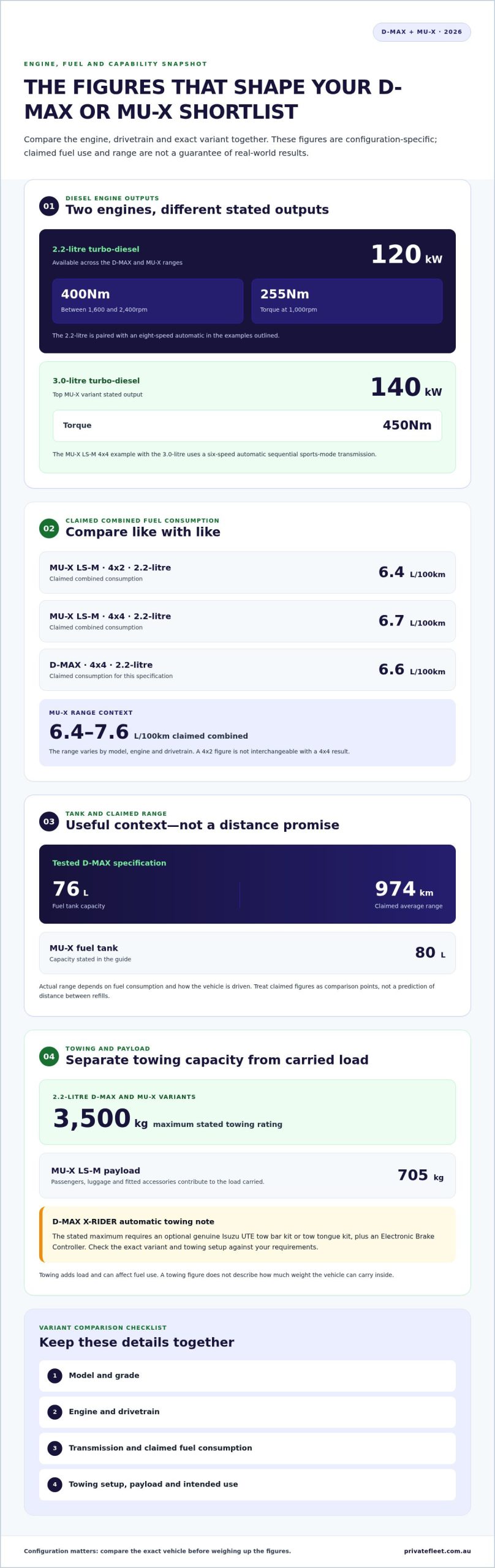
The Australian D-MAX and MU-X ranges offer 2.2-litre and 3.0-litre turbo-diesel engines. The 2.2-litre produces 120kW at 3,600rpm and 400Nm between 1,600 and 2,400rpm. Its torque reaches 255Nm at 1,000rpm. Compare these figures with your usual driving and load requirements, rather than choosing by engine size alone.
The 2.2-litre diesel is paired with an eight-speed automatic transmission. In the MU-X LS-M 4×2, the 2.2-litre works with an eight-speed automatic sequential transmission. The MU-X LS-M 4×4 with a 3.0-litre diesel instead has a six-speed automatic sequential sports-mode transmission. These examples show why the engine, grade and drivetrain should be considered together.
Both models offer different body styles and purposes. The D-MAX is a ute, while the MU-X is an SUV, so compare the exact variant’s engine and transmission rather than assuming every combination is identical. In the MU-X range, the top variant produces 140kW and 450Nm. That gives buyers a concrete output comparison against the 2.2-litre engine’s stated figures.
- 2.2-litre diesel: 120kW, 400Nm and an eight-speed automatic pairing.
- 3.0-litre diesel: available in the range; the top MU-X variant produces 140kW and 450Nm.
- Transmission example: MU-X LS-M 4×4 3.0-litre uses a six-speed automatic.
For a useful shortlist, note the model, grade, engine, drivetrain and transmission for each candidate. Then compare those details with how you expect to use the vehicle. D-MAX buyers can assess ute configurations against their carrying needs, while MU-X buyers can focus on the SUV variant suited to passenger travel. This makes specification differences easier to spot.
When comparing vehicles, pay attention to how the automatic transmission responds in the driving situations that matter to you. Match your observations to the listed engine and drivetrain, and keep each variant’s specifications together. This helps separate engine differences from grade-level equipment and makes your comparison clearer.
For help weighing up an Isuzu engine and variant, contact Private Fleet, call 1300 303 181, or review Isuzu buying information.
The 2.2-litre Isuzu D-Max and MU-X have claimed fuel consumption of 7.8L/100km in the tested specification, while fuel use can be as low as 6.3L/100km.
Fuel economy and fuel tank capacity
Fuel consumption varies by model, engine and drivetrain. The 2026 MU-X range has claimed combined consumption from 6.4 to 7.6L/100km. The MU-X LS-M 4×2 with a 2.2-litre diesel is listed at 6.4L/100km. Its 4×4 counterpart is listed at 6.7L/100km. These figures help compare variants, but don’t predict every driver’s real-world result.
For the D-MAX, a 4×4 specification with the 2.2-litre diesel has claimed consumption of 6.6L/100km. A tested D-MAX specification has a 76-litre fuel tank and a claimed average range of 974km. The MU-X has an 80-litre tank. Actual range depends on the vehicle’s consumption and how it’s driven, so use the figures as comparison points rather than a promise of distance between refills.
Green Vehicle Guide bases annual fuel costs and tailpipe CO2 emissions on combined fuel consumption for a vehicle travelling 14,000km. This gives buyers a consistent usage basis for considering fuel and emissions. Compare the exact engine and drivetrain: a 4×2 MU-X LS-M figure isn’t interchangeable with a 4×4 D-MAX result. A dealer’s advertised specification should also match the vehicle being priced.
Towing needs can change the choice. The 2.2-litre D-MAX and MU-X variants are rated to tow up to 3,500kg. For the D-MAX X-RIDER automatic, that maximum requires an optional genuine Isuzu UTE tow bar kit or tow tongue kit, plus an Electronic Brake Controller. Check the exact variant’s towing setup before comparing it with your trailer requirements. Towing also adds load and can affect fuel use.
Payload matters alongside towing capacity. The 2026 MU-X LS-M has a vehicle payload capacity of 705kg. Passengers, luggage and fitted accessories all contribute to the load carried, so account for them when planning a trip. A high towing figure alone doesn’t describe how much weight the vehicle can carry inside.
The MU-X boot capacity ranges from 311 to 2,138 litres. That spread reflects the available seating and cargo configuration, making it useful for comparing family luggage needs with larger loads. Buyers should consider how often they’ll carry passengers alongside baggage. The seven-seat layout offers flexibility, while the available boot space changes with how the cabin is arranged. Check fuel consumption, tank size, payload and cargo space together to compare the whole vehicle for daily driving, touring or towing.
Included servicing, warranty and roadside assistance
For the 2026 Isuzu MU-X, the suggested service schedule is every 12 months or 15,000km. Use that interval when planning ownership costs, and compare the servicing requirements for the exact D-MAX or MU-X engine and variant. A regular service schedule helps you map likely workshop visits against annual kilometres and driving patterns.
Before choosing between variants, distinguish scheduled servicing from warranty protection and roadside assistance. They serve different purposes: servicing covers planned maintenance, warranty terms define eligible faults and exclusions, and roadside assistance provides support after a breakdown. Comparing each separately prevents one feature from being mistaken for another.
For servicing, note the scheduled intervals and the work required at each visit. Consider how often you travel and whether your kilometres are mostly urban, regional or long-distance. A driver covering long distances may reach a distance-based interval sooner, while a lower-kilometre driver still needs to account for the time-based schedule. Keep service records with your purchase documents.
Look beyond the headline warranty duration. Compare covered components, exclusions, maintenance conditions and whether coverage can transfer to a later owner. Note when the warranty starts and whether accessories have separate terms. These details clarify the coverage and the conditions that may apply to a particular repair or component.
Consider roadside assistance separately from the vehicle warranty. Compare the eligibility period, events covered and any conditions for continued support. Check whether assistance is linked to the vehicle or its owner. These terms matter when planning regional trips, where a breakdown can disrupt travel more than a routine city journey.
- Servicing: record the scheduled interval and maintenance requirements for the exact variant.
- Warranty: review coverage, exclusions, service conditions and transferability.
- Roadside assistance: understand eligibility, covered events and any continuation conditions.
Compare practical ownership costs and terms, not just the purchase price. A buyer planning regular regional travel may value clear roadside assistance terms, while someone keeping a vehicle for an extended period may focus on warranty conditions and scheduled maintenance. Compare equivalent D-MAX and MU-X variants, and keep the relevant documents so you can follow the schedule and understand the coverage for your chosen vehicle.
2026 Isuzu MU-X Australian price range
The 2026 MU-X has two useful price reference points: recommended retail price (RRP) before on-road costs, and drive-away estimates. These figures help frame the grade and drivetrain you’re considering, but they aren’t directly equivalent to a drive-away total.
Compare like with like. Each price is before on-road costs.
Indicative drive-away figures offer another perspective. These examples show how engine and grade affect the estimated total.
Read these alongside the figures for specific variants, not as a single fixed national quote. Location and chosen configuration affect final drive-away amounts.
For a clear comparison, record the grade, engine, drivetrain and price basis in separate columns. Compare the same details across listings to avoid mistaking an RRP before on-road costs for the amount needed to drive away.
Tour Mate listings are separate from the standard grade references. Keep the model distinction clear when considering touring equipment or reliability priorities. If you need a seven-seat SUV, shortlist the MU-X grade and drivetrain first, then compare the complete price basis.
For Isuzu-specific buying support, explore Isuzu discount information or call 1300 303 181.
Private Fleet: New Cars
Private Fleet’s New Car Buying Service can help you compare a new Isuzu D-MAX or MU-X. Its tender process invites dealers in its nationwide network to compete for your business, making it easier to compare offers for your preferred variant, postcode and buying timeframe.
If you’re replacing a vehicle, Private Fleet’s Trade-In Assistance can help with that part of the purchase. Car Finance is also available if you’re considering finance alongside your vehicle choice. Private Fleet sources vehicles through dealerships rather than holding its own vehicle inventory.
To discuss your Isuzu shortlist, contact Private Fleet or call 1300 303 181. You can also explore Isuzu buying information.
Choose your shortlist and take the next step
For the 2026 Isuzu D-MAX and MU-X price in Australia, the most useful comparison is one built around your actual priorities. Decide which body style and engine suit your everyday driving, then note the variant, drivetrain and key requirements such as towing or passenger space. That gives you a clear brief for comparing new-car offers.
If you’re ready to move ahead, share your preferred Isuzu model and variant, postcode and buying timeframe. Private Fleet can help organise the new-car buying process, with Trade-In Assistance available if you’re replacing your current vehicle. You can also explore Isuzu buying information or call 1300 303 181.
A considered shortlist makes the next step more focused. Contact Private Fleet to discuss your requirements and compare options that suit your needs.
Frequently Asked Questions
What is the 2026 Isuzu D-MAX price in Australia by variant?
These offers are listed until 31 October 2026.
What is the 2026 Isuzu MU-X price in Australia by variant?
These offers run until 31 October 2026.
Are 2026 Isuzu D-MAX and MU-X prices drive-away or before on-road costs?
The price basis depends on the figure: recommended retail prices are before on-road costs, while the listed 25.5MY offers are drive-away. Those offer prices include one year of registration, CTP insurance, dealer delivery and statutory charges. Compare the exact variant and paint selection to understand the advertised total.
What engine, transmission and drivetrain options are available for the 2026 D-MAX and MU-X?
Both ranges offer 2.2-litre and 3.0-litre turbo-diesel engines, with available drivetrains depending on model and variant. The 2.2-litre is paired with an eight-speed automatic. In the MU-X, the 3.0-litre LS-M 4×4 uses a six-speed automatic sequential sports-mode transmission. Check the specific grade’s specification: for example, MU-X LS-M 4×2 and 4×4 configurations pair different engines and transmissions.