
These 2026 Kia Tasman, Sorento and Carnival prices in Australia vary by model, variant and location, so comparing the right configurations matters as much as checking the starting figure.
Each model serves a different purpose: the Carnival is a people mover, the Sorento is an SUV, and the Tasman is a ute. Your passengers, cargo, driving patterns and towing plans can help narrow your shortlist before you compare grades. Start with how you’ll use the vehicle, then consider which specifications and features suit those needs.
This guide compares the Carnival’s Australian variant prices, hybrid and diesel options, claimed fuel economy, passenger space and luggage capacity. It also places the Carnival’s price range alongside the Sorento and Tasman, and explains why advertised prices may use different bases. Use these comparisons to build a shortlist around your budget and intended use, then consider which model and grade suit your next new-car purchase.
Key Takeaways
- Match the Carnival’s diesel or hybrid powertrain to your regular driving, fuel-use priorities and towing needs.
- Check how the Carnival’s seating and luggage capacity suit your usual passengers and cargo before choosing a variant.
- Compare variant pricing on the same basis: drive-away estimates include on-road costs, while prices before on-road costs don’t.
- Use the variant breakdown to narrow your shortlist and identify which features are worth prioritising.
Seating, luggage capacity and comfort
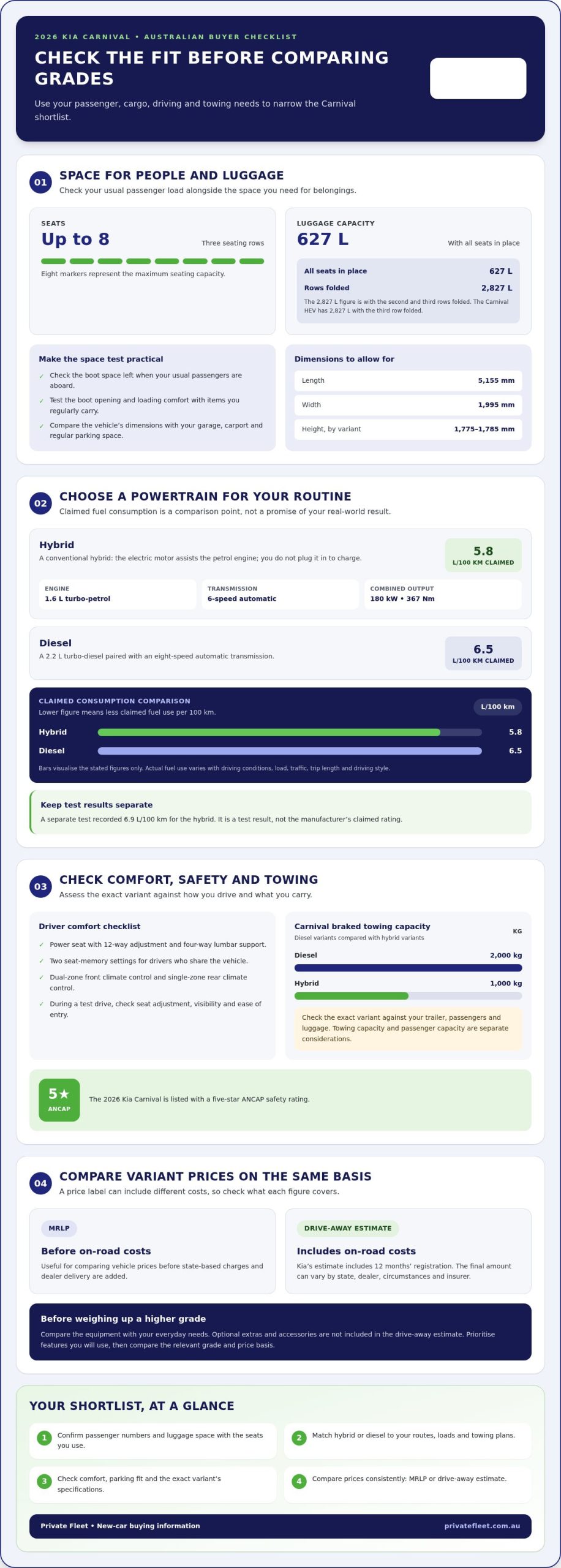
The 2026 Kia Carnival has three seating rows and accommodates up to eight people. Its 627-litre luggage capacity with all seats in place gives buyers a clear starting point for assessing everyday space. With the second and third rows folded down, capacity expands to 2,827 litres. The Carnival HEV also has 627 litres with all seats in place and 2,827 litres with the third row folded.
Capacity figures are useful, but the way you arrange passengers and belongings matters too. If you regularly travel with a full load, check how much boot space remains behind the occupied seats. For a family trip, compare the room needed for luggage with the number of passengers travelling. If cargo takes priority, consider whether folding the second and third rows works for the items you carry.
Check the fit in person using the objects you expect to transport. A pram, mobility aid, suitcase or sports bag can be a useful test item, but its shape affects how it fits. Look at the boot opening as well as the stated volume, and consider whether you can load and unload comfortably. The 627-litre figure describes capacity, not the dimensions of any particular item that will fit.
The Carnival measures 5,155mm long and 1,995mm wide. Its height ranges from 1,775mm to 1,785mm, depending on variant. Compare those dimensions with your garage, carport and regular parking space. Also consider the room needed to open doors and load passengers. These checks can help identify whether the vehicle suits your normal parking routine as well as longer journeys.
For the driver, the power seat offers 12-way adjustment and four-way lumbar support, with two memory settings. Front climate control is dual-zone, while rear climate control is single-zone. During a test drive, check the seat adjustment, visibility and ease of entry. If drivers share the vehicle, try the memory settings and assess how easily each person can settle into a comfortable position.
The 2026 Carnival is listed with a five-star ANCAP safety rating. Its diesel variants have a braked towing capacity of 2,000kg, compared with 1,000kg for hybrid variants. Treat towing capacity and passenger capacity as separate considerations: check the exact variant against your intended trailer, passengers and luggage.
The Tasman Dual Cab Chassis S 4×4 with General Purpose Alloy Tray has a 3,500kg braked towing capacity, 350kg towball download and payload of up to one tonne. These figures relate to that configuration, not every Tasman. Before choosing, list your regular passengers, cargo and towing tasks, then compare the specific vehicle variant against each requirement.
Engine outputs and fuel economy
The 2026 Carnival range includes a 2.2-litre turbo-diesel and a 1.6-litre turbo-petrol hybrid. The hybrid is a conventional hybrid, not a plug-in model: its electric motor assists the petrol engine, and you don’t plug the vehicle in to charge it. This distinction helps set expectations if you’re comparing it with a plug-in hybrid or fully electric vehicle.
The hybrid’s claimed fuel consumption is 5.8L/100km, with combined system output of 180kW and 367Nm. It uses a six-speed automatic transmission. A separate test recorded 6.9L/100km, illustrating that a test result and the manufacturer’s claimed rating are different measures. Actual fuel use varies with driving conditions, passenger and luggage load, traffic, trip length and driving style.
The diesel’s claimed consumption is 6.5L/100km, and its 2.2-litre engine is paired with an eight-speed automatic transmission. Compare its figure with the hybrid’s, but treat both as reference points rather than a guarantee of your own result. The manufacturer’s rating provides a consistent basis for comparing models; your own mix of urban traffic, open-road driving and loaded trips shapes real-world consumption.
Choosing a powertrain involves more than comparing claimed fuel consumption. Consider your regular routes, how often the Carnival carries a full passenger load, and whether you plan to tow. The hybrid has a lower claimed consumption figure, while the diesel pairs a different engine with a different transmission. Match these characteristics to your routine rather than assuming one option suits every buyer.
- Hybrid: 1.6-litre turbo-petrol engine, electric assistance, six-speed automatic, 180kW and 367Nm combined output, and claimed consumption of 5.8L/100km.
- Diesel: 2.2-litre turbo-diesel engine, eight-speed automatic and claimed consumption of 6.5L/100km.
- Compare your use: Consider annual kilometres, traffic, longer journeys, passenger loads and towing before choosing.
- Read figures correctly: Keep the claimed rating separate from test results and your own driving experience.
To make a practical shortlist, note which powertrain suits your driving pattern, then compare the relevant Carnival grade and price basis. For help considering a new Kia, you can contact Private Fleet, call 1300 303 181, or review its Kia new-car buying information.
2026 Kia Carnival trim and hybrid prices
The 2026 Kia Carnival hybrid range has three listed grades: S, Sport+ and GT-Line. The MRLP lets you compare vehicle prices before state-based charges and dealer delivery are added.
It’s a different price basis from MRLP: drive-away estimates include registration and other on-road costs. Kia’s estimate includes 12 months’ registration, but the final amount can vary by state, dealer, circumstances and insurer. Optional extras and accessories aren’t included.
Compare the hybrid grades by weighing their equipment against how you’ll use the vehicle. The S is the entry grade, with Sport+ and GT-Line higher in the range. If you regularly carry passengers, consider which features would be useful on everyday trips. A higher grade makes sense when its additional equipment is worth the price difference to you.
The Sorento provides another hybrid comparison, but it’s an SUV rather than a people mover. Both estimates are valid until 31 October 2026. A conventional hybrid and a plug-in hybrid are different powertrains, so compare their vehicle type and how you’ll use them, not just their starting prices.
For a like-for-like price check, record the grade, powertrain, price basis, postcode and offer end date. Keep MRLP separate from drive-away estimates, then compare the same configuration and included items. Kia’s drive-away estimates include its recommended retail price and luxury car tax, stamp duty, an estimated dealer delivery charge and 12 months’ registration. They exclude optional extras and accessories, and are for private buyers rather than government, fleet or rental buyers.
Before choosing, consider your budget, passenger needs and preferred equipment. Then compare the listed price with the drive-away figure that applies to your location. This gives you a clearer view of the amount payable for a new Carnival or Sorento, without treating pre-cost pricing and on-road estimates as interchangeable.
2026 Kia Carnival variant prices
The five-grade range also includes Sport, Sport+ and GT-Line Lite. Compare these figures on the same basis: they exclude stamp duty, other government charges and options, so they are not drive-away prices.
The petrol variant steps are:
These comparisons show how your grade choice affects the budget before on-road costs.
Use the price ladder alongside equipment that matters to your driving. The 12.3-inch infotainment screen is available across all Carnival grades. A separate 12.3-inch driver cluster is listed for Sport+ and above, including GT-Line Lite and GT-Line. If screen layout is important, compare the dashboard displays in the grades on your shortlist rather than assuming every screen feature is identical.
Styling and cabin equipment can help distinguish grades, but the price alone doesn’t describe the whole ownership decision. Kia’s warranty is seven years with unlimited kilometres for most uses; specified vehicle uses have a 150,000-kilometre limit. Keep warranty terms separate from trim comparisons, and consider which grade’s features you’ll use throughout your intended ownership period.
For a clear comparison, note your preferred grade, its listed price, the on-road costs relevant to your location and any options you want. Then compare the drive-away amount for the same petrol variant. Dealer delivery charges and state-based costs affect the final figure, so avoid comparing one grade’s pre-cost price with another grade’s drive-away price.
Prices and model updates can change, so use the listed figures as a starting point for your shortlist. If you’re weighing Carnival grades against your budget and must-have features, get help comparing your new-car shortlist.
2026 Kia Carnival price range in Australia
The lower end reflects an S diesel estimate; higher grades and hybrid configurations cost more. Treat this range as a starting point, then compare the same grade, powertrain and price basis for a clearer picture.
Kia’s seven-year warranty has unlimited kilometres for most uses, with a 150,000-kilometre limit for specified vehicle uses.
Drive-away estimates include Kia’s recommended retail price and luxury car tax, stamp duty, estimated dealer delivery, and 12 months’ registration. They exclude optional extras and accessories. The actual drive-away amount can vary by state, dealer, individual circumstances and insurer, so compare the same inclusions across each written offer.
These are specific estimates, not prices that apply identically to every location or buyer.
Hybrid drive-away estimates vary by grade.
Before deciding, use this three-step comparison:
- Match the model: Record Carnival grade, diesel or hybrid powertrain, and model year.
- Match the price basis: Separate MRLP before on-road costs from drive-away pricing.
- Check the offer period: Note the expiry date and whether registration, delivery and selected options are included.
A common pitfall is treating advertised estimates as fixed national prices. State charges, dealer delivery and chosen extras can change the total. Also distinguish the vehicle warranty from scheduled servicing costs, as each affects ownership differently over the period you plan to keep the car.
Private Fleet: New Cars
Private Fleet can help you compare your preferred Kia Carnival, Sorento or Tasman through its independent new-car buying service. Its national dealer network competes for your business through a tender process. Private Fleet sources the vehicle rather than holding its own inventory.
Share your preferred model and grade, postcode and buying timeframe to make the comparison relevant to your plans. If you’re replacing a vehicle, Trade-In Assistance can help with that part of the purchase. Car Finance is also available if needed.
Explore the Kia new-car buying information, then contact Private Fleet or call 1300 303 181 to discuss your shortlist.
Choose the Kia that fits your next chapter
Your shortlist is most useful when it reflects how you’ll use the vehicle, not just its place in the range. Decide which body style suits your household, what equipment you’ll value day to day, and whether your preferred powertrain matches your regular driving. Then compare like-for-like offers using your postcode and purchase timeframe. This turns the kia Tasman, Sorento and Carnival 2026 price comparison in Australia into a practical next step, rather than a list of figures.
Private Fleet can help you source a new Kia through its independent buying service, with multiple authorised dealerships invited to compete for your business. If you’re replacing a vehicle, Trade-In Assistance can also form part of your new-car purchase planning. Explore Kia new-car buying information, or call 1300 303 181 to discuss your shortlist.
With your model preference, postcode and timing in hand, you can move ahead with a clearer comparison and choose a vehicle suited to your needs.
Frequently Asked Questions
How much does the Kia Carnival cost?
The relevant amount depends on the grade, powertrain, location and options you choose. Kia may change prices without notice, so note the offer period when comparing figures.
What do you get?
Equipment varies by grade. Every 2026 Carnival grade has a 12.3-inch infotainment display, while the 12.3-inch driver cluster is listed for Sport+, GT-Line Lite and GT-Line. The driver’s power seat offers adjustment, lumbar support and memory settings. Compare the display and seat features on your preferred grades, then consider which options will matter most to the driver and passengers.
What is the 2026 Kia Carnival price in Australia by variant?
Include applicable on-road costs when comparing these figures with drive-away prices.
Are 2026 Kia Tasman, Sorento and Carnival prices drive-away or before on-road costs?
Variant prices described as MRLP or “before on-road costs” are different from drive-away prices: they exclude charges such as stamp duty and dealer delivery. For a clear comparison, make sure each figure uses the same price basis and vehicle configuration.
What are the Australian on-road costs for the 2026 Kia Tasman, Sorento and Carnival?
Drive-away estimates include 12 months’ registration, stamp duty and an estimated dealer delivery charge; actual prices vary by state, dealer, circumstances and insurer.
What is the 2026 Kia Sorento price in Australia by variant?
What are the key features and specifications of each 2026 Kia Tasman variant in Australia?
The Tasman Dual Cab Chassis S 4×4 with General Purpose Alloy Tray has a 3,500kg braked towing capacity, 350kg towball download and payload of up to one tonne.