
The run-out LDV T60 Max may suit buyers prioritising an eligible ABN offer, while waiting for the newer model makes sense if its revised diesel powertrain and updated equipment better fit the job. The 2026 Australian ABN price for an LDV T60 Max or D90 depends on the model, variant and offer conditions; ABN pricing is for eligible buyers purchasing in the ABN entity’s name, and proof may be required. There isn’t one answer for every buyer.
It’s sensible to weigh the advertised drive-away price against what you need the vehicle to do, and to distinguish run-out stock from the newer model year. This guide explains how to compare T60 and D90 offers, what to consider about diesel performance, safety status and dimensions, and when the next T60 may be worth waiting for. It also covers the Deliver 9 as a separate commercial-vehicle option, so you can focus your shortlist on the right type of vehicle before weighing up an offer.
Key Takeaways
- Compare the run-out T60 with the newer model by weighing the offer against the diesel powertrain and equipment that matter for your work.
- ABN pricing is for eligible buyers purchasing in the ABN entity’s name; proof of ABN may be required, and listed new-stock pricing is valid at participating Australian dealers until 30 November 2026.
- Separate the T60’s standard safety equipment from its ANCAP status: the 2027 model’s rating expired in December 2024, and it doesn’t yet have a current rating.
- Assess the exact variant’s dimensions and towing needs alongside its headline price, as specifications differ across the range.
- Compare drive-away offers on the same basis, then treat GST-credit eligibility as a separate business tax question from the vehicle’s advertised price.
2.5-Litre turbo-diesel engine and eight-speed automatic
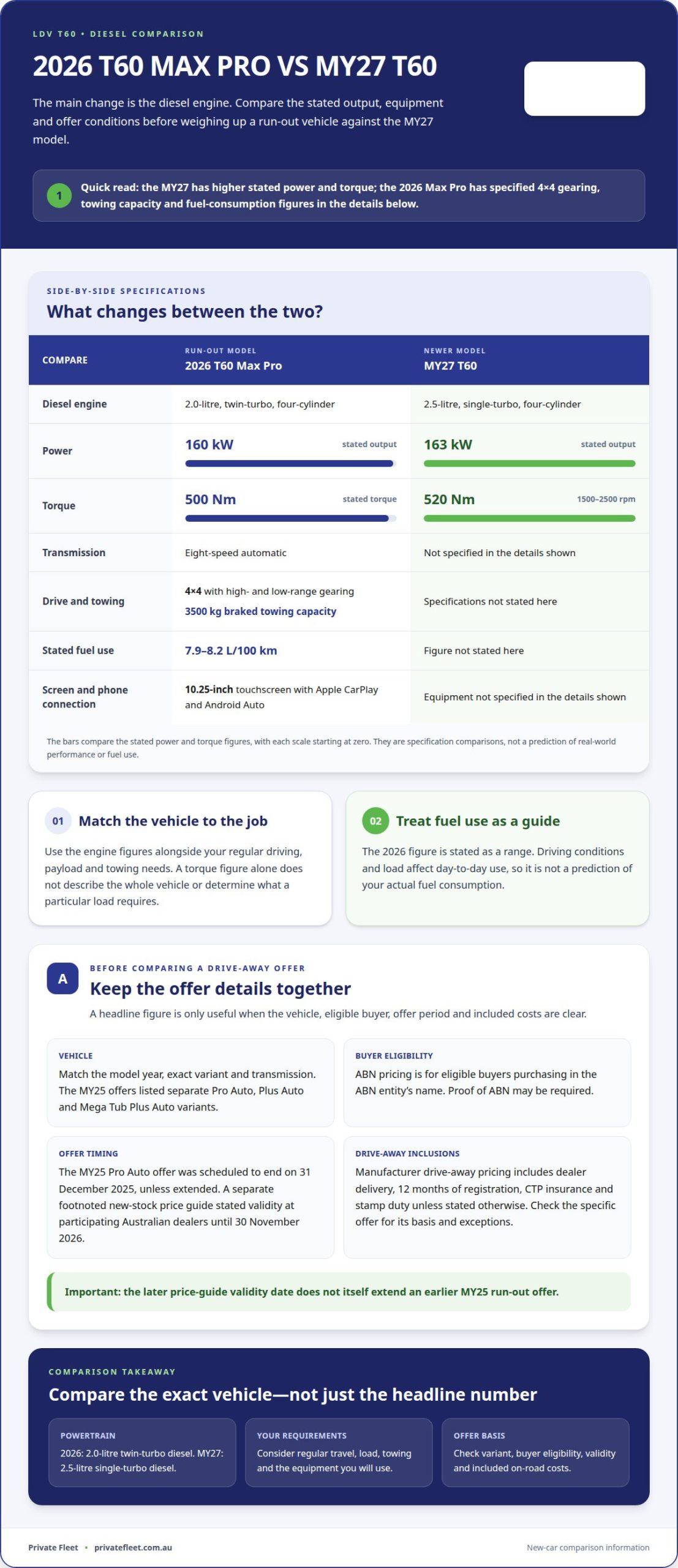
The engine description depends on the T60 model year. The 2026 T60 Max Pro uses a 2.0-litre twin-turbo four-cylinder diesel, producing 160kW and 500Nm. It pairs with an eight-speed automatic transmission. The newer MY27 T60 switches to a 2.5-litre single-turbo four-cylinder diesel, producing 163kW and 520Nm. That difference matters when comparing a run-out vehicle with its replacement.
For the MY27 engine, peak torque arrives from 1500 to 2500rpm. Torque describes the engine’s turning force, which helps explain how it responds under load. The 2026 Max Pro’s 500Nm and the newer model’s 520Nm are useful comparison points, but they don’t tell the whole story. Match the engine figures to your regular driving, payload and towing needs.
The 2026 Max Pro is a 4×4 with high- and low-range gearing. Check that the vehicle’s towing capacity suits the load and your intended use. Those details may matter for work that involves towing or travel on demanding surfaces. A towing figure alone doesn’t establish what a particular load requires, so consider the vehicle’s intended use and the relevant variant’s specifications together.
Fuel consumption is another practical point. The 2026 T60’s stated range is 7.9 to 8.2L/100km. Your driving conditions and load affect the way a diesel ute is used day to day. Compare the stated figure with your own travel pattern, rather than treating it as a prediction of your actual fuel use.
The 2026 Max Pro’s 10.25-inch touchscreen supports Apple CarPlay and Android Auto. These features are separate from the engine and transmission, but can influence how well the vehicle suits your routine. Consider whether the screen, phone connectivity and controls work for your usual trips, alongside the mechanical specifications.
- Run-out T60 Max Pro: 2.0-litre twin-turbo diesel, 160kW, 500Nm and eight-speed automatic.
- MY27 T60: 2.5-litre single-turbo diesel, 163kW and 520Nm from 1500 to 2500rpm.
- 2026 Max Pro: 4×4 high- and low-range gearing, with 3500kg braked towing capacity.
MY27 T60 models were due in Australian LDV showrooms in October 2026. For a buying decision, compare the exact model year, variant and transmission shown on each drive-away offer. Then weigh the engine figures against towing requirements, expected fuel use and equipment. A lower away price may appeal, while the newer engine’s extra torque may better suit a buyer’s priorities.
Pricing validity and offer conditions
Run-out pricing depends on the exact T60 MAX variant and buyer eligibility. MY25 offers covered the T60 MAX Pro Auto, T60 MAX Plus Auto and T60 MAX Mega Tub Plus Auto. Each was listed as an ABN-holder drive-away offer, not a general retail price. Compare the model year, variant, transmission and buyer category shown in each offer before judging the figures side by side.
The MY25 Pro Auto ABN offer was scheduled to run until 31 December 2025, unless extended. A separate new-stock price guide, marked with footnote 1, is valid at participating Australian dealers until 30 November 2026. These are separate offer references and dates. The later price-guide deadline doesn’t itself extend an earlier MY25 run-out offer.
ABN pricing applies to eligible buyers purchasing in an ABN entity’s name, and proof of ABN may be required. The purchasing entity and offer conditions matter, so a private purchase shouldn’t be treated as eligible just because the buyer has access to an ABN.
Compare drive-away amounts on the same basis. LDV manufacturer drive-away pricing includes dealer delivery, 12 months of registration, CTP insurance and stamp duty unless stated otherwise. Check the specific offer’s stated basis and any exceptions. A drive-away figure shouldn’t be compared directly with a price that excludes on-road costs.
- Match the variant: Pro Auto, Plus Auto and Mega Tub Plus Auto are separate offers.
- Match the buyer: ABN pricing is for eligible purchases in the entity’s name.
- Match the date: the MY25 run-out offer and later price-guide period differ.
- Match the price basis: note included on-road costs and stated exceptions.
The MY25 run-out offer’s scheduled end date has passed. The separate footnoted price guide has its own stated validity period. For any comparison, keep the model year, variant, offer conditions and price basis together. That helps distinguish a specific offer from a general price reference and keeps the buyer category clear.
For help comparing an LDV T60 offer, contact Private Fleet, call 1300 303 181, or see LDV discount information.
These are variant-specific offer prices, so compare vehicles of the same model on the same driveaway basis. The listed figures do not establish a corresponding retail price for the Plus Auto.
Keep that earlier figure separate from the MY25 run-out offer prices above: it is an earlier offer reference, not a replacement for the variant and buyer-category details attached to each listed price. When comparing offers, verify that the vehicle variant and eligible purchaser match before relying on a figure.
ANCAP rating status and standard safety equipment
Separate the T60’s safety equipment from its ANCAP rating status. The 2026 LDV T60 Max Pro includes autonomous emergency braking, adaptive cruise control, lane departure warning and lane keep assist as standard equipment. The 2027 LDV T60’s ANCAP rating expired in December 2024, and the model doesn’t yet have a current rating. These facts describe different things: fitted features and an independent vehicle safety rating.
An expired rating doesn’t mean the T60 has no safety equipment. It means there isn’t a current ANCAP rating for the 2027 model. Buyers comparing the 2026 Max Pro with the newer T60 should therefore consider the equipment list and rating status separately. Don’t treat standard driver-assistance features as a substitute for a current rating, or assume an older rating applies to a newer model.
The four named systems serve different purposes. Autonomous emergency braking can assist with braking when it detects a potential collision. Adaptive cruise control helps manage speed and following distance. Lane departure warning alerts the driver to unintended lane movement, while lane keep assist can provide steering assistance. These systems do not replace the need for driver attention and control.
For a fair comparison, make a short specification check before deciding between run-out and newer-model T60s:
- Identify the exact vehicle: record the model year and variant, such as 2026 Max Pro or 2027 T60.
- Separate the two measures: write down standard safety equipment and ANCAP rating status independently.
- Confirm what is standard: the listed four systems are standard on the 2026 Max Pro.
- Assess your use: consider whether the vehicle’s safety features suit your regular driving, including commuting or regional trips.
That distinction matters when an attractive drive-away offer concerns a specific model year. An offer for a 2026 Max Pro shouldn’t be judged using the 2027 model’s rating status, or vice versa. Keep the vehicle year, variant and safety details together while comparing prices. That prevents a low headline figure from obscuring a difference relevant to your decision.
Before choosing, consider how you’ll use the T60 and which safety information matters most to you. If standard driver-assistance equipment is a priority, note the four systems fitted to the 2026 Max Pro. If an ANCAP rating is central to your decision, note that the 2027 rating expired in December 2024 and there’s no current rating. Those points help frame a clearer comparison without confusing equipment with a rating.
Are LDV ABN prices GST-inclusive, and can businesses claim GST credits?
An LDV ABN offer is a vehicle purchase price, not confirmation that a buyer can claim GST credits. The offer wording and purchase documents show the transaction’s price information, but do not determine a business’s tax outcome. Consider the advertised amount and any GST-credit question separately when making your buying decision.
Before comparing an ABN offer, read the price description and note what it says about GST. If the wording is unclear, don’t infer the treatment from the ABN label or driveaway description. Keep the offer and final purchase documents together so the actual amounts and terms can be considered, rather than relying on assumptions from an advertisement.
Use these steps to keep the price comparison organised:
- Record the vehicle. Note the LDV model, variant and model year attached to the offer.
- Record the buyer. Keep the ABN entity named in the proposed purchase consistent with the offer details.
- Read the price wording. Record whether the offer describes a drive-away amount and what it says about GST.
- Keep the transaction documents. Retain the final invoice and purchase paperwork with the offer.
- Separate the tax question. Use the transaction documents when considering GST-credit treatment for the business.
This distinction matters if you’re comparing a T60, D90 or Deliver 9 for a business purchase. An ABN price helps identify the offer being presented to an eligible buyer. It shouldn’t be read as confirmation of a GST credit, nor as a calculation of the business’s eventual tax position. The amount payable under the vehicle offer and the accounting treatment are separate questions.
For a clear buying record, keep the offer, final vehicle specification and purchase paperwork together. This helps distinguish the quoted vehicle amount from any later accounting treatment. Avoid estimating a credit by subtracting an assumed GST amount from the advertised price. The offer documents and the business’s tax records are the relevant basis for that discussion.
In short, an ABN offer alone does not establish GST-credit eligibility. It identifies a purchase offer for an eligible ABN buyer. Compare the vehicle price using its stated terms, and consider any GST-credit treatment separately using the transaction documents and advice relevant to the business’s circumstances.
Its claimed fuel consumption is 8.0L/100km.
Price indicative
There isn’t one indicative figure that covers every LDV T60, D90 and Deliver 9. The vehicle type, model year, variant and buyer eligibility all shape the comparison. Treat an indicative price as a starting point for narrowing your shortlist, not as a final amount for a particular vehicle. The next useful step is matching the price basis to the exact LDV you intend to buy.
Start with the model. A T60 is a ute, the D90 is an SUV, and the Deliver 9 is a van. Those vehicles serve different needs, so comparing their headline figures directly won’t tell you which is better value for your use. First decide which vehicle type belongs on your shortlist. Then compare variants within that model rather than treating the LDV range as one category.
For a T60 comparison, record the exact variant and model year. For a D90, keep the specified model and drivetrain together. For a Deliver 9, identify the exact vehicle configuration shown in the offer. These details make it easier to compare like with like and avoid assuming that a figure for one LDV applies to another.
Use a simple comparison record for each vehicle:
- Model: T60, D90 or Deliver 9.
- Variant and year: copy the exact description used in the offer.
- Buyer category: note whether the figure is for an eligible ABN buyer or retail buyer.
- Price basis: record whether it is drive-away and what the offer says it includes.
- Vehicle fit: note why that model suits your intended use.
This method is especially useful when two LDV offers look similar at first glance. A T60 MAX Pro and T60 MAX Luxe are different variants; a D90 Executive and D90 Luxe are also distinct. Keep their names attached to their respective figures. That gives you a clearer comparison without treating a model range as one fixed-price vehicle.
For your purchase decision, focus on the exact vehicle and offer terms rather than a broad indicative label. The price for a particular purchase depends on the model, variant, buyer eligibility and transaction details, and is provided after a quote request. Once your shortlist is clear, compare vehicles on the same price basis and consider how well each meets your needs.
Private Fleet can help you compare an LDV shortlist and discuss the buying process. Explore LDV discount information, contact the team, or call 1300 303 181.
Private Fleet
Private Fleet can help compare a new LDV T60, D90 or Deliver 9 against your preferred model, variant and buying timeframe. Its New Car Buying Service invites authorised dealerships in its national network to tender for your business, then supports negotiation and purchase paperwork. This can help when you’re weighing an eligible ABN offer against a different model year or retail option.
Share your preferred LDV, postcode and timeframe to give the comparison a clear starting point. Private Fleet can also assist with a trade-in or car finance as part of your new-car purchase. Review how the car-buying process works, then decide on your next step.
For help comparing your new LDV options, contact Private Fleet or call 1300 303 181.
Make your next step a clear one
A useful Australian comparison of the 2026 ABN price for the LDV T60 Max and D90 starts with your priorities: the vehicle’s role, the variant you want and how soon you plan to buy. Keep the purchase decision practical. Separate business tax considerations from the vehicle’s price, then focus on the specifications and purchase terms that suit your circumstances.
If you’re ready to move from research to a shortlist, Private Fleet’s New Car Buying Service can help source your preferred new LDV through its network of authorised dealerships. You can also discuss Trade-In Assistance as part of your next-car plans. Share your preferred model, postcode and timeframe to give the buying process a useful starting point.
A considered shortlist helps you choose the LDV that best fits your next move.
Frequently Asked Questions
When is the new LDV T60 available in Australia?
The MY27 LDV T60 was due in Australian showrooms in October 2026. Its newer powertrain distinguishes it from MY25 run-out vehicles, so identify the model year on any offer you’re comparing. A listed new-stock price guide marked with footnote 1 is valid at participating Australian dealers until 30 November 2026. ABN pricing applies to eligible purchases in the ABN entity’s name, and proof may be required.
What are the current 2026 LDV T60 Max and D90 ABN offers in Australia?
These are variant-specific amounts, not one price for every T60 or D90. ABN eligibility applies, and the listed new-stock price guide runs until 30 November 2026.
What are the 2026 LDV T60 Max and D90 drive-away prices by trim and state?
What fees and on-road costs are excluded from LDV ABN prices in Australia?
LDV manufacturer drive-away pricing includes dealer delivery, 12 months of registration, CTP insurance and stamp duty unless stated otherwise. Check the specific offer for any exceptions.