
A clear car decision starts with your needs, not an endless search through every model on sale. If you’re feeling overwhelmed by car choices, narrow your focus to a small group of new cars that suit your budget, daily routine and priorities. Then compare what matters to you, rather than trying to assess every feature and specification at once. This gives your research a purpose and makes the next steps easier to manage.
It’s understandable to hesitate when several vehicles seem suitable or important details are hard to compare. You may be weighing practicality against comfort, familiar features against new technology, or today’s needs against plans for the years ahead. You don’t need perfect certainty about every future need to make a sound decision. You need a clear view of what you value and enough information to judge the options fairly.
This guide will help you organise your thinking, seek useful advice and prepare to decide. You’ll find ways to focus your research, ask clearer questions and assess how a car fits your everyday life. Use the steps that apply to you, and treat the final choice as a practical decision based on your priorities, not pressure to keep searching.
Key Takeaways
- Start with your budget, regular journeys and must-have features to make the options easier to filter.
- Build a shortlist of two or three new cars, then compare their variants, drive-away offers and practical features side by side.
- Use a test drive to assess comfort, visibility, controls and how well each car suits your everyday driving.
- Prepare questions and review the purchase documents at your own pace before deciding.
- Get organised before visiting a dealership by saving relevant offers and working out your total ownership costs.
1. Breaking car buying into manageable steps
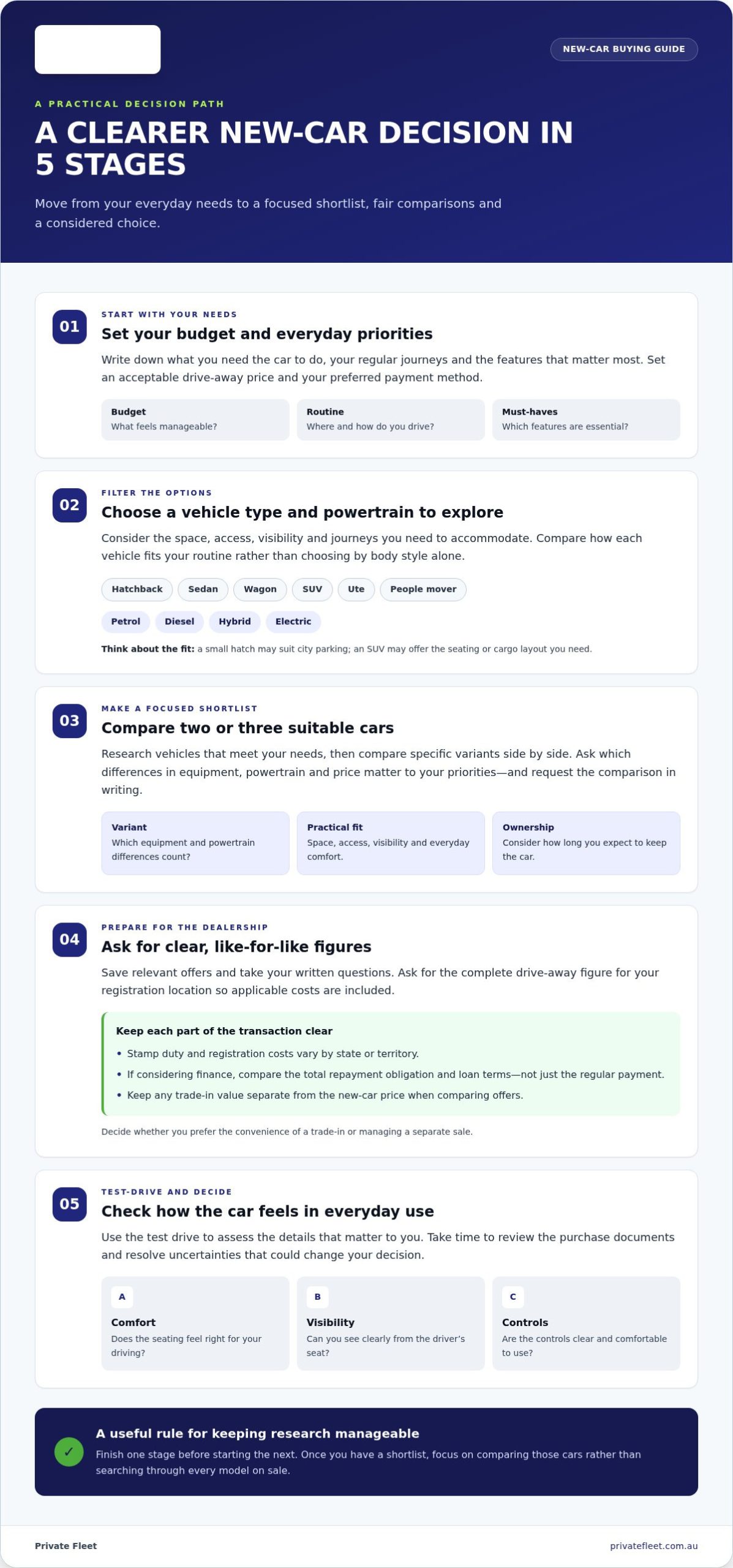
If you’re feeling overwhelmed by car choices, break the purchase into stages: set your needs and budget, research suitable vehicles, compare a shortlist, visit a dealership, test-drive and decide. Finish one stage before starting the next to limit distractions and give each decision a clear purpose.
Start by choosing a vehicle type and powertrain that fit your routine. Australian buyers can consider hatchbacks, sedans, wagons, SUVs, utes and people movers, with petrol, diesel, hybrid and electric options available across the market. A small hatch may suit city parking, while an SUV may offer the seating or cargo layout you need. Compare space, access, visibility and your regular journeys, rather than choosing by body style alone.
New cars generally cost more to buy than used cars, and both can lose value through depreciation. A used car may reduce the initial outlay, but compare its condition and ongoing ownership costs with the price, warranty and features of a new car. For a fair comparison, consider how long you plan to keep the vehicle and what you might receive when selling or trading it.
In Australia, stamp duty and registration costs vary by state or territory. Ask for the complete drive-away figure for your registration location, so you compare the applicable charges as well as the advertised vehicle price.
Next, consider how you’ll pay: buy outright, arrange finance or trade in your current vehicle. If you’re considering finance, compare the total repayment obligation and loan terms, not just the regular payment. If trading in, keep the trade-in value separate from the new-car price when comparing offers. This makes each part of the transaction easier to assess.
Car-buying anxiety often grows when there are too many models, unfamiliar features, unclear costs or pressure to decide quickly. Online research can help you compare specifications and save advertisements, but close the browser tabs once you have a shortlist. Reading about every available model rarely clarifies which one suits your needs.
Women’s experiences buying used cars vary, and no single approach suits everyone. Any buyer can prepare by listing questions, checking the vehicle’s history and condition, and taking time to review the offer. If a conversation feels rushed, pause and consider the details before returning to the decision.
Use a simple written checklist to keep the process manageable: must-have features, acceptable drive-away price, preferred payment method and questions for the dealership. For example, a commuter might prioritise comfortable seating, clear controls and parking assistance; a household carrying passengers may focus on rear-seat access and luggage space. Your list turns research into a decision, not an endless search.
Seeking professional help with vehicle selection
A professional can help turn your priorities into a focused new-car shortlist. Explain how you’ll use the vehicle, what you need it to carry, which features matter and what budget feels manageable. Ask for two or three suitable options and why each fits. A useful recommendation connects a vehicle’s features to your needs, rather than simply listing popular models.
Fear of choosing poorly can come from trying to predict every future change. Ask an adviser to separate essential needs from possibilities. If you expect to commute most days but take occasional longer trips, discuss how each shortlisted car balances daily comfort, luggage space and distance driving. Consider how long you expect to own it, too. This can help you judge whether a feature will be useful throughout your intended ownership period.
Ask for comparisons between specific variants. A model range may include versions with different equipment, powertrains and prices. Request a clear explanation of which differences matter to your priorities. If a higher variant adds a feature you’ll rarely use, weigh that against a better-fitting alternative. Ask for the comparison in writing, so you can consider the options without relying on memory.
Professional support can also help organise the sale or trade-in of your current car. Decide whether convenience or managing a separate sale matters more to you. For a trade-in, keep its quoted value separate from the new-car price. For a private sale, consider the time needed to prepare the vehicle, handle enquiries and arrange viewings. The right approach depends on how involved you want to be in changing cars.
If you’re interested in an electric vehicle, describe your typical week rather than asking whether EVs are simply “worth it”. Explain your regular kilometres, access to charging and how often you take longer trips. An adviser can help you assess whether an EV belongs on your shortlist or if another powertrain better fits your routine. You can also ask how the specific vehicle’s charging arrangements and warranty terms match your priorities.
Good guidance should clarify the decision while leaving the final choice to you. Bring a short list of needs and ask the adviser to explain trade-offs in plain language. If a recommendation doesn’t address a concern, such as passenger access or ownership costs, raise it directly. This can reveal a missing requirement before you commit to a vehicle that only looks suitable on paper.
For a useful first discussion, note your preferred make or model, postcode and buying timeframe. If you’d like help working through your new-car shortlist, share your vehicle preferences and buying timeframe.
3. Asking questions and taking time to decide
Taking time means resolving uncertainties that could change your decision, not researching every car on sale. Ask questions that uncover trade-offs: how does a feature work in everyday use, how does the selected variant differ, and which ownership conditions apply? If an answer affects comfort, practicality or ongoing costs, write it down and make sure you understand it before moving forward.
Separate concerns you can settle now from future possibilities you can’t predict. If you’re unsure whether you’ll need a larger vehicle later, consider how often you currently carry passengers or bulky items. If that need is occasional, ask what choosing the smaller option would mean for your regular routine. This keeps a hypothetical future from outweighing a clear present-day requirement.
Some questions need a direct explanation, not another brochure. Ask how a driver-assistance feature behaves in ordinary conditions, whether you can use the controls without a touchscreen, or what the servicing schedule requires. If the answer includes unfamiliar terms, ask for a plain-language explanation. Understanding how a feature works is more useful than simply knowing its name.
Before deciding, list the uncertainties that remain and resolve those that could change your choice:
- Which feature or condition is still unclear?
- Would the answer change which car suits your needs?
- Who can explain that detail, and what information should they provide?
- After receiving an answer, does the concern remain important?
Use this process to distinguish a genuine concern from decision fatigue. If you keep revisiting the same question, write down what you already know and what new information could change your view. If cabin space is settled but colour choice keeps delaying you, for example, decide whether colour affects daily use or is simply a preference. This helps you focus on what matters.
Include anyone who regularly shares the car, but keep the discussion centred on actual needs. A partner may prioritise boot space, while another driver values seat comfort or simple controls. Agree on which requirements are essential and where each person can be flexible. If you disagree, return to the journeys and tasks the vehicle must handle instead of debating preferences in isolation.
Once the important questions have clear answers, take time to consider the decision away from the dealership. A quieter moment can help you judge whether the option fits your priorities without the pressure of a live conversation. If a substantial concern remains, pause and address it. If not, you can move forward with a clearer sense of why the car suits you.
Choosing a car for family use or commuting
Start with the journeys the car must handle, not the features that look impressive in an advertisement. A weekday commute, school drop-off and weekend trip place different demands on a vehicle. Note who usually travels, what you carry and where you park. These details can help you decide whether a hatchback, sedan, wagon or SUV belongs on your shortlist.
For family use, check the rear doors, seat access and space around child restraints. Take regular passengers to viewings and try the seating positions together. The boot should suit the pram, sports gear or shopping you actually carry. If you sometimes transport grandparents or grandchildren, check the entry height, rear legroom and how easily passengers can get in and out.
Commuters should consider their full daily routine. For a city trip with tight parking, visibility, turning and parking assistance may matter more than a large cargo area. For regular motorway or longer-distance travel, assess seat adjustment, cabin noise, ride comfort and how easily you can use the controls. Where practical, test-drive the route you drive most often.
Choose a powertrain to suit your driving patterns and charging access. A petrol car suits buyers who prefer familiar refuelling; a conventional hybrid combines a petrol engine with electric assistance and doesn’t plug in. A plug-in hybrid can be charged, while a battery electric vehicle runs on electricity and needs charging. If you’re considering an EV or plug-in hybrid, think about how charging fits your routine and how you handle longer trips.
Compare the specific variant’s safety equipment and technology rather than assuming every version has the same features. Ask which driver-assistance systems are included, and try the touchscreen, buttons and parking aids yourself. A system is useful only if you find it easy to use. Check the manufacturer’s specifications for the Australian variant you’re considering, because equipment can differ between versions.
Build a family or commuting comparison around the features you’ll use most:
- People: check seating comfort, rear access and room for regular passengers.
- Everyday loads: test the boot with representative luggage, groceries or sports equipment.
- Regular routes: consider parking, visibility, longer-drive comfort and charging arrangements.
- Ownership: compare the drive-away offer, servicing schedule, warranty terms and expected running costs.
A couple downsizing from a large SUV, for example, may value easy entry, comfortable seats and useful boot space over maximum passenger capacity. A household commuting with children may prioritise rear access and easy-to-use controls. Compare those needs with the specific vehicles, then test-drive the strongest matches with your usual passengers and everyday items. This practical check shows whether a car fits your routine, not just its brochure description.
5. Researching and preparing before visiting a dealership
Good preparation makes dealership visits more focused. Before you go, gather the Australian specifications, current offers and questions for each shortlisted make and model. Save relevant online advertisements as screenshots or printouts, including the vehicle variant, advertised price, included accessories and offer details. This gives you a clear reference if the displayed offer differs from your notes.
Compare fuel economy, running costs and reliability using the same criteria for each car. Review the manufacturer’s fuel-consumption information, then consider how your regular routes, traffic and driving conditions may affect real-world use. Add servicing requirements, warranty terms and insurance estimates to your ownership comparison. Read reviews that discuss performance, quality and owner experiences, but check that the review covers the Australian model and relevant variant. Australian car reviews can help you identify questions to take to the dealership.
Prepare a simple comparison sheet before requesting quotes. Record the exact model and variant, drive-away price for your postcode, included features, delivery information and any offer expiry. A Toyota RAV4 quote, for example, is easier to compare with another SUV when both quotes identify their variants and inclusions. Ask for changes to be shown clearly, rather than relying on a verbal summary.
Work out your budget before discussing add-ons or monthly repayments. Include likely ownership costs such as fuel or charging, insurance, servicing, tyres and registration. If you’re considering a loan, pre-approval can clarify your borrowing limit before you shop. An online loan calculator can estimate repayments using the vehicle price, interest rate and loan duration. Compare the overall borrowing terms as well as the regular payment.
Plan the dealership visit around what you need to learn. Bring your comparison sheet, saved advertisements, driving licence and written questions. Ask to see the precise variant you’re considering, check how its controls work and arrange a test drive on roads similar to your usual commute. If a feature matters, such as parking assistance or rear-seat access, try it instead of relying on the brochure description.
Keep the visit centred on the car before discussing a trade-in or finance. Ask for the vehicle’s drive-away price and included equipment in writing. Then consider any trade-in separately, so the new-car offer and old-car value remain clear. Take the documents away, compare them with your notes and return with questions. A prepared visit should leave you with written details you can compare, not a decision based on memory.
Private Fleet: New Cars
Private Fleet’s New Car Buying Service can help turn your shortlist into a more manageable purchase process. As an independent vehicle sourcing service, it works with a national network of authorised dealerships. Its tender process invites multiple dealers to compete for your business, giving you offers to compare against your preferred make, model and variant.
If you’re replacing a vehicle, Trade-In Assistance can help with that part of the changeover. Car Finance is available if you want to explore finance alongside your new-car purchase. Share your preferred make or model, postcode and buying timeframe to start the conversation with useful details.
Take the next step with confidence
A car decision doesn’t require predicting every change in your life. It needs to suit the journeys, passengers and priorities that matter now, while allowing for how you expect to use it. If you’re feeling overwhelmed by car choices, focus on the strongest match rather than searching for a perfect vehicle with every possible feature.
Before moving ahead, note the make or model you prefer, your postcode and when you hope to buy. These details provide a useful starting point for discussing your options and what matters most to you. Take the next step at your own pace, with any remaining questions ready to discuss.
A thoughtful choice starts with your needs, not pressure to decide quickly. Trust the preparation you’ve done and move forward when the option feels right for your circumstances.
Frequently Asked Questions
How do I narrow down car choices based on budget and needs?
Set your maximum purchase budget, then shortlist cars that meet your essential requirements without relying on optional extras. Consider total ownership costs too: fuel or charging, insurance, servicing, tyres and registration all affect affordability. If you regularly carry bulky equipment, for example, compare boot access and usable space, not just published capacity. Mark each feature as essential or desirable, then remove options that don’t meet your essential needs.
What are the best cars in Australia for commuting, families and long-distance driving?
The right fit depends on your passengers, routes and parking, not on one universally suitable model. A commuter might value clear visibility and easy parking; a family may need practical rear-seat access and flexible luggage space. For regular long-distance travel, prioritise supportive seats, a comfortable ride and easy-to-use controls. Compare Australian-market variants and test the features you’ll use, as equipment can differ within the same model range.
How do electric, hybrid, petrol and diesel cars compare on costs and trade-offs in Australia?
Purchase and running costs vary by vehicle, driving pattern and access to energy, so compare specific variants rather than powertrains in isolation. An EV needs charging access; a conventional hybrid uses petrol with electric assistance and doesn’t plug in. A plug-in hybrid can be charged, while petrol and diesel cars use liquid fuel. Include energy, servicing and insurance in your comparison, and consider how longer trips fit your usual routine.
What is a simple step-by-step process for choosing and buying a car in Australia?
Follow a sequence: define your must-haves, set a budget, research matching new cars, compare written drive-away offers, test-drive the leading options, then review the paperwork before signing. Record the exact variant, included equipment and any trade-in arrangement. Compare quotes for the same specification and registration location, for example. Once the documents match your understanding, you can decide with the key details in front of you.