
The right Mazda depends on more than the headline figure: body style, seating, engine and the way you’ll use the vehicle all shape the decision. This guide compares the 2026 Mazda BT-50, CX-60 and CX-90 prices in Australia, while keeping drive-away offers distinct from prices before on-road costs. That distinction helps you build a more realistic shortlist before comparing vehicles with different specifications.
It’s also worth weighing how each model fits your day-to-day driving. A ute, a five-seat SUV and a larger family SUV serve different needs, so consider passenger space, luggage, towing requirements and whether plug-in charging suits your routine. For the CX-60, the choice between petrol, diesel and plug-in hybrid involves different priorities, not simply a higher or lower price.
The sections ahead explain how to read price formats, compare grades and understand the main engine options. Use them to identify the versions that suit your priorities, then compare like-for-like quotes for the same model, grade, powertrain and postcode. This makes it easier to decide which Mazda to explore, without assuming a promotional offer applies to every variant.
Key Takeaways
- Compare BT-50 variants on the same drive-away basis so you can assess like-for-like quotes.
- See how the CX-60 P50e plug-in hybrid sits alongside the petrol and diesel choices, and what charging access means for your decision.
- Use the CX-60 grade and powertrain breakdown to narrow your shortlist before comparing final costs.
- Understand why CX-90 figures can differ depending on whether they’re listed before on-road costs or presented as a drive-away offer.
- Compare the CX-90’s petrol and diesel mild-hybrid options against your priorities for performance, fuel use and towing.
2026 Mazda CX-60 PHEV pricing in Australia
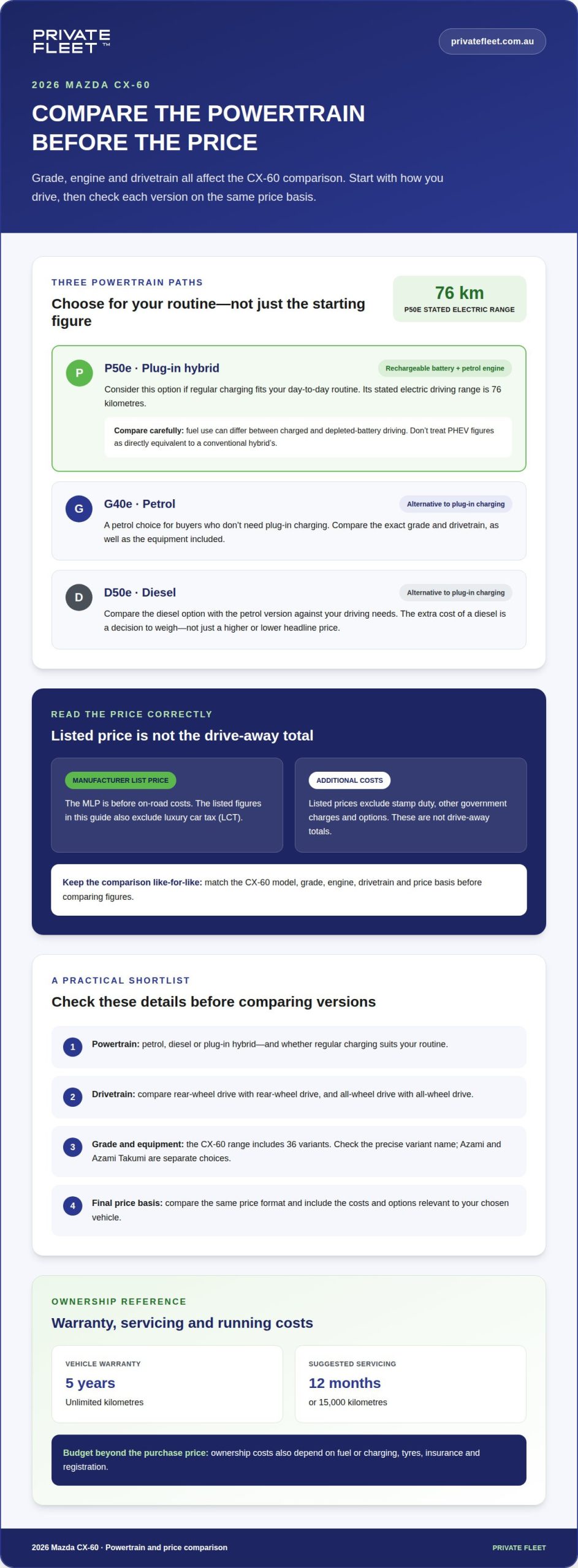
A plug-in hybrid electric vehicle (PHEV) pairs a rechargeable battery and electric motor with a petrol engine. In the 2026 Mazda CX-60 range, the P50e is the plug-in hybrid option; G40e petrol and D50e diesel variants provide alternatives for buyers who don’t need plug-in charging. The PHEV’s price premium is part of the decision, alongside charging access and the way you drive.
Those figures aren’t drive-away totals. CX-60 listed prices exclude stamp duty, other government charges and options. When comparing grades, keep the same price basis and drivetrain, then account for the equipment and options you actually want. The P50e’s stated electric driving range is 76 kilometres, which may make regular charging relevant to your day-to-day use. A PHEV’s fuel use can differ between charged and depleted-battery driving, so don’t treat its figures as directly equivalent to a conventional hybrid’s.
The wider Mazda large SUV range gives useful context, though the models aren’t direct substitutes. CX-80 Pure is also available with a 3.3-litre e-Skyactiv D diesel engine.
For CX-90 budgeting, the CX-60 provides a reference point, not a like-for-like price. Keep those estimates distinct from listed prices and drive-away offers.
What warranty, servicing and ownership costs apply to these Mazda models in Australia? The 2026 CX-60 has a five-year, unlimited-kilometre warranty, with suggested servicing every 12 months or 15,000 kilometres. Ownership costs also depend on fuel or charging, tyres, insurance and registration.
Are 2026 Mazda BT-50, CX-60 and CX-90 prices confirmed or estimated for Australia?
When will 2026 Mazda BT-50, CX-60 and CX-90 models arrive at Australian dealers? The 2026 model-year ranges are listed for Australia, enabling buyers to compare them now; timing for a particular vehicle depends on its variant and dealer allocation.
2026 Mazda BT-50 indicative drive-away price range
An indicative drive-away price estimates the vehicle’s total cost, including applicable on-road costs. The exact amount depends on the selected variant and location, so use the range to set an initial budget rather than assume every configuration costs the same.
For a useful BT-50 comparison, first decide which variant and configuration suit your regular use. Then compare offers for that same vehicle, including its drivetrain and included equipment. A quote for one configuration can’t be compared fairly with a different version simply because both carry the BT-50 name. Record the specification alongside the total, so you can see what each figure covers.
The P50e is a plug-in hybrid with a stated electric driving range of 76 kilometres. That distinction matters if charging access and regular electric driving are part of your choice.
Its six- or seven-seat layouts, petrol and diesel mild-hybrid engines, and grade-specific equipment create different buying options. Touring provides an entry point to the range, while GT and Azami grades add features such as larger wheels and a larger infotainment screen. Compare the cabin layout and features you’ll use, not just the model name.
It includes 12 months of registration and excludes premium exterior paint. Its stated offer conditions make it a distinct comparison from the general CX-90 range, so don’t assume every paint choice or grade shares the same total. The G50e petrol mild-hybrid uses a 3.3-litre turbocharged six-cylinder engine producing 254 kW and 500 Nm.
Across the three models, a price comparison becomes more useful when you write down the model, grade, powertrain, drivetrain, seating and included items. For the CX-60 P50e, consider whether you can charge regularly; for the CX-90, decide whether six or seven seats matter. For a BT-50, settle the intended configuration first. Then compare the same price basis and postcode.
To discuss a Mazda shortlist, contact the buying team or call 1300 303 181. You can also view Mazda buying options as you narrow your preferred model.
2026 Mazda CX-60 prices in Australia
The manufacturer list price (MLP) is the vehicle price before on-road costs and, for the listed figures here, excludes luxury car tax (LCT). The 2026 CX-60’s prices vary by grade, engine and drivetrain, so compare each variant on the same price basis before choosing.
The entry Pure grade offers a lower-priced petrol option, while Evolve and Touring add different powertrain combinations. Both use the G25 turbo-petrol engine and rear-wheel drive.
A diesel premium is the extra cost of choosing a diesel engine over its turbo-petrol counterpart. Compare that additional cost with your driving needs, not just the starting price.
The P50e is Mazda’s plug-in hybrid powertrain, combining a rechargeable battery with a petrol engine.
Check the precise variant name as well as the engine: “Azami” and “Azami Takumi” are separate choices.
The range includes 36 variants, so a quick shortlist can prevent comparisons across mismatched equipment. That reduction applies to this named variant; it shouldn’t be assumed for every grade or powertrain.
- Set the price basis: these MLP figures exclude on-road costs, and listed prices also exclude stamp duty, other government charges and options.
- Match the drivetrain: compare RWD with RWD and AWD with AWD before assessing a grade or engine premium.
- Choose the powertrain: weigh petrol, diesel and plug-in hybrid against your regular driving and access to charging.
Are 2026 Mazda BT-50, CX-60 and CX-90 prices drive-away or before on-road costs?
A drive-away price is a quoted total that includes applicable on-road costs for a specified vehicle and location. A price before on-road costs is the vehicle’s listed price, with additional charges payable. The 2026 Mazda ranges use both formats, so check the label before comparing variants.
For the Mazda BT-50, the indicative range is presented as drive-away pricing. It’s a useful starting point, but the exact total can depend on the selected variant and buyer’s location. Compare the same BT-50 grade, drivetrain and configuration when reviewing two figures. A range’s upper and lower limits describe different versions, not one vehicle with a negotiable price span.
The CX-60 has indicative drive-away figures as well as manufacturer list prices before on-road costs. For example, the CX-60 P50e AWD Evolve and Touring are listed before on-road costs, while the range’s indicative drive-away figures include on-road costs. Don’t treat those formats as equivalent. Stamp duty, registration, other government charges and options can sit outside a listed price; the CX-60’s stated list prices exclude those items.
The CX-90 also has an indicative drive-away range, alongside grade prices shown before on-road costs. The D50e Touring AWD, GT AWD, Azami AWD and Azami Takumi AWD are examples of grades with listed prices before those extra costs. Each figure needs its basis attached when you compare it. A CX-90 drive-away offer may have separate conditions, such as the Touring G50e offer’s exclusion of premium paint.
Use this practical comparison sequence for any of the three Mazda models:
- Identify the basis: mark each figure as drive-away or before on-road costs.
- Match the vehicle: record model, grade, engine, drivetrain and options.
- Check the location: compare quotes for the same postcode, since on-road costs can vary by jurisdiction.
- Read the inclusions: note registration, paint exclusions and any other stated offer conditions.
- Compare the total: use the final drive-away amount for the same specification and location.
For instance, a CX-60 P50e Touring AWD listed before on-road costs shouldn’t be compared directly with a drive-away CX-90 offer. First establish the CX-60’s complete total for the relevant location, then compare the vehicles’ grades and equipment. The same discipline applies to BT-50 figures: confirm that the quoted configuration matches your intended vehicle. This makes the price basis clear before you weigh the models against each other.
What are the 2026 Mazda BT-50, CX-60 and CX-90 Australian specifications and engine options?
An engine option identifies the vehicle’s power source, while a mild hybrid uses electric assistance without being a plug-in hybrid. The CX-60 and CX-90 have petrol, diesel and hybrid choices across their ranges; compare the exact BT-50 variant and specification when shortlisting the ute.
The 2026 Mazda CX-60 is a five-seat SUV measuring 4,740 millimetres long, 1,890 millimetres wide and 1,675 millimetres high. Its boot capacity ranges from 477 to 1,726 litres, depending on seat configuration. Those figures help assess garage fit and luggage space before settling on a grade.
The CX-60 G40e is a turbo-petrol mild hybrid producing 209 kW and 450 Nm. Its P50e is a plug-in hybrid with a stated electric driving range of 76 kilometres. Across the range, quoted fuel consumption spans 2.1 to 7.5 litres per 100 kilometres. These figures cover different powertrains, so they aren’t direct like-for-like comparisons.
For the CX-90, the G50e petrol mild hybrid is a 3.3-litre turbocharged six-cylinder producing 254 kW and 500 Nm. The D50e diesel mild hybrid is also a 3.3-litre turbo six, producing 187 kW and 550 Nm. Quoted consumption is 8.2 litres per 100 kilometres for petrol and 5.4 for diesel. The diesel’s braked towing capacity is 2.0 tonnes.
The CX-90 is available with six or seven seats, making seating layout a practical part of variant selection. Touring grades have a 10.25-inch infotainment screen, while GT and Azami grades feature a 12.3-inch screen. Lower grades have 19-inch alloy wheels; GT and Azami grades can have 21-inch wheels. Compare the equipment and seating configuration you’ll use, not just the engine badge.
Towing specifications depend on the CX-90 powertrain and equipment. The petrol mild hybrid can tow up to 2.5 tonnes braked when fitted with a Genuine Mazda Towing Kit, with a 150-kilogram tow-ball rating. These figures differ from the diesel’s 2.0-tonne braked capacity, so match the specification to your intended load.
For a BT-50 comparison, start with the exact variant, engine and drivetrain, then match those details against your work, travel and towing needs. For the CX-60, consider five-seat cabin space and whether plug-in charging suits your routine. For the CX-90, balance six- or seven-seat capacity against petrol or diesel priorities.
Private Fleet: New Cars
Private Fleet can help turn your Mazda shortlist into a new-car purchase through its New Car Buying Service. As an independent car broker, Private Fleet uses a national dealer network rather than holding vehicle inventory. Its tender process invites dealers to compete for your business, helping streamline comparisons across your preferred model, grade and postcode.
Share whether you’re weighing a BT-50, CX-60 or CX-90, along with your postcode and buying timeframe. Private Fleet can also assist with a trade-in and, if relevant, car finance. Explore the Mazda discount service as you narrow your options.
For help with your new Mazda purchase, contact Private Fleet or call 1300 303 181.
Make your Mazda shortlist work for you
The next step is to decide which vehicle best fits your regular driving, passengers and plans for ownership. For the Mazda BT-50, CX-60 and CX-90, 2026 prices in Australia are only one part of the decision; compare the exact grade and powertrain you’d genuinely choose, then weigh its practical features against your needs.
Before moving ahead, note your preferred model and variant, budget, postcode and buying timeframe. If you’re considering a CX-60 PHEV, include your charging access and typical driving in that shortlist. You can also explore Mazda buying options and discuss trade-in assistance as part of planning your next new-car purchase.
Private Fleet’s independent New Car Buying Service uses a tender process with authorised dealerships, giving you support to compare a shortlist and progress the purchase. Call 1300 303 181 or get in touch with your preferred model, postcode and timeframe.
A clear shortlist makes the next step easier. Build yours around what matters most to you.
Frequently Asked Questions
How much will Mazda’s CX-90 be in Australia?
For the combined 2026 Mazda BT-50, CX-60 and CX-90 prices in Australia, keep this offer separate from the broader ranges and variant prices before on-road costs. Your comparison depends on grade, engine and offer conditions.
What will CX-90 buyers get for the money?
CX-90 buyers can choose a six- or seven-seat layout, with petrol or diesel mild-hybrid powertrains. The G50e petrol produces 254 kW and 500 Nm; the D50e diesel produces 187 kW and 550 Nm. Touring has a 10.25-inch screen, while GT and Azami grades have a 12.3-inch screen. Compare seating, engine and equipment together, since the badge alone doesn’t show the full specification.
What is the 2026 Mazda BT-50 price in Australia by variant?
The range covers different variants, so use it to establish the overall budget spread rather than assigning either endpoint to a specific trim. For a useful comparison, note your chosen BT-50 variant and configuration, then compare a drive-away figure for the same vehicle and postcode. This avoids treating unlike specifications as equivalent.
What is the 2026 Mazda CX-60 price in Australia by variant?
These are listed prices before on-road costs. Check the price basis before comparing them with drive-away figures.
What is the 2026 Mazda CX-90 price in Australia by variant?
For the combined 2026 Mazda BT-50, CX-60 and CX-90 price comparison in Australia, keep CX-90 listed prices distinct from drive-away totals.