
In the Mazda CX-5 vs Hyundai Tucson vs Kia Sportage 2026 comparison, the Kia Sportage stands out on paper for screen-focused technology. But the strongest fit depends on how easily you can use the systems, which features are available in your preferred variant, and how well the SUV suits your everyday driving.
A large display can catch your eye, yet it’s only one part of the decision. Consider whether the controls feel intuitive, whether driver assistance suits your routine, and how technology works alongside visibility and comfort. A test drive helps you judge the details that specifications alone can’t settle.
This comparison brings together safety, cabin practicality, fuel use, performance, warranty and servicing. Narrow your options by variant, driving needs and ownership priorities, then compare your preferred SUVs on an even basis. The aim is a confident shortlist, not a one-size-fits-all winner.
Key Takeaways
- The Sportage’s dual 12.3-inch screens give it a strong on-paper technology advantage, but compare how each SUV’s controls and driver assistance work for you.
- Boot capacity differs across the range, so match the exact variant’s space and rear-seat room to the people and gear you regularly carry.
- The Sportage SX Hybrid and Tucson Elite Hybrid have lower listed combined fuel consumption than the conventional-engine ranges; your driving pattern helps determine which suits you.
- Compare powertrain, performance and towing specifications by variant rather than assuming every version of an SUV offers the same capability.
- Factor warranty terms and hybrid servicing intervals into your ownership plans, then weigh them alongside comfort, safety and everyday practicality.
ANCAP safety ratings and driver assistance
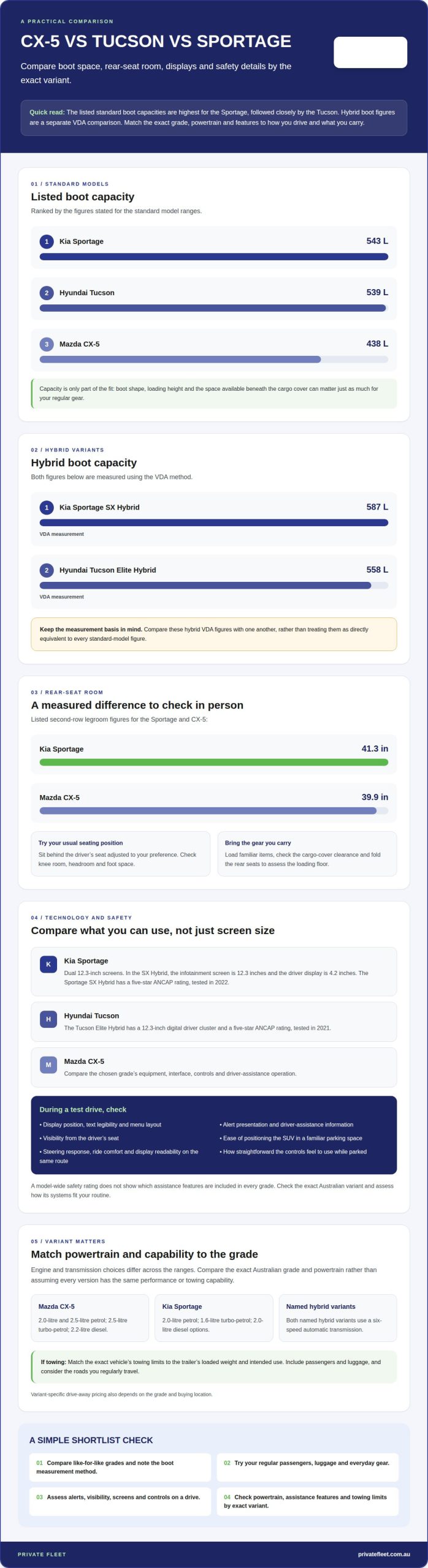
For safety, the Kia Sportage and selected hybrid variants have five-star ANCAP ratings. The Sportage SX Hybrid rating was tested in 2022, while the Hyundai Tucson Elite Hybrid rating was tested in 2021. Compare the exact grade you’re considering, because a model-wide rating doesn’t tell you which assistance features that variant includes.
During a test drive, assess how clearly the vehicle presents alerts and driver-assistance information. Check visibility from the driver’s seat, then try parking in a familiar space to judge how easily you can position the SUV. Notice whether the controls are straightforward to use while parked. These practical checks show how the technology fits your routine.
The Kia Sportage has dual 12.3-inch screens. In the SX Hybrid, the infotainment screen measures 12.3 inches and the driver display measures 4.2 inches. The Hyundai Tucson Elite Hybrid has a 12.3-inch digital driver cluster. Compare the display position, text legibility and menu layout in person, rather than choosing by screen size alone.
Engine and transmission choices also vary across these model ranges. The Mazda CX-5 lists 2.0-litre and 2.5-litre petrol engines, a 2.5-litre turbo-petrol and a 2.2-litre diesel. Kia lists 2.0-litre petrol, 1.6-litre turbo-petrol and 2.0-litre diesel Sportage options. Both named hybrid variants use a six-speed automatic transmission. Choose by exact Australian grade and powertrain; variant-specific drive-away pricing also depends on the grade and buying location.
| Model or variant | Safety information | Display information | What to assess |
|---|---|---|---|
| Kia Sportage SX Hybrid | Five stars, tested in 2022 | 12.3-inch infotainment; 4.2-inch driver display | Alert presentation and screen layout |
| Hyundai Tucson Elite Hybrid | Five stars, tested in 2021 | 12.3-inch digital driver cluster | Visibility and display readability |
| Mazda CX-5 | Compare the chosen grade’s equipment | Compare the chosen grade’s interface | Controls and assistance operation |
For a fair driving comparison, take each shortlisted vehicle over the same route. Try a tight turn, a parking manoeuvre and a stretch of uneven road. Notice steering response, ride comfort and how naturally you can read the displays. These observations help you compare the driving experience without assuming that a larger screen or higher engine output suits every driver.
- Match ANCAP information to the exact model and grade.
- Assess alerts, visibility and display controls during a drive.
- Compare engine, transmission and drivetrain by Australian variant.
Choose the SUV whose safety information, controls and road manners feel clearest for your regular driving.
Boot capacity and practicality
The Kia Sportage and Hyundai Tucson have larger listed standard boot capacities than the Mazda CX-5. Their figures are 543 litres and 539 litres respectively, while the CX-5 is listed at 438 litres. For the hybrid grades, the Sportage SX Hybrid has 587 litres and the Tucson Elite Hybrid 558 litres, both measured using the VDA method.
Keep the measurement basis in mind: compare the hybrid VDA figures with one another, rather than treating them as directly equivalent to every standard-model figure. A few litres may matter less than boot shape, loading height and the space left for your regular items. A rigid suitcase, shopping bags or a folded pram can make those differences easier to judge than specifications alone.
| Model or variant | Listed boot capacity | Practical point |
|---|---|---|
| Kia Sportage | 543 L | Compare the exact grade and boot layout |
| Kia Sportage SX Hybrid | 587 L, VDA | Hybrid-specific VDA figure |
| Hyundai Tucson | 539 L | Listed capacity is close to the Sportage |
| Hyundai Tucson Elite Hybrid | 558 L, VDA | Hybrid-specific VDA figure |
| Mazda CX-5 | 438 L | Less listed capacity than the standard figures above |
Cabin space can change how practical an SUV feels with passengers aboard. The Kia Sportage has listed second-row legroom of 41.3 inches, compared with 39.9 inches in the Mazda CX-5. Sit in the rear seat behind your usual driving position and check knee room, headroom and foot space. If you regularly carry family, try getting in and out with the front seat set where you prefer it.
Use a repeatable loading test when comparing the CX-5, Tucson and Sportage. Bring two or three items you often carry, place them in the boot, and check whether they fit beneath the cargo cover. Fold the rear seats and assess the loading floor for longer objects. A bulky item may need a wider opening, while smaller shopping bags may be easier to secure with a different boot shape.
Towing capacity also varies by variant. Before choosing a grade for a trailer, caravan or small boat, match the exact vehicle’s towing limits to the trailer’s loaded weight and intended use. Account for passengers and luggage, then consider the roads you regularly travel. A model name alone can’t establish whether a particular variant suits your towing needs.
- Compare like-for-like grades and note the stated boot measurement method.
- Test rear-seat access with the front seat adjusted for your driving position.
- Load your regular gear and match towing needs to the exact variant.
The most practical choice is the one that accommodates your passengers, cargo and trailer needs in the configuration you’ll actually buy.
Fuel economy and running costs
The listed combined figures are a useful starting point, with hybrid variants using less fuel on paper. Your annual kilometres, driving conditions and fuel price shape the actual running-cost comparison.
Combined fuel consumption
Fuel consumption varies across the Kia Sportage and Hyundai Tucson ranges. The Mazda CX-5 range spans 6.0 to 8.2 L/100 km, giving it the lowest starting figure but the highest upper figure here. The Sportage SX Hybrid is listed at 4.9 L/100 km, compared with 5.2 L/100 km for the Tucson Elite Hybrid.
| Model or variant | Listed combined fuel use | Comparison point |
|---|---|---|
| Kia Sportage range | 6.3 to 8.1 L/100 km | Range varies by variant |
| Hyundai Tucson range | 6.3 to 8.1 L/100 km | Range varies by variant |
| Mazda CX-5 range | 6.0 to 8.2 L/100 km | Broadest listed spread of these ranges |
| Kia Sportage SX Hybrid | 4.9 L/100 km | Lower listed hybrid figure |
| Hyundai Tucson Elite Hybrid | 5.2 L/100 km | Compare against the matching Kia hybrid |
These figures are most useful when comparing like with like. A hybrid’s combined consumption shouldn’t be treated as directly equivalent to a conventional engine’s result without considering the powertrain and variant. Factor fuel requirements into your own cost comparison.
Fuel economy estimates
Published combined consumption is an estimate for comparison, not a promise of what every owner will record. Congested urban trips, steady highway travel, hills, passenger loads and driving style can all change fuel use. Compare your usual commute and regional journeys with the listed figure for the same variant, rather than assuming each SUV will match its combined result.
To estimate fuel spending, use the selected variant’s L/100 km figure, your annual distance and the fuel price you pay. Apply the same method to each shortlist option. A lower listed figure can reduce fuel required for a given distance, while changing fuel prices affect the total spend. Keep the distance, fuel-price assumption and variant consistent for a fair comparison.
- Choose the exact CX-5, Tucson or Sportage variant first.
- Compare its listed consumption with your typical urban and highway use.
- For the two hybrids, weigh the listed figures alongside your driving pattern and fuel choice.
Consider fuel consumption alongside servicing, tyres, insurance and registration when estimating ownership costs. Your preferred powertrain and annual kilometres determine how much fuel economy matters to your overall decision.
Powertrain and driving performance
Engine choice affects how each SUV responds during commutes, overtaking and loaded trips. Compare the specific Australian variant, not just each model’s maximum power.
Engine options and power outputs
The Mazda CX-5 lists 2.0-litre and 2.5-litre petrol engines, a 2.5-litre turbo-petrol and a 2.2-litre diesel. Kia Sportage options include 2.0-litre petrol, 1.6-litre turbo-petrol and 2.0-litre diesel engines. The Hyundai Tucson range also includes a hybrid option. The Sportage offers a choice of powertrains.
| Model or powertrain | Listed engine or output detail | What to compare |
|---|---|---|
| Mazda CX-5 | 2.0-litre petrol; 2.5-litre petrol and turbo-petrol; 2.2-litre diesel; 115 to 170 kW range | Engine type and variant power |
| Kia Sportage | 2.0-litre petrol; 1.6-litre turbo-petrol; 2.0-litre diesel; 115 to 137 kW range | Engine choice and hybrid variant |
| Hyundai Tucson | 115 to 132 kW range; Elite Hybrid | Exact grade and powertrain |
Those ranges show why checking a grade matters: the CX-5’s listed spread reaches higher, while the Sportage and Tucson figures cover different ranges. A hybrid is another distinct option in the Sportage and Tucson line-ups. Don’t treat the highest-output engine as representative of every variant.
Engine power and torque
The Kia Sportage SX Hybrid produces 169 kW of combined power and 350 Nm of torque. The Hyundai Tucson Elite Hybrid is another hybrid option to compare. Both hybrids use a six-speed automatic transmission. These figures help compare the hybrid variants, but they don’t describe every petrol or diesel grade.
For a useful driving comparison, take each shortlisted variant over the same route. Notice how it responds from a standstill, accelerates into traffic and maintains speed on an incline. A test drive also shows whether gear changes feel smooth during low-speed manoeuvres. These observations translate the specification sheet into real driving impressions.
- Compare the exact engine and transmission in your preferred grade.
- Try a safe merge and a hill on your usual type of road.
- Assess low-speed response, cabin noise and ease of maintaining a steady pace.
If you regularly travel on open roads, include that kind of route in each test drive. If your shortlist includes a Sportage SX Hybrid or Tucson Elite Hybrid, compare them directly. Match the powertrain to your routes and driving preferences, rather than relying on peak output alone.
Warranty and servicing costs
Warranty length helps you compare cover, but it doesn’t establish reliability or predict resale value. Listed terms give the Kia Sportage a seven-year warranty, while the Hyundai Tucson and Mazda CX-5 each have a five-year warranty.
To compare reliability, ownership costs and resale, consider the exact variant, scheduled servicing, expected use and ownership period. Warranty length alone doesn’t prove that one SUV will be more reliable or retain more value. Resale also depends on factors such as condition, kilometres travelled and buyer demand when you sell.
| Model | Listed vehicle warranty | Ownership-cost consideration |
|---|---|---|
| Kia Sportage | 7 years | Compare servicing requirements for the chosen engine |
| Hyundai Tucson | 5 years | Check the schedule for the exact powertrain |
| Mazda CX-5 | 5 years | Compare service intervals and included items |
Warranty duration is only one part of coverage. Before choosing a grade, read the terms for what’s covered, exclusions, servicing conditions and transferability. For a hybrid, distinguish the vehicle warranty from any separate battery coverage. Compare the terms for the Kia Sportage SX Hybrid and Hyundai Tucson Elite Hybrid rather than assuming their hybrid components have identical coverage.
Servicing schedules influence both workshop visits and predictable ownership expenses. Hybrid servicing for the Sportage and Tucson is due every 12 months or 10,000 km, whichever comes first. If you drive shorter distances, the annual interval still matters. If you cover more kilometres, the distance limit may bring a service due sooner.
Compare scheduled service plans for the exact CX-5, Tucson and Sportage variant. Look at the required interval, listed inclusions and whether the plan covers the period you intend to own the vehicle. A petrol CX-5 and a Tucson Elite Hybrid shouldn’t be treated as identical servicing comparisons. Build a like-for-like schedule using each vehicle’s own service requirements.
- Match warranty terms to the exact model, grade and powertrain.
- Note service timing by both calendar interval and kilometres travelled.
- Include tyres, insurance, registration and fuel in your ownership budget.
- For resale planning, use a range of estimates rather than assuming a guaranteed future value.
These comparisons help you assess total ownership costs without treating warranty length as a stand-in for reliability. If you’re weighing these SUVs and want support comparing new-car options, explore a new car buying service.
The Sportage has a seven-year warranty, compared with five years for the Tucson and CX-5, but warranty length alone does not establish a reliability or resale advantage. Ownership costs depend on each variant’s servicing requirements and plan inclusions; the Sportage and Tucson hybrids are serviced every 12 months or 10,000 km, whichever comes first. Resale depends on condition, kilometres travelled and buyer demand when you sell.
Private Fleet: New Cars
Private Fleet helps Australian buyers source a new Mazda CX-5, Hyundai Tucson or Kia Sportage through its independent car buying service. Its tender process invites multiple authorised dealerships to compete for your business, helping you compare options without managing every conversation yourself. You can also use Trade-In Assistance when replacing your current vehicle, with car finance available as a secondary part of the purchase.
Share your preferred model and variant, postcode, budget and buying timeframe to get support with your shortlist and purchase process. Explore the relevant Mazda offers, Hyundai offers and Kia offers, then contact Private Fleet or call 1300 303 181 to discuss your new-car purchase.
Make your shortlist work for you
Turn the Mazda CX-5 vs Hyundai Tucson vs Kia Sportage 2026 comparison into a practical shortlist by choosing the exact variant of each model you’d consider. Note your non-negotiables, such as a particular powertrain, cabin space or ownership budget, then compare the vehicles on the same basis. That makes the next decision clearer: which option best suits how you plan to drive and what matters most in your next car.
Private Fleet can help you progress from that shortlist to a new-car purchase, including trade-in assistance if you’re replacing a vehicle. Explore the Mazda range, Hyundai range and Kia range, then share your preferred model, postcode and buying timeframe with the team. You can also call 1300 303 181.
A clear shortlist gives you a confident starting point. Take the next step when you’re ready.
Frequently Asked Questions
Which car has the better tech?
The Kia Sportage has the strongest headline screen arrangement, with dual 12.3-inch displays. In the Mazda CX-5 vs Hyundai Tucson vs Kia Sportage 2026 comparison, its SX Hybrid pairs a 12.3-inch infotainment screen with a 4.2-inch driver display, while the Tucson Elite Hybrid has a 12.3-inch digital driver cluster. Screen size isn’t the whole story. Compare menu clarity, phone connection and common settings while parked.
Which drives better?
There’s no universal winner, because steering feel, ride comfort and power delivery come down to personal preference and variant. The CX-5’s listed engine range reaches 170 kW, compared with 137 kW for the Sportage and 132 kW for the Tucson. Arrange drives in the exact grades you’re considering. Try the same mix of suburban streets and open road, noting acceleration, road noise and suspension response.
Which is cheaper to run?
The Sportage SX Hybrid has the lowest listed combined fuel figure among the two hybrids, at 4.9 L/100 km, compared with 5.2 L/100 km for the Tucson Elite Hybrid. Fuel is only one ownership expense, though. Compare the service schedule for each exact variant, then factor in your annual kilometres, insurance, tyres and registration. A lower consumption figure matters most when it reflects your regular driving.
Which is more practical?
The Sportage has the largest listed standard boot figure, at 543 litres, just ahead of the Tucson’s 539 litres. The CX-5’s listed 438 litres may still suit lighter everyday loads. For a real-world check, take your usual bags or equipment to a test drive. Load them through each boot opening, then sit behind your normal driving position to assess rear-seat comfort and usable legroom.
Which looks better?
Looks are a personal choice, so there isn’t an objective winner between the Mazda CX-5, Hyundai Tucson and Kia Sportage. Compare them in person rather than relying on photos, which can make body proportions and details look different. View each shortlisted grade in the colours you’d consider, then look at the front, side and rear in daylight. Choose the design you’ll enjoy seeing in your driveway.
Which one should you choose?
Use the Mazda CX-5 vs Hyundai Tucson vs Kia Sportage 2026 comparison to identify your priorities, then choose the exact variant that best fits them. Consider the Sportage SX Hybrid if its fuel figure and screen layout appeal; compare the Tucson Elite Hybrid’s cabin and driving feel, or the CX-5’s available powertrains. Rank your needs, test-drive your preferred variants and weigh up ownership costs before deciding.
What are the fuel consumption figures for the CX-5, Tucson and Sportage in Australia?
The listed combined figures are 6.0 to 8.2 L/100 km for the Mazda CX-5, and 6.3 to 8.1 L/100 km for both the Hyundai Tucson and Kia Sportage ranges. The Sportage SX Hybrid is listed at 4.9 L/100 km; the Tucson Elite Hybrid is 5.2 L/100 km. Compare like-for-like variants, as the range figures cover different powertrains.
How do the three SUVs compare in size, boot capacity and rear-seat space?
Listed boot capacity is 543 litres for the Kia Sportage, 539 litres for the Hyundai Tucson and 438 litres for the Mazda CX-5. The Sportage’s listed second-row legroom is 41.3 inches, compared with 39.9 inches for the CX-5. To judge fit, take rear passengers along and check their seating position, headroom and ease of entry in each exact variant.