
The GLE isn’t simply a larger GLC: it’s a step up in space and touring ability, while the GLA is the more compact option. For Australians comparing the 2026 Mercedes-Benz GLC, GLE and GLA prices, the available market range for a GLC300 is A$90,000 to A$97,000. The right comparison also depends on fuel use, comfort, technology and the exact variant being considered.
It’s easy to focus on the headline price, but a drive-away offer tells only part of the story. Weigh the vehicle’s size and features against how and where you drive, then compare offers for the same variant on the same price basis.
This article explains how the GLE compares with the GLC and GLA, what to check when comparing Australian prices, and how to assess fuel consumption, range, cabin comfort and technology. It also covers availability and the details that can affect a drive-away offer, helping you narrow your shortlist around what suits your needs.
Key Takeaways
- Compare drive-away offers on the same model year and variant, and keep location and included costs in view.
- Match the GLA, GLC or GLE to your priorities: a more compact SUV, a middle-ground option or greater space for longer trips.
- Look beyond the headline price to compare fuel use, stated range, cabin comfort and technology that matters in everyday driving.
- Use the GLE’s listed fuel consumption, range and boot capacity to judge whether its touring practicality suits your needs.
- Private Fleet can tender your chosen Mercedes-Benz across its national authorised-dealer network and assist with the purchase process.
Related GLA and GLC listing prices
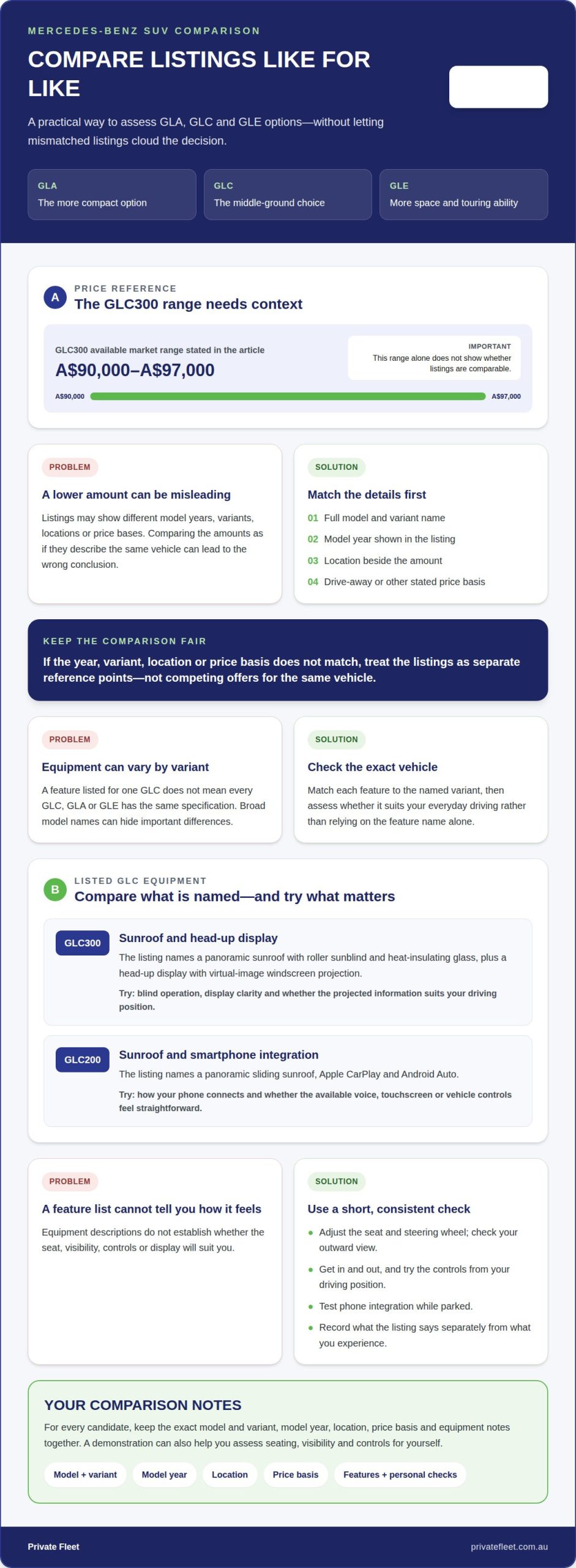
For Australians comparing 2026 Mercedes-Benz GLA, GLC and GLE prices, matching the listing details matters as much as comparing amounts. The examples below show why model year, exact variant, location and price basis belong together in your notes.
GLA listing prices
Treat this as a reference for the named variant, not a price that applies to every GLA. Record the model year, Special Edition name and drive-away basis alongside the amount. If another listing names a different GLA variant, keep it separate rather than treating the two as like-for-like offers.
GLC listing prices
The examples span different years and variants. These figures describe individual listings, not one price that applies to every GLC.
The amounts alone can’t show which vehicle offers better value. First decide which variant meets your needs, then compare listings for that same variant and year. This prevents a lower figure for one model from being mistaken for a directly comparable offer on another.
Record location separately. Don’t place it beside a national figure as though both describe the same offer conditions. A comparison table can clarify this with separate columns for advertised amount, state or territory, model year and variant.
Keep the price basis visible, too. The examples above are described as drive-away prices, so compare them with offers on the same basis. If an advertisement uses a different basis, label it rather than combining the figures. This helps you avoid judging one listing as cheaper when the amounts aren’t directly comparable.
For each candidate, note the vehicle’s exact advertised name instead of shortening it to “GLC” or “GLA”. Include whether the listing identifies a Special Edition, GLC200 or GLC300. Then record the stated year and location beside the price. Those details make it easier to discuss the specific vehicle you want, rather than a broad model range.
Use a consistent comparison record for every listing:
- Write the full model and variant name.
- Record the model year shown in the advertisement.
- Keep the stated location beside the amount.
- Mark whether the price is drive-away or uses another basis.
Once those fields match, differences in advertised amounts are easier to assess. If they don’t match, treat the listings as separate reference points, not competing offers for the same vehicle. This keeps your shortlist focused on the Mercedes-Benz variant you intend to buy.
Comfort and technology features
Equipment can shape how well a Mercedes-Benz SUV suits your routine. Compare the listed GLC200 and GLC300 features, then assess seating, visibility and controls in the exact vehicle. A clear equipment comparison is more useful than assuming every GLC, GLA or GLE has the same specification.
The listed GLC300 has a panoramic sunroof with a roller sunblind and heat-insulating glass. Consider when you’d use the sunroof, and whether the blind’s operation feels straightforward. During a vehicle demonstration, try its controls from the driver’s seat. If you regularly drive in bright conditions, assess the glass and blind for yourself rather than assuming they’ll feel the same to every occupant.
The GLC300 listing also names a head-up display with virtual-image windscreen projection. Sit in your usual driving position and see whether the projected information is clear and comfortable to view. Check the display while stationary, then consider how it fits your normal routine. A feature only adds value if its presentation suits you and doesn’t complicate the way you use the car.
For the listed GLC200, the equipment includes a panoramic sliding sunroof, Apple CarPlay and Android Auto. If smartphone integration matters, check how your phone connects and which familiar functions you can access. Consider whether you prefer voice commands, touchscreen input or the controls available in the vehicle. Try the setup while parked, so you can judge its layout without dividing your attention.
Assess seat comfort and visibility as carefully as technology. Adjust the driver’s seat and steering wheel, then check your view through the windscreen and side windows. Get in and out more than once. If another regular driver will share the vehicle, repeat the adjustments for their driving position. Your own comfort matters more than a feature name in a listing.
Plan a short demonstration around your actual driving. A highway commute lets you assess the seating position and how easily you can reach the controls. Local streets can help you check visibility while turning and parking. Where practical, use the same route for each shortlisted vehicle. Don’t infer cabin noise, ride quality or parking assistance from equipment descriptions alone.
Keep a brief record for each vehicle so your impressions don’t blur together. Note the seat adjustment, outward view, sunroof operation, display visibility and phone connection. Separate what the listing says from what you experienced. Advertisement details and images can help identify equipment, but a demonstration lets you assess how it works for you.
- Match the listed features to the exact GLC variant.
- Try the seat, view and controls from your driving position.
- Test phone integration while parked.
- Write down any difference between the listing and vehicle presented.
If the seller’s description differs from the vehicle, ask for clarification about the equipment before deciding. Share only the personal information needed for the purchase discussion, and choose communication preferences that suit you. If a discrepancy remains and affects your decision, raise the specific issue and keep the details clear.
Use those observations to decide which features you’ll value during everyday driving. If you’re comparing Mercedes-Benz options, share your shortlist and preferred equipment to discuss your next step.
Release date and Australian market positioning
A 2026 model-year label and an Australian sale date answer different questions. The label identifies the advertised vehicle year; it doesn’t establish when every variant went on sale or when a particular order will arrive. For the GLA, GLC and GLE, treat release timing and an individual vehicle’s advertised status as separate details when planning a purchase.
Start with the exact vehicle you’re considering. Record whether the listing describes a new-car order, a vehicle available for purchase or a demonstrator. Then note its model year and full variant name. This clarifies what the advertisement covers and avoids assuming that every GLA, GLC or GLE follows the same ordering path.
A model-year reference doesn’t tell you how a vehicle fits the Australian market. Consider the role you want the SUV to fill, then compare the relevant variant’s price basis, powertrain and equipment. Keep the GLA, GLC and GLE on the same shortlist only if each meets your practical needs. A model name alone doesn’t establish that two offers provide equivalent features or value.
For release-date questions, distinguish a dated announcement from a vehicle listing. An announcement can describe a market launch, while an advertisement relates to the specific vehicle it identifies. Record the source and date for each. When assessing an offer, focus on the vehicle’s stated status and purchase conditions rather than inferring a launch date from a model-year label.
Availability also needs to be considered at variant level. A general reference to the 2026 GLC doesn’t tell you whether the GLC200 or GLC300 is the vehicle being advertised. Apply the same check to the GLA and GLE. Write down the exact variant before discussing price or timing, so the information you receive relates to the model you actually intend to buy.
Use this sequence to keep the decision organised:
- Write down the full Mercedes-Benz model and variant.
- Record the model year shown for the vehicle.
- Identify whether the listing describes an order, a new vehicle or a demonstrator.
- Keep advertised price basis and location with the listing.
- Separate any dated launch announcement from vehicle-specific availability information.
Once you have those details, assess each model against your priorities. A buyer who values compact dimensions may weigh the GLA differently from someone whose shortlist centres on the GLE. When comparing GLC variants, focus on the exact equipment and powertrain rather than assuming a shared badge makes the offers interchangeable.
For delivery planning, describe your preferred model, variant and buying timeframe clearly. The advertised vehicle’s status and the exact version you want are more useful than asking generally about “the 2026 model”. Keep any written information about the offer with your notes, including the stated vehicle year and price basis. This makes it easier to compare the same vehicle specification across discussions.
In short, use the model-year label to identify the advertised vehicle, not to infer a national release date. Assess the GLA, GLC and GLE by their specific variants and the role each would play in your driving. Separating these questions helps you understand both the Australian market positioning and the practical next step for your shortlist.
Mercedes-Benz
Choosing between the Mercedes-Benz GLA, GLC and GLE means matching the vehicle to your everyday needs, not just comparing badges. For the GLE, the listed dimensions, cargo capacity and towing figure help explain its position as the largest SUV in this trio.
The 2026 GLE base model measures 4,924 mm long, 1,947 mm wide excluding mirrors and 1,797 mm high. Its wheelbase is 2,995 mm. Those measurements give you a practical starting point when considering garage space, parking and access at home. The GLE’s listed unladen ground clearance is 205 mm, another specification to weigh against your regular driving conditions.
Cabin and luggage needs can make the GLE’s size worthwhile. Its boot holds 630 litres with the rear seats up, increasing to 2,055 litres with them folded. Think through the items you carry most often, such as luggage for regional trips or equipment for weekend activities. A larger maximum capacity matters less if your usual load fits comfortably in a smaller vehicle.
Towing is another point where the exact variant matters. The listed 2026 GLE base has a braked towing capacity of 3,500 kg. Use that figure only for the specified model, then compare it with your intended trailer and loaded setup. Don’t assume the same capacity applies to every GLE, GLC or GLA variant. Check the exact vehicle’s towing specifications before making a shortlist around towing needs.
Powertrain choice also shapes the comparison. The listed 2026 GLE base uses a 2.0-litre diesel engine, while the listed GLC300 combines a 2.0-litre petrol engine with 17 kW electric assistance. The GLC300 listing also specifies a nine-speed automatic transmission and four-wheel drive. These descriptions identify different powertrain configurations, so compare the variant you actually intend to buy.
A useful shortlist should reflect how you’ll use the vehicle:
- Choose by space: compare the GLE’s stated cargo capacity with the luggage or equipment you carry.
- Choose by towing: use the exact variant’s braked capacity, not a figure attached to another GLE.
- Choose by fit: consider the GLE’s length and width against your parking space and regular routes.
- Choose by powertrain: distinguish the GLE diesel from the GLC300 petrol configuration before comparing offers.
Finally, align the model and variant before comparing prices when researching the mercedes glc gle gla 2026 price australia. The GLA, GLC and GLE serve different size priorities, so the lowest listed amount won’t necessarily be the best fit. Compare like-for-like offers for your chosen model, then consider whether its space, towing capability and powertrain suit your plans. This keeps the decision focused on the vehicle you’ll use, rather than just its badge or headline figure.
Private Fleet
Private Fleet’s New Car Buying Service can help once you’ve narrowed your choice to a GLA, GLC or GLE and want support comparing offers. Its nationwide dealer network invites dealers to compete for your exact vehicle. Private Fleet manages the negotiation and paperwork, with regular updates on delivery.
Share your preferred Mercedes-Benz model and variant, postcode, budget and buying timeframe to give the team a clear brief. Trade-In Assistance can help if you’re replacing your current car, and Car Finance is available if you need it.
For help with your Mercedes-Benz purchase, get in touch with Private Fleet, call 1300 303 181, or explore Mercedes-Benz offers.
Choose the Mercedes-Benz that fits your next chapter
Before settling on a model, decide what matters most in your daily driving: easier parking, extra room for passengers, or space for longer trips. Then make your shortlist specific, including the model, variant, location and buying timeframe. Comparing Mercedes-Benz GLC, GLE and GLA prices in Australia for 2026 is more useful when each offer matches the vehicle you actually want.
Private Fleet can help you take the next step with a new Mercedes-Benz purchase and trade-in support. Explore Mercedes-Benz offers or call 1300 303 181 to discuss your shortlist.
Share your preferred model, postcode and timing to start a focused conversation about buying your new car.
Frequently Asked Questions
How does the GLE compare?
The GLE suits buyers prioritising a larger SUV for passengers, luggage or touring, while the GLC and GLA are more compact alternatives. Consider how often you’ll use the extra room and whether the GLE’s size suits your regular parking and driving. For example, someone who mainly commutes and carries light luggage may prefer a smaller model, while extra space can be useful for regular longer trips.
What are the 2026 Mercedes-Benz GLA prices in Australia by variant?
This is a price example for the named variant, not a complete schedule for every GLA. For a like-for-like comparison, match the model year and variant, then check that each offer uses the same price basis. A drive-away amount is more directly comparable with another drive-away amount than with a price that excludes on-road costs.
What are the 2026 Mercedes-Benz GLC prices in Australia by variant?
Australian listing examples cover the GLC200 and GLC300, but they don’t form a complete variant-by-variant price schedule. Compare the exact model year and variant, and keep the price basis and location attached to each offer. For instance, a GLC300 offer for a particular state shouldn’t be treated as a national figure. A matched written offer for the new vehicle you want gives you a clearer basis for comparison.
How do the 2026 Mercedes-Benz GLA, GLC and GLE compare in size, performance and equipment?
The GLA is the compact choice, the GLC sits between it and the larger GLE, and the GLE targets buyers needing more room. Performance and equipment depend on the specific variant and powertrain, so compare names such as GLA200, GLC300 and GLE base individually. Before choosing, consider who regularly travels in the vehicle, what you carry, and which listed features you’ll use in everyday driving.
When will 2026 Mercedes-Benz GLA, GLC and GLE models go on sale or be delivered in Australia?
A 2026 model-year label identifies the advertised vehicle year; it doesn’t give a single Australian sale or delivery date. Timing depends on the specific vehicle and ordering circumstances. For your shortlist, distinguish a new-car order from an advertised demonstrator, then consider the exact variant and your buying timeframe. That gives you a more useful basis for planning than relying on the model-year label alone.
Which engines, hybrid options and AMG variants are available for the 2026 GLA, GLC and GLE in Australia?
The listed 2026 GLC300 has a 2.0-litre petrol engine with 17 kW electric assistance, while the GLE Base has a 2.0-litre diesel engine and a 15 kW mild-hybrid motor. The GLE53 AMG listing is for a 2027 model, with a 3.0-litre petrol engine and 17 kW electric assistance; engine details for the GLA aren’t available here.