
What if the lowest advertised price isn’t the best new-car offer? Comparing quotes can be difficult when the vehicles, variants, inclusions and delivery details don’t match. A new car price comparison service australia buyers use can help bring those details into view, so you’re comparing the complete drive-away offer rather than a headline figure alone.
It’s sensible to want clarity before committing to a major purchase, and to understand who is representing your interests. This guide explains how to compare offers on a like-for-like basis, including the model and variant, on-road costs, included features and delivery arrangements. You’ll also learn how dealer competition works and what to consider when choosing between contacting dealerships yourself and using an independent buying service.
Private Fleet is an independent car buying service that sources vehicles through a national network of authorised dealerships. Its tender process invites multiple dealers to compete for your business, while helping you move from a shortlist towards a clear next step. With the right details in hand, you can assess your options with greater confidence and choose a buying approach that suits your needs.
Key Takeaways
- Compare the same make, model, model year, variant and powertrain to keep dealer offers like for like.
- Look beyond the headline price: check the price basis, inclusions, conditions and delivery details.
- A new car price comparison service australia buyers use can bring dealer competition into the process without promising a lowest price or guaranteed saving.
- Prepare your budget, shortlist, trade-in details and preferred buying timeframe to make comparisons more focused.
- See how Private Fleet sources vehicles through authorised dealerships and lets you review offer details before deciding whether to proceed.
What do new car price comparison services in Australia do?
A new-car price comparison service helps private buyers source and compare offers from dealerships. Rather than relying only on advertised prices, buyers can assess offers for a vehicle that matches their preferred make, model and variant. A new car price comparison service australia buyers use can help organise that process, but the buyer still reviews the offer details and decides whether to proceed.
There are two useful comparisons to keep distinct. Comparing vehicle specifications helps you decide which cars suit your needs. Comparing dealer offers means assessing prices for the same model year, variant and powertrain. A quote for a different variant may include different features, so its price isn’t directly comparable.
A drive-away offer states a price for taking the vehicle on the road, but you should still check the written price basis, location, inclusions and conditions. Don’t assume two offers with the same label cover identical items.
How is a price comparison service different from browsing listings?
Listings and research tools help you explore vehicles, specifications and advertised prices. An advert, however, isn’t necessarily a buyer-specific offer for your preferred variant. A service can coordinate sourcing and dealer enquiries around the details you provide, reducing the need to manage every enquiry yourself. A general comparison shopping website may display products or prices, while a buying service can help source offers through dealerships.
Private Fleet’s new-car buying service sources vehicles through authorised dealerships. Private Fleet doesn’t hold its own vehicle inventory.
What does independent mean when comparing new-car offers?
Private Fleet is an independent Australian vehicle sourcing and car buying service, not a manufacturer-owned or authorised brand dealer. It works with a national network of authorised dealerships and uses a tender process that invites multiple dealers to compete for the buyer’s business.
This gives private buyers a structured way to review available dealer offers without personally coordinating every enquiry. Independence doesn’t guarantee a particular price, saving or dealer response. The buyer considers the offer details and remains in control of whether to proceed.
Which details should you compare in Australian new-car offers?
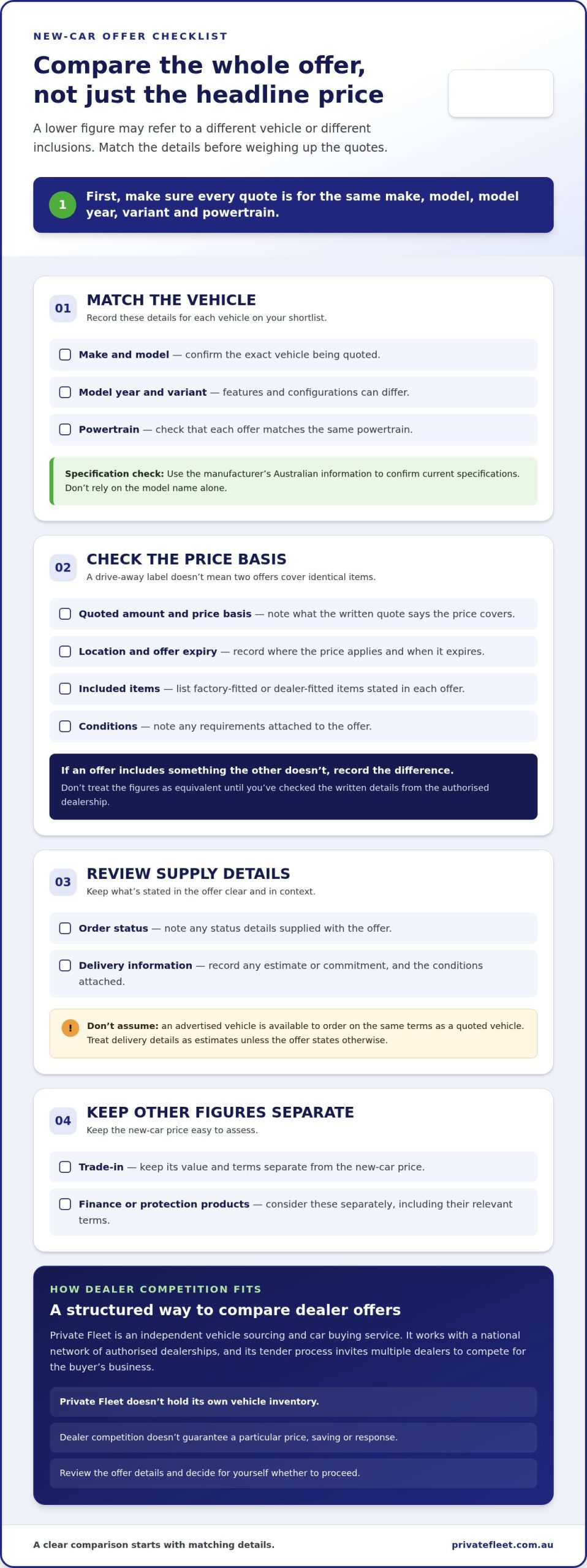
Start by confirming you’re comparing the same vehicle, then assess each dealer’s offer separately. A lower figure may relate to a different model year, variant, powertrain or set of inclusions, so record the vehicle details before weighing up the quoted price.
| Make | Model | Model year | Variant | Powertrain |
|---|---|---|---|---|
| Enter make | Enter model | Enter model year | Enter variant | Enter powertrain |
Use one row for each vehicle on your shortlist. Confirm current Australian specifications through the manufacturer’s information, then use authorised dealer material to check offer details. Features, included accessories and available configurations can differ by variant or model year, so don’t rely on a model name alone.
Are two drive-away offers genuinely like for like?
Match the model year, variant and powertrain first. Then compare any factory-fitted or dealer-fitted items included in each quote. Record the quoted price basis, the location it applies to, any stated conditions and the offer expiry. If one quote includes an item that another doesn’t, note that difference rather than treating the figures as equivalent.
Check current specifications against the manufacturer’s Australian information and review the written terms from the authorised dealership providing the offer. That way, a specification difference won’t be mistaken for a price advantage.
Which purchase details matter beyond the headline price?
Capture the details that affect how and when the vehicle may be supplied, but only if they’re stated in the offer. Note any order status, estimated delivery information and conditions, and whether those details are estimates or commitments. Don’t assume an advertised vehicle is available to order on the same terms as a quoted one.
- Price: Record the quoted amount, price basis, location and expiry.
- Inclusions and conditions: List the items included and any requirements attached to the offer.
- Trade-in: Keep its value and terms separate from the new-car price so the vehicle offers remain clear.
- Finance or protection products: Consider these separately from the vehicle quote, including any relevant terms, rather than letting them obscure the car’s price.
A new car price comparison service australia buyers use can help organise these details around a consistent shortlist. If you’d like assistance sourcing and comparing offers, share your preferred vehicle and buying timeframe with Private Fleet.
Dealer comparison service or contacting dealerships yourself: which suits you?
The right approach depends on how much of the research and dealer communication you want to manage. You can research models and offers yourself, contact dealerships directly, or use an independent sourcing service to coordinate dealer interest. Each route can suit a different buyer, and none guarantees a particular price or outcome.
When might you prefer to contact dealers directly?
Direct enquiries may suit you if you like managing each conversation and negotiation yourself. You can speak with dealerships about your shortlist, ask for written offers and follow up on details in your own time. The trade-off is that you’ll need to keep each enquiry consistent: specify the same model year, variant and powertrain, and compare the same price basis and conditions.
Good organisation helps. Keep a record of who provided each offer, what it includes and any stated expiry or delivery information. Otherwise, small differences between quotes can make the comparison harder to judge. This hands-on route gives you direct control, but requires you to coordinate the enquiries and review the details yourself.
When can a buying service reduce comparison effort?
A buying service can suit buyers who want help coordinating vehicle sourcing and dealer enquiries. Private Fleet is an independent Australian vehicle sourcing and car buying service. It works with a national network of authorised dealerships and uses a tender process that invites multiple dealers to compete for the buyer’s business.
You share your preferences, such as the vehicle you’re considering and your buying timeframe. The service helps source offers through dealerships; you review the available details and decide whether to proceed. You remain in control of the vehicle you’re seeking and the purchase decision, while having support with the sourcing steps. Dealer participation and offer details can vary, so this process shouldn’t be read as a promise of a lowest price or guaranteed saving.
Buyer-led research is useful for choosing which vehicle to pursue. Direct enquiries place the coordination in your hands, while an independent service can organise sourcing around your stated preferences. A guide to the car buying process explains how the service works. If you’d like help with your shortlist, share your preferred make or model, postcode and buying timeframe with Private Fleet.
How to prepare for a new-car price comparison in five practical steps
A focused request makes it easier to source relevant offers and compare them clearly. Before seeking help from a new car price comparison service australia buyers can prepare a few details to keep the process centred on vehicles that suit their needs.
- Set a budget. Decide on a comfortable total purchase budget in A$, and note whether it includes on-road costs. This gives your shortlist a practical boundary without locking you into a particular model.
- Shortlist vehicles. Choose a few makes and models that suit your everyday driving, passenger and luggage needs, and intended ownership period. Check current Australian specifications and availability using manufacturer information.
- Specify variants and priorities. Record the preferred model year, variant and powertrain, plus must-have features. If you’re open to alternatives, say what matters most so comparisons stay relevant.
- Prepare trade-in details. If you have a vehicle to trade, note its make, model, year, variant and condition. Keep the trade-in discussion separate from the new-car offer so you can assess each part on its own.
- Set your timing. Share when you’d like to buy and your postcode. These details help make an offer request specific to your circumstances, while any delivery estimate should be treated according to the terms provided.
To narrow your shortlist, consider how each vehicle fits your routine, not just its feature list. If comfort and usability matter to you, assess seat adjustment, ease of entry and exit, visibility, ride comfort, cabin noise and the layout of physical and touchscreen controls. These are personal preferences, not assumptions based on age. If possible, assess the cars yourself and use current Australian specifications alongside reviews to inform your decision.
Be clear about your preferred make or model, variant, powertrain and must-have features when requesting assistance. Include your postcode and buying timeframe, and provide trade-in details separately if relevant. Private Fleet’s guide to how the new-car buying process works explains the steps involved in sourcing and comparing offers.
How Private Fleet’s new-car comparison and buying process works
Private Fleet helps buyers move from a shortlist to a considered decision by coordinating vehicle sourcing through its national network of authorised dealerships. As an independent buying service, it doesn’t hold its own vehicle inventory. Its tender process invites multiple dealers to compete for your business, giving you offer details to review before you decide whether to proceed. There’s no promise of a particular price, saving, vehicle availability or delivery date.
What happens after you share your shortlist?
Share the make, model and variant you’re considering, along with the features that matter to you. Private Fleet uses these preferences to source relevant vehicles through authorised dealerships and invite dealer competition. You can then review the available offer details, including the vehicle and stated terms, and decide whether to take the next step. The choice remains yours.
For a clearer picture of the stages, read the guide to how the new-car buying process works. Support can also include trade-in assistance. If you’re considering finance, assess its terms separately from the vehicle offer so you can keep the car price clear.
What should you have ready before asking for help?
A clear brief helps focus the sourcing request. Include your preferred make or model, shortlisted variants, budget, postcode and buying timeframe. If you have a trade-in, share its make, model, year and condition separately. Annual kilometres can help explain your driving needs; for an EV or plug-in hybrid, mention whether you have access to charging.
- Shortlist: Note preferred models, variants, powertrains and must-have features.
- Budget: State your intended spend and whether you’re considering a trade-in.
- Timing and location: Provide your postcode and when you’re looking to buy.
- Driving needs: Include annual kilometres and charging access where relevant.
These details give a new car price comparison service australia buyers use a practical starting point for sourcing offers that fit their preferences. You can explore the new-car buying service or share your shortlist and buying details for assistance.
Take your shortlist forward with confidence
A confident new-car decision starts with comparing the same model, year, variant and powertrain, then checking each offer’s price basis, inclusions and conditions. A new car price comparison service australia buyers consider can help organise dealer offers, while you stay in control of which vehicle you choose and whether to proceed.
Private Fleet is an independent Australian car brokerage founded in 1999. It sources vehicles through a national network of authorised dealerships, using a tender process that invites multiple dealers to compete for your business. Share your preferred make or model, shortlist, budget, postcode and buying timeframe to give the process a focused starting point.
You don’t have to manage every dealer conversation alone to make an informed choice. Take the next step when you’re ready.
With clear preferences and comparable offer details, you can move ahead at your own pace and choose the buying approach that suits you.
Frequently Asked Questions
What is a new car price comparison service in Australia?
A new car price comparison service helps private buyers source and assess offers from dealerships. Some services compare vehicle listings or specifications, while an independent buying service can coordinate dealer enquiries for a specific make, model and variant. Private Fleet uses a tender process that invites multiple dealers to compete for the buyer’s business, then lets the buyer review the available offer details and decide whether to proceed.
How do I compare new-car drive-away offers?
First, check that each offer is for the same model year, variant and powertrain. Then compare the stated price basis, inclusions, conditions, location basis and expiry. Check whether accessories or other items are included, and don’t assume the phrase “drive-away” means every offer has identical terms. Use current Australian manufacturer specifications and written authorised dealer offer details to check the vehicle and quote information.
Is a new car price comparison service the same as a car broker?
The terms can overlap, but they don’t always describe the same service. A comparison tool may help you review vehicle specifications, listings or prices, while a car broker or buying service can help source offers through dealerships. Private Fleet is an independent Australian car brokerage and new-car buying service. It uses a dealer tender process, with the buyer retaining the choice of vehicle and whether to proceed.
Can a comparison service guarantee the lowest new-car price?
No. Dealer competition can give you a structured way to compare available offers, but it can’t guarantee the lowest price or a particular saving. Offers and their conditions can vary according to the vehicle requested and the dealer response. Review the written details carefully, check that the quotes match your preferred vehicle and compare their inclusions before deciding which offer, if any, suits you.
What information should I provide to compare new-car offers?
Share your preferred make and model, model year, variant, powertrain and any must-have features. Include your budget, postcode and buying timeframe so the request reflects your preferences and circumstances. If you have a trade-in, provide its make, model, year and condition separately. Annual kilometres and charging access can also help clarify your needs if you’re considering an electric vehicle or plug-in hybrid.
Does Private Fleet hold its own new-car inventory?
No. Private Fleet sources new vehicles through a national network of authorised dealerships; it doesn’t hold its own vehicle inventory. Its independent sourcing service uses a tender process that invites multiple dealers to compete for the buyer’s business. You can review the available offer details and decide whether to proceed. Vehicle supply and any delivery information are handled through the relevant dealership offer and its stated terms.
Can a new-car comparison service help with a trade-in?
Yes. Private Fleet’s support can include trade-in assistance alongside sourcing a new car. Provide details such as your current vehicle’s make, model, year and condition. Keep the trade-in information separate from the new-car offer while comparing, so you can assess the proposed vehicle price and trade-in terms as distinct parts of the purchase. This makes the overall offer easier to understand before you decide how to proceed.