
The lowest quote isn’t always the best-value car purchase. A new car procurement agency can help you compare offers for the same make, model and variant, taking account of drive-away pricing, terms and how well the car suits your needs. This makes it easier to judge the full offer, not just the price.
It’s reasonable to want a fair deal and a straightforward process when buying a new car. Ethical purchasing relies on clear criteria and transparent dealings. An efficient process can also reduce the time and effort involved in approaching dealerships and comparing offers yourself.
This article explains how to assess value for money, compare offers on equal terms and keep a purchase organised. It also covers what to look for in a procurement service, so you can choose an approach that fits your priorities and decide on your next steps with confidence.
Key Takeaways
- Set clear requirements and compare offers on consistent terms to make procurement more transparent and easier to assess.
- Look beyond the quoted price: consider whether the vehicle suits its intended use and how the full cost of ownership affects value.
- Understand how a buying agency sources offers, represents your interests and structures its fees before choosing an approach.
- Private Fleet’s tender process invites multiple authorised dealerships to compete for your business, helping streamline offer comparisons.
- Prepare your preferred make and model, postcode and buying timeframe to make the next step more focused.
Ethical, efficient, effective and economical procurement
Ethical procurement means using clear criteria and transparent dealings to support a fair purchase. For private buyers, efficiency means less time spent comparing offers, while value depends on assessing the complete deal.
Consumer protections for agency purchases
Consumer protections are the rights and safeguards that apply to the vehicle sale. They aren’t an extra benefit created by using an agency. For Australian private buyers, the dealer’s written sale contract, accurate quote and applicable consumer rights remain central.
Before committing, identify the seller and read the contract naming that party. Keep the written quote, order details and records of any promises about the vehicle or delivery. An agency that sources or compares offers doesn’t replace the sale documents. If an issue arises, these records help clarify what was agreed and who was responsible.
How car procurement agencies work
A car procurement agency helps buyers source and compare new-car offers from dealerships. It can share your preferred model and requirements with a dealer network, then present the resulting offers for you to consider.
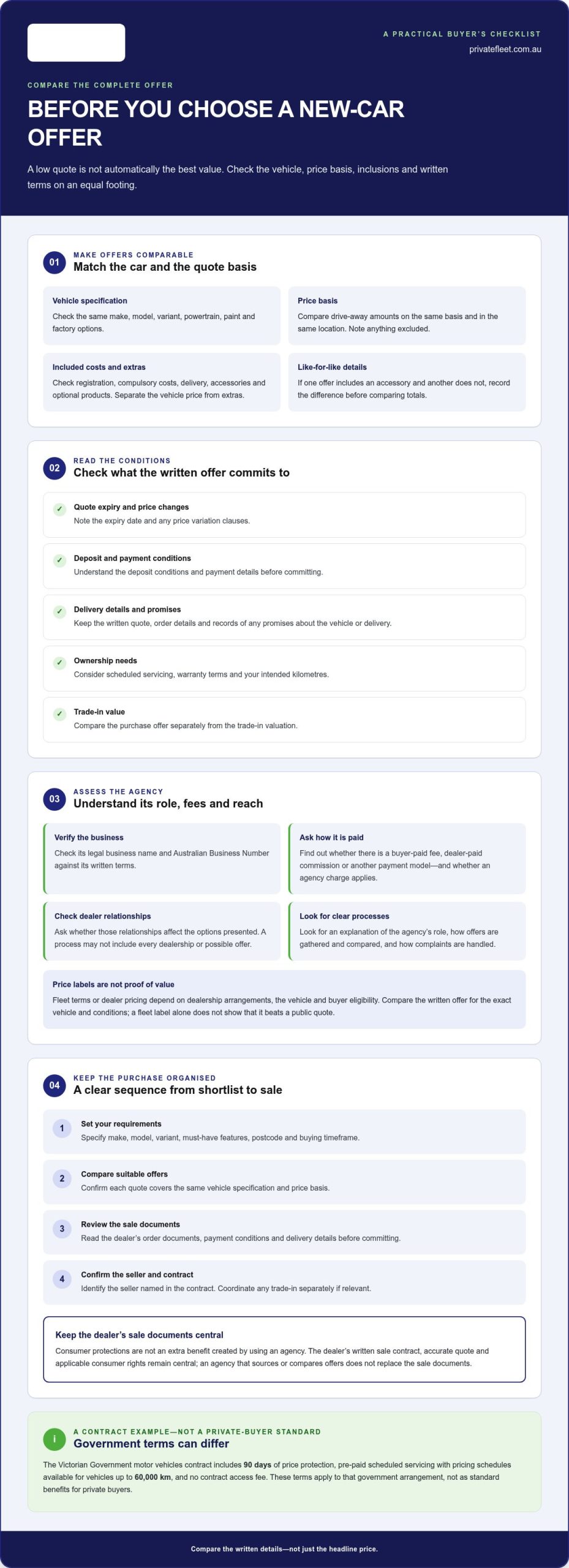
Start by comparing offers for the same make, model, variant and key options. Check whether each quote is drive-away or excludes registration and other costs. Ask how the agency is paid and whether its dealer relationships affect the options presented. An agency’s process may not include every dealership or possible offer, so assess the written details rather than relying on a headline price.
Australian car procurement agencies
Australian buyers can choose between independent car-buying agencies and dealer-based purchasing channels. An independent agency helps source options on the buyer’s behalf; a dealer sells its own vehicles.
To assess an agency’s credentials and reputation, check its legal business name and Australian Business Number, then compare those details with its written terms. Look for a clear explanation of its role, fees, dealer relationships and complaint-handling process. Check how offers are gathered and compared, and be cautious of unsupported promises about outcomes. A transparent process helps you decide whether the agency suits your priorities.
The agency buying process
The agency buying process takes you from choosing a vehicle to considering a dealership offer and sale. Use this sequence to keep the decision organised:
- Set requirements: specify the make, model, variant, must-have features, postcode and buying timeframe.
- Compare suitable offers: check that each quote covers the same vehicle specification and price basis.
- Review the terms: read the dealer’s order documents, payment conditions and delivery details before committing.
- Complete the purchase: confirm the seller and contract, then coordinate any trade-in separately if relevant.
Each step gives you a point to review your decision. Refine your shortlist before comparing quotes, then assess the written terms before placing an order.
Value for money
Value for money means weighing the complete offer against the vehicle and terms you need. Compare the same variant, price basis and inclusions before deciding which option suits you.
Agency fee structures
An agency’s fee structure explains how the service is paid for and who pays. Arrangements vary, so establish whether there’s a buyer-paid fee, dealer-paid commission or another payment model. Ask how the arrangement could influence the offers presented. Then compare the total outlay, including any agency charge and the dealer’s written drive-away quote. A clear explanation helps you weigh the service cost against the time and negotiation work it may save.
Fleet discounts and dealer-only pricing
An agency may seek fleet terms or dealer pricing, but access depends on the dealership’s arrangements, the vehicle and the buyer’s eligibility. A fleet label alone doesn’t show that an offer beats a public quote. Compare the written price for the exact make, model, variant and options, then check all inclusions and conditions. For a like-for-like assessment, compare a dealer quote with an agency-sourced offer on the same price basis.
For a private buyer, compare the vehicle price separately from extras. Check whether registration, compulsory costs, delivery, accessories and optional products are included in the drive-away amount. If one quote includes floor mats and another doesn’t, note the difference before comparing totals. Also review the order terms and any price expiry stated in each offer.
- Vehicle: match the model, variant, powertrain, paint and factory options.
- Price: compare drive-away amounts on the same basis and in the same location.
- Terms: note quote expiry, deposit conditions and any price variation clauses.
- Ownership: consider scheduled servicing, warranty terms and intended kilometres.
- Trade-in: compare the purchase offer separately from the trade-in valuation.
Public-sector contracts show why terms matter. The Victorian Government motor vehicles contract offers price protection for 90 days, pre-paid scheduled servicing with pricing schedules available for vehicles up to 60,000km, and no contract access fee. Those are terms of that government arrangement, not standard benefits for private buyers. They illustrate why a quote’s conditions and inclusions matter alongside its headline price.
For a tailored comparison, share your preferred model, postcode and buying timeframe through a new-car buying enquiry. That gives the discussion a clear starting point, without treating a headline discount as the whole value calculation.
Eligibility rules can affect what a headline saving means in practice. Western Australian Senior Officer Vehicle Scheme participants are restricted to the lowest-cost vehicle in the specified passenger and SUV categories. This condition applies to that scheme, not to every buyer. Before comparing an arrangement with a retail quote, confirm who can participate and which vehicles qualify.
Record any eligibility and vehicle limits alongside the written price, and check that your preferred model and variant meet the terms. A vehicle selected under a category limit may not be comparable with your preferred vehicle, so assess the offer against the same vehicle and inclusions.
How do new car buying agencies work in Australia?
A new car buying agency acts as an intermediary between a private buyer and the dealership selling the vehicle. It helps organise the purchase; the buyer retains control of the decision, and the dealer remains responsible for the sale.
From brief to dealer offers
A buyer brief records what matters to you and gives the agency guidance on your preferences. Note whether you’re replacing a current car, have a trade-in or need a vehicle by a particular point in your plans.
Be clear about which decisions remain yours. You might allow the agency to discuss your preferred variant but want to approve any change in colour or optional equipment. Setting boundaries early helps prevent an alternative from being treated as an automatic substitute. The brief guides the service; it doesn’t oblige you to buy.
How a tender works
A tender is a structured way for an agency to invite dealers to respond to a buyer’s stated requirements. It provides a channel for communication without transferring the buyer’s decision-making authority to the agency.
The agency can manage enquiries and relay relevant details while you consider the options. Ask how updates will be shared and how to revise your preferences during the process. If your plans change, for example, if you decide to trade in your current vehicle, tell the agency before committing to a purchase. Clear communication keeps the process aligned with your intentions.
Who handles the order?
The dealership prepares the purchase documents and sells the car. The agency’s involvement doesn’t make it the vehicle’s seller or owner.
That distinction matters if you need to resolve a question about the order. Direct purchase matters, such as payment instructions or a contract change, belong with the dealership named in the documents. The agency can help with communication during the buying process, but you should understand each party’s responsibilities. Keep the agency’s service terms separate from the dealership’s sale paperwork.
What happens after you choose?
After you select an offer, the purchase moves into the dealer’s order and delivery process. The agency can support communication, while the dealership manages the vehicle order and handover.
Agree on how you’ll receive progress updates and whom to contact if the dealer changes an expected detail. Before collection, check the order documents against the vehicle and options you agreed to buy. If you’re trading in a vehicle, clarify when and how it will be handed over. These details help ensure the final handover reflects your original decision.
Which new car procurement agencies operate in Australia?
Private Fleet is an Australian option for private buyers seeking help with a new-car purchase. The wider market also includes dealer-based sales channels and fleet purchasing arrangements, though these aren’t all independent procurement agencies for individual motorists.
Independent vehicle-sourcing agencies
An independent vehicle-sourcing agency helps buyers approach the new-car market without selling cars from its own inventory. Private Fleet is an independent vehicle-sourcing and car-buying service for private individuals.
Private Fleet’s tender process invites dealers from its national network to compete for your business. This offers an alternative to contacting dealerships one by one. The dealership remains responsible for selling the vehicle, and you decide whether to proceed with an offer. An agency helps source a purchase; it isn’t the manufacturer or the authorised dealer selling the car.
Dealer-based buying channels
A dealer-based buying channel means purchasing directly through a dealership’s own sales operation. It isn’t an independent agency acting on the buyer’s behalf.
This route may suit you if you have a preferred dealership or want to handle discussions directly. The dealer provides its offer and order documents, and you decide whether the approach fits your preferences, including how much time you want to spend making enquiries and comparing proposals. A dealership’s sales channel and a buyer-side sourcing service play different roles, even though both can lead to a new-car purchase.
Fleet purchasing arrangements
A fleet purchasing arrangement is a vehicle-buying process established for an organisation or eligible fleet buyer. It should not be confused with a consumer-facing agency service for an individual.
For example, a business may buy vehicles through its own procurement arrangements, while a private motorist seeks help with a personal car. Your status and the arrangement’s eligibility conditions determine whether that route applies. Government contracts are another distinct category; their existence doesn’t mean individuals can use them to buy personal vehicles.
Choosing the right route
Start by matching the service to your circumstances. If you’re an individual seeking help to source a personal new car, consider an independent service such as Private Fleet. If you prefer direct contact, approach a dealership. Organisational fleet arrangements are designed for eligible organisations.
Before choosing, identify whom you’ll deal with, who sells the car and which documents govern the purchase. These distinctions clarify what each service involves and help you choose a route that matches your preferred level of involvement.
Are new car procurement agency fees fixed or commission-based?
An agency may be paid a fixed fee, a commission linked to a completed sale or a combination. The practical question for buyers is whether the arrangement could affect which vehicles or dealerships receive attention. The label alone doesn’t explain how the service makes decisions, so look for a clear account of its commercial relationships and their role in the buying process.
How payment can shape recommendations
A fixed payment is generally set independently of the vehicle selected, while a commission may depend on a transaction taking place. These models can create different incentives, but neither label alone shows whether a recommendation is suitable.
Focus on how the agency handles your shortlist. If you request a particular make and variant, can you understand why it suggests an alternative? Is the recommendation based on your stated needs or a commercial arrangement? Clear reasoning helps you assess whether the advice reflects your priorities. You should be able to decline an alternative without pressure to change your brief.
What to look for in disclosures
A useful disclosure explains relevant commercial relationships in plain language and identifies any conditions attached to the service. Read it alongside the agency’s terms before authorising enquiries or proceeding with a purchase.
Check how the service describes its dealer relationships, whether payment depends on a completed purchase and whether optional products are separate from choosing the car. If finance or protection products are offered, decide whether you want to consider them. Keeping these decisions separate helps you assess the vehicle on its own merits.
Assessing whether the arrangement suits you
Your preferred level of control can help determine which payment approach suits you. If you’re comfortable managing dealer conversations, you may prefer to do so directly. If you value help coordinating the process, consider an agency with a clear role and understandable commercial terms.
Before engaging a service, set out your preferred make, model and variant, along with acceptable alternatives. Ask how the agency will explain recommendations and keep your preferences in view if circumstances change. Note any conditions that apply if you pause or stop the process. This gives you a practical basis for deciding whether the service suits your buying style, without assuming one fee model is always better.
Use these prompts to assess the arrangement:
- Incentives: identify whether remuneration depends on a particular outcome.
- Recommendations: ask how suggested alternatives relate to your requirements.
- Optional products: decide separately whether you want to consider them.
- Your control: establish how you can revise or pause your instructions.
Understanding the arrangement helps you focus on choosing a car that meets your needs. Review the terms and decide how much support you want during the purchase.
Private Fleet: New Cars
Private Fleet is an independent vehicle sourcing and car buying service that helps Australians compare new-car offers. Its tender process invites multiple dealers in a national network of authorised dealerships to compete for your business. You can use the new-car buying service when you want support sourcing offers and comparing dealership proposals, while keeping the final choice yours.
Share your preferred make and model, postcode and buying timeframe to give the process a clear starting point. If you’re replacing a vehicle, Private Fleet’s Trade-In Assistance can help. Car Protection Products are also available as a separate consideration alongside your car purchase.
For help with your new-car purchase, contact Private Fleet.
Make your next car decision with confidence
Before choosing a new car procurement agency, decide what a good outcome means beyond the final quote. Rank your priorities, such as a particular variant, a comfortable driving position, easy-to-use controls or your preferred handover arrangements. Separate essentials from features you’d consider only if the offer suits.
This decision brief gives you a useful reference when comparing options. It also keeps discussions focused on the vehicle and buying arrangements that matter, rather than extras that don’t fit your plans. You remain in control of the final choice and can take the time you need to understand the written offer.
With your priorities clear, the next step can feel more manageable. Share what matters most with Private Fleet and get support with your new-car purchase.
A considered choice starts with your needs. Move forward at your own pace and choose the option that feels right for your next car.
Frequently Asked Questions
What is a new car procurement agency in Australia?
A new car procurement agency in Australia helps buyers source purchase options without acting as the vehicle’s seller. It can help if you’re choosing between a preferred model and suitable alternatives or want support organising enquiries. For example, you could compare two variants with different features. The dealership named in your sale contract remains responsible for selling the vehicle, and you decide whether an offer meets your needs.
How do agency prices compare with dealer prices and manufacturer drive-away offers?
Agency prices don’t automatically beat dealer quotes or manufacturer drive-away offers. Compare the same model, variant, options and postcode, then check whether each amount includes registration, delivery and other required costs. Manufacturer campaigns may have eligibility conditions or expiry dates, so read the terms. Keep any trade-in valuation separate from the new-car price, and compare the final written totals before deciding.