
In Australia, a novated lease and a car broker serve different purposes. A novated lease arranges vehicle payments through your employer, while a car broker helps source and negotiate the car you want. Buying outright is another way to pay, and you can use a broker whether you pay with your own funds or arrange finance.
It’s easy to focus on one figure, such as a drive-away offer or regular payment. But neither necessarily shows the full picture. Your choice depends on what matters most: getting the right model and variant, understanding costs over your intended ownership period, or having flexibility in how you buy and pay for the car.
This article explains how the options differ, what to consider when comparing salary packaging and potential tax effects, and how a broker can help with the vehicle purchase. You’ll be better equipped to compare the same new car under different buying and payment arrangements, then decide which approach suits your needs.
Key Takeaways
- A novated lease arranges car finance and salary deductions, while a car-buying broker helps source and negotiate the new vehicle. These solve different parts of the purchase.
- Compare the full cost and terms, including packaged running costs, any end-of-lease residual, and the flexibility you want as the car’s owner.
- Salary packaging and tax treatment can affect the overall cost, but the outcome depends on your circumstances and the vehicle’s eligibility.
- Separate the financing decision from the car-buying decision: choosing the right model, variant and drive-away offer matters whichever payment route you use.
- A car-buying agency can tender your chosen new car to authorised dealers, giving you support with negotiation and purchase paperwork.
What is a novated lease?
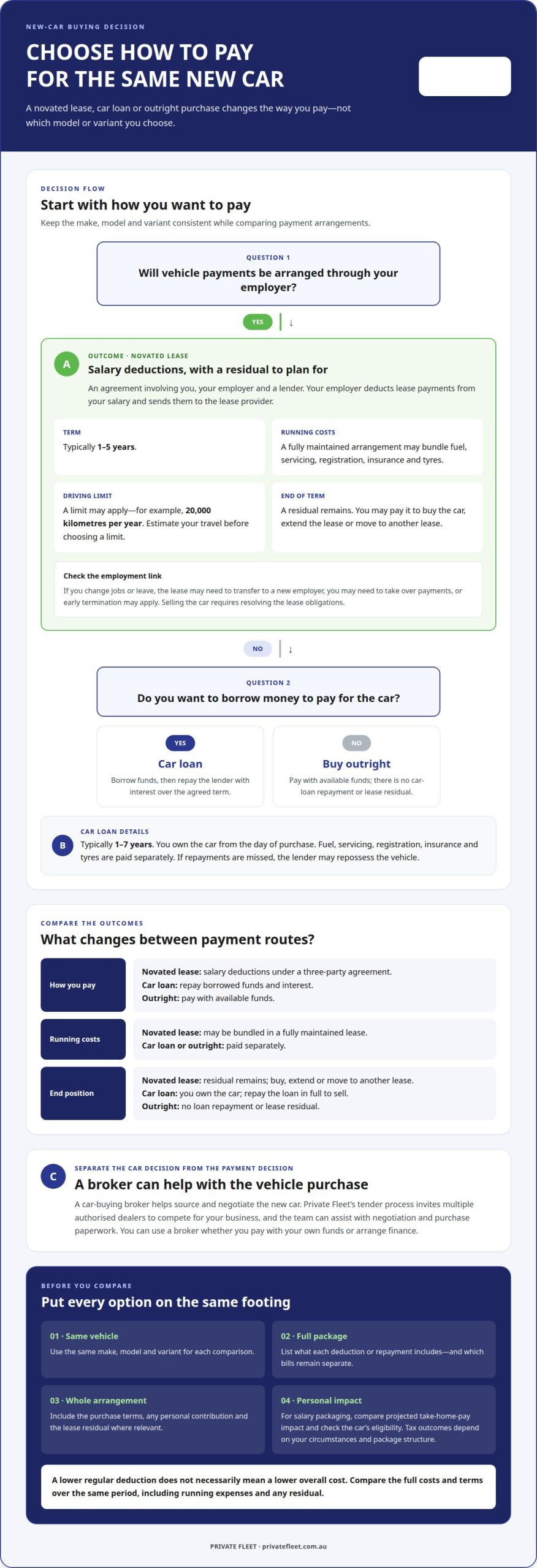
A novated lease is an agreement involving three parties: you, your employer and a lender. Your employer deducts lease payments from your salary and sends them to the lease provider. For a new car, this changes how you pay for it, not which model or variant you choose. Decide on the car first, then compare the purchase and payment arrangements for that same specification.
Novated leases in Australia typically run for 1-5 years. A fully maintained arrangement can bundle expenses such as fuel, servicing, registration, insurance and tyres into regular payments. Check how the package treats each expense, because a bundled amount and a separate bill affect your budget differently. A lease may also set a driving limit, such as 20,000 kilometres per year. Estimate your annual travel, including commuting and regional trips, before settling on a limit.
A novated lease has a residual payment at the end of the term. You may pay it to buy the car, trade the vehicle in for a new lease, or extend the lease. Include this end-of-term amount in your comparison instead of judging the arrangement by salary deductions alone. The lease is also linked to your employment, which matters if your work situation changes during the agreed term.
A car loan is a different way to fund a new-car purchase. You borrow money to pay for the vehicle, then repay the lender with interest over the agreed term. Australian car loans typically run for 1-7 years, and the borrower owns the vehicle from the day of purchase. Running costs such as fuel, servicing, registration, insurance and tyres are paid separately. If repayments are missed, the lender may repossess the vehicle.
If you change jobs or leave your employer, the lease may need to transfer to a new employer, or you may need to take over the payments. Leaving can also trigger early termination. Selling a leased car requires resolving the lease obligations. With a car loan, you can sell the vehicle if you repay the loan in full. These differences make your employment plans and the timing of a possible sale relevant to the purchase decision.
| Option | How you pay | Running costs | End-of-term position |
|---|---|---|---|
| Novated lease | Salary deductions under a three-party agreement | May be bundled in a fully maintained lease | Residual remains; buy, extend or move to another lease |
| Car loan | Repay borrowed funds and interest | Paid separately | You own the car; repay the loan in full to sell |
| Buying outright | Pay with available funds | Paid separately | No car-loan repayment or lease residual |
Compare the payment structure, treatment of running costs, residual obligation and flexibility you need for your planned ownership period. Keep the new car’s make, model and variant consistent across the options, so your comparison reflects the finance choice rather than a different vehicle.
Salary packaging and potential tax savings
Salary packaging changes how a new-car package affects your pay. Compare the estimated take-home-pay impact with the vehicle and its purchase terms. The tax outcome depends on the package structure and the car’s treatment under Australian rules.
Salary packaging tax implications
Salary packaging routes agreed vehicle-related payments through your employer rather than leaving every cost to be paid from your take-home income. A pre-tax deduction can affect the income used in tax calculations, while the car benefit may have separate fringe benefits tax treatment. These effects are connected, but they are not interchangeable: the deduction amount alone doesn’t show the final change to your pay.
For a useful comparison, look at the projected take-home-pay difference over the same period as the vehicle arrangement. Then consider the exact car, its eligibility and which costs the package includes. A calculation for one vehicle or employee may not represent another person’s result. Treat any quoted tax saving as one part of the buying decision, alongside the drive-away offer and expected ownership expenses.
Salary deductions and repayments
A salary deduction is how an agreed package payment is collected, not the total cost of owning the car. The package may combine vehicle finance with eligible running costs, while a separate car loan generally leaves those expenses outside its repayments. Ask for the deduction and its expected effect on your take-home pay as separate figures in the comparison.
Interest rates, fees and the package’s treatment of expenses can change the comparison. A lower regular deduction doesn’t necessarily mean the vehicle costs less overall, particularly if it excludes costs you’ll pay separately. Compare the same make, model and variant, then review the purchase amount, package components, personal contribution and residual on a consistent basis.
If two arrangements show different deductions, list what each includes before comparing them. One may account for servicing and other running expenses; another may leave those bills for you to manage. Align the ownership period and expected use, then include relevant costs outside the deduction. This turns a payroll figure into a more useful view of your new-car budget.
Keep the decision focused on the vehicle as well as the tax calculation. A package may affect how you pay, but it doesn’t establish whether the chosen car, variant or drive-away offer suits your needs. If you’re comparing a shortlist with a salary package, discussing your new-car options can help you work through the purchase considerations.
Tax benefits and GST savings
Tax treatment can change the effective cost of a new car, but compare it with the vehicle’s drive-away price and ownership costs. A novated lease may involve salary packaging and GST treatment, while buying outright doesn’t use lease payments. Separate each potential tax effect from the car’s purchase price, so projected savings don’t obscure what you’ll pay overall.
Fringe benefits tax (FBT) applies to certain benefits provided through employment. In Australia, the FBT rate on taxable fringe benefits is 47%, according to the Australian Taxation Office. That rate applies to the taxable benefit, not automatically to the car’s full purchase price or every employee’s package. The taxable value and any applicable exemption or concession affect the calculation.
For eligible electric vehicles, an FBT exemption may change the package calculation. Eligibility depends on the vehicle and applicable rules; the exemption alone doesn’t show the total cost of leasing. Compare the resulting take-home-pay effect with the vehicle’s drive-away price, expected running costs and any residual. A conventional hybrid, plug-in hybrid and battery electric vehicle shouldn’t be treated as interchangeable for tax purposes.
GST can also affect a novated lease vehicle purchase. For FY 26/27, the maximum GST saving on a novated lease vehicle purchase is A$6,353. A lease provider can claim back GST on the vehicle purchase price, subject to the applicable limit. The maximum isn’t a guaranteed saving for every car or package. The vehicle price and the relevant GST limit shape the calculation.
Use a like-for-like comparison before deciding. Take the same new-car make, model and variant, then set out the drive-away price, lease payments, any GST adjustment, running costs and residual separately. Compare that with buying outright, including expected servicing, insurance, registration and other ownership expenses. For car loans, include interest and fees rather than comparing repayments alone. This shows whether a tax benefit changes the overall decision, not just one line in the calculation.
- Vehicle: confirm the exact model and variant being costed.
- Tax: identify any applicable FBT treatment and GST adjustment.
- Ownership: include running costs and the lease-end residual.
- Alternative: compare the same vehicle bought outright or with a car loan.
These steps keep tax and GST in context: they can affect the numbers, but the right new car still needs to suit your use and budget. If you’re weighing a specific vehicle against a lease calculation, discussing your new-car purchase options can help you consider the vehicle price alongside the financing structure.
How a car broker can support a new-car purchase
A car broker and a novated lease provider handle different parts of buying a new vehicle. The broker helps source and negotiate the vehicle you choose; the lease provider arranges the lease and salary-payment structure. Keeping these roles separate helps you compare the car’s purchase terms independently from how you’ll pay for it.
A broker can take your preferred make, model, variant and postcode, then seek offers from dealerships. If you want a particular SUV with specified features, for example, the broker can tender that configuration rather than substitute a different vehicle. You can then assess the drive-away offer, inclusions, ordering details and delivery updates against your requirements.
Broker charges don’t follow one universal structure. A service may charge a separate fee, receive commission or use another disclosed arrangement. The key is understanding what the charge covers and who pays it. Read the engagement terms for the fee basis, any additional charges and when payment is due. No fee amount is assumed here.
A novated lease provider has a different role: it assesses the lease arrangement, calculates payments and administers salary packaging with your employer. A vehicle broker focuses on sourcing and negotiating the car. One organisation may offer both functions, but the roles remain distinct. Compare the vehicle price and lease calculation as separate parts of the purchase.
You can nominate the car you want, but a novated lease isn’t simply a way to lease any vehicle under any arrangement. Your employer must offer novated leasing, and the vehicle and lease must fit the relevant provider’s eligibility rules. Choosing a broker is separate from the lease: a broker can help source your chosen new car, while your employer’s arrangement determines how the lease is administered.
Use this sequence to keep decisions clear:
- Set your preferred make, model, variant and essential features.
- Compare like-for-like drive-away offers for that exact vehicle.
- Review the broker’s written fee arrangement and service scope.
- Assess the lease payments, running costs and residual separately.
- Decide whether the vehicle and payment structure suit your plans.
This approach puts the car first, then lets you assess financing against a defined purchase. It also helps avoid comparing a lease estimate for one variant with a cash offer for another. The new-car buying process can include vehicle selection, dealer negotiation and purchase paperwork.
Private Fleet
Private Fleet is an independent new-car buying service, not a vehicle retailer with its own stock. It helps Australian buyers source the exact new car they’ve chosen through a national network of dealers. This is a practical next step when you want dealers to compete on the vehicle before you compare how to pay, whether outright or through a novated lease.
Private Fleet’s tender process invites dealers to compete for your business on the specified car. You choose the make, model, variant and key features; Private Fleet takes those requirements to its dealer network and supports the negotiation and purchase paperwork. Keeping the vehicle specification consistent makes offers easier to compare, rather than weighing one variant against a differently equipped car.
The buying service focuses on the car purchase, not the tax treatment of your salary package. Consider the vehicle offer alongside a separate novated lease calculation through your employer’s arrangement. Compare the same specification and drive-away basis, then review lease payments, running costs and the residual separately. This helps you see how the purchase price fits into your overall decision without treating Private Fleet as a lease provider.
Private Fleet also assists with trade-ins and car finance as part of the broader purchase process. A trade-in can be considered alongside the new-car transaction, while finance remains a separate decision from selecting and negotiating the vehicle. If your employer offers novated leasing, you can use the sourced car details when assessing that option through your employer’s arrangement.
Before you start, prepare a clear shortlist and buying timeframe. Share your preferred make and model, postcode, and when you intend to buy. If you’re still choosing between variants, describe the features that matter most, such as cabin space, comfort, visibility or the type of driving you do. Private Fleet’s new-car buying service centres the process on your requirements, then supports negotiation and paperwork as the purchase progresses.
You’ll receive regular delivery updates after placing an order. This is useful when coordinating the vehicle purchase with a lease or another payment plan, because car selection and the purchase process stay distinct from the finance arrangement. You can also discuss whether trade-in assistance or car finance fits your plans, without making those services the starting point for choosing a suitable new vehicle.
To discuss your preferred new car, postcode and buying timeframe, get help buying my new car from Private Fleet or call 1300 303 181.
Take the next step with your car shortlist
If you’re weighing a novated lease against using a car broker in Australia, settle on the car before choosing the payment method. Note your preferred make and model, postcode, buying timeframe and must-have features. This gives you a clear brief for comparing the same new-car specification and deciding whether your preferred way to pay suits your plans.
Private Fleet can source new cars through its new-car buying service, with dealers invited to compete for your chosen vehicle. Trade-in assistance can also support the purchase if you have a vehicle to exchange. Share your shortlist and buying priorities with Private Fleet to start a practical conversation about the next steps.
Get help buying my new car
You can also call 1300 303 181 to discuss your new-car purchase. A clear brief is a useful first step towards choosing a car and purchase path that fit your needs.
Frequently Asked Questions
What is fringe benefits tax (FBT)?
Fringe benefits tax is a tax on certain non-cash benefits employers provide to employees, including some car benefits. The Australian Taxation Office sets the FBT rate on taxable fringe benefits at 47%. For a novated lease, the taxable value and any applicable exemption affect how FBT is handled. It’s distinct from your personal income tax, so a package’s salary deductions alone don’t show its full tax treatment.
Which option saves you more money?
Neither option saves more in every case. The result depends on the exact new car, negotiated purchase price, lease and running-cost terms, tax treatment, loan interest and how long you keep the vehicle. For example, compare the same model and variant under both options, including servicing, insurance and any lease-end residual. A lower salary deduction or repayment alone doesn’t establish the lower overall cost.
What is a novated lease in Australia and how does it work?
A novated lease is an arrangement involving an employee, employer and lease provider. If your employer offers it, agreed payments can be deducted from your salary and sent to the provider. The lease applies to your chosen vehicle and has an end-of-term residual to address. If you change employers, the lease may need to transfer, or you may have to take over payments, so factor employment changes into your plans.
How do the total costs of a novated lease compare with buying through a car broker?
The options cover different parts of the decision: a lease structures payment and may package running costs, while a car broker helps source and negotiate the vehicle. First, compare the same new-car specification and drive-away basis. Then add the lease payments, included expenses and residual, or the outright purchase amount and separate ownership costs. This separates the car’s cost from the cost and structure of financing it.
How do GST and income tax savings affect novated lease costs in Australia?
Salary packaging can change the take-home-pay impact, and GST treatment may affect the vehicle purchase calculation. Neither figure alone shows the total saving. Compare the package calculation with the exact vehicle price, running-cost budget and residual, then set it against the cost of buying the same car outright or with a loan. Eligibility and the arrangement’s structure affect the result, so don’t treat a headline tax benefit as a guaranteed net saving.
What are the Australian fringe benefits tax rules and exemption thresholds for novated leases?
Eligible battery electric and hydrogen fuel cell vehicles may qualify for an FBT exemption when their value is below the fuel-efficient Luxury Car Tax threshold. The supplied Australian rules identify A$91,661 as that threshold for FY 26/27. Plug-in hybrids generally lost the exemption for leases commencing on 1 April 2025, except where the vehicle was already held or used before then. Eligibility depends on the vehicle and lease circumstances.
How do running costs, residual value and balloon payments work in a novated lease?
A fully maintained novated lease may include expenses such as fuel, servicing, registration, insurance and tyres in its payments. At the end, the residual is the amount left to address; you may pay it to buy the vehicle, extend the lease or move to another lease. A five-year Australian novated lease has a minimum residual value of 28.13%. A car loan balloon is a separate loan term, not the lease residual.