
Handing over the legwork doesn’t mean handing over the decision. With outsourced car buying for private buyers, you set the brief and approve the key choices, while a buyer handles agreed search and purchase tasks. You still need to understand the vehicle, terms and responsibilities before committing. The trade-off is straightforward: buying directly gives you control of every step, while outsourcing can reduce the coordination you handle yourself.
It’s reasonable to want help with a time-consuming purchase without losing control of a major decision. Consider which parts you’re comfortable managing, how much time you can give the search, and where you want to make the final call. These preferences matter whether you’re comparing new-car offers or considering a private-sale vehicle.
This comparison looks at the time, responsibilities, costs and protections involved in each approach. It also explains how to set expectations with a buying service, assess the work it will handle and keep your decisions clear. Use the practical criteria to choose a process that suits your circumstances and preferred level of involvement.
Key Takeaways
- Compare the time and tasks you’ll take on yourself with the responsibilities you can delegate before choosing how to buy.
- Agree on your budget, vehicle requirements and which decisions remain yours to keep the process under your control.
- Allow for the costs of inspections and checks when weighing a private sale against a dealer purchase.
- Understand how contracts, finance arrangements and cooling-off rules can differ by state and purchase type.
- Check the vehicle’s history, financial encumbrances and paperwork, even when someone else helps manage the purchase.
Contracts, finance and cooling-off periods
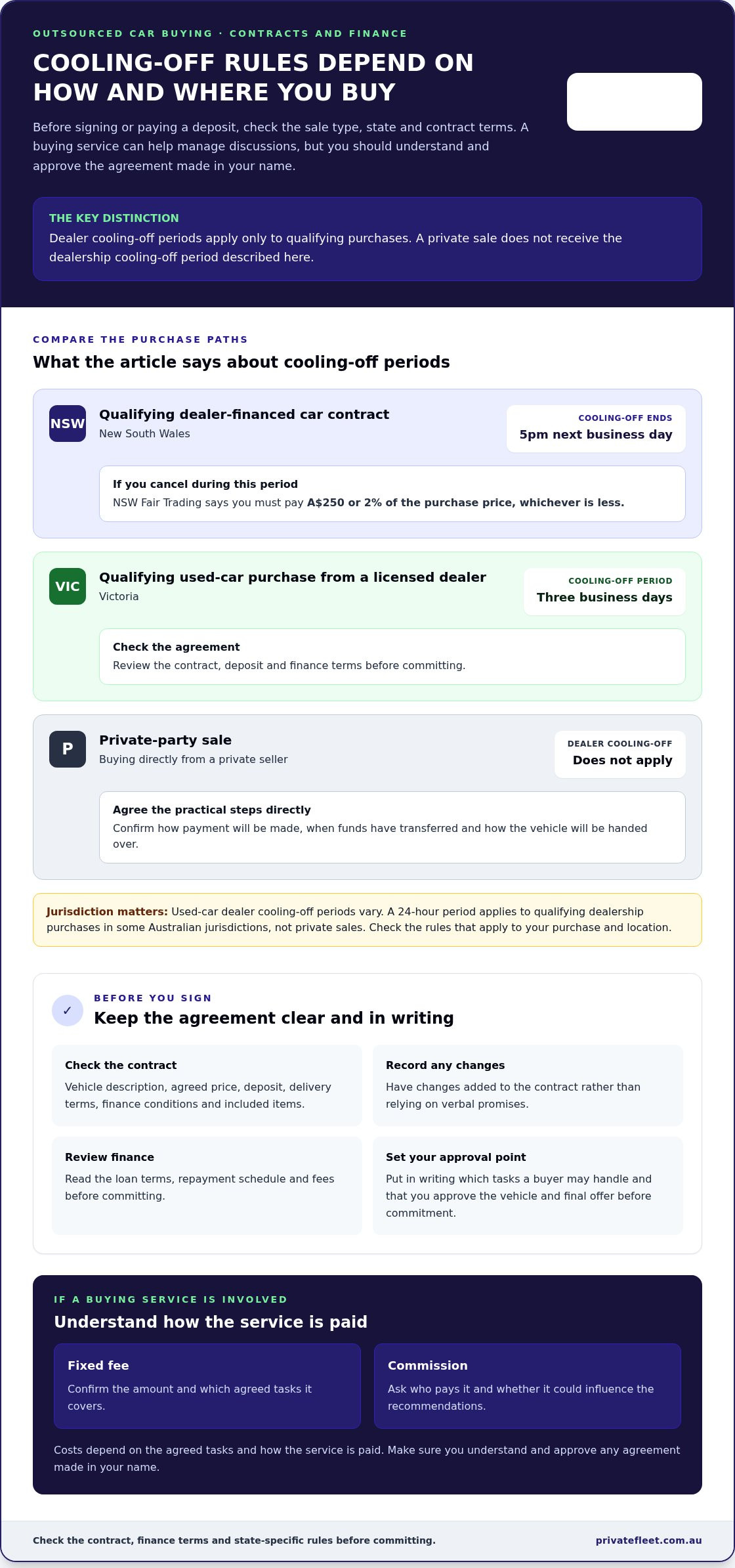
In NSW, a qualifying dealer-financed car contract usually has a cooling-off period ending at 5pm on the next business day after signing. If you cancel during that period, NSW Fair Trading says you must pay the dealer A$250 or 2% of the purchase price, whichever is less.
Car-buying services may charge a fixed fee or work on commission. The cost depends on the agreed tasks and how the service is paid. Before signing, clarify who pays the service and whether any commission could influence the recommendations.
Read the contract before paying a deposit or signing finance documents. Check the vehicle description, agreed price, deposit, delivery terms, finance conditions and included items. Have any changes added to the contract rather than relying on verbal promises. A buying service can help manage discussions, but make sure you understand and approve the agreement made in your name.
A private sale is different from a dealer-financed contract. Cooling-off periods for used cars bought from dealers vary by jurisdiction, and a private sale does not receive the dealership cooling-off period described for some jurisdictions. In Victoria, buyers have a three-business-day cooling-off period for a qualifying used car bought from a licensed dealer. A 24-hour cooling-off period applies to qualifying used-car dealership purchases in some Australian jurisdictions, not private sales.
Finance also affects the practical steps. If you’re borrowing, review the loan terms, repayment schedule and fees before committing. For a private sale, agree how payment will be made and confirm the funds have transferred before taking possession. Keep the signed contract, finance documents, payment evidence and seller’s details together.
| Purchase option | Cooling-off position | Contract and finance focus |
|---|---|---|
| Qualifying NSW dealer-financed purchase | Usually ends at 5pm on the next business day after signing | Cancellation costs A$250 or 2% of the purchase price, whichever is less |
| Qualifying Victorian used-car dealer purchase | Three business days | Check the contract, deposit and finance terms |
| Private-party sale | No dealership cooling-off period | Agree payment, transfer and handover steps directly with the seller |
Match the sale type and state to the contract, then confirm finance conditions and cancellation terms before signing.
For an outsourced arrangement, put the approval point in writing: the buyer can negotiate within your instructions, but you retain the final decision to sign or proceed. This keeps delegated tasks separate from your legal commitment.
Common concerns about outsourced buyers
Check a service’s credentials by comparing its business identity across its website, written agreement and invoice. Look for specific review details about communication, negotiation and follow-through. Ask how the service is paid and whether it has relationships with sellers or dealerships.
A buyer may worry that outsourcing means losing control of the shortlist. Set your requirements in writing: preferred make and model, budget, kilometres, must-have features and acceptable condition. Agree that you’ll approve any vehicle and final offer before a commitment. For example, you might allow an agent to arrange enquiries but require your approval before an inspection or deposit.
Discuss potential conflicts of interest directly. Ask whether the buyer receives payment from a seller, dealer or another party, and whether that affects the vehicles presented. Find out how competing options are assessed. A useful comparison explains how each vehicle matches your brief, including price, condition, history and compromises, rather than presenting only one choice.
Condition and history need evidence, not confidence alone. For a used vehicle, request service records, check its identification details and arrange an independent mechanical inspection. Consumer Affairs Victoria’s July 2026 report examined 50 vehicles bought through auctions by offenders investigated for odometer tampering; 28% of advertised odometers were more than 25,000 kilometres lower than auction readings. That sample concerns investigated offenders, not all cars for sale.
Before appointing a buyer, use these practical checks:
- Read the service agreement and identify the tasks the buyer will handle.
- Confirm who can authorise an offer, deposit or contract on your behalf.
- Ask for inspection findings and vehicle-history information in writing.
- Keep your own copies of messages, reports and signed documents.
Reviews can reveal patterns, but look beyond star ratings. A detailed account of a delayed update or a clear explanation of why a vehicle was unsuitable gives more context than a short score. Compare several recent reviews and see whether the business responds constructively to specific concerns. Treat testimonials on the service’s own site as just one part of your assessment.
For a new-car purchase, the same control questions apply, but the process centres on the exact model, variant, dealer offer and delivery terms. Ask who obtains and compares dealer quotes, how a trade-in is handled, and which decisions require your approval. A written offer summary makes inclusions easier to compare and avoids relying on verbal descriptions.
If you’re considering a new car and want to discuss your shortlist, share your preferred make, model and buying timeframe.
Consumer rights and legal protections
Your legal protection depends on whether you buy from a dealer or a private seller, and where you live. The Australian Consumer Law requires vehicles to meet the acceptable quality standard, but it doesn’t apply to cars bought and sold privately. Dealer purchases may come with consumer protections that differ from those available in private sales.
That difference matters if a fault appears after handover. A dealer purchase may come with consumer protections that don’t apply to the same private sale. Before choosing, identify the seller’s legal status and state, then keep the advertisement, inspection report, contract and payment records. These documents help establish what was represented and agreed.
In NSW, a used vehicle bought from a licensed motor dealer is generally eligible for a dealer guarantee if it’s less than 10 years old and has travelled less than 160,000 kilometres. NSW dealers must complete a safety inspection and declare accident history when selling a used car. These requirements offer specific safeguards, but they don’t replace checking the vehicle’s condition and service records.
Odometer tampering also has legal consequences in NSW. Under section 52 of the Motor Dealers and Repairers Act 2013, the maximum prosecution penalty for each instance is A$55,000. An infringement notice can be A$5,500. If the displayed kilometres seem inconsistent with service records, ask for supporting documents before proceeding.
Victoria has a separate statutory warranty for qualifying dealer sales. A used car bought from a licensed dealer qualifies if it’s less than 10 years old and has fewer than 160,000 kilometres. The warranty lasts three months or 5,000 kilometres. Victoria’s Motor Car Traders Guarantee Fund can pay up to A$40,000 for consumers’ financial loss caused by wrongful dealer actions.
Private-sale protections differ too. In Western Australia, a private seller isn’t legally required to obtain a roadworthiness check. In a private sale, clarify whether finance is owing and ask about any known serious defects before proceeding. Arrange an independent inspection and check the vehicle’s history before paying.
- Dealer purchase: confirm licensing, written guarantees and the applicable state rules.
- Private sale: check service records, condition, finance and ownership documents yourself.
- Either option: keep the advert, contract and all seller communications.
Dealer-purchased used vehicles are entitled to guaranteed clear title. For a private sale, make a Personal Property Securities Register enquiry to check for money owing or write-off status. These steps offer practical protection, but the seller type and state determine which legal safeguards apply.
Outsourcing benefits and onboarding time
Compared with buying privately, an outsourced buyer can coordinate the search and agreed checks. At a dealership, discussions stay directly between you and the dealer. Outsourcing adds an intermediary, while a private sale leaves you to organise each step with the seller.
The process starts with a brief covering your preferred make, model, variant, budget, postcode and buying timeframe. The agent searches against those priorities, presents suitable options, then coordinates quote discussions and agreed next steps. You review the recommendation and make the final purchase decision.
Onboarding means agreeing on the brief and boundaries, not simply handing over a shopping list. Specify, for example, whether a hybrid is acceptable, which safety features matter, and whether you’d consider a different colour for earlier delivery. Set out who may contact dealers, negotiate terms or arrange a trade-in, and which actions need your approval.
Preparing this information can prevent repeated conversations. A written shortlist helps keep dealer quotes comparable: use the same model, variant, optional equipment, delivery location and price basis. Ask for drive-away costs and included items to be shown clearly. This makes it easier to spot differences in accessories or conditions, rather than comparing headline prices alone.
To keep the process moving, prepare these details before the first discussion:
- Your preferred make and model, plus acceptable alternatives.
- Your budget and whether it includes a trade-in.
- Your postcode and intended purchase timeframe.
- Must-have features, colour preferences and deal-breakers.
- The decisions you want to approve before an offer proceeds.
For a new car, an independent buying service can invite competing offers from a national network of authorised dealerships through a tender process. That differs from visiting one dealer yourself, where you manage quote comparisons, follow-up and negotiation. You still choose the vehicle and decide whether the proposed terms suit you.
The benefit depends on what you want to delegate. A confident buyer with time to contact several dealers may prefer direct control. If you’re balancing work, family or travel, help coordinating enquiries and comparing written offers may be useful. Either way, review the exact variant, contract and delivery terms before committing.
Use the written service scope to understand the stages and responsibilities. A clear process should show when options are presented, when you approve a choice, and who handles dealer communication. The new-car buying process offers a useful reference for mapping those stages to your own brief.
Responsibilities of an outsourced private-party buyer
Delegating the car search doesn’t remove your role in setting boundaries and approving the purchase. Agree in writing which tasks the buyer handles, what information they provide, and which decisions remain yours.
Car-buying brokers
Australian private buyers can use independent car-buying brokers or buyer’s agents to help source and negotiate a vehicle. They act for a buyer under an agreed brief, unlike a private seller or dealership offering a vehicle for sale. Check whom the agent represents, what authority you’re giving them, and whether any seller or dealer pays them. Make clear that you approve the final vehicle and offer before committing.
Services included in the fee
A car-buying agent’s fee may cover searching listings, contacting sellers, coordinating inspections or negotiating terms. The written agreement defines the scope, so compare its inclusions with the tasks you expect. Ask whether inspection and history-check costs are separate, and whether the agent can make an offer or arrange payment. Paying a fee doesn’t establish that the car has been inspected or is mechanically sound.
For a used car, ask the agent to gather service records, vehicle-history information, details of financial encumbrances and relevant paperwork. You can also make an online PPSR enquiry or call 1300 007 777. Keep the report with the sale documents.
Arrange an independent mechanical inspection and request the findings in writing. Compare the findings with the seller’s description, service records and odometer reading. If the report identifies repairs or inconsistencies, ask what evidence supports the seller’s explanation. Decide whether the vehicle still meets your requirements before authorising an offer or proceeding with payment.
Before paying, match the vehicle identification details on the paperwork to the car. Confirm the agreed price, handover arrangements and registration documents with the private seller. Keep the signed paperwork and payment record, and confirm the payment has transferred before collecting the keys.
Use this checklist to keep responsibilities clear:
- Set the vehicle requirements and approve changes to the shortlist.
- Review the PPSR result, inspection report and service records.
- Read and sign the sale documents yourself unless you’ve authorised another arrangement.
- Confirm payment, paperwork and key handover before completing the transaction.
An agent can coordinate agreed tasks, but your brief should set clear limits. For example, authorise enquiries and negotiation while reserving approval of the final vehicle and offer for yourself. This keeps delegated work separate from your purchase decisions.
Private Fleet: New Cars
Private Fleet helps Australian buyers source new cars through its independent New Car Buying Service. It invites dealers from a national network of authorised dealerships to compete for your business through a tender process. You choose the vehicle and approve the purchase, while Private Fleet coordinates sourcing and compares dealer offers.
This option suits buyers who want support comparing new-car models, variants and offers rather than managing every dealer conversation themselves. Private Fleet can also assist with a trade-in, with car finance available as a separate consideration. It doesn’t hold its own vehicle inventory.
Explore the new-car buying service if you’re moving from a private-sale search to a new vehicle. To discuss your preferred make or model, postcode and buying timeframe, contact Private Fleet.
Make your next car-buying step your own
If you’re weighing outsourced car buying for private buyers against managing the purchase yourself, start by deciding what you want to delegate. You might want support comparing offers while keeping the shortlist, budget and final approval in your hands. A clear brief turns that preference into practical instructions.
Before you get in touch, note your preferred make and model, postcode and buying timeframe. You can also describe the priorities that will shape your choice, such as a particular variant, trade-in needs or features that matter for everyday driving. This gives the conversation a useful starting point without committing you to a vehicle or offer.
The next step is to talk through what would make the process easier for you. Choose the level of support that suits your time, confidence and decisions, then move forward at your pace.
A clear brief can make the next decision easier, while keeping the purchase yours to approve.
Frequently Asked Questions
Do I have to manage them day to day?
No, you can delegate agreed tasks without directing every conversation. With outsourced car buying for private buyers, set expectations at the start: how the buyer will report progress, which decisions need your approval, and what happens if a suitable option exceeds your budget. For example, ask to review a written comparison before an offer is accepted. This gives you oversight at key decision points without requiring you to manage every enquiry.
How many vehicles can an outsourced buyer help acquire?
There’s no standard vehicle count for an outsourced buyer working with private individuals. A single-car brief may involve sourcing one vehicle, while a household replacing more than one car could agree on separate searches. The practical limit depends on the service scope, timing and complexity of each purchase. Specify whether the engagement covers one vehicle or multiple purchases, and how priorities change if suitable options appear at different times.
What is an outsourced car buying service for private buyers in Australia?
It’s an arrangement where an individual appoints a buying agent to handle agreed parts of finding and purchasing a vehicle. With outsourced car buying for private buyers, this can mean help identifying suitable models and obtaining dealer offers, while you choose and approve the purchase. The agent should explain whom they represent, how they’re paid and whether they receive any benefit from a seller or dealer.
What Australian laws and consumer protections apply when buying a car through an agent?
Protections depend on who sells the car, not simply on whether an agent helped. The Australian Consumer Law provides consumer guarantees for vehicles bought from businesses, but doesn’t apply to cars bought and sold privately. Before signing, check which seller is named on the contract and who handles vehicle complaints. An agent’s involvement doesn’t, by itself, turn a private sale into a dealer sale.
What risks should private buyers consider when using an outsourced car-buying service?
Key risks include unclear authority, undisclosed financial interests and assumptions about the service’s scope. Before choosing outsourced car buying for private buyers, clarify whether the agent may accept an offer, place a deposit or sign documents. Put those limits in writing and ask for any commission or dealer relationship to be explained. Also distinguish coordinating an inspection from assessing the vehicle mechanically, then review the inspection report yourself.
Can a car-buying agent negotiate, arrange finance, inspections, and delivery across Australian states?
An agent may coordinate these steps, but the agreed service scope determines what they handle. For a cross-state purchase, establish who arranges the inspection, who submits any finance application, and who manages delivery and registration paperwork. Ask for state-specific charges and handover responsibilities to appear in the dealer’s written offer. Approve the final vehicle, contract and finance terms before committing.