
An optional protection product isn’t automatically extra peace of mind: its value depends on what it covers, what it excludes and whether you need it. If you’re researching Private Fleet new car buying Australia, it helps to separate a manufacturer’s warranty and your Australian Consumer Law rights from products you can buy separately.
It’s understandable to want to protect a major purchase, while avoiding cover that duplicates protections you already have. This guide explains the differences between consumer guarantees, vehicle warranties and common protection products, including surface treatments and add-on insurance. You’ll learn what to look for in the terms, exclusions and claims process, then weigh those details against how you’ll use the car and how long you plan to keep it.
Private Fleet has helped Australians with new-car buying since 1999, sourcing vehicles through a national network of authorised dealerships. Its tender process invites multiple dealers to compete for your business. Whether you’re still comparing cars or preparing to finalise a purchase, understanding the protection options can help keep the decision clear and manageable.
Key Takeaways
- Vehicle protection products vary, so use the product documents to establish exactly what is covered and under what conditions.
- Compare a manufacturer’s warranty, Australian Consumer Law guarantees and separately purchased products as distinct forms of protection.
- Assess each option against its exclusions, duration, conditions, claims process and any stated excess or limits.
- Before deciding, consider your intended ownership period, how you’ll use the car and which uncovered costs you could manage.
- For private fleet new car buying australia, understand how Private Fleet’s dealer tender process supports the wider purchase while keeping protection decisions in perspective.
What are motor vehicle protection products, and what question should buyers ask first?
Motor vehicle protection products are a broad category, not one standardised type of cover. The useful first question is: what does this specific product protect, and under what conditions? The name or sales description won’t answer that. The governing documents set out the cover, duration, exclusions, conditions and process for making a claim. Suitability depends on those written terms and your needs, not the label alone.
Products sold separately from a new car can differ in purpose and structure. Across the wider Australian automotive aftermarket, businesses supply a range of vehicle-related products and services; the Australian Automotive Aftermarket Association provides background on that industry. A category description is not evidence that a particular product is included with a car or offered by a specific business. Read the product documents for the exact details.
What does the term vehicle protection product mean?
It’s an umbrella term that may be used for different kinds of separately purchased products. Their purpose, terms and legal treatment can vary, so don’t assume two products with similar names offer comparable protection. Marketing phrases can introduce an option, but they aren’t a substitute for the actual wording.
Find the product disclosure statement, contract or other governing document, and identify who provides the product and what it applies to. Look for what is covered, how long cover lasts, relevant exclusions and conditions, and what you need to do if you want to make a claim. If a description sounds broader than the written terms, use the written terms to understand the offer.
What protection may already apply to a new car?
A new car may have a manufacturer’s warranty as well as consumer rights under the Australian Consumer Law. These are different protections. A manufacturer’s warranty is a voluntary promise from the manufacturer, set out in its warranty terms. Those terms explain its duration, coverage and any conditions that apply.
Consumer guarantees are automatic legal rights when a vehicle is bought from a business. The Australian Competition and Consumer Commission explains that guarantees cannot be excluded or replaced by a warranty. They don’t have one fixed expiry date; how long they apply depends on what is reasonable in the circumstances. Rights may therefore remain relevant after a manufacturer’s warranty ends. See the ACCC guidance on consumer rights and guarantees for more information.
A separately purchased product is another set of terms to assess. Don’t assume it replaces, limits or extends your existing rights; read its wording and keep each source of protection distinct. For buyers exploring private fleet new car buying australia, Private Fleet’s new-car buying service is part of the wider purchase process. Keep the focus on choosing the right car first, then decide whether any additional product fits your plans and its documented terms.
How do vehicle protection products differ from warranties and consumer guarantees?
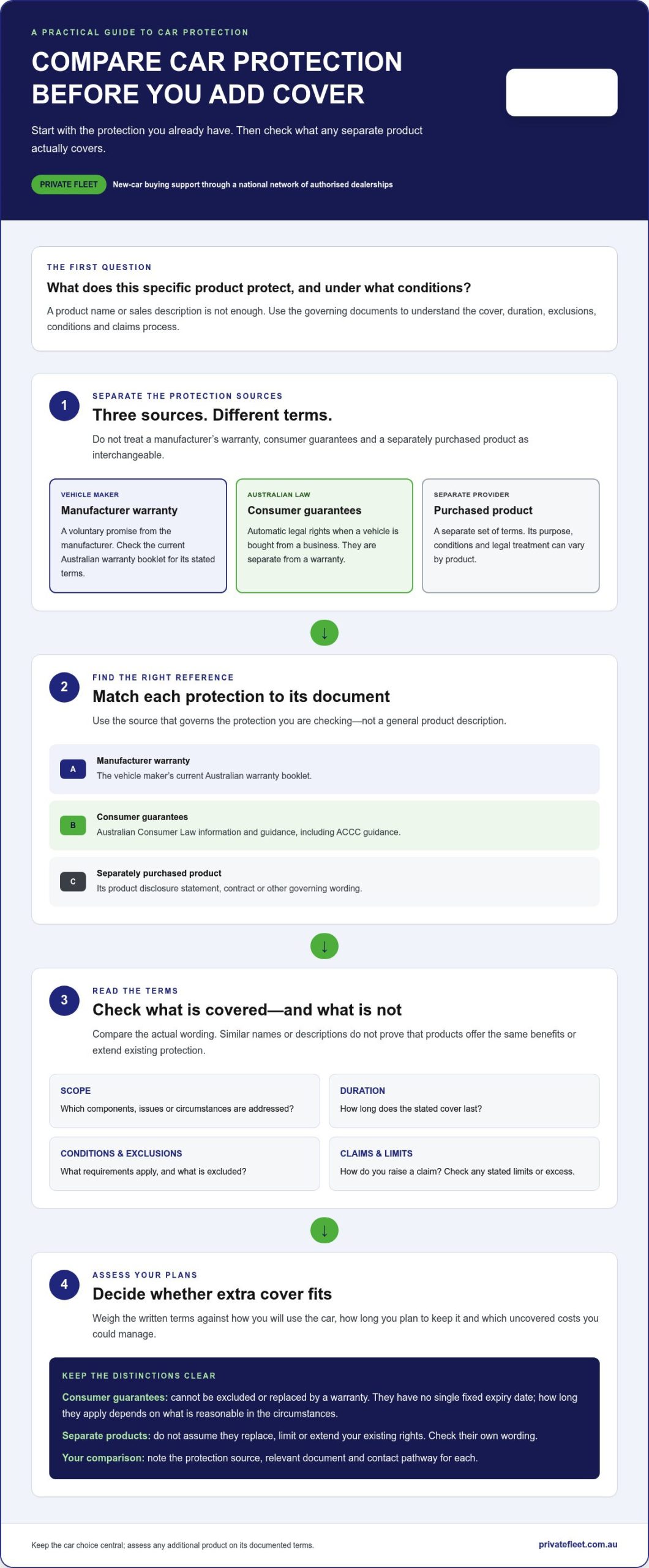
To compare these protections, focus on who provides each one and which document sets out its terms. A manufacturer warranty, consumer guarantees and a separately purchased product are not interchangeable labels. The table shows where to look and what to compare, so you can identify the relevant source before assessing a particular concern.
| Protection source | Governing document or source | Questions to check |
|---|---|---|
| Manufacturer warranty | The vehicle maker’s current Australian warranty booklet | Which components and circumstances are addressed? What conditions and exclusions apply? How are warranty concerns raised? |
| Consumer guarantees | Australian Consumer Law information and guidance | What information is relevant to the issue? Which business supplied the vehicle? |
| Separately purchased product | The product’s disclosure statement, contract or other governing wording | What benefit is described? What conditions, limits and exclusions apply? What is the stated claims process? |
How is a manufacturer warranty different from a protection product?
The warranty booklet is the reference for the manufacturer’s stated warranty terms. A separate product has its own wording and provider. Compare the documents directly: check whether they address the same components or situations, and note differences in conditions, exclusions and claim steps. Similar descriptions don’t establish that benefits match, overlap or extend one another. For your specific vehicle, use the current Australian warranty information rather than relying on a general summary.
Where do Australian Consumer Law consumer guarantees fit?
Consumer guarantees are separate from both a warranty booklet and a product contract. For plain-English guidance on their place in a vehicle purchase, consult the ACCC information on consumer rights and guarantees. Keep that guidance distinct from the terms of any optional product, and avoid assuming that a product changes how the law applies to a particular concern.
As you compare, write down the source, relevant document and contact pathway for each protection. This makes it easier to see which set of terms you’re relying on and where to direct a question. For buyers considering private fleet new car buying australia, the vehicle and its purchase details can remain the priority while you assess any optional product separately.
If you’d like support with your new-car plans, get help with your purchase.
How can you compare motor vehicle protection products fairly?
Compare the written terms side by side, not product names or broad sales descriptions. Start with the exact document for each option, then check what it promises, when that promise applies and what could prevent a claim. This makes differences easier to see and helps you avoid treating similar-sounding products as equivalent.
Use this checklist to record what each document actually says. If a term isn’t stated clearly, mark it as unanswered rather than filling the gap with an assumption.
| What to compare | What to find in the wording | Question to ask |
|---|---|---|
| Scope | Covered components, events or services, and the benefit provided | Does the wording cover the concern I want to address? |
| Duration | When cover starts and ends, including any time or distance limits | Does the stated period fit my plans for the car? |
| Exclusions | Situations, faults or items the product excludes | Could an exclusion rule out the circumstances I’m concerned about? |
| Conditions | Eligibility requirements and responsibilities placed on the buyer | What must I do to keep the stated benefit available? |
| Claims process | How to notify the provider, required records and the decision process | Who do I contact, and what information must I supply? |
| Excess and limits | Any stated excess, caps, sub-limits or other boundaries | What could remain my responsibility if a claim is accepted? |
Which terms deserve a close read?
Look beyond the summary page. Check the definitions and any sections that explain exclusions, conditions or claims. Note whether the wording specifies the records you must keep, who assesses a claim and what steps are required before work or other action is taken. These details can affect how the product operates in practice. If the document uses a term you don’t understand, locate its definition in the same wording before comparing offers.
How do you spot overlap or gaps?
Set the product wording beside the relevant manufacturer warranty documents and your understanding of applicable consumer guarantees. Compare only benefits and limits supported by those documents. A potential overlap exists only where the wording addresses the same issue; a gap exists only where the documents show the concern falls outside their stated protection. Don’t infer either from a product name.
Keeping a car for longer doesn’t, on its own, establish that an additional product is worthwhile. Consider the documented cover, its conditions and your own circumstances together. If the price is part of your comparison, use a current figure tied to that specific product and note what it includes; don’t compare amounts on different bases.
This document-led approach keeps private fleet new car buying australia focused on the vehicle and the buyer’s needs, rather than broad promises. If you’re weighing up a new-car purchase, you can talk through your new-car plans.
How do you decide whether a protection product suits your new-car plans?
A product may suit one buyer and be unnecessary for another. Base your decision on the concern you want to address, the car’s expected use and the benefit set out in the product’s written terms. Then weigh that benefit against any stated price and the costs or situations the wording leaves to you.
Use a steady sequence rather than deciding at the point of sale:
- Identify your concern. Name the specific cost, event or inconvenience you’re considering protection for. A general desire for peace of mind is a starting point, not proof that a particular product meets your needs.
- Review what already applies. Set aside the relevant manufacturer warranty information and consider your consumer rights. Keep these distinct from a separately purchased product.
- Compare the written terms. Check the stated benefit, exclusions, conditions, limits and claim steps. If a price is supplied, assess it alongside the benefit and duration described for that exact product.
- Decide in your own time. If you can’t explain what the product would do for you, or which situations it excludes, pause and revisit the documents before agreeing.
What should you consider about your ownership plans?
Think about how long you expect to keep the car, your likely annual kilometres and the journeys you typically make. Regular commuting, regional trips and occasional longer drives can involve different patterns of use, but none automatically makes a product worthwhile. Match your circumstances to the wording rather than relying on a broad claim about who usually buys it.
Consider practical ownership priorities too. You might value predictable costs, a straightforward claims process or convenient purchase administration. Those preferences matter only if the product’s documented benefits address them. Also ask yourself how comfortable you’d be managing a cost that falls outside the stated cover; don’t treat that concern as evidence that every available product is suitable.
What is a practical final decision checklist?
Before making a decision, make sure you can answer these questions in plain language:
- Do I have the exact product document, and can I identify the provider and applicable terms?
- What specific benefit does the wording promise, and for how long?
- Which exclusions, eligibility requirements or limits could affect me?
- How do I start a claim, and what records or steps does the document require?
- If a price is stated, does the documented benefit seem relevant to my ownership plans?
If the answers remain unclear, don’t let urgency or an unsupported claim about savings or outcomes make the decision for you. This guide offers general information to help you assess fit; it isn’t personalised legal or financial advice. For buyers exploring private fleet new car buying australia, keeping the car choice and any optional protection decision separate can make the purchase process easier to manage.
How can Private Fleet help keep protection decisions in perspective?
Start with the vehicle, not the optional extras. Private Fleet is an independent Australian vehicle sourcing and car buying service that works with a national network of authorised dealerships. Its tender process invites multiple dealerships to compete for your business. That support can help keep the purchase journey organised while you focus on choosing a new car that suits your priorities.
How does protection fit into the wider new-car purchase?
Settle your preferred make, model and variant before weighing up additional products. Think about the features that matter for your day-to-day driving, the way you’ll use the car and your likely ownership period. Then compare the purchase details, including the written terms for any optional protection product, as separate decisions.
Private Fleet’s new-car buying service supports vehicle sourcing, while its car-buying process explains how the purchase journey works. Protection and finance can be considered as part of that broader journey, but neither should distract from selecting the right vehicle or understanding the purchase terms. Private Fleet doesn’t hold its own vehicle inventory, and a sourcing service or product description shouldn’t be read as a promise about a particular vehicle outcome.
For buyers researching private fleet new car buying australia, keeping these choices in sequence makes comparisons clearer. First shortlist the vehicles and variants that meet your needs. Then assess the purchase and delivery arrangements. Finally, decide whether a separate product’s documented benefits are relevant to your plans. If the terms don’t address a concern you have, or you can’t explain what benefit you’d receive, you can leave that decision open rather than treating it as an automatic part of buying a car.
What information helps make the next conversation useful?
A clear shortlist helps focus the discussion on the car you want, rather than a broad list of possibilities. Share your preferred make or model, postcode and buying timeframe. If you’re still comparing, include the models or variants you’re considering and what matters most in the choice.
It can also help to outline your expected annual kilometres and intended ownership period. These details give useful context for discussing your vehicle plans and any documented protection option you’re weighing up. You don’t need to have every detail decided; a starting preference is enough to make the conversation more focused.
Make your next new-car decision with clarity
Your next step doesn’t need to settle every detail at once. Take the time you need to decide what matters most in your new car, and keep any remaining questions visible as you move forward. A considered pace can make private fleet new car buying australia feel more straightforward, with room to focus on the choices that suit you.
When you’re ready to discuss your purchase, share your preferred make or model, postcode and buying timeframe.
Get help buying my new car
Frequently Asked Questions
Are motor vehicle protection products worth considering?
Sometimes, if a product addresses a specific concern you’d otherwise manage yourself. Consider whether its stated benefit would matter in a realistic situation, whether you could absorb the relevant cost without it, and whether the price shown feels proportionate to the value you expect. Reassurance alone isn’t a reason to buy. There’s no universal recommendation, so weigh the decision against your circumstances and current Australian consumer guidance.
Do vehicle protection products replace a manufacturer warranty?
No, not automatically. Treat a separately purchased product as a separate arrangement unless its own wording expressly describes a relationship with the manufacturer’s warranty. A practical step is to note who handles each enquiry and what information they request; the claim pathways may differ even if the concern sounds similar. Use the current Australian warranty booklet for your specific model when checking manufacturer details.
Can I purchase a vehicle protection product after buying a new car?
Possibly, but only if the product’s terms allow it. Before relying on a later purchase, check whether eligibility depends on criteria such as the vehicle’s age, odometer reading, purchase channel or another condition stated in the document. Don’t assume these apply to every product. Note the date cover would begin and whether waiting changes the terms presented, then keep a copy of the relevant offer.
What should I compare before choosing a car protection product?
Test the wording against a realistic situation you care about. Describe the concern in plain language, then trace how the document says it will be assessed and what outcome, if any, it describes. This scenario check can reveal a mismatch between the reassurance you expect and the benefit actually stated. Keep a copy of the version supplied with the offer, as a short product name or verbal summary may not capture its details.
Are car protection products the same as Australian Consumer Law guarantees?
No. They’re different: a product describes contractual benefits, while consumer guarantees arise under the Australian Consumer Law. For a general explanation, consult the ACCC’s current consumer-guarantees guidance. A product brochure can’t determine how a particular legal issue or remedy will be handled. The facts matter, and this general answer can’t resolve an individual dispute or establish which rights apply in a specific case.
What information should I have ready when discussing a new-car purchase?
For a focused discussion, bring any written vehicle quote or order details, including the exact variant and the price basis, such as whether it’s presented as drive-away. Note your must-have features, any trade-in you want considered and the questions you still need answered. If protection is on your mind, bring the relevant offer document too. This helps keep the conversation grounded in the actual car and proposal.