
A professional vehicle sourcing service in Australia can find new cars that match your requirements, compare dealer offers and help manage the purchase. It can support private, business and fleet buyers by narrowing down models and variants, comparing prices and organising the next steps. The right approach depends on how you’ll use the vehicle, your budget and your buying timeframe.
Comparing cars takes time, especially when dealer offers differ in inclusions, trade-in arrangements or delivery details. A sourcing service brings those details together, making it easier to assess your options.
This article explains how sourcing works, what to look for when reviewing quotes and which factors can affect timing. You’ll also learn how support with trade-ins, finance, warranty and insurance decisions can fit around the new-car purchase, whether you’re buying for yourself or coordinating vehicles for a business or fleet.
Key Takeaways
- Compare dealer offers on the same basis, including the vehicle’s variant, drive-away inclusions, trade-in terms and delivery details.
- Set out your must-haves, budget and intended use before sourcing begins to make the shortlist more relevant.
- Personal, business and fleet buyers can have different priorities, so clarify who will use the vehicle and what the purchase needs to achieve.
- Understand how a sourcing service searches for vehicles, gathers offers and supports the buying process before choosing one.
- Consider finance, warranty and insurance alongside the vehicle decision, while keeping the new-car purchase at the centre.
Offer review and pricing transparency
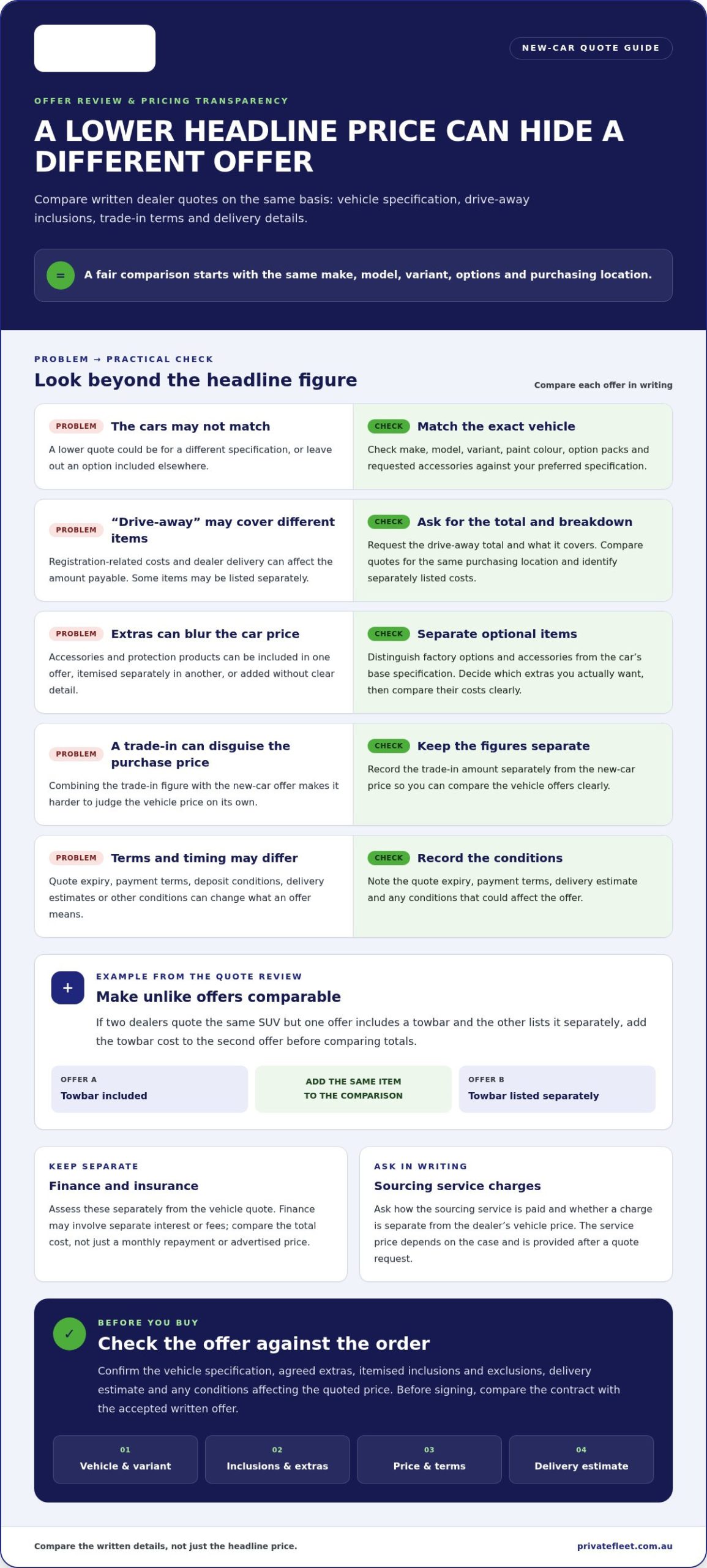
Compare written dealer offers line by line, not just by headline price. For the same make, model and variant, check that each quote includes the same factory options, accessories and delivery arrangements. A lower price may reflect a different specification or exclude items included elsewhere. Ask for the drive-away total and a breakdown of what it covers. Registration-related costs and dealer delivery can affect the amount payable in Australia, so compare offers for the same purchasing location.
Use written quotes as your comparison record. Match the vehicle description, paint colour, option packs and accessories against your preferred specification. Then check the quote’s expiry, payment terms, delivery estimate and conditions. Keep any trade-in amount separate from the new-car price. That makes it easier to judge whether the vehicle offer is competitive, without a trade-in figure disguising a higher purchase price.
- Vehicle specification: Confirm the exact model and variant, including options such as a sunroof or upgraded audio if you requested them.
- Drive-away inclusions: Check which registration and delivery costs are included, and identify any item listed separately.
- Optional extras: Separate accessories and protection products from the car’s base specification. Decide which items you actually want.
- Timing and terms: Note the quote expiry, deposit conditions and stated delivery estimate. Record any conditions that could change the offer.
- Service charges: Ask how the sourcing service is paid and whether any charge is separate from the dealer’s vehicle price. The service price depends on the case and is provided after a quote request.
Before you buy, check that the offer matches your requested vehicle, the dealer’s written terms are clear, and inclusions and exclusions are itemised. Review the order details, delivery estimate and any conditions affecting the quoted price. Before signing, compare the contract with the accepted offer, including the vehicle specification and agreed extras.
Extra costs can arise when an offer excludes delivery, accessories or other charges, or when optional products are added without clear itemisation. Finance may involve separate interest or fees, and a trade-in changes the total amount you pay. Ask for each component in writing and compare the total cost, not just the monthly repayment or advertised vehicle price.
For example, if two dealers quote the same SUV, one offer may include a towbar while the other lists it separately. Add the towbar cost to the second offer before comparing totals. Keep finance and insurance decisions distinct from the vehicle quote, then assess how each affects your budget. A clear comparison helps you identify the offer that best fits your requirements, rather than assuming the lowest headline figure is the best value.
Vehicle requirements and preferences
Build your shortlist around how you’ll use the car, not just its badge. Note your usual trips, passenger needs, parking situation and budget. A commuter on regular urban routes may value compact dimensions and easy parking. Someone travelling on regional roads may prioritise comfortable seats, visibility and a quieter cabin. These details help narrow your choices to vehicles suited to everyday use.
Separate essential requirements from preferences. A must-have might be room for child seats, a particular body style or enough boot space for regular luggage. Preferences could include a specific colour, a panoramic roof or upgraded audio. This distinction keeps your shortlist practical if your preferred model or variant doesn’t include every feature you’d like.
- Driving pattern: Describe typical trips, annual kilometres and how often you travel long distances. Regular short trips and extended highway journeys can point towards different priorities.
- Powertrain: Consider whether a petrol or diesel vehicle, conventional hybrid, plug-in hybrid or electric vehicle fits your routine. A plug-in hybrid needs charging to make use of its electric driving capability; an electric vehicle depends on access to charging.
- People and luggage: List usual passengers, child seats, mobility aids or sports equipment. Check seating flexibility and boot access against the items you carry.
- Comfort and controls: Assess seat adjustment, entry and exit, visibility, cabin noise, ride comfort and whether key controls feel intuitive.
- Parking and towing: Note garage dimensions, street-parking conditions and whether towing matters. Compare the exact Australian variant’s dimensions and towing specifications.
- Ownership plans: Consider how long you expect to keep the car, servicing access and the ownership costs that matter most to you.
For a practical comparison, choose a shortlist and record each vehicle’s model, variant and powertrain. Test the same everyday tasks in each: adjust the driver’s seat, check rear visibility, load a typical bag and practise parking. A vehicle that looks suitable on paper may feel different on your regular route or in a tight car park.
Stay flexible on details that don’t affect your needs. If colour is optional, allowing alternatives may broaden your choices. If a safety feature, seating arrangement or powertrain is essential, mark it clearly. This gives the sourcing professional useful boundaries without making every preference a deal-breaker.
Have a preferred make or model, postcode and buying timeframe? Share those details through a new-car buying enquiry to help shape a shortlist around your priorities.
Vehicle sourcing for personal, business and fleet buyers
Australian vehicle sourcing services can find new vehicles, compare dealer offers and support the purchase process. The scope can differ depending on whether you’re buying one car or arranging several.
Sourcing service options
For a private buyer, sourcing might focus on one vehicle, such as a comfortable SUV for commuting and regional trips. A business buyer may need a vehicle suited to a specific role, while a fleet buyer may prioritise consistent specifications across several cars. Explain how each vehicle will be used and who will drive it.
Services differ in what they handle. Some find vehicles and negotiate with dealers; others also coordinate purchase steps or help with finance. Compare the tasks included: finding new cars, contacting dealers, comparing offers and coordinating orders. For a fleet, clarify whether each vehicle needs the same variant, accessories and delivery arrangements.
Steps in the sourcing process
Start with a clear brief: preferred make and model, acceptable alternatives, postcode, budget and buying timeframe. Add practical needs, such as passenger capacity, business use or a particular powertrain. This gives the sourcing professional a clear basis for approaching dealers and assessing suitable offers.
The service then searches for matching vehicles and gathers dealer responses. Review the options against your brief, then decide which offer to pursue. Before agreeing, check the written order for the exact vehicle, agreed inclusions, payment arrangements and delivery details. For several vehicles, document any differences between individual orders to avoid specification mix-ups.
Sourcing timeframes
There’s no standard timeframe for sourcing a vehicle in Australia. Timing depends on your requirements and market availability. Being flexible on model, variant or colour can open up more options than insisting on one exact specification. Dealer responses, order arrangements and delivery also affect the overall process.
Plan for the search and delivery as separate stages. Ask about the expected steps and timing, including when you’ll review offers and the dealer’s estimated delivery date. If you need to replace a car by a set date, share that deadline early. Fleet buyers can plan around each vehicle’s intended use and required arrival sequence.
Interstate purchases and logistics
An interstate purchase involves more than agreeing on a vehicle price. You and the dealer need to agree on the vehicle’s location, transport to its destination and the registration process where it will be used. Confirm who arranges transport, who pays each charge and how the vehicle will be handed over. Put those details in writing before accepting the offer.
Registration procedures differ between Australian states and territories, so the destination matters. For an interstate vehicle, establish which registration steps the dealer handles and which remain with you. A business receiving cars at multiple locations should record each destination and delivery contact against its order. This keeps transport, handover and registration tasks clear for every vehicle.
Which professional vehicle sourcing services operate in Australia?
Australian buyers can use an independent vehicle sourcing service, a car broker or a dealer directly. These options differ in who searches for the vehicle, how offers are gathered and which purchase steps receive support. If you’re buying a new Toyota, for example, compare how each service finds a suitable variant, contacts dealers and reviews purchase terms.
An independent sourcing service acts for the buyer during the search and offer process. A sourcing agent can look for vehicles matching the buyer’s criteria, negotiate with dealers and help manage the purchase. Some services cover new and used vehicles, so confirm that the service suits your intended purchase. A buyer seeking a new car should focus on the Australian model, variant and dealer offer.
How the main options differ
- Independent sourcing service: The service takes the buyer’s brief and searches its dealer network for matching vehicles. Ask how it gathers offers and what purchase steps it handles.
- Broker: A broker helps connect a buyer with a vehicle offer and may negotiate with a dealer. Clarify whether the broker compares multiple offers or works from a narrower selection.
- Dealer direct: A buyer contacts a dealer themselves about a specific make, model and variant. This can suit someone who already has a clear shortlist and wants to manage quote comparisons personally.
Labels don’t explain the full scope of a service. Compare the tasks included, such as finding a particular variant, explaining dealer offers, coordinating an order or assisting with a trade-in. Someone choosing between two Mazda variants, for example, may value help comparing their specifications and written offers. A buyer with one exact model in mind may prioritise dealer communication and order coordination.
Check how the service is paid for and whether any charge is separate from the vehicle price. Understand who presents the offer, who the vehicle purchase contract is with, and who handles delivery arrangements. These details clarify the sourcing service’s role and the dealer’s role as seller. Keep the offer, order and agreed extras in writing.
For a business or fleet, consider whether the service can work from one consistent brief across several orders. You may need different vehicles for different roles or the same model and variant throughout. Either way, specify the intended use, delivery locations and required accessories before comparing options. That makes it easier to judge whether the service suits your needs.
Choose an approach that matches your time, shortlist and preferred level of support. If you know the make and model but want help comparing dealer offers, an independent sourcing service can help. If you prefer to contact dealers yourself, you can manage the enquiries directly.
What steps are involved in using a car sourcing service in Australia?
A vehicle sourcing service turns your brief into dealer offers and an organised order. You remain responsible for choosing the vehicle and approving the purchase. The process moves from initial requirements through to delivery.
- Set the brief. Provide your preferred make, model and variant, plus acceptable alternatives. Include your postcode, buying timeframe, budget and intended use. For example, specify whether a Kia Sportage must have a particular powertrain or whether another variant could suit. Clear priorities give the sourcing service a practical basis for beginning the search.
- Agree on the service scope. Establish which tasks the service will handle, such as contacting dealers, gathering offers or helping coordinate the order. Clarify how it communicates options and what decisions remain yours. If you’re replacing a current car, explain whether trade-in assistance is relevant. A defined role avoids confusion once dealer discussions begin.
- Review suitable options. The service searches for vehicles that match your brief and presents relevant dealer responses. Compare each option against your priorities, not just the model name. A variant may differ in equipment, powertrain or accessories. Ask for the exact specification and written terms so you can assess whether each offer genuinely meets your needs.
- Choose and approve an offer. Once you select an option, review the dealer’s written offer and purchase documents before proceeding. Confirm the exact vehicle, agreed extras, payment arrangements and delivery details. Keep a copy of the accepted terms. If the dealer’s order paperwork differs from the offer, resolve the discrepancy before signing or paying a deposit.
- Consider related decisions. Some sourcing services assist with finance options or work with lending partners. Treat finance as a separate decision from choosing the car. Compare the repayment structure, interest and applicable fees with your budget. Warranty and insurance choices also relate to ownership, but should not distract from confirming the vehicle and purchase terms first.
- Follow the order through. After the dealer accepts the order, keep the order documents and communication together. Agree how updates about the order and delivery will reach you. If the estimated timing changes, ask how that affects your plans. Before handover, use the agreed specification to check the vehicle and included accessories.
The process gives you clear decision points: define your brief, assess dealer offers, approve the paperwork and track the order. Sharing your preferred make or model, postcode and buying timeframe helps focus the search from the outset.
Private Fleet: New Cars
Private Fleet’s New Car Buying Service helps Australian buyers source new vehicles through a national network of authorised dealerships. Its tender process invites multiple dealers to compete for your business, giving you offers to compare against your preferred make, model and requirements. Private Fleet is independent and does not hold its own vehicle inventory.
Use the service when you want help comparing dealer offers or coordinating your purchase. Trade-In Assistance can help when you’re replacing your current car, and Car Finance is available as part of the broader buying process. Customers receive regular delivery updates to follow progress after ordering.
Share your preferred make or model, postcode and buying timeframe to discuss your next step. Contact Private Fleet.
Make your next car decision with confidence
Before taking the next step, turn your research into a clear buying brief. Decide what a successful purchase looks like, whether that means the right variant, comfort for everyday driving or a smooth process from order to handover. Clear priorities help keep the decision focused on what matters to you.
When choosing a professional vehicle sourcing service in Australia, look for a clear explanation of its role and your options. You should understand who sells the vehicle, which decisions are yours and how the purchase will progress. Clear expectations make it easier to stay in control from choosing a car through to arranging the order.
You don’t need to settle every detail before seeking support. A preferred make or model, your postcode and a realistic buying timeframe provide a practical starting point. You can refine your priorities as you consider the available options.
Take the next step at your own pace, with a clearer brief and a decision that fits your needs.
Frequently Asked Questions
Why Choose Car Sourcing in Australia?
Car sourcing gives private buyers a more structured way to approach a major purchase. It can help you set priorities, understand the stages involved and organise decisions. For example, if you have a firm budget and a shortlist, a written brief keeps the search focused and makes it easier to explain any changes to your requirements.
What does a professional vehicle sourcing service in Australia do?
A sourcing service supports the buying process, but the supplying dealer remains the seller of the new car. The dealer issues the purchase documents and handles the vehicle order and handover. If you agree to change the variant, accessories or other order details, make sure the changes appear in the dealer’s paperwork. That records the terms you accepted and who is responsible for supplying the vehicle.
How much do Australian vehicle sourcing services charge?
Before engaging a service, clarify how its charge is calculated and when it’s payable. Charges may be fixed, percentage-based, linked to a successful purchase or separate for particular work. Ask whether the amount is bundled with another service, what happens if you don’t proceed with a vehicle, and whether additional work changes the charge. Get the agreed terms in writing.
How does vehicle sourcing compare with buying from a dealer or privately?
Vehicle sourcing is assistance with the buying process, not a separate type of vehicle sale. For a new car, the authorised dealership supplies the vehicle and its purchase documents. A private sale involves an individual seller, with the buyer assessing the vehicle based on the information and condition presented. The key distinction is who sells the vehicle and handles the transaction, not simply who helped you find it.