
The easiest way to buy a new car is to make fewer decisions at once. With so many models, variants and offers to compare, it’s easy to lose sight of what you actually need. A stress free car buying australia plan starts with a clear shortlist, then compares the details that affect your purchase, from drive-away pricing to trade-in value and delivery.
If negotiation or high-pressure sales conversations make the process harder, you’re not alone. You can make the experience more manageable by deciding what matters before speaking with dealers and choosing a buying approach that suits you. This guide will help you define your needs, compare relevant new-car options and offers, and keep practical details organised.
Private Fleet is an independent vehicle sourcing and car buying service that works with a national network of authorised dealerships. Its tender process invites multiple dealers to compete for your business, helping reduce the direct negotiation workload without promising a particular price. You’ll also learn how to weigh up trade-in assistance, ordering and delivery, so you can move from a broad search to a considered purchase with greater confidence.
Key Takeaways
- Make stress free car buying australia more manageable by deciding what matters to you before comparing models and offers.
- Work through the purchase in stages, from setting your needs to reviewing comparable offers and organising delivery.
- Choose between buying directly, using an online process or getting independent sourcing support based on the effort and comparison help you want.
- Prepare a simple shortlist with your budget range, must-haves, preferred models and buying timeframe to keep research focused.
- Private Fleet’s tender process invites multiple authorised dealers to compete for your business, helping reduce the direct negotiation workload.
Why can buying a new car feel stressful in Australia – and what helps?
Buying a new car feels more manageable when you decide what matters before comparing vehicles or offers. Stress-free buying doesn’t mean finding a perfect deal or eliminating every uncertainty. It means having enough clear information to make choices at your own pace, understand what you’re agreeing to and know what happens next.
The pressure often comes from several decisions arriving together: which body style suits your routine, which model and variant has the right features, how offers compare, and when to commit. A focused approach separates those questions. Start with your needs, then assess only the options that could meet them. That’s the practical foundation of stress free car buying australia.
Which parts of new-car buying create the most pressure?
A long list of models can make small differences between variants seem decisive. Without a shortlist, it’s easy to spend time comparing features that don’t matter to your daily driving. For example, someone who mostly commutes and parks in tight spaces may prioritise visibility and parking assistance over equipment they’re unlikely to use.
Offers can be difficult to compare if they include different vehicle variants, accessories, trade-in arrangements or delivery details. A headline price alone may not show whether two quotes cover the same things. Ask for the key inclusions and exclusions in writing, then compare like with like. That gives you a clearer basis for deciding, without treating every advertised offer as directly equivalent.
Some buyers also feel uneasy about negotiating or being asked to make a decision before they’re ready. Dealership conversations vary; not every interaction is high-pressure. A car dealership can be a place to discuss a vehicle and its purchase, but you can prepare questions in advance and take time to consider the answers. If an important point is unclear, pause and seek clarification before proceeding.
What does a calmer buying experience look like?
A calmer buyer sets priorities, narrows the options and compares relevant details in a consistent way. They don’t need to know every model on the market. They need a suitable shortlist and enough information to choose between it. The new-car buying process can be easier to manage when each step has a clear purpose and the next action is understood.
Comfort is personal, so consider how a car feels in the situations you expect to encounter. Check whether getting in and out feels natural, whether the seat adjusts to a comfortable position, and whether you can see clearly from the driver’s seat. Notice ride comfort and cabin noise on a drive, and try the controls you’d use regularly. Some people prefer physical buttons; others are comfortable with touchscreen menus. Age alone doesn’t determine those preferences.
A considered purchase is one you can explain to yourself; a rushed purchase is one you feel pushed to justify. Take notes during comparisons, keep unresolved questions visible and make the decision when the vehicle, offer and next steps make sense to you.
A stress-free new-car buying process: make each decision manageable
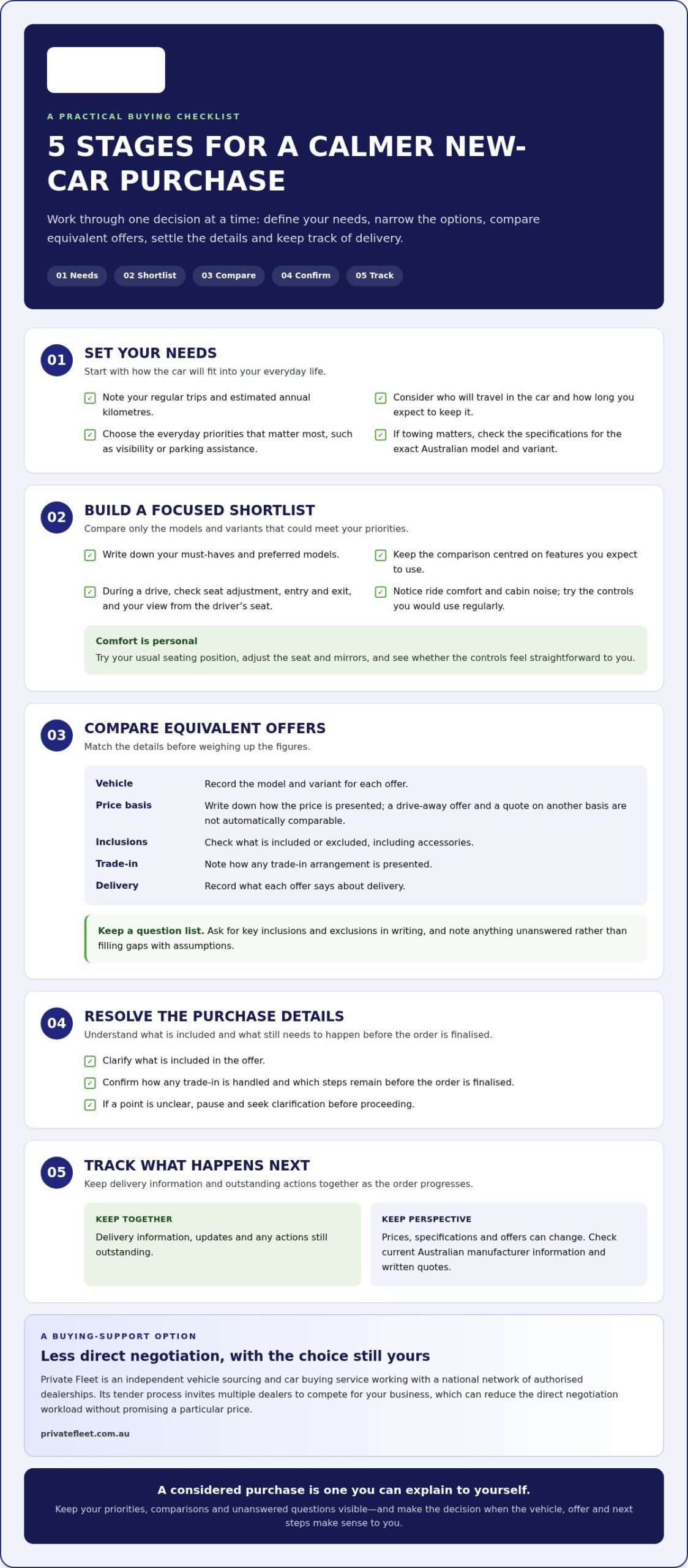
A clear sequence turns a large purchase into a set of smaller decisions: define your needs, build a shortlist, compare equivalent offers, settle the purchase details, then keep track of delivery updates. Resolve one question before moving to the next. That way, a new offer or model doesn’t send you back to the beginning.
This is the practical idea behind stress free car buying australia: choose with clear information, not pressure to decide everything at once. The new-car buying process can be easier to follow when you know what each stage needs to establish.
- Set your needs. Note how you’ll use the car, who’ll travel in it and what matters most in everyday driving.
- Build a shortlist. Focus on models and variants that fit those priorities, rather than comparing every vehicle on the market.
- Compare equivalent offers. Match the model, variant, inclusions and price basis before weighing up the figures.
- Resolve purchase details. Clarify what’s included, how any trade-in is handled and what steps remain before the order is finalised.
- Track what happens next. Keep delivery information and outstanding actions together, so you know what to expect as the order progresses.
Start with how the car will be used
Think about regular trips, estimated annual kilometres, passengers and how long you expect to keep the car. These details help distinguish useful features from nice-to-haves. During a test drive, try your usual seating position, adjust the seat and mirrors, check visibility, listen to cabin noise and notice how the car feels over a familiar type of road. If towing matters, compare the towing specifications for the exact Australian model and variant.
Compare like-for-like offers before deciding
Write down the model and variant, included items and quoted price basis for each offer. A drive-away offer and a quote presented on another basis aren’t automatically comparable. Check what each quote says about accessories, trade-in arrangements and delivery, and record any unanswered questions rather than filling gaps with assumptions.
Prices, specifications and offers can change. Use current Australian manufacturer information and written quotes from authorised dealerships to check that the details match. For wider guidance on the buying decision, Moneysmart.gov.au’s car buying guide is an Australian government resource.
| Comparison point | What to record | Question to resolve |
|---|---|---|
| Needs | Trips, passengers, annual kilometres | Does it suit everyday use? |
| Model or variant | Exact version and key features | Are the vehicles equivalent? |
| Offer basis | Price basis and inclusions | What’s included or excluded? |
| Outstanding details | Trade-in, order and delivery points | What needs an answer before proceeding? |
Keep the table beside your shortlist and update it as details become clear. If you’d like support with the next step, you can share your preferred make or model, postcode and buying timeframe.
Dealer, online or buying service: which route makes new-car buying calmer?
The right buying route depends on how much direct contact and comparison work you want to handle yourself. Buying at a dealership gives you direct conversations about a vehicle and its offer. An online process may let you manage more of the journey remotely. An independent sourcing service can help coordinate comparisons with dealerships. In each case, you remain the person who decides which car to buy and whether to proceed.
Support doesn’t mean handing over control. You set the requirements, assess the options and make the final purchase decision. A stress free car buying Australia approach is about choosing a process that fits your preferences, not following one prescribed route.
| Buying route | Buyer effort | Dealer interaction | Comparison support | Who makes the final choice? |
|---|---|---|---|---|
| Direct dealership | You organise research, discussions and offer comparisons. | Direct contact with the dealership about the vehicle and purchase. | You compare the offers and information you gather. | You. |
| Online process | You complete research and steps through the available online process. | May involve remote communication with a dealership. | Depends on the process; you assess the available information. | You. |
| Independent sourcing service | You explain your requirements; sourcing support can reduce the direct coordination involved. | Dealers are engaged through the sourcing process. | Multiple dealers can be invited to compete for your business. | You. |
What changes when you buy directly from a dealership?
You can speak directly with a dealership about a specific new car, its variant and the offer presented. That gives you a direct point of contact, while leaving you to decide whether the vehicle suits your needs and whether the purchase details are clear. Before committing, compare the offer with other quotes on the same basis and note any unanswered questions. Dealer interactions and offers vary, so focus on the details in front of you rather than assumptions about how a conversation will go.
How can independent buying support reduce effort?
A dealership sells vehicles through its own retail operation. An independent sourcing service works differently: it helps source a vehicle through a network of authorised dealerships rather than selling from its own inventory. Private Fleet’s tender process invites multiple dealers to compete for your business. This can reduce the amount of direct negotiation and coordination you handle, but it doesn’t guarantee a particular price or outcome. You still choose the model and decide whether to accept an offer.
If you’re weighing up support, explore the new-car buying service and consider how it fits your preferred level of involvement. RACQ’s car buying tips also provide a practical Australian perspective on purchasing a vehicle.
Choose the route that gives you useful information without adding unnecessary steps. If you’d like help with your shortlist, share your preferred make or model, postcode and buying timeframe.
A new-car buying checklist that keeps preparation simple
A short written brief can keep your research focused and make it easier to explain what you’re looking for. Before comparing offers, note your budget range, essential features, preferred models and buying timeframe. Add questions as they come up, then compare only vehicles that meet your core requirements. This supports stress free car buying australia by giving each conversation and quote a clear purpose.
What information should you gather before comparing cars?
Start with the people and routines the car needs to suit. Think about passenger space, regular journeys, parking conditions and how long you expect to own it. Then record your preferred makes, models or variants, along with any alternatives you’d consider. A focused shortlist makes it easier to spot meaningful differences without researching every vehicle in a category.
- Budget: Set a comfortable purchase-price range and note whether you’re comparing drive-away quotes or another price basis.
- Must-haves: List the features you need, such as suitable passenger space, a particular type of access or parking assistance.
- Shortlist: Write down preferred models and variants, plus what would make an alternative suitable.
- Timing: Note when you’d like to purchase and any flexibility around ordering and delivery.
- Questions: Record points to clarify about the quote, included items, order steps or delivery updates.
If you have a trade-in, include its make, model, variant, approximate kilometres and general condition in your notes. This helps keep the trade-in discussion connected to the new-car purchase rather than letting it distract from choosing the right vehicle. If you’re considering finance, make that a supporting check: understand how repayments and the overall cost fit your budget before making a commitment.
How can you keep the decision personal and practical?
Use your checklist to assess the details you’ll notice every day. If you can view a vehicle in person, try the seat and steering-wheel adjustments, check the visibility from your usual driving position, and explore the controls you’d use regularly. Notice whether key functions are easy for you to find on a touchscreen or with physical buttons. Where a test drive is available as part of your chosen buying route, use it to assess comfort and handling on roads like those you normally travel.
Parking assistance may matter if your usual spaces are tight, while cabin layout or passenger access may be more important for other routines. These are personal preferences, not age-based rules. Choose around how you drive and what feels intuitive to you.
Keep one page for the budget, shortlist, timeframe and questions. After each conversation or vehicle viewing, update it with the answers and any new points to resolve. If a model doesn’t meet a must-have, set it aside instead of letting extra features pull you away from your priorities. That small discipline helps turn a wide search into a decision you can assess calmly.
How Private Fleet can make buying a new car in Australia more manageable
Once you have a shortlist, the next challenge is turning your preferences into a purchase you can assess clearly. Private Fleet’s new-car buying service can support that step by helping with vehicle sourcing and the practical details around the purchase. You remain responsible for deciding which vehicle suits you and whether to proceed.
How can you stay in control of the decision?
Be specific about the variant and features you want, and note whether you’d consider alternatives. That gives the sourcing discussion a clear direction without locking you into a purchase. When reviewing an offer, take time to consider whether it matches your stated requirements and whether the purchase details make sense to you. Dealer offers can differ, so focus on the terms presented rather than assuming every option is equivalent.
Private Fleet can also provide trade-in assistance and finance support as part of the wider purchase journey. These are optional considerations alongside choosing the car, not substitutes for deciding whether the vehicle and its offer are right for you. The new-car buying service is intended to help make the process more manageable while keeping your preferences central.
What can you prepare for the next steps?
Before progressing, have your preferred make or model, postcode and buying timeframe ready. If you’re comparing variants, note the features that matter most and any alternatives you’d consider. Keep a short list of unresolved questions about the offer or purchase arrangements, so you can address them before making a decision. This gives the next conversation a useful focus, whether your shortlist is settled or still taking shape.
Move forward when the vehicle and the details feel right for your circumstances. You can take the next step at your own pace.
Take your next step with confidence
Your next step doesn’t need to be a commitment to buy. Start by sharing what you’re looking for, then use the conversation to clarify your options and decide what suits your circumstances. A practical approach to stress free car buying australia keeps the decision yours while making it easier to move forward at a pace that feels right.
If you’re ready to explore your options, include your preferred make or model, postcode and buying timeframe when you get in touch. A clear starting point helps focus the discussion on the new car you want and the support that would be useful to you.
Get help buying my new car
Take the next step when you’re ready. A considered choice is a confident one.
Frequently Asked Questions
Is a car buying service worth considering if I already know which new car I want?
Yes, it can still help if your decision is made but you’d rather not coordinate every part of the purchase yourself. Be precise about the model and variant, and note any acceptable alternatives. If you already have a quote, keep it handy so you can compare the written inclusions and conditions with any other offer. Knowing your preferred car can make the support more focused without obliging you to proceed.
Can I test-drive a new car before deciding to buy it?
Yes, you can arrange a test drive before committing, subject to the dealership’s arrangements and the vehicle available to drive. Ask to try the model and variant you’re considering, as equipment and driving feel can differ across versions. Use the opportunity to check your seating position, visibility and the controls you’ll use most. A test drive is a useful assessment, but it doesn’t itself confirm the purchase terms.
Can I include my trade-in when arranging help to buy a new car?
Yes, trade-in assistance can be included. To assess an offer clearly, ask for the trade-in value and the new-car price to be shown separately in the written details. That makes it easier to understand each part rather than judging the transaction only by a final changeover figure. Note any conditions attached to the trade-in offer, including what could affect the valuation before the purchase is finalised.
Do I have to use car finance when using a car buying service?
No, using a car buying service doesn’t require you to take finance. You can choose how to fund the purchase, based on what suits your circumstances. If you’re comparing finance options, look beyond the repayment amount and read the relevant terms, including the overall amount payable and any applicable fees. Keep this assessment separate from your choice of vehicle so you can judge the car and the funding on their own merits.
Are new-car delivery dates guaranteed when I buy through a car buying service?
No, an estimated delivery timeframe shouldn’t be treated as a guaranteed arrival date. Before accepting an order, look for the timing information in the written documents and clarify whether it is an estimate or a firm commitment. It’s also useful to understand how you’ll be notified if the expected timing changes and what arrangements you may need to make for collecting the vehicle.
Does Private Fleet sell cars from its own vehicle inventory?
No. Private Fleet arranges new-car sourcing through authorised dealerships rather than selling from its own stock. Before you accept an offer, check the order paperwork identifies the supplying dealership and sets out the exact vehicle, variant and purchase terms. This helps you understand who is supplying the car and what you’re agreeing to, without changing the fact that you choose whether to proceed.
What should I have ready before asking for help buying a new car?
You don’t need every decision settled before making an enquiry. It’s useful to know what part of the purchase you want help with, such as narrowing a model choice, understanding a quote or coordinating a trade-in. If you’ve received written offers, keep them available so the details can be discussed accurately. You can also mention what remains uncertain, rather than trying to resolve every question on your own first.