
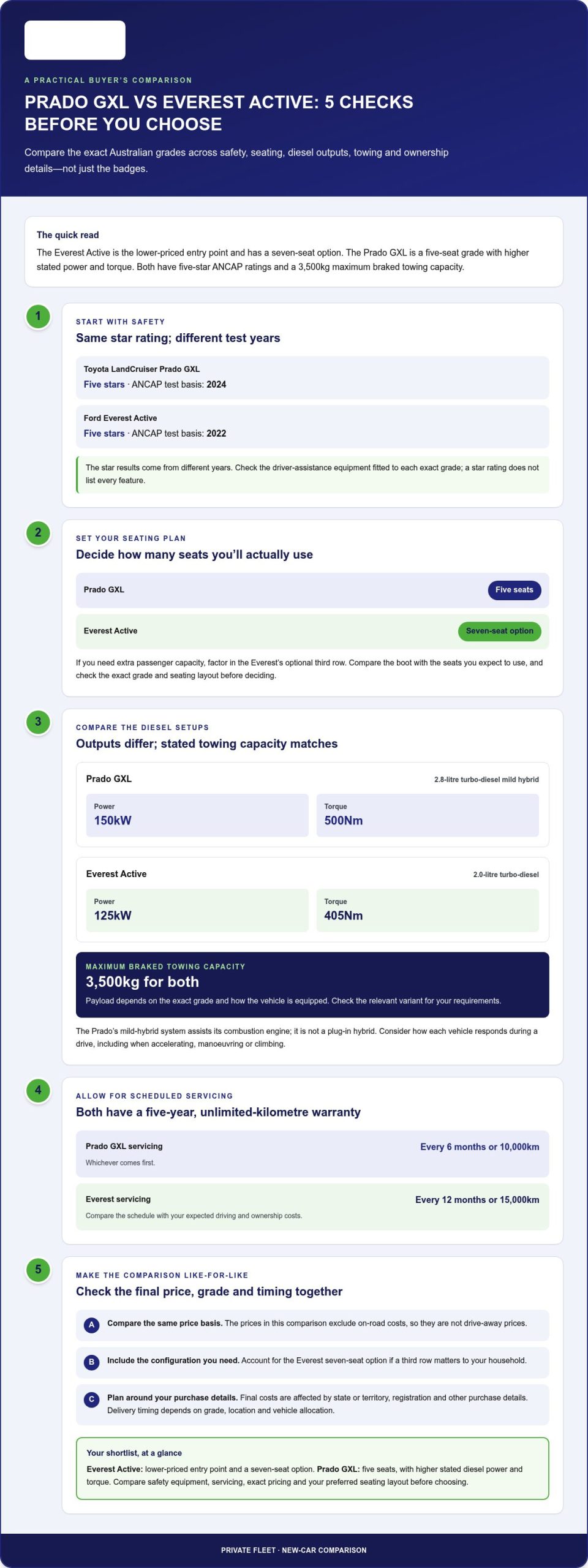
The Toyota Prado versus Ford Everest 2026 comparison in Australia comes down to the kind of family travel you do, not just the badge. The Ford Everest Active is the lower-priced entry point, while the Prado GXL’s 2.8-litre turbo-diesel mild hybrid produces 150kW and 500Nm, compared with 125kW and 405Nm from the Everest Active’s 2.0-litre turbo-diesel. Both offer five-star ANCAP ratings, based on testing in different years.
It makes sense to compare price, engine performance and safety before choosing a large SUV. But cabin space, seating, servicing and how each vehicle suits your regular trips matter just as much once you move beyond the initial comparison.
This guide compares the Toyota Prado GXL and Ford Everest Active in Australia, covering price, diesel performance, safety and family space. You’ll see how each suits everyday driving and longer trips, and how to build a shortlist around your priorities.
Key Takeaways
- Compare the exact variants you’re considering, including their seating layout and the features that matter for your family.
- Look beyond engine outputs: towing needs, fuel use and the way you drive can all shape which diesel setup suits you.
- Both SUVs have five-star ANCAP ratings, but the ratings are based on tests from different years.
- Check boot capacity with the seats you’ll actually use, then consider how passengers and luggage fit together.
- Use your priorities, budget and buying timeframe to narrow the choice before arranging the next steps for a new-car purchase.
ANCAP safety ratings
The 2026 Toyota LandCruiser Prado GXL and Ford Everest Active both have five-star ANCAP safety ratings, based on tests from different years. For advanced driver assistance, compare the equipment on each exact variant: a five-star rating alone doesn’t identify which features are fitted.
Prado safety ratings and features
The Prado GXL’s five-star ANCAP rating is based on testing in 2024, while the Everest Active’s rating comes from testing in 2022. That gives the Prado the newer test basis, but the shared star result doesn’t tell you which driver-assistance features come standard on either grade. Check the GXL’s equipment against your priorities, such as the assistance features you’ll use on highways or in traffic.
Everest safety ratings and features
The Everest Active also holds a five-star ANCAP rating, based on its 2022 test. As with the Prado, assess the Active’s driver-assistance equipment separately from its star rating. A safety score and a list of fitted features answer different questions.
| Vehicle and grade | ANCAP rating | Test year | Seating detail |
|---|---|---|---|
| Toyota LandCruiser Prado GXL | Five stars | 2024 | Five-seat grade |
| Ford Everest Active | Five stars | 2022 |
Choose by matching the seating layout and driver-assistance equipment you need to the exact grade, rather than relying on star ratings alone.
The two five-star results are a useful starting point, not a complete feature comparison. The tests were conducted in different years, so each rating reflects an assessment from a separate year. A newer Prado test does not prove that every safety feature is superior; the star rating alone cannot establish that.
Use this practical comparison when assessing the vehicles:
- Confirm the grade: compare the Prado GXL with the Everest Active, not with a different trim.
- Set the seating plan: decide whether five seats are enough or the Everest Active’s seven-seat option matters.
- Compare assistance equipment: review the exact feature list for each variant, including what is standard.
- Match features to your driving: consider which assistance functions suit your regular routes and parking situations.
For households carrying children or extra passengers, the Everest’s optional third row may matter more than the equal star ratings. If you need five seats, focus on driver-assistance equipment, visibility and how the controls feel during a drive. Either way, compare the exact Australian grade you plan to buy, because a model-level rating does not show the equipment on every trim.
Base-model pricing in Australia
Both 2026 models have Australian prices; delivery timing depends on the chosen grade, location and vehicle allocation.
Both vehicles have five-year, unlimited-kilometre warranties. Prado servicing is scheduled every six months or 10,000km, whichever comes first, while Everest servicing is due every 12 months or 15,000km.
Prado pricing and options
Compare the GX and GXL by grade, not just by badge. The GXL is the named comparison here, while the GX is a lower-priced starting point in the Prado range.
Everest pricing and options
Compare prices on the same basis before deciding. These figures exclude on-road costs, so they are not drive-away prices. Your state or territory, registration and other purchase details affect the final amount. For a like-for-like comparison, also account for the Everest’s seven-seat option if you need a third row.
Ownership costs extend beyond the initial price. Ford Everest servicing is scheduled every 12 months or 15,000km.
For a clearer budget, compare each vehicle over the same ownership period and annual kilometres. Include purchase costs, scheduled servicing and fuel use, then consider how often you’ll travel with seven seats occupied. The difference between starting prices can help narrow your shortlist, but grade and seating needs determine which comparison is relevant.
- Choose the Prado GXL if that specific grade is your preferred configuration and its higher starting price fits your budget.
- Choose the Everest Active if the lower entry price suits you, adding the seven-seat option only when needed.
- Compare the final figures on the same basis, including on-road costs and any selected seating option.
For Australian delivery planning, distinguish a published model price from an individual vehicle’s timing. The 2026 starting prices establish that both models are priced for Australia; grade, location and allocation influence when a particular vehicle can be supplied. If you’re weighing the two against your budget and preferred timing, you can share your shortlist and buying timeframe.
Diesel engine outputs and transmissions
The Prado GXL’s 2.8-litre turbo-diesel mild hybrid produces 150kW and 500Nm; the Everest Active’s 2.0-litre turbo-diesel produces 125kW and 405Nm. Both have a maximum braked towing capacity of 3,500kg, but payload depends on the exact grade and how the vehicle is equipped.
Prado diesel outputs and transmission
The Prado GXL pairs its 2.8-litre diesel with a mild-hybrid system, delivering 150kW and 500Nm. Its higher torque output than the Everest Active’s 405Nm is relevant when assessing loaded driving and towing. A mild hybrid assists the combustion engine; it isn’t a plug-in hybrid. Evaluate the transmission’s response during a drive, especially when accelerating, manoeuvring or climbing.
Everest diesel outputs and transmission
The Everest Active uses a 2.0-litre four-cylinder turbo-diesel producing 125kW and 405Nm. That’s less power and torque than the Prado GXL, although the Active shares its 3,500kg maximum braked towing capacity. Transmission behaviour matters beyond the output figures: notice how the Everest responds to throttle changes and maintains progress when carrying passengers or luggage.
| Australian grade | Diesel engine | Maximum output | Maximum braked towing | Payload reference |
|---|---|---|---|---|
| Toyota Prado GXL | 2.8-litre turbo-diesel mild hybrid | 150kW, 500Nm | 3,500kg | 615kg |
| Ford Everest Active | 2.0-litre four-cylinder turbo-diesel | 125kW, 405Nm | 3,500kg | Compare the exact Active specification |
The towing figure doesn’t tell you how much payload remains once passengers, luggage and accessories are aboard. The Prado GXL’s payload is 615kg. A Ford Everest Trend payload is 717kg, but that’s a different grade and shouldn’t be treated as the Active’s figure. Match payload information to the precise variant before planning a loaded trip.
For towing, assess the whole combination rather than relying on the headline capacity. A 3,500kg braked towing limit applies to the vehicle’s stated maximum; the trailer, passengers and carried equipment all matter to the practical load. For either SUV, list who travels, what goes inside and what the trailer carries. Then compare that use case with the exact variant’s load limits.
On a test drive, pay attention to how the drivetrain behaves in the conditions you expect to encounter. Try a gradual pull-away, steady cruising and a safe acceleration manoeuvre. Compare how the Prado GXL and Everest Active deliver power and whether their transmissions feel predictable to you. Output figures are useful context, but driving feel, load and towing needs help determine the better fit.
Choose the Prado GXL if its 150kW and 500Nm output suits your priorities; consider the Everest Active’s lower outputs alongside its matching 3,500kg towing capacity. For payload planning, use the exact grade’s figures rather than substituting the Everest Trend’s 717kg specification.
Family cabin and cargo space
Boot capacity changes considerably between five-seat and seven-seat layouts in both the Prado and Everest. Compare luggage space with the seats you’ll use, then check how the cabin works for your passengers.
Prado cabin and cargo space
The Toyota Prado’s claimed boot capacity is 906 litres with five seats in use, falling to 182 litres with seven seats in use. That difference matters for family trips: with all seven seats occupied, bulky bags may need careful placement. Compare the five-seat figure only with the Everest’s five-seat layout, and the seven-seat figure only when assessing full passenger capacity.
For a practical check, bring items you regularly carry, such as prams, sports bags or travel cases. See how they fit behind the seating row you expect to use. The Prado’s larger five-seat boot may suit regular luggage runs, while its reduced seven-seat capacity requires a different packing plan.
Everest cabin and cargo space
The Ford Everest provides 898 litres of boot space with five seats in use and 259 litres with seven seats in use. Its five-seat capacity is close to the Prado’s, while the Everest has more listed cargo volume with all seven seats in use. That can make a practical difference when the third row is occupied and passengers still need room for smaller bags.
Check rear-seat and boot access with your usual passengers aboard. With all seven seats in use, the Everest has less cargo volume than in its five-seat arrangement, so consider where everyday items will go. For school bags, shopping or weekend luggage, try loading representative items rather than relying on litres alone.
Seating and cabin equipment
Assess both cabins in the seating arrangement you’ll actually use. The Everest Active starts as a five-seat grade, with seven seats available as an option; the Prado GXL comparison is a five-seat configuration. If you need a third row, compare the Everest’s optional layout with the Prado’s seven-seat cargo figures as separate configurations.
During a showroom visit, sit in each row and adjust the driver’s seat, mirrors and steering position. Check entry and exit, rear visibility, child-seat access and whether the controls are easy to reach. Try the touchscreen and physical controls in both vehicles, then consider whether passengers can settle comfortably for a longer journey.
| Model | Boot with five seats in use | Boot with seven seats in use | Seating detail |
|---|---|---|---|
| Toyota Prado | 906 litres | 182 litres | Compare the required seating configuration |
| Ford Everest | 898 litres | 259 litres | Seven seats are an option on Everest Active |
Match passenger numbers to usable luggage space: the Everest lists more boot capacity with seven seats occupied, while the Prado lists slightly more with five seats in use.
Choosing between the Everest and Prado
In a Toyota Prado vs Ford Everest 2026 Australia comparison, the Everest Active offers 226mm ground clearance and a claimed 800mm wading depth. Prado GX has 210mm ground clearance, while the Prado’s permanent four-wheel-drive system sends torque to the front and rear wheels in a 40:60 split by default.
Prado off-road capability
The Prado’s permanent four-wheel-drive system uses a default 40:60 front-to-rear torque split. Its 210mm ground clearance figure applies to the Prado GX, not specifically the GXL, so keep the grade distinction clear. If you’re considering a GXL, compare its exact specification with the terrain you expect to encounter rather than assuming the GX figure transfers across.
Ground clearance can matter on uneven tracks, where the space beneath the vehicle affects obstacle clearance. The Prado GX’s 110-litre tank is another planning consideration for longer journeys between fuel stops. Think about the route, fuel access and the load you’ll carry before deciding whether the Prado’s four-wheel-drive setup suits your trips.
Everest off-road capability
The Everest Active has 226mm of ground clearance and a claimed 800mm wading depth. Those figures can be compared with the Prado GX’s 210mm clearance, but they don’t describe every part of off-road capability. Assess the four-wheel-drive configuration of the specific Everest grade alongside the conditions and terrain you plan to tackle.
Clearance and wading depth are useful measures, not guarantees of suitability for every track. Consider the route’s obstacles and conditions, then match them to the vehicle’s specifications. The Everest Trend has an 80-litre fuel tank, but that capacity belongs to the Trend grade, not the Active. Keep model and grade details distinct when planning remote travel.
The Toyota Prado vs Ford Everest 2026 Australia choice depends on the vehicle’s exact grade and your intended routes. Neither SUV is automatically the better fit for every off-road journey. Compare the terrain, distance and four-wheel-drive system you need before settling on a model.
| Off-road consideration | Toyota Prado | Ford Everest |
|---|---|---|
| Ground clearance | 210mm for Prado GX | 226mm for Everest Active |
| Wading depth | Consider the intended route and vehicle specification | Claimed 800mm for Everest Active |
| Four-wheel-drive detail | Permanent system; default 40:60 front-to-rear torque split | Assess the exact grade’s configuration |
| Fuel tank reference | 110 litres for Prado GX | 80 litres for Everest Trend |
Use these checks to narrow your choice:
- Match the terrain: compare clearance and wading figures with the tracks and conditions you expect.
- Confirm the grade: Prado GX figures don’t automatically describe the GXL.
- Plan the route: consider fuel-stop access and the tank capacity of the exact variant.
- Assess the system: compare the four-wheel-drive configuration fitted to your preferred grade.
The Prado’s permanent four-wheel drive and the Everest Active’s listed ground clearance and claimed wading depth offer different points to compare. Base your decision on the route, grade and equipment that suit your intended use.
For help comparing your shortlist, explore Toyota new-car options and Ford new-car options, call 1300 303 181, or Get help buying my new car.
Private Fleet: New Cars
Private Fleet’s New Car Buying Service can help you compare a new Toyota Prado GXL and Ford Everest Active through its nationwide network of authorised dealerships. Its tender process invites multiple dealers to compete for your business. Private Fleet sources vehicles rather than holding its own stock, so the service can help once you’ve chosen a preferred grade and want support with the purchase.
Share your preferred model, postcode and buying timeframe to help shape the search. If you have a vehicle to replace, Trade-In Assistance can also form part of your purchase planning. Explore the Toyota vehicle buying information and Ford vehicle buying information, or call 1300 303 181.
Turn your shortlist into a buying plan
The next step in the Toyota Prado versus Ford Everest 2026 decision in Australia is to set your priorities before pursuing a vehicle. Decide which grade you want, whether your preference is firm or flexible, and what timing works for your household. A clear shortlist makes it easier to compare new-car options and plan the purchase around your needs.
Private Fleet’s New Car Buying Service uses a nationwide network of authorised dealerships and a tender process that invites multiple dealers to compete for your business. If you’re replacing a vehicle, the service can also assist with trade-in valuation. Explore Toyota new-car buying information and Ford new-car buying information as you refine your shortlist.
Share your preferred model or grades, postcode and buying timeframe when you get in touch. You can also call 1300 303 181 to discuss your next step.
Get help buying my new car
A considered shortlist puts you in a stronger position to move forward with confidence.
Frequently Asked Questions
How much do the Ford Everest Active and Toyota LandCruiser Prado GXL cost?
These are Australian starting prices, not drive-away totals. Compare the same price basis and seating configuration, then account for the on-road costs applicable to your purchase. If you’re considering an Everest Active with seven seats, include that option in your budget.
What are the 2026 Toyota Prado prices in Australia by grade?
These figures distinguish the entry grade from the GXL comparison model. Before choosing, decide whether the GX or GXL best suits your needs, then compare the total purchase cost on the same basis. On-road costs are additional to both listed prices.
What are the 2026 Ford Everest prices in Australia by grade?
Compare the Active and Trend as separate grades, and include the seating configuration you need. These listed amounts exclude on-road costs, so they are not final drive-away prices.
What engines, transmissions and fuel types do the 2026 Prado and Everest offer in Australia?
Both comparison vehicles use diesel. The Prado GXL has a 2.8-litre turbo-diesel mild-hybrid engine producing 150kW and 500Nm; the Everest Active has a 2.0-litre four-cylinder turbo-diesel producing 125kW and 405Nm. The Prado’s mild-hybrid system isn’t a plug-in hybrid. Compare the transmission fitted to your preferred grade and how it responds during a test drive, particularly under load.
How do the Prado and Everest compare in fuel consumption and driving range?
The Everest Active’s claimed combined consumption is 7.1L/100km. The Prado GX’s ADR figure is 7.6L/100km, while the Prado GXL recorded an observed 12.6L/100km in a comparison test. These figures use different contexts, so don’t treat them as a direct like-for-like result. Tank size also varies by grade; range depends on consumption in your driving and the tank fitted to that variant.
How do the Prado and Everest compare in passenger space, boot capacity and seating?
The Everest Active can be optioned with seven seats, while the five-seat configuration leaves the full boot available for luggage. First decide how many passengers you usually carry, then assess the cargo space behind the seats you’ll use. If your family carries a mix of passengers and bags, try loading a typical set of items. Also consider third-row access and where smaller items can go when every seat is occupied.
What safety features and ANCAP ratings do the 2026 Prado and Everest have?
Both have five-star ANCAP ratings: the Prado rating is based on 2024 testing, and the Everest rating on 2022 testing. A star rating doesn’t list every feature fitted to a particular grade. For your shortlist, compare the driver-assistance equipment and controls on the exact variants, then consider which functions you’ll use in your regular driving, parking and longer trips.