
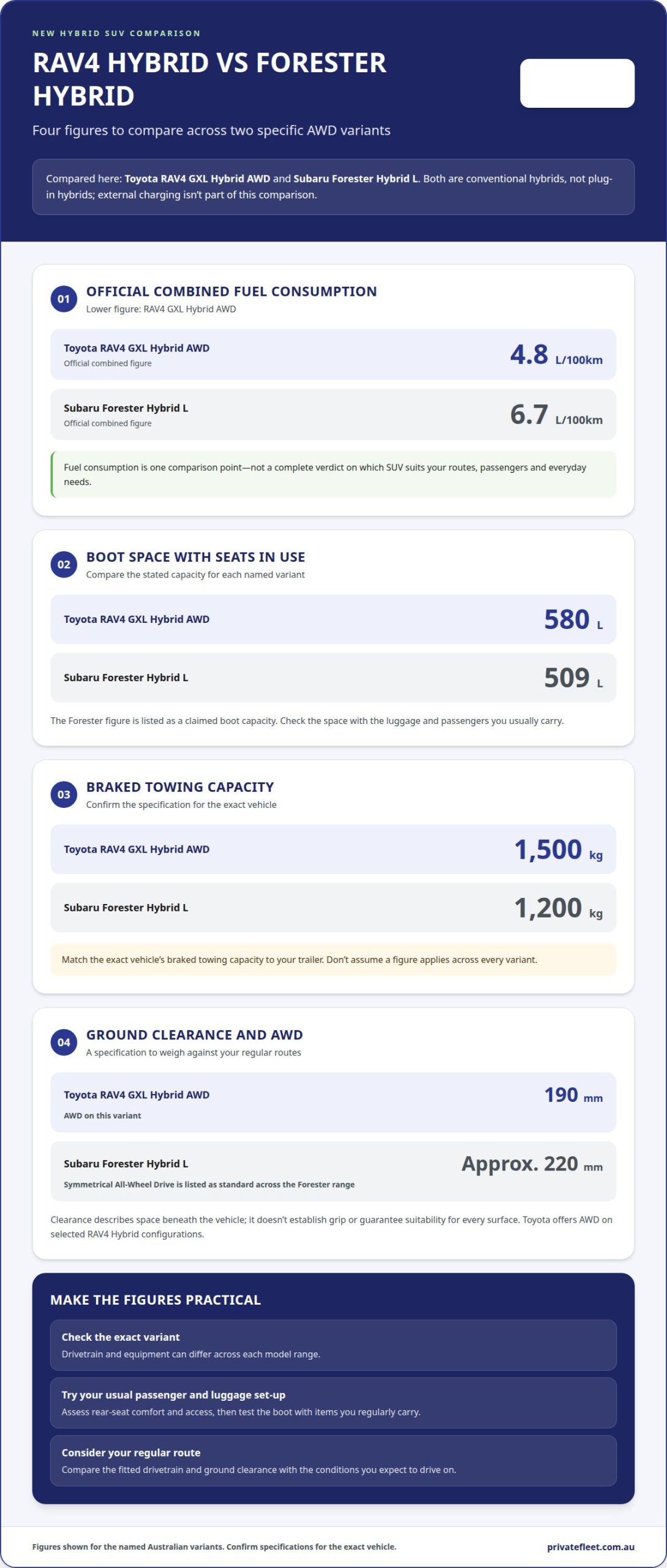
The lower-fuel-use hybrid isn’t automatically the better all-round buy. In the Toyota RAV4 Hybrid versus Subaru Forester Hybrid 2026 comparison, the RAV4 GXL Hybrid AWD has an official combined fuel consumption figure of 4.8 L/100km, compared with 6.7 L/100km for the Forester Hybrid L. That gives the RAV4 the lower official figure, but it doesn’t settle which SUV is right for your driving.
It’s reasonable to look beyond fuel use when choosing a new hybrid. The way each car feels on your regular routes, the room you need for passengers and luggage, and the servicing and warranty terms can all shape the decision, especially if you plan to keep your car for years.
This guide compares how the RAV4 and Forester stack up on driving, fuel consumption, space, comfort and technology, then examines servicing, vehicle warranty and battery coverage. It also brings the Nissan X-Trail e-POWER into the wider shortlist, so you can weigh the options against your priorities and narrow down which new SUV deserves a closer look.
Key Takeaways
- The RAV4 GXL Hybrid AWD has a lower official combined fuel consumption figure than the Forester Hybrid L: 4.8 L/100km versus 6.7 L/100km.
- Compare the exact variants you’re considering, as powertrain, all-wheel drive and equipment can affect how each SUV suits your regular driving.
- Use the boot capacities and passenger space figures to judge whether each vehicle fits your usual mix of people and luggage.
- Look beyond touchscreen size: consider seat comfort, visibility, physical controls and parking assistance during your comparison.
- Compare servicing intervals, vehicle warranty and battery coverage separately, then weigh them alongside fuel use and the features you’ll value day to day.
Hybrid engines and all-wheel drive
The 2026 Toyota RAV4 Hybrid and Subaru Forester Hybrid are listed for Australia, with different engine outputs and AWD arrangements. Figures and equipment below were checked in November 2026; compare the exact variant before choosing.
Hybrid engine specifications
The RAV4 GXL Hybrid AWD pairs a 2.5-litre petrol engine producing 131kW and 221Nm with a hybrid system delivering 163kW combined maximum power. The Forester Hybrid L pairs a petrol engine with a hybrid system, so engine output and combined system output are separate measures. These figures distinguish engine output from combined system output, so compare like-for-like measures when assessing performance.
Both are conventional hybrids, not plug-in hybrids, so external charging isn’t part of this comparison. The listed Australian 2026 RAV4 hybrid range includes front-wheel-drive and all-wheel-drive configurations. Check the variant name carefully: the GXL Hybrid AWD is the all-wheel-drive version, while equipment and drivetrain can differ across the wider range.
All-wheel-drive availability and traction
Subaru lists Symmetrical All-Wheel Drive as standard across the 2026 Forester range. Toyota offers AWD on selected RAV4 Hybrid configurations. For a driver regularly using gravel access roads or slippery inclines, compare the drivetrain fitted to the exact vehicle, rather than assuming all hybrids in either range have the same traction setup.
Ground clearance is another specification to weigh alongside AWD. The Forester is listed with approximately 220mm, compared with 190mm for the RAV4 GXL Hybrid AWD. Clearance describes space beneath the vehicle; it doesn’t establish grip or guarantee suitability for every surface. Consider your regular route and how much clearance it demands.
| Australian variant | Engine and listed output | AWD configuration | Ground clearance |
|---|---|---|---|
| Toyota RAV4 GXL Hybrid AWD | 2.5-litre petrol, 131kW/221Nm; 163kW combined | AWD | 190mm |
| Subaru Forester Hybrid L | 2.0-litre petrol, 110kW/196Nm; 145kW hybrid output | Symmetrical AWD | Approximately 220mm |
Drive-away pricing depends on the chosen variant and postcode. Compare the same price basis and equivalent equipment, because a RAV4 Cruiser and Forester Hybrid listing represent different grades. Driver-assistance equipment also varies: the compared 2026 RAV4 has front parking-distance control, while the compared Forester Hybrid does not. Choose by matching your preferred drivetrain, route conditions and useful assistance features to the exact variant.
Cargo capacity and passenger room
Boot space and towing limits depend on the exact Australian variant, so compare the RAV4 GXL Hybrid AWD and Forester Hybrid L using their matching specification sheets. A model name alone isn’t enough: trim and powertrain can affect the figures relevant to your purchase.
To assess passenger comfort, sit in the rear seat with the driver’s seat in your usual position. Check whether passengers can sit comfortably and get in and out easily. If you regularly carry family or friends, bring them along to assess the cabin for themselves.
Try the boot with items you often carry. A pram, suitcase or golf clubs can show whether the opening, floor shape and available space suit your needs. Load an item without folding a seat, then see how the layout changes when you fold the rear seats. This practical check can be more useful than comparing headline capacity figures alone.
Towing needs a separate, variant-specific check. Compare the braked towing capacity for the exact vehicle with the trailer you intend to tow, and consider how often you’ll carry passengers or luggage at the same time. Don’t assume a figure for one RAV4 or Forester variant applies across its entire range.
| Comparison point | Toyota RAV4 GXL Hybrid AWD | Subaru Forester Hybrid L |
|---|---|---|
| Boot with seats in use | Compare the Australian variant specification | Compare the Australian variant specification |
| Rear passenger fit | Assess with your usual occupants | Assess with your usual occupants |
| Braked towing capacity | Use the exact variant’s specification | Use the exact variant’s specification |
Bring your usual luggage and passengers when viewing either SUV. Check how child seats or other equipment fit if relevant, and consider how often you need the full boot compared with extra space from folding the seats. For the Nissan X-Trail e-POWER, make the same checks on the specific Australian variant rather than assuming its cabin or towing figures match either rival.
The Toyota RAV4 GXL Hybrid AWD has a braked towing capacity of 1500kg, compared with 1200kg for the Subaru Forester Hybrid L.
The Toyota RAV4 GXL Hybrid AWD has a 580L boot capacity with all seats in use, while the Subaru Forester Hybrid L has a claimed boot capacity of 509 litres. Based on their specification sheets, the Subaru Forester Hybrid has about 10.2 cu.-ft. less seats-up cargo space than the Toyota RAV4.
Comfort and technology features
Comfort and cabin technology are personal, so compare the exact Australian variants you’re considering. A close inspection can show whether the seats, controls and storage suit your daily routine.
Interior comfort and ergonomics
Start with the driver’s seat in the Toyota RAV4, Subaru Forester and Nissan X-Trail e-POWER. Adjust it and the steering wheel to your preferred position, then check whether the pedals and frequently used controls feel easy to reach. Look across the bonnet and through the side windows to assess visibility from your normal driving posture.
Spend time in each cabin before deciding. Try the door handles, adjust the seats and explore the storage, then put your everyday items where you’d naturally keep them. Test the displays and buttons in likely lighting conditions, especially if you wear reading glasses or prefer a particular way of using the controls.
Trim levels and standard features
Trim names and equipment vary across model ranges. Compare the exact Australian grade of each SUV, using its specification sheet to see what’s standard and what changes between variants. This keeps the comparison focused on the cars you could actually choose, rather than assuming similarly named grades have equivalent features.
List the features you’ll use regularly, such as phone connectivity, climate controls and parking assistance. Check each against the specifications for the exact variant. A feature offered in the model range may not be fitted to every grade, so distinguish standard equipment from optional or higher-grade items.
| Cabin check | Toyota RAV4 | Subaru Forester | Nissan X-Trail e-POWER |
|---|---|---|---|
| Driving position | Adjust seat and steering wheel | Adjust seat and steering wheel | Adjust seat and steering wheel |
| Controls and display | Try common tasks while parked | Try common tasks while parked | Try common tasks while parked |
| Variant equipment | Compare the exact grade specification | Compare the exact grade specification | Compare the exact grade specification |
Drive each SUV on familiar roads to assess how it feels in motion. Notice whether the seat stays comfortable, whether you can use familiar functions without distraction, and how clearly you can judge the vehicle’s position. A quiet, low-speed street and a busier route can reveal different aspects of the cabin experience.
For a fair comparison, assess the RAV4, Forester and X-Trail e-POWER using the same checks. Record the variant names and the features that matter to you, then compare those notes after the drive. This makes your choice about usable comfort and equipment, not a screen measurement or trim label alone.
Fuel economy
The RAV4 GXL Hybrid AWD has a lower official combined consumption figure than the Forester Hybrid L. Comparing official figures with a pump-measured test helps show why your own routes matter.
Fuel economy estimates
Toyota lists the RAV4 GXL Hybrid AWD at 4.8 L/100km combined, while Subaru lists the Forester Hybrid L at 6.7 L/100km. In a pump-measured review test, the RAV4 used 4.9 L/100km and the Forester used 7.8 L/100km. Those test results relate to that specific drive, not every owner’s typical use.
Keep the two kinds of figures separate. The official combined figures offer a consistent reference, while a test result reflects its particular route and conditions. For the Nissan X-Trail e-POWER, compare the official Australian figure for the exact variant against the RAV4 and Forester figures. Don’t treat a single trip as a guaranteed prediction.
| Australian hybrid variant | Official combined fuel consumption | Pump-measured review test | Fuel tank |
|---|---|---|---|
| Toyota RAV4 GXL Hybrid AWD | 4.8 L/100km | 4.9 L/100km | 55 litres |
| Subaru Forester Hybrid L | 6.7 L/100km | 7.8 L/100km | 48 litres |
Driving range
Fuel consumption and tank capacity both shape how far you can travel between refills. The RAV4 GXL Hybrid AWD combines a 55-litre tank with its lower official consumption figure; the Forester Hybrid L has a 48-litre tank. This points to a potential RAV4 advantage between stops, but your actual distance depends on driving conditions and fuel use.
For regional trips, consider how often your usual route offers convenient refuelling. In the city, frequent stops, traffic and short journeys can make your fuel use differ from a combined test figure. Compare the same planned journey for both SUVs rather than assuming a published figure translates directly into a set distance.
Build your comparison around your driving habits. Note whether you mostly drive in city traffic, cruise on open roads or regularly carry a full passenger load. Then compare the official combined figures for the exact variants, treating pump-measured results as a separate reference.
- Mostly urban driving: focus on how the SUV performs over your regular stop-start routes.
- Long-distance travel: weigh consumption alongside tank capacity and access to fuel stops.
- Three-model shortlist: compare each Australian variant using the same official consumption measure.
The RAV4 figures are lower than the Forester’s in both comparisons provided, while the Nissan needs to be assessed using its exact Australian variant. Use those figures to shortlist, then consider how your own route, load and driving habits may affect fuel economy.
Servicing, warranty and battery coverage
Servicing intervals and warranty terms affect the ownership picture beyond fuel use. For the RAV4 GXL Hybrid AWD, the listed service interval is 12 months or 15,000km, whichever comes first.
Toyota’s listed cover for the RAV4 GXL Hybrid AWD is five years of unlimited-kilometre warranty cover. Powertrain cover can extend up to seven years when logbook servicing is maintained. Treat the standard vehicle warranty and any extended powertrain cover as separate terms, and read the servicing conditions alongside both.
Battery coverage is another distinct item. A hybrid battery warranty may have its own duration, distance limit, capacity conditions, exclusions and service requirements. Compare those terms separately from the vehicle warranty for the exact Australian RAV4, Forester and X-Trail variants you’re considering. Don’t assume one model’s general warranty duration also describes its battery cover.
For the Forester Hybrid and Nissan X-Trail e-POWER, compare the Australian warranty booklet and service schedule with Toyota’s terms. Check covered components, start date, kilometre limits, exclusions, transferability and servicing conditions. This gives you a more useful comparison than warranty length alone, because the coverage and conditions matter too.
| Ownership detail | Toyota RAV4 GXL Hybrid AWD | Forester Hybrid and X-Trail e-POWER |
|---|---|---|
| Listed service interval | 12 months or 15,000km | Compare the exact Australian variant schedule |
| Vehicle warranty | Five years, unlimited kilometres | Compare duration, distance limits and covered components |
| Powertrain cover | Up to seven years with maintained logbook servicing | Review the variant’s terms and conditions |
| Battery cover | Assess separately from vehicle warranty | Assess separately from vehicle warranty |
Compare servicing on a like-for-like basis, using the same ownership period and distance for each SUV. Consider the timing of scheduled visits, the work included and how the service conditions relate to warranty cover. Fewer service visits do not necessarily mean lower total servicing costs.
Before choosing, set out the terms for each exact model and variant: scheduled service intervals, vehicle warranty, powertrain coverage and hybrid battery coverage. This gives you a clearer view of both planned maintenance and warranty conditions. For the RAV4, keep the 12-month or 15,000km interval in mind when mapping servicing against your expected kilometres.
Private Fleet: New Cars
Private Fleet can help turn your RAV4, Forester or X-Trail shortlist into a new-car purchase plan. Its New Car Buying Service works with a national network of authorised dealerships, inviting multiple dealers to compete for your business through a tender process. You can compare options around your preferred model, variant and buying timeframe without managing each step alone.
If replacing your current vehicle is part of the decision, Trade-In Assistance can help with that side of the purchase. Car Finance is also available if you’re considering finance alongside your new-car choice. Explore the Toyota discount page, Subaru discount page and Nissan discount page as you refine your shortlist.
A clear shortlist makes the next step easier. Choose the SUV that best matches how you plan to use your next car.
Frequently Asked Questions
How do they drive?
Expect the RAV4 Hybrid and Forester Hybrid to feel different behind the wheel, so try both on familiar roads before choosing. Include a mix of low-speed traffic, open-road cruising and rougher surfaces. Notice how smoothly each responds when accelerating, how easily you judge the vehicle’s edges, and whether its steering feels comfortable during parking manoeuvres. The X-Trail e-POWER adds another driving character to assess on the same route.
How do they look?
Looks are personal, so compare the RAV4, Forester and X-Trail side by side rather than relying on photos. View each from the front, rear and driver’s seat. Check whether the shape suits your taste and whether the windows give you a clear view when manoeuvring. A walk-around can also help you judge how easy it is to see the vehicle’s corners in a car park.
Subaru Forester vs Toyota RAV4 2026: which SUV is right for you?
The right choice depends on how you’ll use the SUV and which Australian variant matches that routine. In a 2026 comparison of the Toyota RAV4 Hybrid and Subaru Forester Hybrid, start with your regular passengers, luggage, routes and parking conditions. Add the Nissan X-Trail e-POWER if it meets your needs, then compare each shortlist vehicle’s exact features and ownership terms before deciding.
What about their interiors?
The best interior is the one that works naturally for you and your passengers. Sit in each SUV and check the driving position, visibility, storage and access to controls. While parked, try adjusting the climate settings and connecting your phone. Then sit in the rear and assess comfort with the front seat in your preferred position. These checks can reveal everyday differences that photos and feature lists won’t.
What are the Australian prices for the 2026 Toyota RAV4 Hybrid and Subaru Forester Hybrid?
Pricing varies by model variant and postcode, so compare drive-away figures on the same basis. The listed Victorian RAV4 figure applies to the Cruiser, while the Forester figure applies to its Hybrid variant, making them different equipment grades. Compare the precise trim, included equipment and applicable on-road costs for your location. That gives you a more useful comparison than treating unlike variants as direct price equivalents.
How do the RAV4 Hybrid and Forester Hybrid compare in fuel consumption and real-world economy?
The RAV4 GXL Hybrid AWD has lower listed official and pump-measured consumption than the Forester Hybrid L in the figures compared. Real-world use still depends on your routes, traffic, speeds and how the vehicle is loaded. To make your own comparison useful, record fuel use across similar driving conditions rather than judging either SUV from one short trip or relying on a single result.
What are the dimensions, boot capacity and cabin space of the 2026 RAV4 Hybrid and Forester Hybrid?
The RAV4 GXL Hybrid AWD has the larger seats-up boot in the compared Australian variants, while the Forester Hybrid L is slightly longer overall. Those figures won’t tell you whether your luggage fits or rear seats suit your passengers. Bring a typical case, pram or other bulky item to each vehicle, then check access, seat comfort and visibility from both rows.
Which 2026 hybrid SUV has better safety ratings and driver-assistance features in Australia?
A parking-assistance difference alone can’t establish which SUV has a better safety rating. The RAV4 comparison includes front parking-distance control, while the compared Forester Hybrid does not. Crash-test ratings and driver-assistance equipment assess different aspects of a vehicle. Compare the rating for the exact Australian model year and variant alongside its included assistance features, rather than treating one parking function as a complete safety verdict.