
What if more dealer offers still leave you unsure which new car deal is right? A vehicle tender system for car buyers can invite multiple dealers to compete for your business, but the number of offers matters less than whether each one matches your needs. It’s reasonable to wonder what happens after you submit a request, especially when prices, inclusions and delivery details don’t line up.
Private Fleet is an independent Australian vehicle sourcing and car buying service that manages a tender process through a national network of authorised dealerships. It doesn’t hold its own vehicle inventory: dealers respond to your vehicle brief, and you make the final decision. This guide explains how the process works, what information to prepare and how to assess offers on a like-for-like basis. Check the exact make, model, variant and model year, compare drive-away prices and included costs, and clarify estimated delivery timing and any conditions. That way, you can decide whether a tender suits your priorities instead of assuming dealer competition automatically makes an offer suitable or transparent.
Key Takeaways
- A vehicle tender system for car buyers gathers dealer responses to a new-car brief, giving you offers to assess without obliging you to accept one.
- State your preferred make, model, variant and buying timeframe clearly so dealer responses reflect what you’re actually looking for.
- Compare tender responses with direct quotes using the same model year, powertrain, options and price basis to spot meaningful differences.
- Before accepting an offer, confirm the vehicle specification, included costs, conditions and delivery timing in writing.
- Consider the new-car decision separately from optional trade-in or finance choices, so each part of the purchase can be assessed on its own merits.
What is a vehicle tender system for car buyers?
A vehicle tender invites multiple dealers to respond to one buyer’s brief for a new car. Your brief can set out the preferred make, model, variant, options and buying timeframe. Dealers then provide offers for you to assess. You stay in control: you choose which vehicle and terms suit you, and whether to proceed at all.
This approach gives dealers an opportunity to compete for your business, but it doesn’t guarantee the lowest price, a particular vehicle being in stock or a specific delivery date. Responses may differ in what they include and the conditions attached, so a lower quoted figure isn’t automatically the best fit. Check what each offer covers before comparing it with your budget and priorities.
The process is similar to a reverse auction, where sellers compete to win a buyer’s business. In a car-buying tender, you still need to assess each response and make the final decision. Private Fleet is an independent sourcing and car-buying service, not a retailer holding its own vehicle inventory. Its tender process invites dealers in its national network of authorised dealerships to compete. You can read more about how the new-car buying process works.
How is a dealer tender different from requesting one quote?
A direct quote gives you one dealer’s offer. A tender can gather responses from multiple dealers against the same requirements, making it easier to see where offers differ. For a fair comparison, keep the brief consistent: specify the same model year, variant, powertrain, options and price basis. Dealer participation and responses can vary, so don’t assume every request will produce identical or complete offers.
Who may find a vehicle tender useful?
A tender may suit buyers who want help sourcing a new car without approaching dealers individually, or who have a shortlist and want to compare offers against the same requirements. It can also make the process more manageable when you’re weighing vehicle features, timing and ownership priorities. The value lies in getting responses to a clear brief, then deciding whether any offer genuinely suits your circumstances.
To make a tender useful, focus on the full offer rather than the headline price. A consistent brief and careful comparison can show where responses differ, while keeping the final choice firmly with you.
How does a vehicle tender work from brief to dealer response?
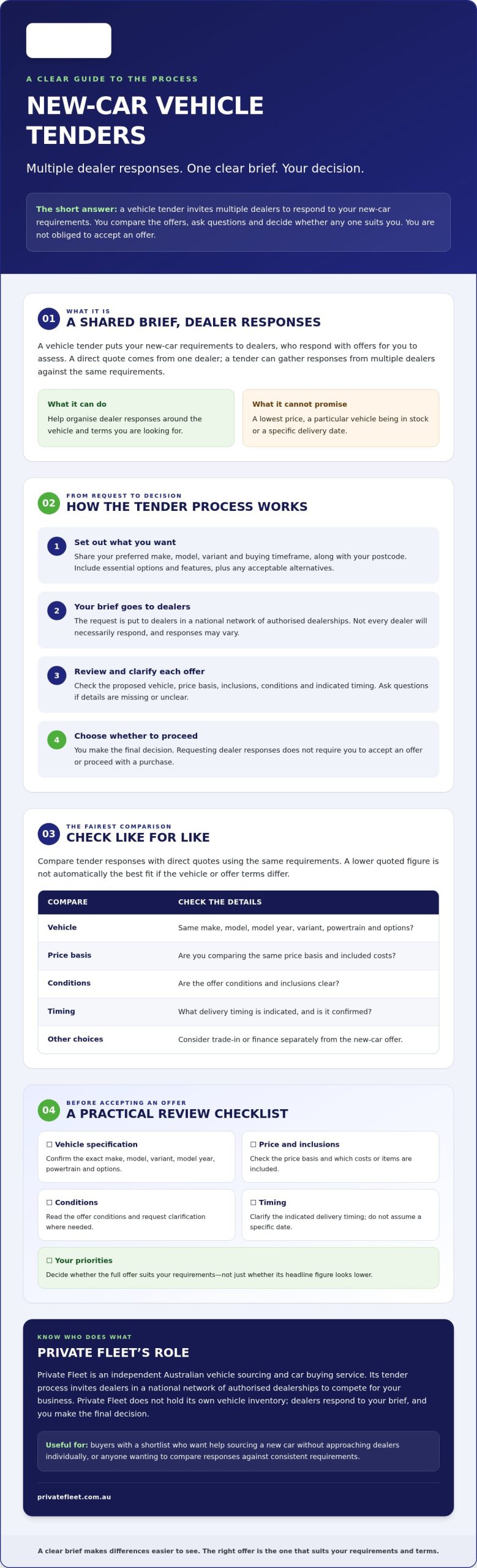
A vehicle tender turns your new-car requirements into a request that can be shared with dealers. In a vehicle tender system for car buyers, the steps are straightforward: set out what you want, have the request put to dealers in a national network of authorised dealerships, review the responses, then decide whether to proceed. A clear brief makes it easier to see which offers match and where they differ.
- Share your requirements. Specify your preferred make, model, variant and buying timeframe, along with your postcode.
- Source dealer responses. The service puts your brief to dealers. Not every dealer will necessarily respond, and responses may vary.
- Review the details. Check each proposed vehicle, price basis, inclusions, conditions and indicated timing.
- Make the decision. Ask questions or seek clarification, then choose whether an offer suits you. Requesting responses doesn’t require you to proceed.
This process helps organise the search, but it doesn’t mean every response will be identical or meet every preference. Use your brief as the reference point. If a dealer proposes a different variant or option, identify the difference before comparing the offer with your requirements.
What should you include in a new-car buying brief?
Be as specific as you can, and note where you’re flexible. Include:
- Preferred make, model, variant and colour, if decided.
- Essential options and features, plus acceptable alternatives.
- Your postcode and intended buying timeframe.
- Any trade-in requirements, if you’d like that considered separately.
If you’re still choosing between variants, say so. A shortlist gives dealers a useful starting point without locking you into a specification before you’re ready. It also helps you judge whether a proposed alternative meets the features you consider essential.
What happens when dealers respond to the tender?
Responses can differ in vehicle configuration, included items, stated price basis and availability. One dealer may quote the exact variant you requested, while another may suggest an alternative. Check the details rather than assuming the offers are directly comparable, and ask for clarification where information is missing. Read how the car-buying process works for more detail on the steps.
Once you have responses, the choice remains yours. Compare them against your brief, request further information or decide not to proceed. If you’d like help setting out your requirements, Get help buying my new car by sharing your preferred make or model, postcode and buying timeframe.
How should you compare tender offers with a direct dealer quote?
Compare the tender response and direct quote against the same requirements, not just their headline figures. A side-by-side record helps show whether a price difference comes from the offer itself or from a different vehicle, price basis or set of inclusions. The best-fit offer may not be the one with the lowest stated amount.
Use these labelled fields as a comparison template:
Vehicle: Record the model year, variant and powertrain in each offer, then note your required specification.
Options and accessories: List what each quote includes or excludes, alongside the options you requested.
Price basis and charges: Note whether each figure is drive-away or uses another price basis. Record the charges and inclusions stated, and ask about anything unclear.
Conditions and timing: Capture quote validity, stated conditions and any availability or delivery information, then compare them with your needs.
Which details make two new-car offers comparable?
First confirm that both offers are for the same model year, variant, powertrain and options. Then check that the price basis matches. If one quote is drive-away and the other isn’t, ask for a clear breakdown before treating them as equivalent. Record included charges, accessories, exclusions, quote validity and conditions so you can compare the full terms, not just the first figure you see.
Check current specifications and offers against Australian manufacturer or authorised dealer information. Treat a trade-in valuation as a separate part of the purchase, and compare it on its own terms. Do the same with finance: keep any repayment, interest or fee details distinct from the vehicle’s quoted price so the comparison stays clear.
Does dealer competition guarantee the lowest price?
No. Competition can give you options to consider, but it doesn’t guarantee the lowest price. An offer’s suitability depends on whether it matches your brief, its terms and the vehicle’s availability. A lower figure may not serve you better if it refers to a different variant, omits items you need or doesn’t align with your timing.
A new-car buying service can help organise dealer responses, but you remain responsible for checking the details and deciding whether to proceed. If you’d like support comparing your shortlist, Get help buying my new car with your preferred make or model, postcode and buying timeframe.
What should you check before accepting a dealer tender offer?
Before agreeing to a tender offer, check that the written details match the car you want and that you understand the price, conditions and timing. A clear response is a starting point, not a reason to rush. Resolve any gaps before you commit:
- Vehicle specification: Confirm the make, model, model year, variant, powertrain, colour and requested options. Ask for any substitutions to be clearly identified.
- Price basis: Check whether the amount is drive-away or uses another basis. Ask what charges, accessories and other inclusions are covered, and what is excluded.
- Conditions and validity: Note how long the offer is valid and whether any terms or assumptions apply.
- Availability and timing: Ask the dealer to confirm the vehicle’s availability and any estimated delivery timing directly. Treat estimates as estimates, not guarantees.
- Contracting dealer and paperwork: Confirm which dealer will enter into the sale with you. Before signing, check that the final order and contract paperwork accurately reflect the agreed vehicle, price and conditions.
How do you check the written offer and vehicle details?
Compare the quote line by line with your chosen specification. For example, if you requested one variant but the offer lists another, ask the dealer to explain the difference and provide revised details if needed. Make sure the price basis is explicit, and clarify anything that could change the total or what you receive. Keep the written response and any updated paperwork together so you can refer back to what was agreed.
If something is unclear, pause and ask. Take time to read the documents and seek clarification rather than deciding under pressure. A vehicle tender system for car buyers helps you assess responses; accepting an offer remains your choice.
How should you consider trade-in and finance offers?
Assess the new-car price separately from any trade-in valuation. If you are trading in, check the valuation and any assumptions about your current vehicle, then consider the new-car offer on its own. This makes it easier to see what each part contributes to the overall deal.
Review finance terms independently, including the repayment structure, total commitment and any stated fees or conditions. Ask whether finance or another optional product is a condition of the vehicle offer, and don’t assume you need to accept one to proceed. Keep each decision clear before signing the dealer’s paperwork.
Get help buying my new car with Private Fleet
How can Private Fleet help with a vehicle tender for car buyers?
Private Fleet is an independent Australian vehicle sourcing and car-buying service, not a car retailer with its own vehicle inventory. Its tender process invites multiple dealers in a national network of authorised dealerships to compete for a buyer’s business. This can help organise the search and gather dealer responses, while leaving the choice of vehicle and whether to buy with you.
A vehicle tender system for car buyers is a way to seek and assess offers, not a promise of a particular price, vehicle availability or delivery date. What dealers can offer depends on the brief and their responses. Review what comes back, ask for clarification and decide whether an offer fits your priorities before taking the next step.
What can buyers expect from an independent sourcing service?
An independent sourcing service can coordinate the request and help present dealer responses for consideration. It doesn’t replace the dealer supplying the vehicle or make the final purchase decision on your behalf. If you accept an offer, confirm the sale details and paperwork with the contracting dealer.
Private Fleet can also assist with trade-ins and finance as supporting parts of the broader purchase process. You can consider these separately from choosing the new car. For more detail, read about how the new-car buying process works.
What information helps start a useful conversation?
A clear starting brief helps make the sourcing request relevant. Share your preferred make and model, postcode and intended buying timeframe. If you have a shortlist, include it, along with essential requirements such as a preferred variant, colour or options. Say where you’re open to alternatives, too, so responses can reflect your priorities without assuming you’ve settled every detail.
If you have a trade-in, mention that you’d like it considered. You can outline the vehicle and what you want to understand about the trade-in, while keeping its valuation separate from the new-car offer. There’s no need to choose finance as part of the initial vehicle brief; consider any finance option on its own terms.
Once you’ve shared the basics, discuss what you’re looking for and decide whether the sourcing process suits your purchase. Keep your questions focused on the vehicle, offer details and next steps, then take the time you need to assess any response.
Get help buying my new car
Make your next car decision with clarity
A vehicle tender system for car buyers can bring multiple dealer responses together, but competition alone doesn’t guarantee the right offer or the lowest price. The value comes from comparing like for like: check the exact model, variant and options, price basis, inclusions, conditions and timing before deciding.
Keep the final choice in your hands. Ask questions, weigh each response against your priorities and choose whether to proceed. Consider any trade-in or finance option separately so the vehicle offer remains clear.
Private Fleet is an independent Australian car brokerage firm founded in 1999. Its tender process invites dealers in a national network of authorised dealerships to compete for your business. To start a conversation, share your preferred make and model, postcode and buying timeframe, along with any shortlist or key requirements.
Get help buying my new car by sharing your preferred make or model, postcode and buying timeframe.
A clear brief and careful comparison can help you move forward with confidence, at a pace that suits you.
Frequently Asked Questions
How does a car dealer tender work in Australia?
A car dealer tender starts with you sharing your new-car requirements, such as your preferred make, model, variant and buying timeframe. A sourcing service can use that brief to invite dealers to respond. You then review the offers, confirm that the vehicle details and terms match your needs, and choose whether to proceed. Dealer participation, vehicle availability and offer conditions can vary, so check each response carefully.
Does a vehicle tender guarantee the lowest new-car price?
No, a vehicle tender doesn’t guarantee the lowest new-car price or a response from every dealer invited. Compare the full written offer, including the exact vehicle specification, price basis, inclusions and conditions. A lower headline figure may relate to a different variant or exclude items you need. The suitable offer is the one that best fits your vehicle, timing and purchase priorities, not necessarily the one with the lowest quoted amount.
Can private buyers use a dealer tender system?
Yes, private buyers can use a sourcing service that invites dealers to respond to their new-car requirements. You don’t need to represent a business fleet to take part in a private-buyer process. Share a clear shortlist and buying timeframe, then review each response against your requirements. Check the vehicle details and offer terms before deciding whether to buy. You remain in control of whether to accept an offer or proceed.
What details should I provide for a new-car tender?
Start with your preferred make, model and variant, along with your postcode and intended buying timeframe. Add essential features, preferred colour or options, and any acceptable alternatives. If you have a trade-in, mention that you’d like it considered separately. Still deciding? Say which details you’re weighing up and what you need clarified. A clear brief helps dealers respond to your priorities, but confirm the final specification and offer details with the dealer.
Is a dealer tender better than negotiating with one dealership?
It depends on how you prefer to buy. Contacting one dealership directly may suit you if you already have a relationship or a specific offer to discuss. A tender can bring responses from multiple dealers against one brief, making it easier to compare options. Neither approach guarantees a particular price or outcome. Whichever route you choose, check the vehicle specification, price basis and conditions before making a decision.
Does Private Fleet own the cars offered through its tender system?
No, Private Fleet doesn’t hold its own vehicle inventory. It’s an independent Australian vehicle sourcing and car-buying service, and its tender process invites dealers in a national network of authorised dealerships to compete for a buyer’s business. If you’re considering an offer, confirm the vehicle, written terms and purchase arrangements with the relevant dealer. You retain the final decision about whether to proceed with the purchase.